Vietnam Wheat Starch Market Size, Share & Growth Rate
The Vietnam Wheat Starch Market was estimated at USD 161 Million in 2025 and is projected to reach USD 228 Million by 2032, growing at a CAGR of 5.1% from 2026 to 2032. This robust growth trajectory is primarily driven by the surging demand for processed foods, which utilize wheat starch as a thickening and stabilizing agent. Additionally, the government's support in promoting wheat cultivation not only bolsters supply stability but also enhances processing capabilities, further fueling market expansion.
Vietnam Wheat Starch Market Growth Rate Analysis (2021-2032)
The Vietnam wheat starch market has shown notable growth, particularly with an impressive surge of 8.1% in 2023, following a more modest 3.0% in 2022. This acceleration can be attributed to rising consumer demand for gluten-free and functional foods, as well as increasing investments in industrial applications. Projections indicate a steady growth trend, with rates expected to stabilize around 5.1% in 2024 and 6.4% in 2025. Additionally, advancements in processing technology and favorable government policies supporting agricultural innovation are enhancing production efficiency. While growth is expected to moderate slightly beyond 2026, the overall positive dynamics are bolstered by the ongoing digitalization of supply chains and increased infrastructure development in the food sector.
Vietnam Wheat Starch Market Year-wise Growth Rate and Key Drivers
This graph highlights how the Vietnam Wheat Starch Market has steadily grown over the past five years, supported by major growth factors.
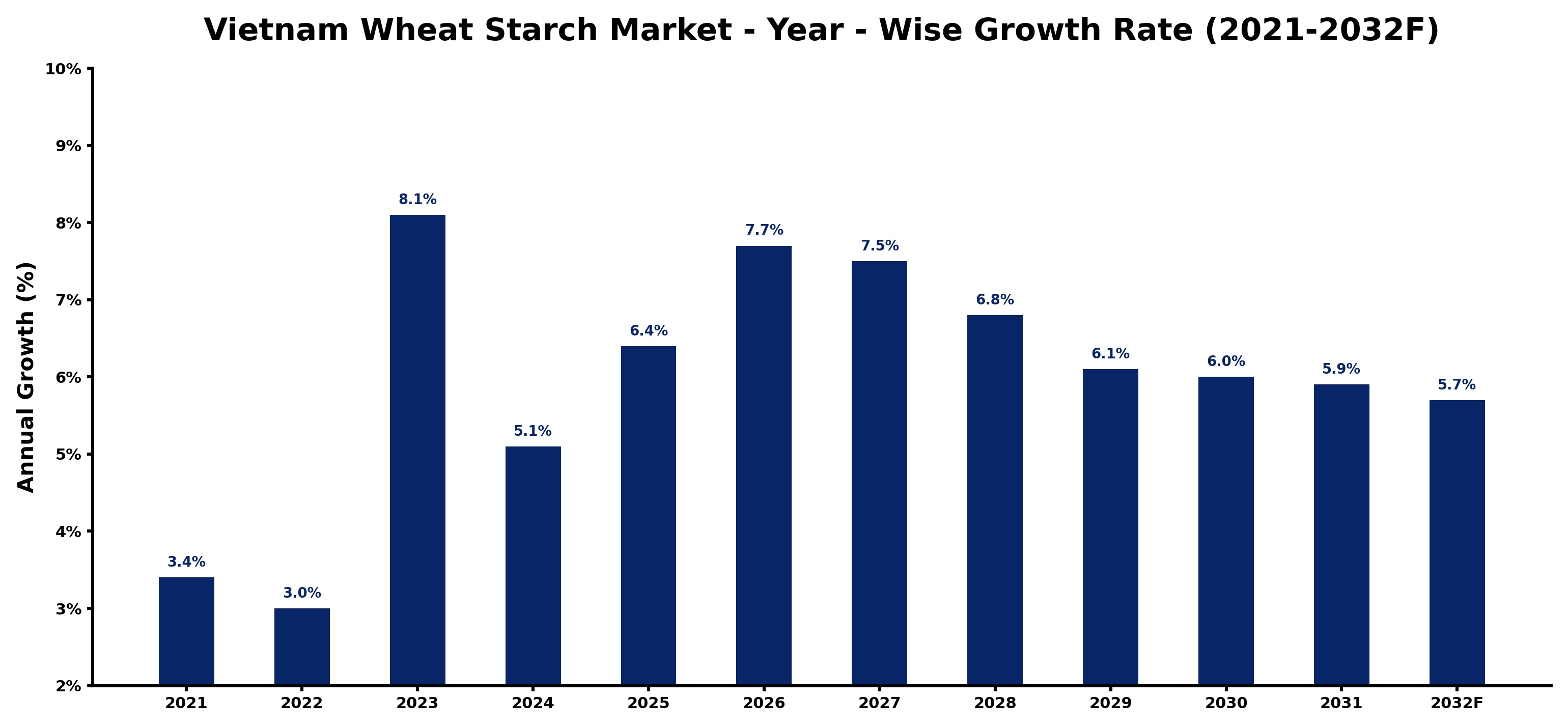
The table below presents the year‑wise growth rates along with the key drivers influencing the market
| Year | Growth Rate | Major Drivers |
| 2021 | 3.4% | Rising demand for gluten alternatives |
| 2022 | 3.0% | Increased health awareness among consumers |
| 2023 | 8.1% | Food processing innovation drove usage |
| 2024 | 5.1% | Growing bakery sector expanded market |
| 2025 | 6.4% | Rising popularity of gluten-free products |
| 2026 | 7.7% | Increased exports to neighboring countries |
| 2027 | 7.5% | Investment in food technology advancements |
| 2028 | 6.8% | Consumer preference for natural ingredients |
| 2029 | 6.1% | Sustainable sourcing practices gained traction |
| 2030 | 6.0% | Emerging food trends influenced choices |
| 2031 | 5.9% | Collaboration with food manufacturers increased |
| 2032 | 5.7% | E-commerce growth enhanced product reach |
Note - Market size estimations and growth projections presented in this report are based on 6Wresearch’s advanced forecasting approach, validated with industry datasets as of June 2026.
Vietnam Wheat Starch Market Synopsis
As of 2025, the Vietnam Wheat Starch Market is characterized by its increasing integration into the food industry, where it serves multiple functions across various product categories. The versatility of wheat starch extends beyond food applications, finding utility in numerous industrial sectors, thus underpinning its significant role in the national economy.
Despite facing competition from alternative starch sources like cassava and corn, the wheat starch market remains resilient. The advancement of extraction technologies and adherence to quality standards play crucial roles in maintaining the market's competitive edge and addressing supply chain challenges.
Vietnam Wheat Starch Market Key Takeaways
- The market is projected to witness significant growth, driven by the rise in processed food consumption.
- Government initiatives are enhancing both wheat cultivation and starch processing capabilities.
- Wheat starch's versatility enables its application in diverse sectors, promoting overall market expansion.
- Supply chain optimization is essential for market players to stay competitive against alternative starches.
- Recent innovations in starch extraction and processing technologies are reshaping the market landscape.
Evaluation of Restraints in Vietnam Wheat Starch Market
While the Vietnam Wheat Starch Market is on an upward trajectory, several factors hinder its full potential. Primarily, competition from other starch sources like cassava and corn poses a significant challenge, as these alternatives are often cheaper and more readily available. Additionally, the requirement for specific wheat varieties and tailored processing techniques complicates supply chains, leading to potential inconsistencies in availability and pricing. Market participants must navigate these intricacies by refining sourcing strategies and fostering collaborations to mitigate these constraints effectively.
Vietnam Wheat Starch Market Trends
The landscape of the Vietnam Wheat Starch Market is shaped by emerging trends that are redefining consumer preferences and technological approaches. A notable trend is the increasing demand for clean-label products, with consumers seeking transparency in ingredient sourcing and processing methods. This shift is prompting manufacturers to innovate in their formulations, leveraging wheat starch's functional properties to meet evolving consumer expectations. Furthermore, the growing interest in sustainability is encouraging investments in research for developing wheat varieties that enhance yield and starch quality.
Vietnam Wheat Starch Market Opportunities
The Vietnam Wheat Starch Market presents numerous opportunities for growth and investment. As processed food consumption continues to rise, there is ample scope for market players to explore new product developments and applications. Additionally, potential collaborations with local farmers to enhance wheat production can lead to more sustainable sourcing practices. The ongoing research into advanced processing technologies offers significant potential for cost reductions and efficiency improvements, positioning companies to capitalize on emerging market trends.
Government Initiatives in the Vietnam Wheat Starch Market
The Vietnamese government is actively promoting initiatives aimed at bolstering wheat cultivation and enhancing the starch processing sector. Through various programs and incentives, the government is working to increase agricultural productivity and improve infrastructure, which is crucial for the efficient distribution of wheat starch. These efforts are designed to support domestic producers and foster a more robust market environment, ultimately benefiting the economy and ensuring a stable supply of wheat starch for various industries.
Future Insights of the Vietnam Wheat Starch Market
Looking ahead to 2026-2032, the Vietnam Wheat Starch Market is poised for remarkable growth driven by technological advancements and shifting consumer preferences. The anticipated increase in processed food consumption, combined with ongoing governmental support, suggests a favorable environment for market expansion. Companies that prioritize innovation and sustainability will likely emerge as leaders, capitalizing on the evolving demands of both food and industrial sectors. As the market matures, opportunities for diversification and specialization will become increasingly prominent.
Vietnam Wheat Starch Market Latest Developments (May 2025 - June 2026)
In recent months, the Vietnam Wheat Starch Market has witnessed a surge in collaborations between industry stakeholders aimed at enhancing supply chain efficiency. Additionally, ongoing research initiatives are exploring novel applications of wheat starch, expanding its utility in both food and non-food sectors. Companies are also adapting to post-pandemic market dynamics by focusing on product innovation, which is expected to influence the sector positively in the near future.
Vietnam Wheat Starch Market - Key Attractiveness of the Report
- 10 Years of Market Numbers
- Historical Data Starting from 2022 to 2025
- Base Year: 2025
- Forecast Data until 2032
- Key Performance Indicators Impacting the Market
- Major Upcoming Developments and Projects
Key Highlights of the Report:
- Vietnam Wheat Starch Market Outlook
- Market Size of Vietnam Wheat Starch Market, 2025
- Forecast of Vietnam Wheat Starch Market, 2032F
- Historical Data and Forecast of Vietnam Wheat Starch Revenues & Volume for the Period 2022-2032F
- Vietnam Wheat Starch Market Trend Evolution
- Vietnam Wheat Starch Market Drivers and Challenges
- Vietnam Wheat Starch Price Trends
- Vietnam Wheat Starch Porter's Five Forces
- Vietnam Wheat Starch Industry Life Cycle
- Historical Data and Forecast of Vietnam Wheat Starch Market Revenues & Volume By Type for the Period 2022-2032F
- Historical Data and Forecast of Vietnam Wheat Starch Market Revenues & Volume By Native Wheat Starch for the Period 2022-2032F
- Historical Data and Forecast of Vietnam Wheat Starch Market Revenues & Volume By Modified Wheat Starch for the Period 2022-2032F
- Historical Data and Forecast of Vietnam Wheat Starch Market Revenues & Volume By Grade for the Period 2022-2032F
- Historical Data and Forecast of Vietnam Wheat Starch Market Revenues & Volume By Food Grade for the Period 2022-2032F
- Historical Data and Forecast of Vietnam Wheat Starch Market Revenues & Volume By Industrial Grade for the Period 2022-2032F
- Historical Data and Forecast of Vietnam Wheat Starch Market Revenues & Volume By End-Users Industry for the Period 2022-2032F
- Historical Data and Forecast of Vietnam Wheat Starch Market Revenues & Volume By Food and Beverages for the Period 2022-2032F
- Historical Data and Forecast of Vietnam Wheat Starch Market Revenues & Volume By Cosmetics for the Period 2022-2032F
- Historical Data and Forecast of Vietnam Wheat Starch Market Revenues & Volume By Others for the Period 2022-2032F
- Vietnam Wheat Starch Import Export Trade Statistics
- Market Opportunity Assessment By Type
- Market Opportunity Assessment By Grade
- Market Opportunity Assessment By End-Users Industry
- Vietnam Wheat Starch Top Companies Market Share
- Vietnam Wheat Starch Competitive Benchmarking By Technical and Operational Parameters
- Vietnam Wheat Starch Company Profiles
- Vietnam Wheat Starch Key Strategic Recommendations






































