Vietnam Wheel Loader Market Size, Share & Growth Rate
The Vietnam Wheel Loader Market was estimated at USD 530 Million in 2025 and is projected to reach USD 755 Million by 2032, growing at a CAGR of 5.2% from 2026 to 2032. This upward trend is significantly propelled by the flourishing construction and mining sectors, which are increasingly reliant on versatile heavy machinery. The governments commitment to extensive infrastructure projects further stimulates demand, creating a robust environment for wheel loader adoption.
Vietnam Wheel Loader Market Year-wise Growth Rate and Key Drivers
This graph highlights how the Vietnam Wheel Loader Market has steadily grown over the years, supported by major growth factors.
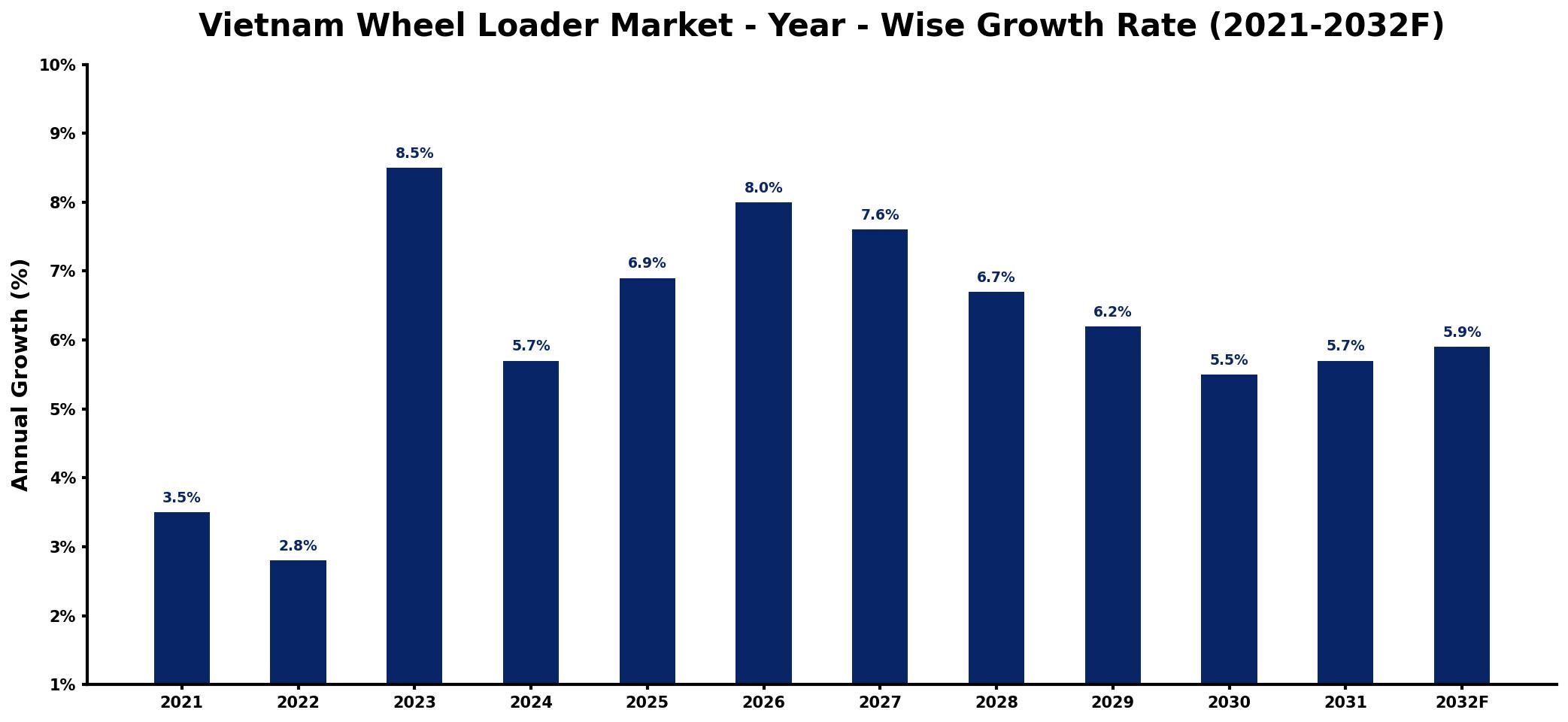
The table below presents the year‑wise growth rates along with the key drivers influencing the market
| Year | Growth Rate | Major Drivers |
| 2021 | 3.5% | Infrastructure investment driving demand |
| 2022 | 2.8% | Construction sector recovery underway |
| 2023 | 8.5% | Increased urbanization and development |
| 2024 | 5.7% | Rising agricultural mechanization trends |
| 2025 | 6.9% | Strong mining activities boosting needs |
| 2026 | 8.0% | Government projects enhancing infrastructure |
| 2027 | 7.6% | Growing logistics and transportation sectors |
| 2028 | 6.7% | Construction projects expanding rapidly |
| 2029 | 6.2% | Rising demand for efficient machinery |
| 2030 | 5.5% | Sustainability initiatives increasing investments |
| 2031 | 5.7% | Technological advancements driving adoption |
| 2032 | 5.9% | Continued growth in regional economies |
Note: Market size estimations and growth projections presented in this report are based on 6Wresearch's proprietary forecasting methodology, utilizing the latest available industry data, government publications, and primary research inputs.
Vietnam Wheel Loader Market Synopsis
The Vietnam wheel loader market is currently undergoing a transformative phase, driven largely by the rapid urbanization and industrialization trends in the region. As key infrastructure projects such as roads, bridges, and urban developments come to the forefront, the demand for efficient and reliable wheel loaders continues to rise, making them indispensable for material handling and earthmoving tasks.
In the backdrop of a recovering economy post-COVID-19, construction activities are resuming with renewed vigor. This resurgence not only addresses the immediate needs for infrastructure but also positions the wheel loader market for sustained growth over the coming years, highlighted by a shift towards automation and enhanced equipment efficiency.
Vietnam Wheel Loader Market Key Takeaways
- The market is heavily influenced by the growth of the construction and mining industries.
- Demand for wheel loaders is rising due to significant government investment in infrastructure projects.
- Market recovery post-COVID-19 is strengthening the demand for efficient heavy machinery.
- Shifts towards automation and advanced technology are defining the future of wheel loader operations.
- Urbanization and industrialization trends are critical drivers propelling market growth.
Evaluation of Restraints in Vietnam Wheel Loader Market
While the Vietnam wheel loader market is witnessing robust demand, it faces certain challenges that could temper its growth. Fluctuations in the pace of infrastructure development mean that demand for wheel loaders can vary significantly over time, with some projects experiencing delays. This uneven growth trajectory can hinder manufacturers ability to forecast demand accurately and adjust production schedules accordingly. Additionally, ongoing supply chain issues, which are a residual effect of the pandemic, may continue to affect the availability of parts and machinery, further complicating the market landscape.
Vietnam Wheel Loader Market Trends
Emerging trends in the Vietnam wheel loader market indicate a strong shift towards enhanced operational efficiency and automation. As companies seek to optimize performance and reduce labor costs, advanced technologies are being integrated into wheel loader systems. The adoption of telematics and IoT capabilities allows for improved fleet management and predictive maintenance. Furthermore, a growing focus on environmentally friendly operations is driving demand for electric and hybrid wheel loaders, marking a significant shift in industry dynamics.
Vietnam Wheel Loader Market Opportunities
The market presents substantial growth and investment opportunities, particularly in the areas of technology adoption and product innovation. Manufacturers focusing on developing more fuel-efficient and environmentally friendly wheel loaders can capitalize on changing industry standards and consumer preferences. Additionally, entering the burgeoning agricultural sector with specialized wheel loader models may offer new revenue streams. Collaborations with government initiatives aimed at infrastructure improvements can further enhance market position and drive demand.
Government Initiatives in the Vietnam Wheel Loader Market
The Vietnamese government is actively promoting infrastructure development through various policies and initiatives, which significantly impact the wheel loader market. Increased public spending on transportation infrastructure, including roads and bridges, is expected to bolster demand for heavy machinery. Initiatives aimed at improving logistics capabilities are also paving the way for enhanced market prospects, as efficient material handling becomes paramount in executing major construction projects.
Future Insights of the Vietnam Wheel Loader Market
Looking ahead to 2026-2032, the Vietnam wheel loader market is positioned for robust growth fueled by continued investments in infrastructure and urban development. The shift towards automation and digital technologies will play a pivotal role in shaping market dynamics. As operators seek to maximize efficiency while minimizing operational costs, the integration of smart technologies in wheel loaders will become increasingly vital. Additionally, evolving environmental regulations will likely drive demand for greener alternatives, thus changing the competitive landscape.
Vietnam Wheel Loader Market Latest Developments (2025 - 2026)
Recent developments in the Vietnam wheel loader market indicate a steady recovery from pandemic-related challenges. Companies are focusing on innovative product launches that align with modern efficiency standards and sustainability practices. The sector is witnessing a gradual resurgence of major infrastructure projects, which is contributing positively to demand for wheel loaders. Additionally, partnerships aimed at enhancing technological advancements in machinery are becoming more commonplace, reflecting a commitment to improving operational capabilities within the industry.
Vietnam Wheel Loader Market - Key Attractiveness of the Report
- 10 Years of Market Numbers
- Historical Data Starting from 2022 to 2025
- Base Year: 2025
- Forecast Data until 2032
- Key Performance Indicators Impacting the Market
- Major Upcoming Developments and Projects
Key Highlights of the Report:
- Vietnam Wheel Loader Market Outlook
- Market Size of Vietnam Wheel Loader Market, 2025
- Forecast of Vietnam Wheel Loader Market, 2032
- Historical Data and Forecast of Vietnam Wheel Loader Revenues & Volume for the Period 2022-2032F
- Vietnam Wheel Loader Market Trend Evolution
- Vietnam Wheel Loader Market Drivers and Challenges
- Vietnam Wheel Loader Price Trends
- Vietnam Wheel Loader Porter's Five Forces
- Vietnam Wheel Loader Industry Life Cycle
- Historical Data and Forecast of Vietnam Wheel Loader Market Revenues & Volume By Types for the Period 2022-2032F
- Historical Data and Forecast of Vietnam Wheel Loader Market Revenues & Volume By Armored Wheel Loaders for the Period 2022-2032F
- Historical Data and Forecast of Vietnam Wheel Loader Market Revenues & Volume By Tractor Front Loaders for the Period 2022-2032F
- Historical Data and Forecast of Vietnam Wheel Loader Market Revenues & Volume By Compact Front End Loaders for the Period 2022-2032F
- Historical Data and Forecast of Vietnam Wheel Loader Market Revenues & Volume By Skid Loaders & Track Loaders for the Period 2022-2032F
- Historical Data and Forecast of Vietnam Wheel Loader Market Revenues & Volume By Operating Power for the Period 2022-2032F
- Historical Data and Forecast of Vietnam Wheel Loader Market Revenues & Volume By 20 ?? 40 Hp for the Period 2022-2032F
- Historical Data and Forecast of Vietnam Wheel Loader Market Revenues & Volume By 40 ?? 80 Hp for the Period 2022-2032F
- Historical Data and Forecast of Vietnam Wheel Loader Market Revenues & Volume By 80 ?? 120 Hp for the Period 2022-2032F
- Historical Data and Forecast of Vietnam Wheel Loader Market Revenues & Volume By 120 ?? 160 Hp for the Period 2022-2032F
- Historical Data and Forecast of Vietnam Wheel Loader Market Revenues & Volume By 160 Hp for the Period 2022-2032F
- Historical Data and Forecast of Vietnam Wheel Loader Market Revenues & Volume By Above for the Period 2022-2032F
- Historical Data and Forecast of Vietnam Wheel Loader Market Revenues & Volume By Types Of Bucket for the Period 2022-2032F
- Historical Data and Forecast of Vietnam Wheel Loader Market Revenues & Volume By Bottom Bucket for the Period 2022-2032F
- Historical Data and Forecast of Vietnam Wheel Loader Market Revenues & Volume By Flat Bottom Bucket for the Period 2022-2032F
- Historical Data and Forecast of Vietnam Wheel Loader Market Revenues & Volume By Backhoe Bucket for the Period 2022-2032F
- Historical Data and Forecast of Vietnam Wheel Loader Market Revenues & Volume By Demolition Bucket for the Period 2022-2032F
- Historical Data and Forecast of Vietnam Wheel Loader Market Revenues & Volume By Excavating Buckets for the Period 2022-2032F
- Historical Data and Forecast of Vietnam Wheel Loader Market Revenues & Volume By Others for the Period 2022-2032F
- Historical Data and Forecast of Vietnam Wheel Loader Market Revenues & Volume By End-use Application for the Period 2022-2032F
- Historical Data and Forecast of Vietnam Wheel Loader Market Revenues & Volume By Stone Quarries for the Period 2022-2032F
- Historical Data and Forecast of Vietnam Wheel Loader Market Revenues & Volume By Mining Zones for the Period 2022-2032F
- Historical Data and Forecast of Vietnam Wheel Loader Market Revenues & Volume By Construction Sites for the Period 2022-2032F
- Historical Data and Forecast of Vietnam Wheel Loader Market Revenues & Volume By Military & Defense for the Period 2022-2032F
- Historical Data and Forecast of Vietnam Wheel Loader Market Revenues & Volume By Public Sectors for the Period 2022-2032F
- Vietnam Wheel Loader Import Export Trade Statistics
- Market Opportunity Assessment By Types
- Market Opportunity Assessment By Operating Power
- Market Opportunity Assessment By Types Of Bucket
- Market Opportunity Assessment By End-use Application
- Vietnam Wheel Loader Top Companies Market Share
- Vietnam Wheel Loader Competitive Benchmarking By Technical and Operational Parameters
- Vietnam Wheel Loader Company Profiles
- Vietnam Wheel Loader Key Strategic Recommendations






































