Vietnam Whipping Cream Market Size, Share & Growth Rate
The Vietnam Whipping Cream Market was estimated at USD 1347 Million in 2025 and is projected to reach USD 1914 Million by 2032, growing at a CAGR of 5.1% from 2026 to 2032. This remarkable growth trajectory is primarily fueled by the rising demand for premium dairy products, as both home cooking and the foodservice industry embrace whipping cream's versatility. Additionally, the growing popularity of gourmet desserts and café-style beverages is likely to further enhance consumption levels across various consumer segments.
Vietnam Whipping Cream Market Year-wise Growth Rate and Key Drivers
This graph highlights how the Vietnam Whipping Cream Market has steadily grown over the years, supported by major growth factors.
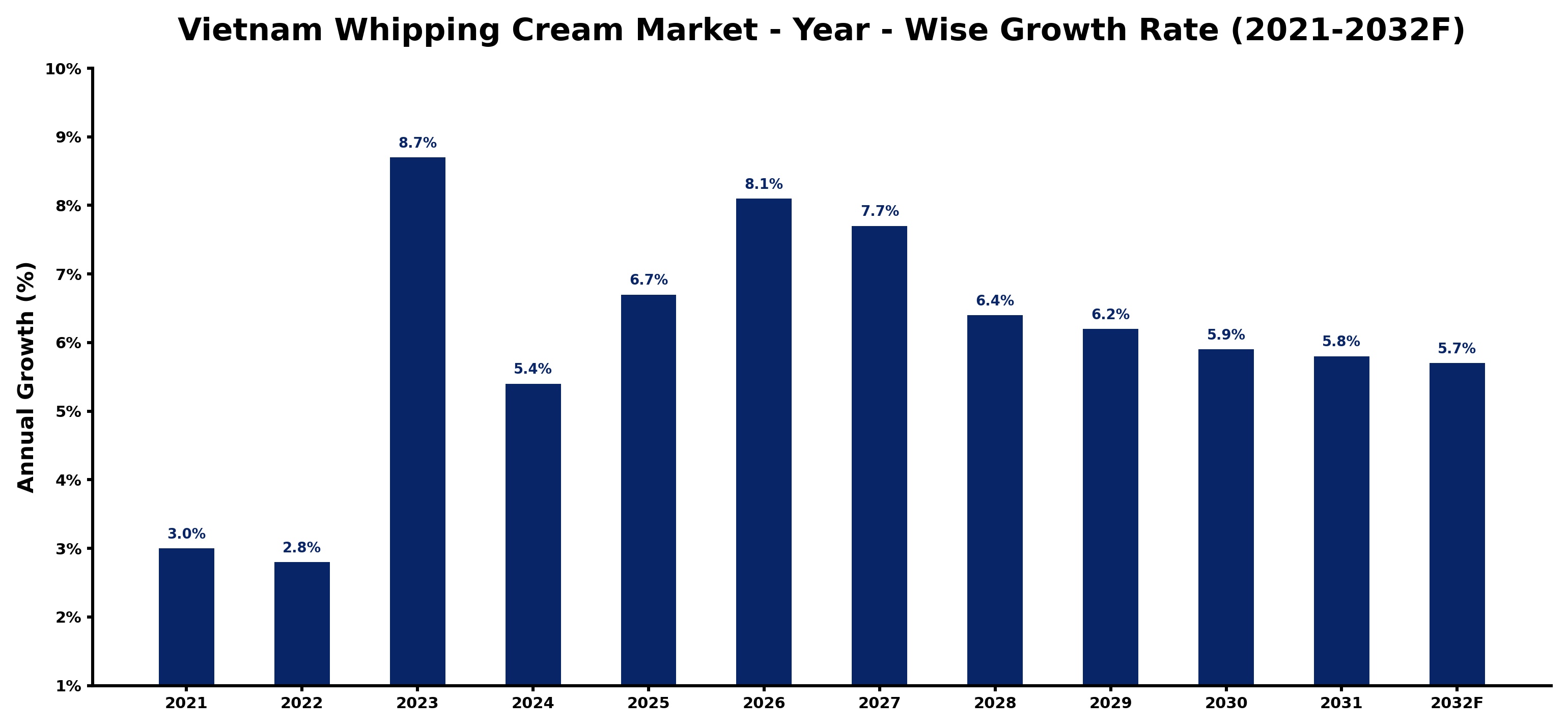
The table below presents the year‑wise growth rates along with the key drivers influencing the market
| Year | Growth Rate | Major Drivers |
| 2021 | 3.0% | Rising demand for desserts |
| 2022 | 2.8% | Growth in bakery products |
| 2023 | 8.7% | Increased home baking trends |
| 2024 | 5.4% | Expansion of foodservice sector |
| 2025 | 6.7% | Diverse flavor offerings introduced |
| 2026 | 8.1% | Industrial activity supported growth |
| 2027 | 7.7% | Innovative packaging solutions emerged |
| 2028 | 6.4% | Rise in culinary tourism interest |
| 2029 | 6.2% | Sustainable sourcing practices adopted |
| 2030 | 5.9% | Enhanced distribution networks developed |
| 2031 | 5.8% | Consumer interest in premium products |
| 2032 | 5.7% | Collaborations with local chefs |
Note - Market size estimations and growth projections presented in this report are based on 6Wresearch's advanced forecasting approach, validated with industry datasets as of June 2026.
Vietnam Whipping Cream Market Synopsis
In Vietnam, whipping cream has evolved from a niche ingredient to a culinary staple, increasingly featured in home kitchens and commercial establishments alike. This shift reflects a broader trend toward sophisticated food preparation, with consumers seeking out high-quality ingredients to elevate their cooking and baking.
As the food culture in Vietnam matures, whipping cream is finding its way into a wider array of dishes, including innovative desserts and savory applications. The impact of cafés and bakeries has been significant, showcasing the ingredient's versatility and driving its integration into popular Vietnamese dishes.
Vietnam Whipping Cream Market Key Takeaways
- The market is projected to grow significantly, driven by the expanding foodservice and bakery sectors.
- Consumer trends increasingly favor high-quality dairy products, highlighting a shift towards gourmet and artisanal offerings.
- Home baking is on the rise, boosting demand as consumers replicate professional-quality culinary creations.
- Effective distribution channels are essential for market players to reach a broader audience.
- Market competition is intensifying, necessitating innovative product differentiation strategies.
Evaluation of Restraints in Vietnam Whipping Cream Market
The Vietnam Whipping Cream Market faces certain restraints that could hinder its growth potential. One of the primary challenges is the health-conscious consumer trend, with an increasing segment of the population seeking lower-fat alternatives to traditional high-fat dairy products. Additionally, competition from a variety of substitute ingredients, such as plant-based creams and low-fat options, makes it essential for whipping cream manufacturers to effectively communicate the unique advantages and quality of their products. Furthermore, establishing robust distribution networks remains a hurdle for many businesses aiming to penetrate the market more effectively.
Vietnam Whipping Cream Market Trends
Current trends in the Vietnam Whipping Cream Market include a notable rise in gourmet dessert creation and specialty coffee drinks, leading to higher demand for premium whipping cream. Additionally, the home baking trend, spurred by social media influences and culinary shows, has created a vibrant environment for whipping cream products. There's also a growing interest in sustainable and organic dairy options, pushing manufacturers to innovate while ensuring quality and environmental responsibility.
Vietnam Whipping Cream Market Opportunities
As consumer preferences shift toward premium quality and health-conscious choices, there are substantial opportunities for investment in product innovation. Companies can capitalize on emerging trends by developing new flavors, organic options, or lower-fat alternatives. Expanding distribution channels into e-commerce platforms can also allow businesses to reach a broader consumer base effectively, catering to the increasing demand for convenience in purchasing.
Government Initiatives in the Vietnam Whipping Cream Market
The Vietnamese government is increasingly supporting the dairy sector through various initiatives aimed at enhancing food safety standards and improving agricultural practices. Public investments in infrastructure and technology for dairy production and processing are fostering growth in the industry. Additionally, programs promoting local dairy products align with the rising consumer trend towards supporting domestic products, further benefiting the whipping cream market.
Future Insights of the Vietnam Whipping Cream Market
Looking ahead to the period between 2026 and 2032, the Vietnam Whipping Cream Market is set to experience continued expansion driven by evolving culinary trends and an increasingly discerning consumer base. As the demand for artisanal and gourmet products rises, manufacturers who can innovate while maintaining high quality are likely to thrive. Emphasis on sustainable practices will further dictate future developments in this competitive market.
Vietnam Whipping Cream Market Latest Developments (May 2025 - June 2026)
Recent developments within the Vietnam Whipping Cream Market indicate a heightened focus on product innovation, with companies exploring new flavors and formulations to meet changing consumer preferences. There is also a notable shift towards online retailing as businesses adapt to the increasing demand for convenience and the impact of the pandemic on traditional shopping habits. Furthermore, collaborations between food service providers and ingredient manufacturers are on the rise, fostering a more dynamic market environment.
Vietnam Whipping Cream Market - Key Attractiveness of the Report
- 10 Years of Market Numbers
- Historical Data Starting from 2022 to 2025
- Base Year: 2025
- Forecast Data until 2032
- Key Performance Indicators Impacting the Market
- Major Upcoming Developments and Projects
Key Highlights of the Report:
- Vietnam Whipping Cream Market Outlook
- Market Size of Vietnam Whipping Cream Market, 2025
- Forecast of Vietnam Whipping Cream Market, 2032
- Historical Data and Forecast of Vietnam Whipping Cream Revenues & Volume for the Period 2022-2032F
- Vietnam Whipping Cream Market Trend Evolution
- Vietnam Whipping Cream Market Drivers and Challenges
- Vietnam Whipping Cream Price Trends
- Vietnam Whipping Cream Porter's Five Forces
- Vietnam Whipping Cream Industry Life Cycle
- Historical Data and Forecast of Vietnam Whipping Cream Market Revenues & Volume By Product for the Period 2022-2032F
- Historical Data and Forecast of Vietnam Whipping Cream Market Revenues & Volume By Dairy for the Period 2022-2032F
- Historical Data and Forecast of Vietnam Whipping Cream Market Revenues & Volume By Non-Dairy for the Period 2022-2032F
- Historical Data and Forecast of Vietnam Whipping Cream Market Revenues & Volume By Application for the Period 2022-2032F
- Historical Data and Forecast of Vietnam Whipping Cream Market Revenues & Volume By B2B for the Period 2022-2032F
- Historical Data and Forecast of Vietnam Whipping Cream Market Revenues & Volume By B2C for the Period 2022-2032F
- Historical Data and Forecast of Vietnam Whipping Cream Market Revenues & Volume By Distribution Channel for the Period 2022-2032F
- Historical Data and Forecast of Vietnam Whipping Cream Market Revenues & Volume By Warehouse Clubs for the Period 2022-2032F
- Historical Data and Forecast of Vietnam Whipping Cream Market Revenues & Volume By Variety Stores for the Period 2022-2032F
- Historical Data and Forecast of Vietnam Whipping Cream Market Revenues & Volume By Department Stores for the Period 2022-2032F
- Historical Data and Forecast of Vietnam Whipping Cream Market Revenues & Volume By Online Retail for the Period 2022-2032F
- Historical Data and Forecast of Vietnam Whipping Cream Market Revenues & Volume By Convenience Stores for the Period 2022-2032F
- Historical Data and Forecast of Vietnam Whipping Cream Market Revenues & Volume By Supermarkets and Hypermarket for the Period 2022-2032F
- Historical Data and Forecast of Vietnam Whipping Cream Market Revenues & Volume By Specialist Retailers for the Period 2022-2032F
- Historical Data and Forecast of Vietnam Whipping Cream Market Revenues & Volume By Others for the Period 2022-2032F
- Vietnam Whipping Cream Import Export Trade Statistics
- Market Opportunity Assessment By Product
- Market Opportunity Assessment By Application
- Market Opportunity Assessment By Distribution Channel
- Vietnam Whipping Cream Top Companies Market Share
- Vietnam Whipping Cream Competitive Benchmarking By Technical and Operational Parameters
- Vietnam Whipping Cream Company Profiles
- Vietnam Whipping Cream Key Strategic Recommendations






































