Vietnam Wire and Spring Products Market Size, Share & Growth Rate
The Vietnam Wire and Spring Products Market was estimated at USD 493 Million in 2025 and is projected to reach USD 696 Million by 2032, growing at a CAGR of 5.0% from 2026 to 2032. This growth trajectory is driven by increasing demand across major sectors, particularly automotive, construction, and electronics, where wire and spring products play a critical role in applications ranging from structural support to automotive components. As Vietnam continues to position itself as a manufacturing hub, the reliance on these essential products is expected to rise significantly.
Vietnam Wire and Spring Products Market Year-wise Growth Rate and Key Drivers
This graph highlights how the Vietnam Wire and Spring Products Market has steadily grown over the years, supported by major growth factors.
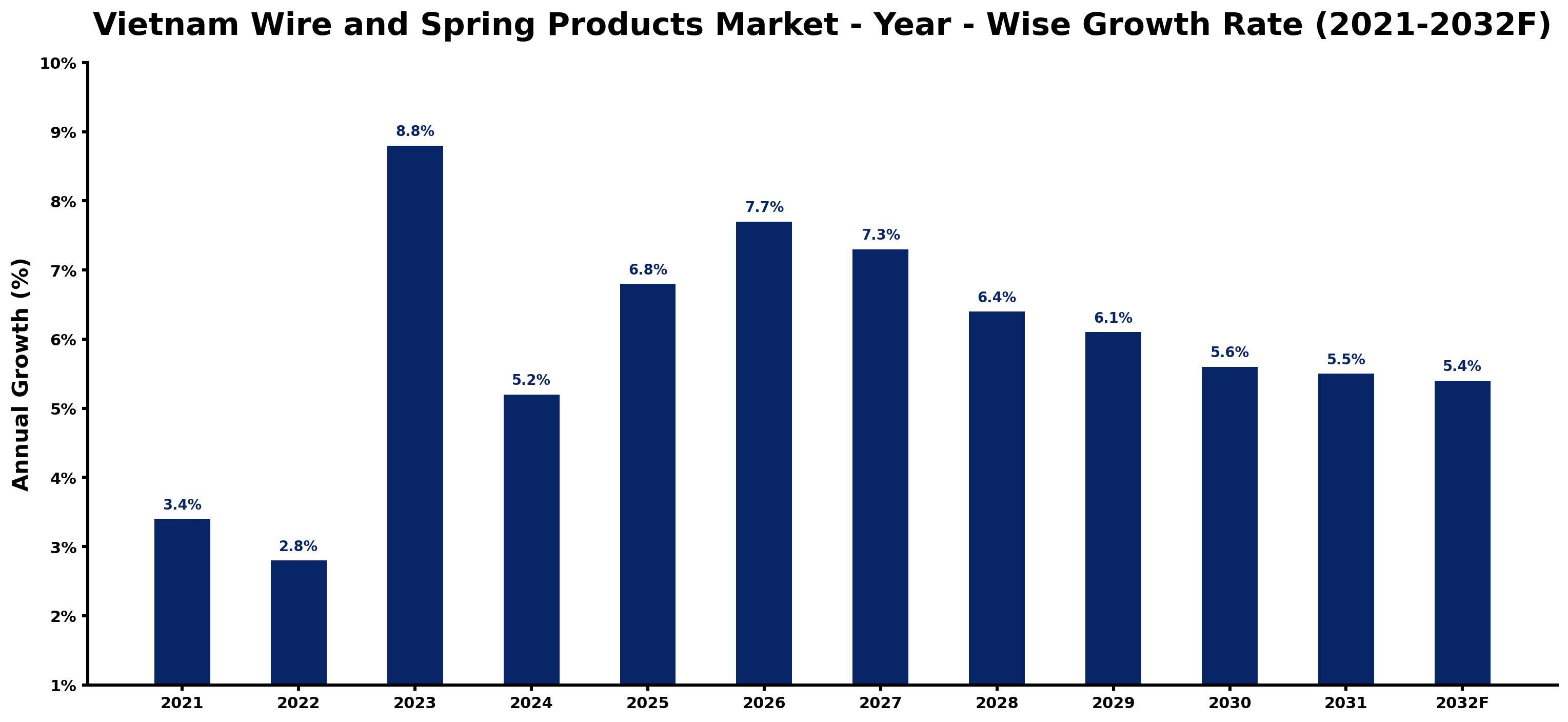
The table below presents the year‑wise growth rates along with the key drivers influencing the market
| Year | Growth Rate | Major Drivers |
| 2021 | 3.4% | Rising electricity demand across industries |
| 2022 | 2.8% | Expansion of manufacturing activities |
| 2023 | 8.8% | Rising electricity demand across industries |
| 2024 | 5.2% | Rising electricity demand across industries |
| 2025 | 6.8% | Increasing smart city development projects |
| 2026 | 7.7% | Rising electricity demand across industries |
| 2027 | 7.3% | Rising electricity demand across industries |
| 2028 | 6.4% | Increasing adoption of advanced technologies |
| 2029 | 6.1% | Expansion of transportation and logistics networks |
| 2030 | 5.6% | Government infrastructure modernization initiatives |
| 2031 | 5.5% | Government infrastructure modernization initiatives |
| 2032 | 5.4% | Expansion of transportation and logistics networks |
Note - Market size estimations and growth projections presented in this report are based on 6Wresearch’s advanced forecasting approach, validated with industry datasets as of June 2026.
Vietnam Wire and Spring Products Market Synopsis
The Vietnam wire and spring products market is witnessing a period of renewed momentum as industrial activities recover post-pandemic. However, this resurgence is accompanied by challenges, particularly from low-cost imports that threaten local manufacturing. Despite these pressures, the long-term outlook remains robust as domestic industries adapt and innovate.
As the economy rebounds, sectors such as automotive and construction are projected to drive demand for high-quality wire and spring products. Local manufacturers are increasingly focused on improving product quality and compliance with international standards to enhance competitiveness in both domestic and global markets.
Vietnam Wire and Spring Products Market Key Takeaways
- The market is driven by demand from the automotive and construction sectors.
- Local manufacturers face competitive pressures from low-cost imports.
- Quality improvement and standard compliance are critical for sustaining growth.
- The impact of COVID-19 was significant but recovery is underway.
- Investments in technology and infrastructure are anticipated to bolster market dynamics.
Evaluation of Restraints in Vietnam Wire and Spring Products Market
One of the primary restraints impacting the Vietnam wire and spring products market is the influx of low-cost imports from neighboring countries, which often leads to pricing pressures on local producers. This situation complicates the landscape for Vietnamese manufacturers striving to compete while also maintaining quality standards. Furthermore, fluctuations in raw material prices can unpredictably affect production costs and ultimately influence market dynamics. To thrive, manufacturers must focus on innovative practices and strategies that enhance operational efficiency while ensuring product reliability and compliance.
Vietnam Wire and Spring Products Market Trends
Emerging trends in the Vietnam wire and spring products market indicate a shift towards sustainability and technological integration. Manufacturers are increasingly investing in eco-friendly materials and production processes in response to global sustainability concerns. Additionally, advancements in automation and smart manufacturing technologies are being adopted to improve efficiency and reduce labor costs. The rising emphasis on quality and precision is also driving innovations in design and manufacturing practices.
Vietnam Wire and Spring Products Market Opportunities
The opportunities for growth in the Vietnam wire and spring products market are particularly pronounced in expanding sectors such as electric vehicles and renewable energy. As these industries continue to evolve, there is a heightened need for specialized wire and spring products that meet their specific demands. Furthermore, government incentives aimed at boosting local manufacturing could provide additional avenues for investment and development within this market.
Government Initiatives in the Vietnam Wire and Spring Products Market
The Vietnamese government is actively promoting initiatives to support local manufacturing through various policies and programs. These initiatives focus on enhancing infrastructure, providing financial incentives for technological upgrades, and facilitating access to international markets. Such support is vital for manufacturers in the wire and spring products sector as they strive to compete on a global scale while ensuring sustainable practices.
Future Insights of the Vietnam Wire and Spring Products Market
Looking ahead to 2026-2032, the Vietnam wire and spring products market is poised for significant evolution. With a growing emphasis on industrial automation and a shift towards greener production methods, the market is likely to see increased investment in research and development. Furthermore, as Vietnam strengthens its position as a global manufacturing center, local companies may find new opportunities in international partnerships and collaborations, setting the stage for robust market growth.
Vietnam Wire and Spring Products Market Latest Developments (May 2025 - June 2026)
Recent developments in the Vietnam wire and spring products market reflect an industry adapting to changing demands and challenges. Manufacturers are increasingly adopting advanced production technologies to enhance efficiency and product quality. Additionally, there has been a noticeable shift towards adopting environmentally sustainable practices, aligning with global trends. These changes indicate a proactive approach among local businesses to better position themselves for future growth and competitiveness.
Vietnam Wire and Spring Products Market - Key Attractiveness of the Report
- 10 Years of Market Numbers
- Historical Data Starting from 2022 to 2025
- Base Year: 2025
- Forecast Data until 2032
- Key Performance Indicators Impacting the Market
- Major Upcoming Developments and Projects
Key Highlights of the Report:
- Vietnam Wire and Spring Products Market Outlook
- Market Size of Vietnam Wire and Spring Products Market, 2025
- Forecast of Vietnam Wire and Spring Products Market, 2032
- Historical Data and Forecast of Vietnam Wire and Spring Products Revenues & Volume for the Period 2022-2032F
- Vietnam Wire and Spring Products Market Trend Evolution
- Vietnam Wire and Spring Products Market Drivers and Challenges
- Vietnam Wire and Spring Products Price Trends
- Vietnam Wire and Spring Products Porter's Five Forces
- Vietnam Wire and Spring Products Industry Life Cycle
- Historical Data and Forecast of Vietnam Wire and Spring Products Market Revenues & Volume By Type for the Period 2022-2032F
- Historical Data and Forecast of Vietnam Wire and Spring Products Market Revenues & Volume By Fabricated wire for the Period 2022-2032F
- Historical Data and Forecast of Vietnam Wire and Spring Products Market Revenues & Volume By Light gauge for the Period 2022-2032F
- Historical Data and Forecast of Vietnam Wire and Spring Products Market Revenues & Volume By Heavy gauge springs for the Period 2022-2032F
- Historical Data and Forecast of Vietnam Wire and Spring Products Market Revenues & Volume By Metal Derivative for the Period 2022-2032F
- Historical Data and Forecast of Vietnam Wire and Spring Products Market Revenues & Volume By Aluminum based for the Period 2022-2032F
- Historical Data and Forecast of Vietnam Wire and Spring Products Market Revenues & Volume By Barbed for the Period 2022-2032F
- Historical Data and Forecast of Vietnam Wire and Spring Products Market Revenues & Volume By Copper based for the Period 2022-2032F
- Historical Data and Forecast of Vietnam Wire and Spring Products Market Revenues & Volume By Coated electrodes for the Period 2022-2032F
- Historical Data and Forecast of Vietnam Wire and Spring Products Market Revenues & Volume By Applications for the Period 2022-2032F
- Historical Data and Forecast of Vietnam Wire and Spring Products Market Revenues & Volume By Automotive for the Period 2022-2032F
- Historical Data and Forecast of Vietnam Wire and Spring Products Market Revenues & Volume By Aerospace for the Period 2022-2032F
- Historical Data and Forecast of Vietnam Wire and Spring Products Market Revenues & Volume By Government for the Period 2022-2032F
- Historical Data and Forecast of Vietnam Wire and Spring Products Market Revenues & Volume By Medical & healthcare for the Period 2022-2032F
- Historical Data and Forecast of Vietnam Wire and Spring Products Market Revenues & Volume By Commercial & industrial sectors for the Period 2022-2032F
- Vietnam Wire and Spring Products Import Export Trade Statistics
- Market Opportunity Assessment By Type
- Market Opportunity Assessment By Metal Derivative
- Market Opportunity Assessment By Applications
- Vietnam Wire and Spring Products Top Companies Market Share
- Vietnam Wire and Spring Products Competitive Benchmarking By Technical and Operational Parameters
- Vietnam Wire and Spring Products Company Profiles
- Vietnam Wire and Spring Products Key Strategic Recommendations






































