Vietnam Wire Mesh Market Summary
The vietnam wire mesh market was estimated at USD 963 Million in 2025 and is projected to reach USD 1369 Million by 2032, growing at a CAGR of 8.4% from 2026 to 2032.
Vietnam Wire Mesh Market Year-wise Growth Rate and Key Drivers
This graph highlights how the Vietnam Wire Mesh Market has steadily grown over the past five years, supported by major growth factors.
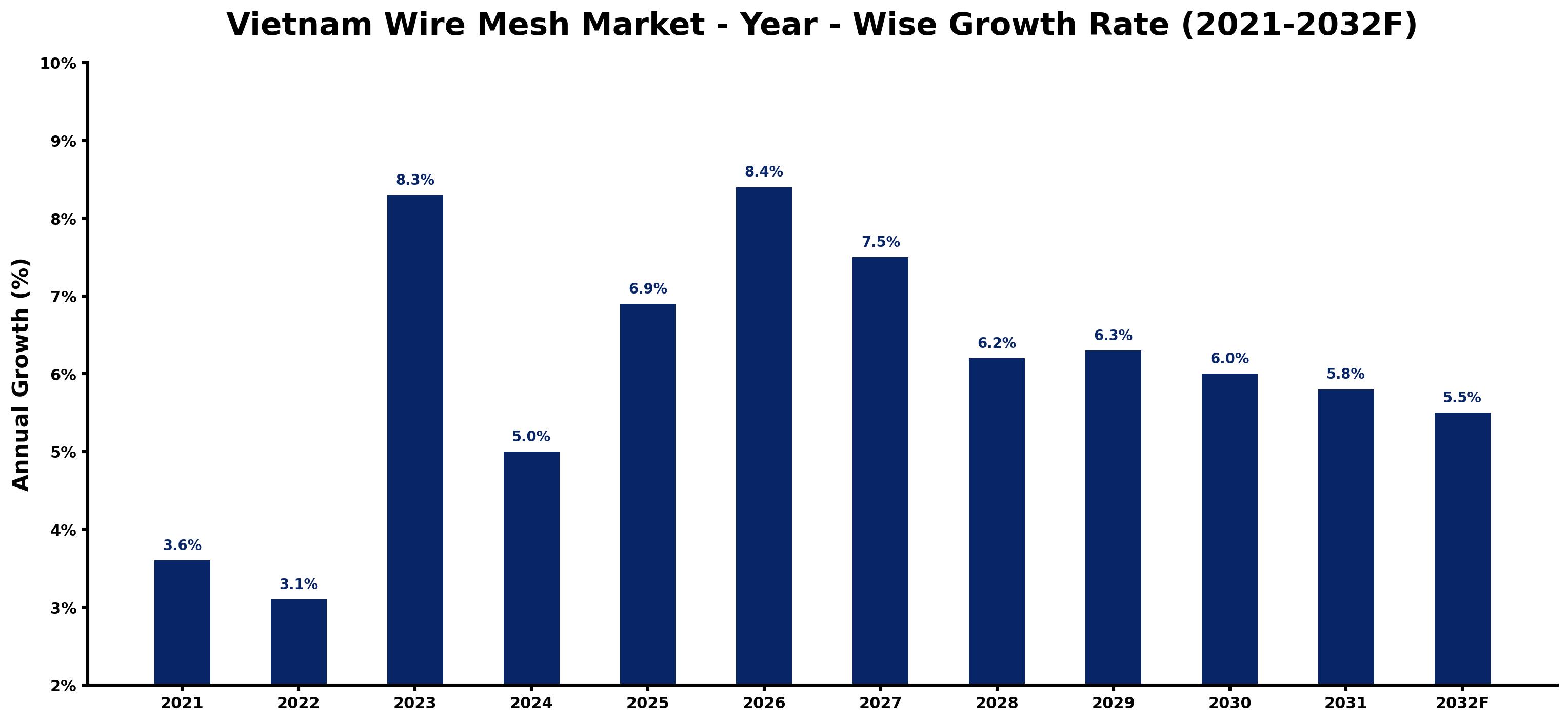
The table below presents the year wise growth rates along with the key drivers influencing the market
| Year | Growth Rate | Major Drivers |
| 2021 | 3.6% | Vietnam's construction sector rebounded, fueling wire mesh demand in infrastructure projects. |
| 2022 | 3.1% | Manufacturers relocated operations to Vietnam, increasing local production capacities and market competition. |
| 2023 | 8.3% | Urbanization accelerated, necessitating efficient construction materials for housing and public utilities. |
| 2024 | 5.0% | Rural electrification projects surged, boosting wire mesh needs for power grid expansions. |
| 2025 | 6.9% | Sustainability trends favored products like stainless steel wire mesh for eco-friendly construction. |
| 2026 | 8.4% | Continued foreign investment bolstered the construction industry, enhancing wire mesh market prospects. |
| 2027 | 7.5% | Technological advancements in production improved efficiency and lowered costs for manufacturers. |
| 2028 | 6.2% | The automotive sector's expansion increased demand for specialized wire mesh components. |
| 2029 | 6.3% | Government policies supporting infrastructure development created opportunities for wire mesh suppliers. |
| 2030 | 6.0% | Emerging smart city projects influenced demand for innovative wire mesh applications. |
| 2031 | 5.8% | Supply chain adjustments post-pandemic led to localized production strategies in Vietnam. |
| 2032 | 5.5% | Consumer preferences shifted towards more durable and sustainable wire mesh options. |
Note - Market size estimations and growth projections presented in this report are based on 6Wresearch's advanced forecasting approach, validated with industry datasets as of June 2026.
Vietnam Wire Mesh Market Synopsis
The Vietnam Wire Mesh Market is projected to reach 8.4% and witness significant growth during the forecast period (2026-2032). This expansion is primarily driven by the increasing demand for industrial-grade wire meshes across various sectors, including food and beverages, construction, and automotive. The surge in infrastructural development in different regions of Vietnam is expected to further enhance the consumption of wire mesh products. Additionally, the rising preference for stainless steel meshes, known for their strength and corrosion resistance, is set to influence the market positively. Enhanced government investments in development projects will also play a crucial role in stimulating market demand.
Vietnam Wire Mesh Market Growth Drivers
Several key factors are contributing to the growth of the Vietnam Wire Mesh Market during the forecast period. These include:
- The continuous rise in the food and beverage sector, necessitating high-quality wire meshes for processing and packaging applications.
- Increased construction activities in urban and rural areas, leading to a higher requirement for wire meshes in building frameworks and reinforcement.
- Growing automotive manufacturing, where wire meshes are utilized in various components for safety and structural integrity.
- Advancements in automated welding technology, enabling manufacturers to produce welded wire mesh panels with enhanced precision and lower costs.
- A rising awareness of the benefits of using stainless steel wire mesh for applications such as security fencing and filtration systems, which bolsters demand.
Vietnam Wire Mesh Market Trends and Opportunities
As the market evolves, several trends and opportunities are emerging that could shape the Vietnam Wire Mesh Market landscape. The trend towards sustainable building materials is gaining traction, with an increasing emphasis on environmentally friendly production processes. Furthermore, the global shift towards automation in manufacturing processes is creating opportunities for the development of innovative wire mesh products. Consumer preferences are increasingly leaning towards durable and low-maintenance options, which stainless steel meshes fulfill. Moreover, the agricultural sector in Vietnam is witnessing growth, leading to higher demand for wire mesh applications in farming and horticulture.
Vietnam Wire Mesh Market Government Investment and Initiatives
The Vietnamese government has been actively promoting infrastructure development and industrial growth, which in turn supports the wire mesh market. Key initiatives include substantial public spending on infrastructure projects, aimed at improving transportation networks and public facilities. Additionally, the government has introduced various incentives for foreign investments in manufacturing sectors, which is beneficial for wire mesh producers. Policies aimed at enhancing industrial efficiency and sustainability also encourage the adoption of advanced technologies in production processes. This proactive stance in infrastructure development is likely to boost the wire mesh market considerably over the forecast period.
Vietnam Wire Mesh Market Latest Developments (May 2025 - June 2026)
From May 2025 to June 2026, the Vietnam Wire Mesh Market has shown notable advancements. The industry has observed a greater emphasis on automation, resulting in enhanced production capabilities and improved product quality. Manufacturers have started integrating smart technologies into their operations, optimizing production processes, and reducing costs. The increase in public sector projects has substantially fueled demand for wire meshes, particularly in construction and security applications. As the market adapts to evolving consumer needs, companies are also focusing on product diversification to cater to various applications.
Vietnam Wire Mesh Market - Key Attractiveness of the Report
- 10 Years of Market Numbers
- Historical Data Starting from 2022 to 2025
- Base Year: 2025
- Forecast Data until 2032
- Key Performance Indicators Impacting the Market
- Major Upcoming Developments and Projects
Key Highlights of the Report:
- Vietnam Wire Mesh Market Outlook
- Market Size of Vietnam Wire Mesh Market, 2025
- Forecast of Vietnam Wire Mesh Market, 2032F
- Historical Data and Forecast of Vietnam Wire Mesh Revenues & Volume for the Period 2022-2032F
- Vietnam Wire Mesh Market Trend Evolution
- Vietnam Wire Mesh Market Drivers and Challenges
- Vietnam Wire Mesh Price Trends
- Vietnam Wire Mesh Porter's Five Forces
- Vietnam Wire Mesh Industry Life Cycle
- Historical Data and Forecast of Vietnam Wire Mesh Market Revenues & Volume By Types for the Period 2022-2032F
- Historical Data and Forecast of Vietnam Wire Mesh Market Revenues & Volume By Electro Galvanized Welded Wire Mesh for the Period 2022-2032F
- Historical Data and Forecast of Vietnam Wire Mesh Market Revenues & Volume By Hot Dipped Galvanized Welded Mesh for the Period 2022-2032F
- Historical Data and Forecast of Vietnam Wire Mesh Market Revenues & Volume By PVC Coated Welded Mesh for the Period 2022-2032F
- Historical Data and Forecast of Vietnam Wire Mesh Market Revenues & Volume By Welded Stainless Steel Mesh for the Period 2022-2032F
- Historical Data and Forecast of Vietnam Wire Mesh Market Revenues & Volume By Welded Wire Fencing Panels for the Period 2022-2032F
- Historical Data and Forecast of Vietnam Wire Mesh Market Revenues & Volume By Applications for the Period 2022-2032F
- Historical Data and Forecast of Vietnam Wire Mesh Market Revenues & Volume By Construction for the Period 2022-2032F
- Historical Data and Forecast of Vietnam Wire Mesh Market Revenues & Volume By Agricultural for the Period 2022-2032F
- Historical Data and Forecast of Vietnam Wire Mesh Market Revenues & Volume By Industrial for the Period 2022-2032F
- Historical Data and Forecast of Vietnam Wire Mesh Market Revenues & Volume By Transportation for the Period 2022-2032F
- Historical Data and Forecast of Vietnam Wire Mesh Market Revenues & Volume By Horticultural for the Period 2022-2032F
- Historical Data and Forecast of Vietnam Wire Mesh Market Revenues & Volume By Food Procuring Sector for the Period 2022-2032F
- Historical Data and Forecast of Vietnam Wire Mesh Market Revenues & Volume By Others for the Period 2022-2032F
- Vietnam Wire Mesh Import Export Trade Statistics
- Market Opportunity Assessment By Types
- Market Opportunity Assessment By Applications
- Vietnam Wire Mesh Top Companies Market Share
- Vietnam Wire Mesh Competitive Benchmarking By Technical and Operational Parameters
- Vietnam Wire Mesh Company Profiles
- Vietnam Wire Mesh Key Strategic Recommendations






































