Vietnam Wireless Connectivity Market Size, Share & Growth Rate
The Vietnam Wireless Connectivity Market was estimated at USD 287 Million in 2025 and is projected to reach USD 404 Million by 2032, growing at a CAGR of 5.0% from 2026 to 2032. This upward trajectory is fueled by the surging demand for high-speed internet driven by the increasing adoption of smartphones, tablets, and Internet of Things (IoT) devices. Moreover, telecom providers are actively expanding their 4G and 5G networks to meet the growing needs of both consumers and businesses for reliable connectivity solutions.
Vietnam Wireless Connectivity Market Year-wise Growth Rate and Key Drivers
This graph highlights how the Vietnam Wireless Connectivity Market has steadily grown over the years, supported by major growth factors.
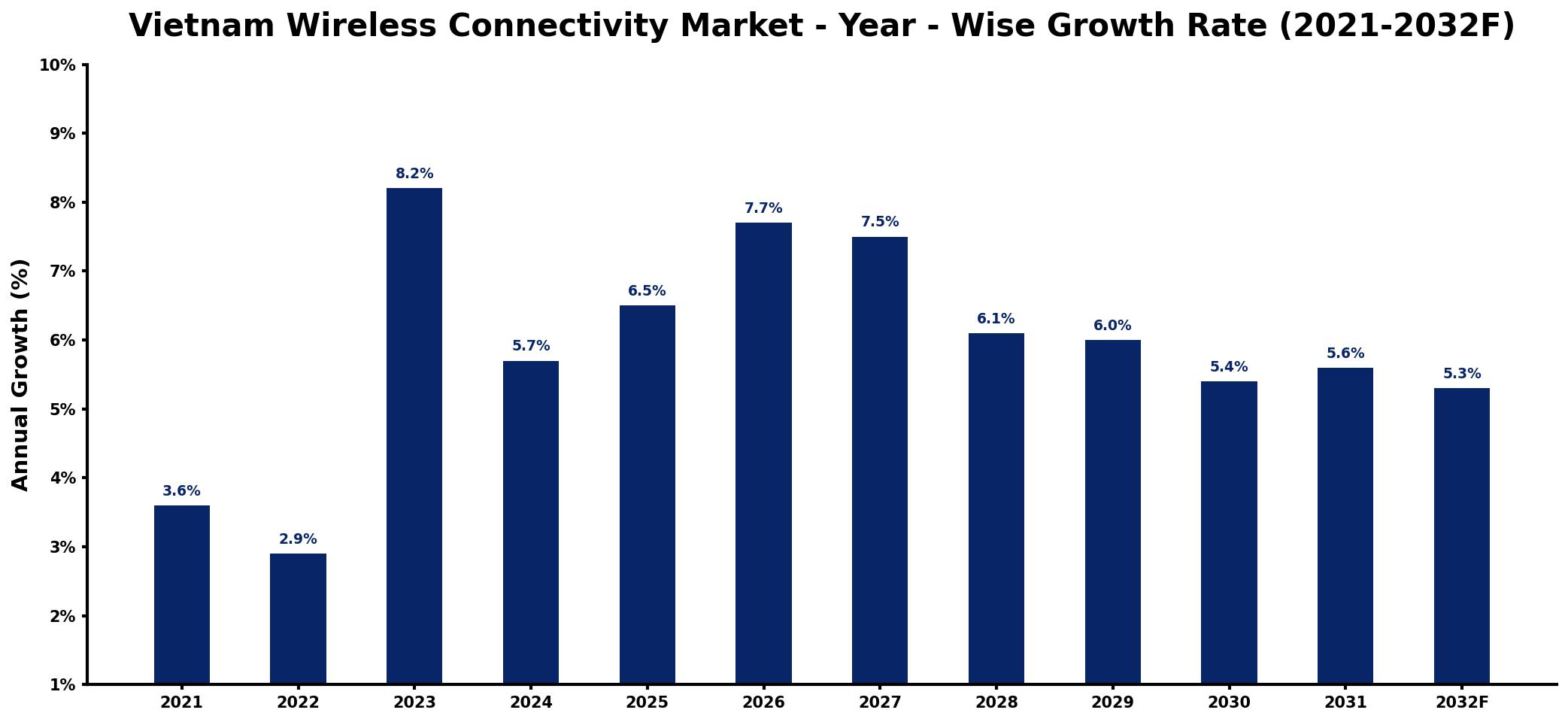
The table below presents the year‑wise growth rates along with the key drivers influencing the market
| Year | Growth Rate | Major Drivers |
| 2021 | 3.6% | Rising smartphone adoption rates |
| 2022 | 2.9% | Increased demand for online services |
| 2023 | 8.2% | Expansion of digital infrastructure projects |
| 2024 | 5.7% | Growth in remote working solutions |
| 2025 | 6.5% | Surge in IoT applications deployment |
| 2026 | 7.7% | Investment in smart city initiatives |
| 2027 | 7.5% | Growing e-commerce market potential |
| 2028 | 6.1% | Adoption of advanced technologies |
| 2029 | 6.0% | Rising consumer tech spending trends |
| 2030 | 5.4% | Increased focus on digital education |
| 2031 | 5.6% | growing downstream application demand |
| 2032 | 5.3% | increased domestic production output |
Note: Market size estimations and growth projections presented in this report are based on 6Wresearch's proprietary forecasting methodology, utilizing the latest available industry data, government publications, and primary research inputs.
Vietnam Wireless Connectivity Market Synopsis
The primary force propelling the Vietnam Wireless Connectivity Market is the extensive investment in infrastructure by telecom operators, aimed at enhancing network coverage and speeds across the nation. As urban centers flourish with technological advancement, the need for seamless wireless connectivity has never been more critical.
Additionally, the Vietnamese government's initiatives focused on increasing digital inclusion are crucial to the market's growth. By improving internet access, especially in rural areas, the government is laying a robust foundation for future advancements in wireless connectivity.
Vietnam Wireless Connectivity Market Key Takeaways
- The market is fueled by the rapid proliferation of mobile devices and IoT technologies.
- Government initiatives are actively promoting digital inclusion, thereby stimulating infrastructure investments.
- The shift towards 5G technology is set to transform user experiences and business applications.
- Competitive dynamics among telecom operators are driving continuous improvements in service quality.
- Urban areas are witnessing a surge in Wi-Fi hotspots, catering to the growing consumer demand.
Evaluation of Restraints in Vietnam Wireless Connectivity Market
While the Vietnam Wireless Connectivity Market demonstrates robust growth, certain limitations must be acknowledged. A significant challenge is the disparity in infrastructure between urban and rural regions. Many rural areas continue to lack access to reliable wireless connectivity, creating a digital divide that hampers overall market potential. This gap necessitates focused investment strategies to ensure equitable access to wireless services. Moreover, adapting to the rapid evolution of wireless standards and technologies poses additional challenges for market players, who must continuously enhance their infrastructure to meet increasing data demands.
Vietnam Wireless Connectivity Market Trends
Several trends are shaping the Vietnam Wireless Connectivity Market today. The rapid adoption of 5G technology is a game-changer, promising unprecedented speed and reliability. Concurrently, the proliferation of smart devices and IoT applications is driving demand for more sophisticated wireless solutions. Moreover, the rising trend of remote work and online learning, accelerated by the COVID-19 pandemic, has heightened the demand for stable wireless connections, prompting both consumers and businesses to seek more reliable options.
Vietnam Wireless Connectivity Market Opportunities
The landscape of the Vietnam Wireless Connectivity Market presents numerous opportunities for growth and investment. Companies can capitalize on the burgeoning demand for 5G technology as it rolls out across the country. Additionally, focusing on developing solutions tailored for rural areas can tap into a largely underserved segment of the population, facilitating broader market penetration. Lastly, as businesses increasingly embrace digital transformation, tailored connectivity solutions that support IoT and smart device integration will become paramount.
Government Initiatives in the Vietnam Wireless Connectivity Market
The Vietnamese government is actively promoting policies aimed at enhancing wireless connectivity throughout the nation. These initiatives include significant public spending on telecommunications infrastructure, with a particular focus on expanding access in rural and underserved regions. Programs to support digital literacy and inclusion are also being implemented, ensuring that all segments of the population can benefit from advancements in wireless technology and contribute to a robust digital economy.
Future Insights of the Vietnam Wireless Connectivity Market
Looking ahead to 2026-2032, the Vietnam Wireless Connectivity Market is poised for significant evolution. The anticipated expansion of 5G networks will likely enable new applications and business models, enhancing consumer experiences. The continued emphasis on digital inclusion suggests that investments in infrastructure will accelerate, particularly in rural areas. Ultimately, as both the public and private sectors collaborate to strengthen wireless connectivity, Vietnam's digital economy stands to benefit significantly from these advancements.
Vietnam Wireless Connectivity Market Latest Developments (2025 - 2026)
Recent developments in the Vietnam Wireless Connectivity Market indicate a growing momentum towards enhanced network capabilities and infrastructure expansion. Increased partnerships between telecom providers and technology firms are facilitating faster deployments of 5G services. Additionally, ongoing government initiatives are likely to drive more comprehensive connectivity solutions, especially aimed at bridging the digital divide in rural communities. These efforts reflect a collective recognition of the need for robust wireless infrastructure to support Vietnam's rapidly evolving digital landscape.
Vietnam Wireless Connectivity Market - Key Attractiveness of the Report
- 10 Years of Market Numbers
- Historical Data Starting from 2022 to 2025
- Base Year: 2025
- Forecast Data until 2032
- Key Performance Indicators Impacting the Market
- Major Upcoming Developments and Projects
Key Highlights of the Report:
- Vietnam Wireless Connectivity Market Outlook
- Market Size of Vietnam Wireless Connectivity Market, 2025
- Forecast of Vietnam Wireless Connectivity Market, 2032
- Historical Data and Forecast of Vietnam Wireless Connectivity Revenues & Volume for the Period 2022-2032F
- Vietnam Wireless Connectivity Market Trend Evolution
- Vietnam Wireless Connectivity Market Drivers and Challenges
- Vietnam Wireless Connectivity Price Trends
- Vietnam Wireless Connectivity Porter's Five Forces
- Vietnam Wireless Connectivity Industry Life Cycle
- Historical Data and Forecast of Vietnam Wireless Connectivity Market Revenues & Volume By Connectivity Type for the Period 2022-2032F
- Historical Data and Forecast of Vietnam Wireless Connectivity Market Revenues & Volume By Wi-Fi for the Period 2022-2032F
- Historical Data and Forecast of Vietnam Wireless Connectivity Market Revenues & Volume By Bluetooth Classic for the Period 2022-2032F
- Historical Data and Forecast of Vietnam Wireless Connectivity Market Revenues & Volume By Bluetooth 4X for the Period 2022-2032F
- Historical Data and Forecast of Vietnam Wireless Connectivity Market Revenues & Volume By Bluetooth 5X for the Period 2022-2032F
- Historical Data and Forecast of Vietnam Wireless Connectivity Market Revenues & Volume By ZigBee for the Period 2022-2032F
- Historical Data and Forecast of Vietnam Wireless Connectivity Market Revenues & Volume By Z-Wave for the Period 2022-2032F
- Historical Data and Forecast of Vietnam Wireless Connectivity Market Revenues & Volume By UWB for the Period 2022-2032F
- Historical Data and Forecast of Vietnam Wi-Fi Wireless Connectivity Market Revenues & Volume By NFC for the Period 2022-2032F
- Historical Data and Forecast of Vietnam Wireless Connectivity Market Revenues & Volume By End Use for the Period 2022-2032F
- Historical Data and Forecast of Vietnam Wireless Connectivity Market Revenues & Volume By Wearable Devices for the Period 2022-2032F
- Historical Data and Forecast of Vietnam Wireless Connectivity Market Revenues & Volume By Healthcare for the Period 2022-2032F
- Historical Data and Forecast of Vietnam Wireless Connectivity Market Revenues & Volume By Consumer Electronics for the Period 2022-2032F
- Historical Data and Forecast of Vietnam Wireless Connectivity Market Revenues & Volume By Building Automation for the Period 2022-2032F
- Historical Data and Forecast of Vietnam Wireless Connectivity Market Revenues & Volume By Automotive & Transportation for the Period 2022-2032F
- Historical Data and Forecast of Vietnam Wireless Connectivity Market Revenues & Volume By Others for the Period 2022-2032F
- Historical Data and Forecast of Vietnam Wireless Connectivity Market Revenues & Volume By Type for the Period 2022-2032F
- Historical Data and Forecast of Vietnam Wireless Connectivity Market Revenues & Volume By LPWAN for the Period 2022-2032F
- Historical Data and Forecast of Vietnam Wireless Connectivity Market Revenues & Volume By Cellular M2M for the Period 2022-2032F
- Historical Data and Forecast of Vietnam Wireless Connectivity Market Revenues & Volume By WPAN for the Period 2022-2032F
- Historical Data and Forecast of Vietnam Wireless Connectivity Market Revenues & Volume By Satellite (GNSS) for the Period 2022-2032F
- Historical Data and Forecast of Vietnam Wireless Connectivity Market Revenues & Volume By WLAN for the Period 2022-2032F
- Vietnam Wireless Connectivity Import Export Trade Statistics
- Market Opportunity Assessment By Connectivity Type
- Market Opportunity Assessment By End Use
- Market Opportunity Assessment By Type
- Vietnam Wireless Connectivity Top Companies Market Share
- Vietnam Wireless Connectivity Competitive Benchmarking By Technical and Operational Parameters
- Vietnam Wireless Connectivity Company Profiles
- Vietnam Wireless Connectivity Key Strategic Recommendations






































