Vietnam Wood Processing Market Size, Share & Growth Rate
The Vietnam Wood Processing Market was estimated at USD 410 Million in 2025 and is projected to reach USD 581 Million by 2032, growing at a CAGR of 5.1% from 2026 to 2032. This positive trajectory is primarily fueled by Vietnam's robust natural resources and an increasing global appetite for high-quality wooden products. Enhanced production efficiencies and a commitment to sustainable practices further propel this growth, establishing Vietnam as a competitive player in the international wood processing arena.
Vietnam Wood Processing Market Year-wise Growth Rate and Key Drivers
This graph highlights how the Vietnam Wood Processing Market has steadily grown over the years, supported by major growth factors.
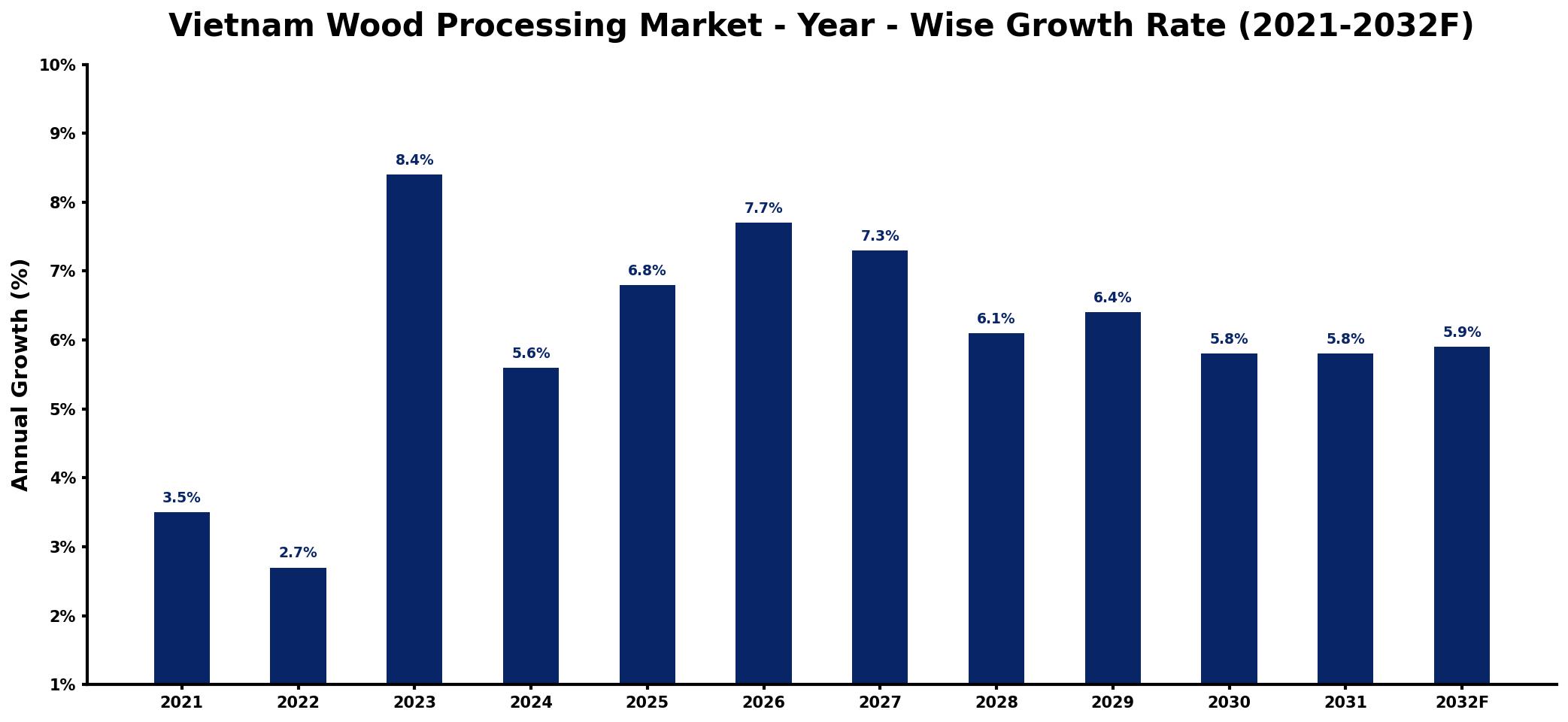
The table below presents the year‑wise growth rates along with the key drivers influencing the market
| Year | Growth Rate | Major Drivers |
| 2021 | 3.5% | Rising domestic construction activities |
| 2022 | 2.7% | Increased export opportunities abroad |
| 2023 | 8.4% | Growing consumer preference for sustainability |
| 2024 | 5.6% | Expansion of regional trade agreements |
| 2025 | 6.8% | Investment in advanced technologies |
| 2026 | 7.7% | Surge in renovation projects nationwide |
| 2027 | 7.3% | Strengthened supply chain networks |
| 2028 | 6.1% | Heightened focus on eco-friendly materials |
| 2029 | 6.4% | Emerging markets demand growth |
| 2030 | 5.8% | Boost in foreign direct investments |
| 2031 | 5.8% | Development of urban infrastructure projects |
| 2032 | 5.9% | Rising popularity of custom designs |
Note: Market size estimations and growth projections presented in this report are based on 6Wresearch's proprietary forecasting methodology, utilizing the latest available industry data, government publications, and primary research inputs.
Vietnam Wood Processing Market Synopsis
In recent years, the Vietnam wood processing market has demonstrated remarkable growth, benefitting from the country's strategic resources and skilled labor. As the demand for wooden products continues to rise globally, Vietnam is uniquely positioned to leverage its capabilities in furniture and timber production.
Looking ahead, the market is set for further expansion as technological advancements and increased sustainability initiatives are prioritized. Such a transition is essential not only for addressing environmental concerns but also for meeting evolving international standards and consumer preferences.
Vietnam Wood Processing Market Key Takeaways
- The Vietnam wood processing sector is projected to grow significantly, with an estimated market size of USD 581 Million by 2032.
- Strategic investments in modern technologies are enhancing production efficiency and product quality.
- Increased global demand for sustainable and affordable wooden products is driving market growth.
- The countrys favorable geographical location supports robust export activities in the wood processing market.
- A skilled workforce and abundant natural resources are key competitive advantages for Vietnamese wood processors.
Evaluation of Restraints in Vietnam Wood Processing Market
Despite its growth potential, the Vietnam wood processing market faces several constraints that could hinder its trajectory. A key concern is the sustainability of wood sourcing; the industry must navigate increasing pressure to adopt responsible forestry practices that align with global environmental standards. Furthermore, the slow adoption of advanced processing technologies may limit efficiency and productivity, making it imperative for companies to invest in modernization efforts to remain competitive in a rapidly evolving global landscape.
Vietnam Wood Processing Market Trends
The Vietnam wood processing market is currently witnessing a trend toward sustainable sourcing and environmentally friendly production methods. Consumers are becoming more conscious of the origins of their products, pushing manufacturers to prioritize transparency and sustainability. Additionally, the integration of advanced technologies—such as automated machinery and artificial intelligence—into the manufacturing processes is emerging, enhancing productivity and product quality while reducing waste.
Vietnam Wood Processing Market Opportunities
Significant opportunities exist for growth within the Vietnam wood processing market, especially in the export segment. With ongoing global demand for high-quality and sustainably sourced wood products, companies that adapt quickly to these trends can capture a larger market share. Furthermore, investments in eco-friendly technologies and practices are likely to yield long-term benefits, positioning firms as leaders in the increasingly competitive global market.
Government Initiatives in the Vietnam Wood Processing Market
The Vietnamese government has recognized the strategic importance of the wood processing industry and is actively supporting its development through various initiatives. Policies aimed at promoting sustainable forestry practices and enhancing export capabilities are being implemented. Furthermore, public spending on infrastructure and technology development is expected to bolster the capabilities of local wood processors, fostering an environment conducive to growth and innovation.
Future Insights of the Vietnam Wood Processing Market
From 2026 to 2032, the Vietnam wood processing market is anticipated to evolve significantly. With a growing emphasis on sustainability and technological advancements, companies are likely to see enhanced production capabilities and a broader international reach. The market will be characterized by increased collaboration with global partners, enabling local producers to align with international standards and cater to diverse consumer demands. As the landscape shifts, adapting to these changes will be crucial for continued success.
Vietnam Wood Processing Market Latest Developments (2025 - 2026)
Recent developments in the Vietnam wood processing market have focused on enhancing productivity through technological adoption. A surge in local investments aimed at modernizing facilities has been observed, reflecting a proactive approach to meet both domestic and international demand. Additionally, companies are increasingly collaborating with international partners to ensure compliance with global sustainability standards, addressing both market needs and environmental concerns.
Vietnam Wood Processing Market - Key Attractiveness of the Report
- 10 Years of Market Numbers
- Historical Data Starting from 2022 to 2025
- Base Year: 2025
- Forecast Data until 2032
- Key Performance Indicators Impacting the Market
- Major Upcoming Developments and Projects
Key Highlights of the Report:
- Vietnam Wood Processing Market Outlook
- Market Size of Vietnam Wood Processing Market, 2025
- Forecast of Vietnam Wood Processing Market, 2032
- Historical Data and Forecast of Vietnam Wood Processing Revenues & Volume for the Period 2022-2032F
- Vietnam Wood Processing Market Trend Evolution
- Vietnam Wood Processing Market Drivers and Challenges
- Vietnam Wood Processing Price Trends
- Vietnam Wood Processing Porter's Five Forces
- Vietnam Wood Processing Industry Life Cycle
- Historical Data and Forecast of Vietnam Wood Processing Market Revenues & Volume By Type for the Period 2022-2032F
- Historical Data and Forecast of Vietnam Wood Processing Market Revenues & Volume By Wood Chips for the Period 2022-2032F
- Historical Data and Forecast of Vietnam Wood Processing Market Revenues & Volume By Sawn Wood Lumber for the Period 2022-2032F
- Historical Data and Forecast of Vietnam Wood Processing Market Revenues & Volume By Others for the Period 2022-2032F
- Vietnam Wood Processing Import Export Trade Statistics
- Market Opportunity Assessment By Type
- Vietnam Wood Processing Top Companies Market Share
- Vietnam Wood Processing Competitive Benchmarking By Technical and Operational Parameters
- Vietnam Wood Processing Company Profiles
- Vietnam Wood Processing Key Strategic Recommendations






































