Vietnam Wooden Furniture Market Size, Share & Growth Rate
The Vietnam Wooden Furniture Market was estimated at USD 558 Million in 2025 and is projected to reach USD 791 Million by 2032, growing at a CAGR of 5.1% from 2026 to 2032. This growth trajectory is fueled by a burgeoning middle class eager to invest in quality home furnishings and an increasing trend towards modern living spaces. Additionally, the rising demand for sustainably sourced wood products is prompting manufacturers to adopt eco-friendly practices, further enhancing the market's potential.
Vietnam Wooden Furniture Market Year-wise Growth Rate and Key Drivers
This graph highlights how the Vietnam Wooden Furniture Market has steadily grown over the years, supported by major growth factors.
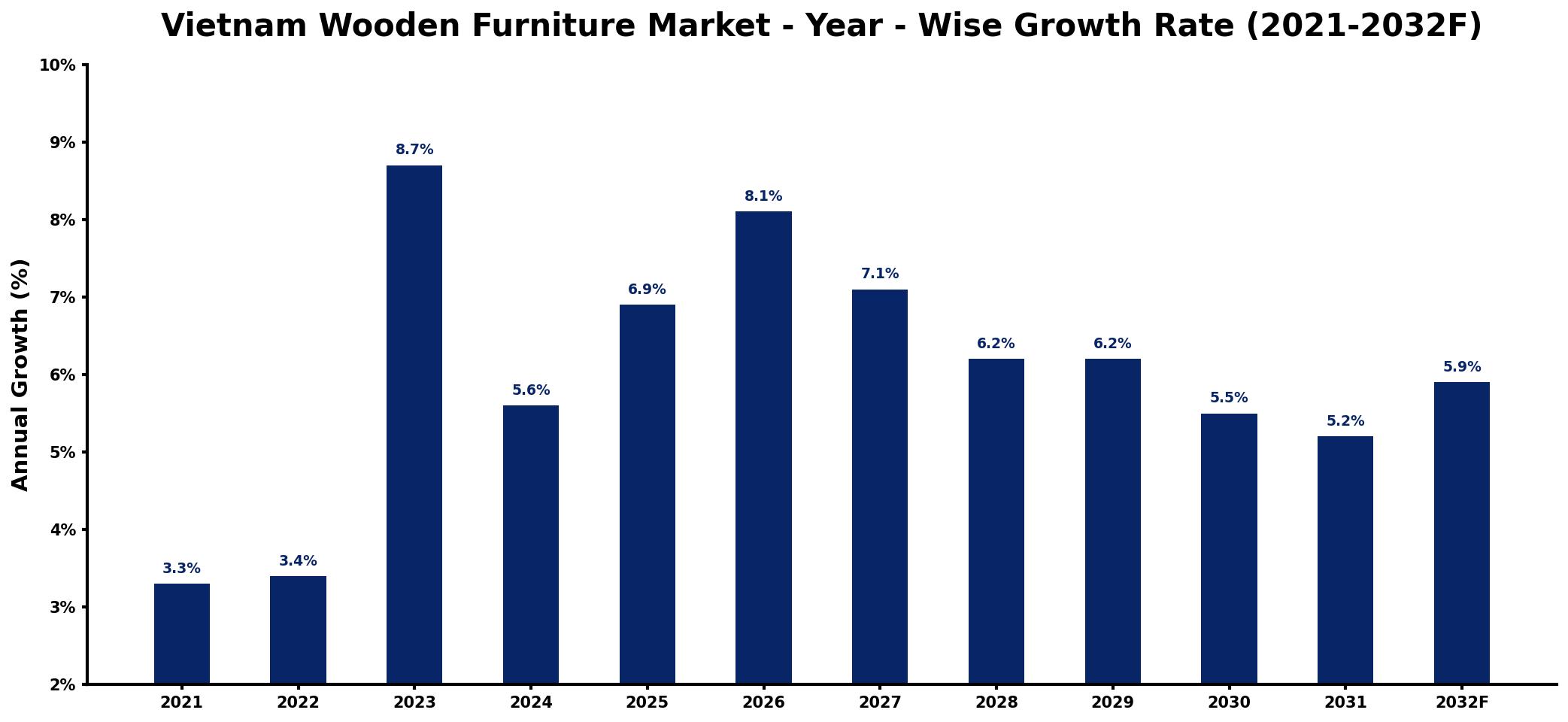
The table below presents the year‑wise growth rates along with the key drivers influencing the market
| Year | Growth Rate | Major Drivers |
| 2021 | 3.3% | Rising disposable income levels |
| 2022 | 3.4% | improved raw material availability |
| 2023 | 8.7% | Growing e-commerce platforms expansion |
| 2024 | 5.6% | Surge in domestic tourism demand |
| 2025 | 6.9% | Investment in sustainable practices |
| 2026 | 8.1% | Technological advancements in production |
| 2027 | 7.1% | Expansion of export markets opportunities |
| 2028 | 6.2% | Rising interest in home renovations |
| 2029 | 6.2% | Increased focus on interior design |
| 2030 | 5.5% | Strengthening of local supply chains |
| 2031 | 5.2% | Growing popularity of customization options |
| 2032 | 5.9% | Emergence of eco-friendly materials |
Note: Market size estimations and growth projections presented in this report are based on 6Wresearch's proprietary forecasting methodology, utilizing the latest available industry data, government publications, and primary research inputs.
Vietnam Wooden Furniture Market Synopsis
In recent years, Vietnam's wooden furniture market has experienced a notable resurgence, driven by domestic consumption and growing export opportunities. As urbanization accelerates and lifestyle preferences evolve, the demand for versatile, stylish furniture has surged, paving the way for further growth in the industry.
Looking ahead, the market is set to capitalize on its rich tradition of craftsmanship and abundant natural resources. As consumers increasingly gravitate towards high-quality, sustainable products, the competitive landscape is shifting, encouraging innovation and investment in advanced manufacturing techniques.
Vietnam Wooden Furniture Market Key Takeaways
- The market is projected to grow at a CAGR of 5.1% from 2026 to 2032.
- Vietnam's craftsmanship and variety of wood types enhance product offerings.
- Sustainable practices are becoming central to consumer purchasing decisions.
- Domestic demand is rising alongside strong export potential in global markets.
- Urbanization and lifestyle changes continue to shape furniture design preferences.
Evaluation of Restraints in Vietnam Wooden Furniture Market
Despite robust growth potential, the Vietnam wooden furniture market grapples with various restraints. A key challenge is the pressure on sustainable sourcing; manufacturers must navigate increasingly stringent regulations and consumer expectations regarding environmentally friendly practices. Global competition also poses a significant hurdle, as foreign manufacturers often offer similar products at competitive prices. This dynamic necessitates a focus on quality, innovation, and effective marketing strategies to maintain market share.
Vietnam Wooden Furniture Market Trends
Current trends reflect a growing consumer preference for multifunctional furniture, driven by urban living constraints. As smaller living spaces become the norm, the demand for space-efficient, aesthetically appealing designs is rising. Furthermore, an increase in e-commerce platforms is reshaping retail strategies, enabling greater accessibility for consumers seeking unique, handcrafted pieces. The influence of contemporary design aesthetics coupled with traditional craftsmanship continues to shape the offerings within the market.
Vietnam Wooden Furniture Market Opportunities
The industry presents significant growth opportunities, particularly in international markets. As demand for eco-friendly furniture escalates globally, Vietnamese manufacturers can leverage sustainable practices to differentiate themselves. Moreover, collaborations with global designers and retail giants can enhance brand visibility and expand market reach. The potential to integrate technology into production processes, such as the use of digital design tools, also represents an exciting avenue for innovation.
Government Initiatives in the Vietnam Wooden Furniture Market
The Vietnamese government is actively promoting initiatives aimed at enhancing the sustainability of the wood furniture industry. Policies focused on reforestation and sustainable forest management are designed to ensure the longevity of wood resources while protecting the environment. Additionally, government support for exporting firms through various trade agreements has opened new avenues for international sales, facilitating growth within the sector.
Future Insights of the Vietnam Wooden Furniture Market
From 2026 to 2032, the Vietnam wooden furniture market is poised for transformative growth, driven by an increasing focus on quality and sustainability. As domestic consumers become more discerning, the demand for premium, environmentally friendly products will rise. Furthermore, the integration of smart technologies into furniture design is likely to create new market niches, positioning Vietnam as a competitive player in the global furniture arena. Overall, innovation will be key to capitalizing on emerging consumer trends.
Vietnam Wooden Furniture Market Latest Developments (2025 - 2026)
Recent developments in the Vietnam wooden furniture market reflect a dynamic industry responding to changing consumer preferences. Manufacturers are increasingly investing in sustainable production methods and exploring partnerships with international brands to enhance their global footprint. Furthermore, there has been a notable uptick in online sales channels, allowing consumers to engage with and purchase products more conveniently than ever.
Vietnam Wooden Furniture Market - Key Attractiveness of the Report
- 10 Years of Market Numbers
- Historical Data Starting from 2022 to 2025
- Base Year: 2025
- Forecast Data until 2032
- Key Performance Indicators Impacting the Market
- Major Upcoming Developments and Projects
Key Highlights of the Report:
- Vietnam Wooden Furniture Market Outlook
- Market Size of Vietnam Wooden Furniture Market, 2025
- Forecast of Vietnam Wooden Furniture Market, 2032
- Historical Data and Forecast of Vietnam Wooden Furniture Revenues & Volume for the Period 2022-2032F
- Vietnam Wooden Furniture Market Trend Evolution
- Vietnam Wooden Furniture Market Drivers and Challenges
- Vietnam Wooden Furniture Price Trends
- Vietnam Wooden Furniture Porter's Five Forces
- Vietnam Wooden Furniture Industry Life Cycle
- Historical Data and Forecast of Vietnam Wooden Furniture Market Revenues & Volume By Type for the Period 2022-2032F
- Historical Data and Forecast of Vietnam Wooden Furniture Market Revenues & Volume By Hardwood for the Period 2022-2032F
- Historical Data and Forecast of Vietnam Wooden Furniture Market Revenues & Volume By Softwood for the Period 2022-2032F
- Historical Data and Forecast of Vietnam Wooden Furniture Market Revenues & Volume By Material for the Period 2022-2032F
- Historical Data and Forecast of Vietnam Wooden Furniture Market Revenues & Volume By Plywood for the Period 2022-2032F
- Historical Data and Forecast of Vietnam Wooden Furniture Market Revenues & Volume By Laminates for the Period 2022-2032F
- Historical Data and Forecast of Vietnam Wooden Furniture Market Revenues & Volume By MDF for the Period 2022-2032F
- Historical Data and Forecast of Vietnam Wooden Furniture Market Revenues & Volume By Other Materials for the Period 2022-2032F
- Historical Data and Forecast of Vietnam Wooden Furniture Market Revenues & Volume By Product for the Period 2022-2032F
- Historical Data and Forecast of Vietnam Wooden Furniture Market Revenues & Volume By Bedroom for the Period 2022-2032F
- Historical Data and Forecast of Vietnam Wooden Furniture Market Revenues & Volume By Seating for the Period 2022-2032F
- Historical Data and Forecast of Vietnam Wooden Furniture Market Revenues & Volume By Kitchen for the Period 2022-2032F
- Historical Data and Forecast of Vietnam Wooden Furniture Market Revenues & Volume By Other Products for the Period 2022-2032F
- Historical Data and Forecast of Vietnam Wooden Furniture Market Revenues & Volume By Application for the Period 2022-2032F
- Historical Data and Forecast of Vietnam Wooden Furniture Market Revenues & Volume By Residential for the Period 2022-2032F
- Historical Data and Forecast of Vietnam Wooden Furniture Market Revenues & Volume By Commercial for the Period 2022-2032F
- Historical Data and Forecast of Vietnam Wooden Furniture Market Revenues & Volume By Distribution Channel for the Period 2022-2032F
- Historical Data and Forecast of Vietnam Wooden Furniture Market Revenues & Volume By Offline for the Period 2022-2032F
- Historical Data and Forecast of Vietnam Wooden Furniture Market Revenues & Volume By Online for the Period 2022-2032F
- Vietnam Wooden Furniture Import Export Trade Statistics
- Market Opportunity Assessment By Type
- Market Opportunity Assessment By Material
- Market Opportunity Assessment By Product
- Market Opportunity Assessment By Application
- Market Opportunity Assessment By Distribution Channel
- Vietnam Wooden Furniture Top Companies Market Share
- Vietnam Wooden Furniture Competitive Benchmarking By Technical and Operational Parameters
- Vietnam Wooden Furniture Company Profiles
- Vietnam Wooden Furniture Key Strategic Recommendations






































