Vietnam Wooden Toys Market Size, Share & Growth Rate
The Vietnam Wooden Toys Market was estimated at USD 332 Million in 2025 and is projected to reach USD 468 Million by 2032, growing at a CAGR of 5.0% from 2026 to 2032. This growth trajectory reflects a pronounced shift among consumers towards eco-friendly and sustainable products, as parents increasingly seek safe, durable, and non-toxic options for their children. Furthermore, the push for early childhood development and educational play experiences is intensifying demand, particularly in urban areas where consumers are more aware of these benefits.
Vietnam Wooden Toys Market Year-wise Growth Rate and Key Drivers
This graph highlights how the Vietnam Wooden Toys Market has steadily grown over the years, supported by major growth factors.
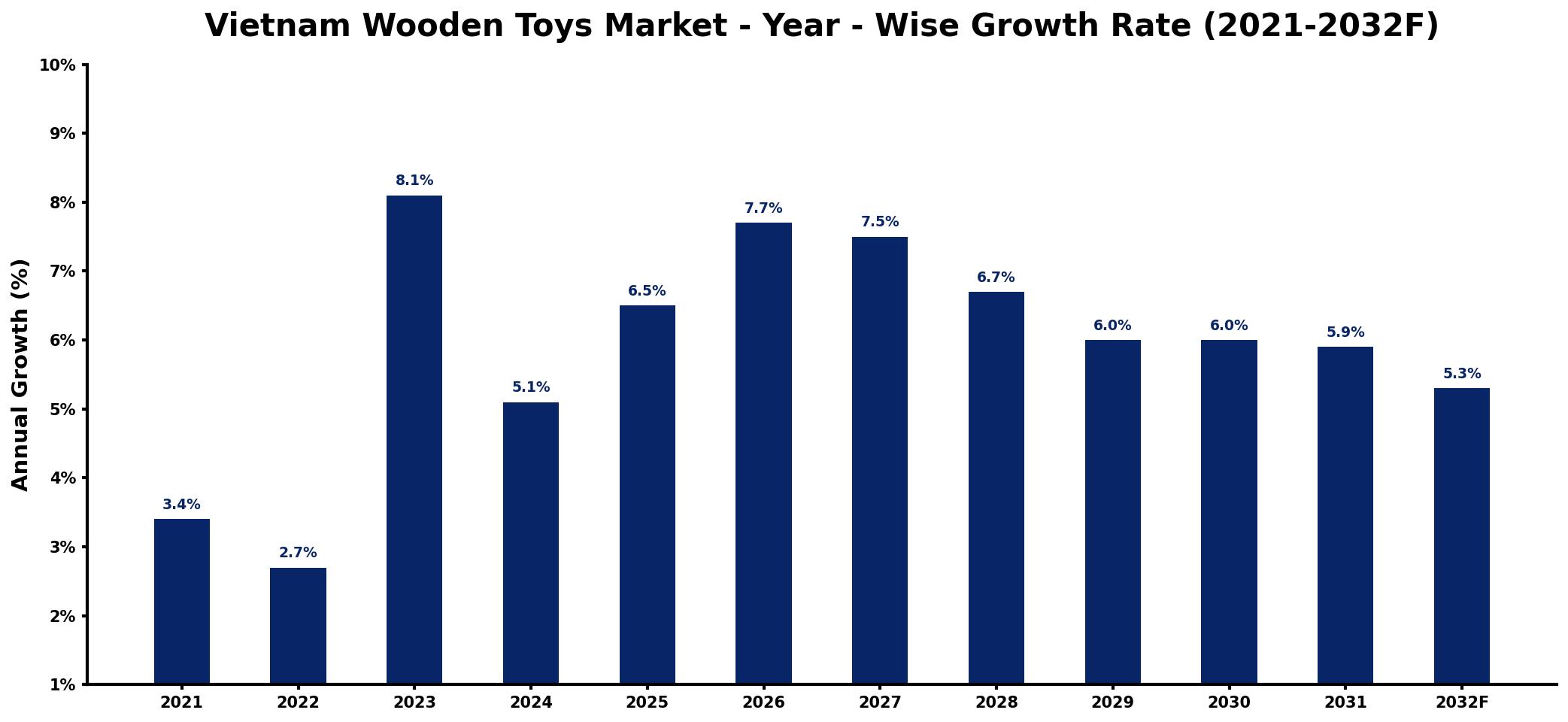
The table below presents the year‑wise growth rates along with the key drivers influencing the market
| Year | Growth Rate | Major Drivers |
| 2021 | 3.4% | Rising consumer environmental awareness |
| 2022 | 2.7% | Increased disposable income levels |
| 2023 | 8.1% | Growing popularity of sustainable products |
| 2024 | 5.1% | Expansion of local manufacturing facilities |
| 2025 | 6.5% | Surge in online retail platforms |
| 2026 | 7.7% | Strengthening export opportunities abroad |
| 2027 | 7.5% | Increased investment in innovation |
| 2028 | 6.7% | Enhanced distribution network efficiency |
| 2029 | 6.0% | Growing interest in educational materials |
| 2030 | 6.0% | Increased collaboration with designers |
| 2031 | 5.9% | Strengthening of eco-friendly regulations |
| 2032 | 5.3% | expanding healthcare application demand |
Note: Market size estimations and growth projections presented in this report are based on 6Wresearch's proprietary forecasting methodology, utilizing the latest available industry data, government publications, and primary research inputs.
Vietnam Wooden Toys Market Synopsis
At the heart of the Vietnam wooden toys market lies the growing awareness of child development and eco-conscious parenting. Parents are increasingly favoring wooden toys that not only promote creativity and learning but also align with their values of sustainability and safety. The demand for such toys is a reflection of broader societal trends prioritizing health and environmental sustainability.
In this context, the market is witnessing a substantial rise in both local and international players who are adapting their offerings to meet evolving consumer expectations. With a range of products that include educational games and puzzles, the market caters to families that prioritize quality over quantity, emphasizing the long-term value of wooden toys.
Vietnam Wooden Toys Market Key Takeaways
- Growing preference for eco-friendly and non-toxic toys is reshaping consumer buying habits.
- Increased availability through e-commerce is driving market access and sales growth.
- Early childhood development emphasis is enhancing the educational toy segment.
- Local manufacturers are innovating to meet stringent safety and sustainability standards.
- The post-pandemic recovery phase is leading to renewed interest and investment in wooden toys.
Evaluation of Restraints in Vietnam Wooden Toys Market
Despite the positive growth outlook, the Vietnam wooden toys market faces several limitations. Firstly, keeping pace with rapid changes in consumer preferences can be challenging for manufacturers. The necessity to meet increasingly stringent safety standards adds another layer of complexity. Moreover, sourcing sustainable materials poses significant operational hurdles. Addressing these factors is vital to maintaining consumer trust while ensuring compliance with regulations aimed at environmental sustainability. Thus, manufacturers must continuously adapt their strategies to thrive in this competitive landscape.
Vietnam Wooden Toys Market Trends
Current trends in the Vietnam wooden toys market highlight an increasing interest in personalized and handcrafted toys. This trend is fueled by a growing consumer desire for unique products that offer distinct play experiences. Additionally, digital engagement, particularly through social media, is enhancing brand awareness and driving sales. The incorporation of technology into traditional wooden toys—such as augmented reality features—is also emerging as a notable trend, blending tactile play with digital interaction. Finally, sustainability has become a core market pillar, influencing design and sourcing choices.
Vietnam Wooden Toys Market Opportunities
The Vietnam wooden toys market presents numerous opportunities for growth and investment. One significant area lies in the expansion of online retail platforms, which allow for greater consumer access to diverse products. Furthermore, there is a burgeoning market for educational toys that facilitate learning in engaging ways. Collaboration with educational institutions to integrate these toys into curriculum could provide a unique competitive advantage. Lastly, the rise of eco-tourism in Vietnam could encourage the development of locally sourced wooden toys that appeal to environmentally-conscious tourists.
Government Initiatives in the Vietnam Wooden Toys Market
The Vietnamese government has been increasingly supportive of sustainable product development, with policies aimed at promoting environmentally-friendly manufacturing practices. Public spending initiatives focused on early childhood education often include provisions for safe and educational toys, creating an indirect boost to the wooden toys market. Furthermore, programs designed to enhance manufacturing capabilities and export potential offer additional avenues for growth in this sector.
Future Insights of the Vietnam Wooden Toys Market
Looking ahead to the period of 2026-2032, the Vietnam wooden toys market is poised for sustained growth driven by persistent consumer preference for sustainable, educational products. As digital integration continues to evolve, manufacturers may explore innovative approaches that combine traditional craftsmanship with modern technology. The anticipated increase in disposable income and evolving family dynamics will likely further fuel market demand. Overall, the future holds promise for a market that prioritizes both quality and environmental responsibility.
Vietnam Wooden Toys Market Latest Developments (2025 - 2026)
Recent developments in the Vietnam wooden toys market reflect a notable shift towards sustainable production practices. Many companies are launching new lines that feature organic materials, aligning with consumer expectations for safety and environmental responsibility. Additionally, collaborations between toy manufacturers and educational experts are becoming more common, resulting in products that not only entertain but also promote learning. The emphasis on online retail has led to innovative marketing strategies, including partnerships with influencers, enhancing brand visibility in a competitive landscape.
Vietnam Wooden Toys Market - Key Attractiveness of the Report
- 10 Years of Market Numbers
- Historical Data Starting from 2022 to 2025
- Base Year: 2025
- Forecast Data until 2032
- Key Performance Indicators Impacting the Market
- Major Upcoming Developments and Projects
Key Highlights of the Report:
- Vietnam Wooden Toys Market Outlook
- Market Size of Vietnam Wooden Toys Market, 2025
- Forecast of Vietnam Wooden Toys Market, 2032
- Historical Data and Forecast of Vietnam Wooden Toys Revenues & Volume for the Period 2022-2032F
- Vietnam Wooden Toys Market Trend Evolution
- Vietnam Wooden Toys Market Drivers and Challenges
- Vietnam Wooden Toys Price Trends
- Vietnam Wooden Toys Porter's Five Forces
- Vietnam Wooden Toys Industry Life Cycle
- Historical Data and Forecast of Vietnam Wooden Toys Market Revenues & Volume By Product Type for the Period 2022-2032F
- Historical Data and Forecast of Vietnam Wooden Toys Market Revenues & Volume By Educational Toys for the Period 2022-2032F
- Historical Data and Forecast of Vietnam Wooden Toys Market Revenues & Volume By Construction Toys for the Period 2022-2032F
- Historical Data and Forecast of Vietnam Wooden Toys Market Revenues & Volume By Musical Toys for the Period 2022-2032F
- Historical Data and Forecast of Vietnam Wooden Toys Market Revenues & Volume By Game Toys for the Period 2022-2032F
- Historical Data and Forecast of Vietnam Wooden Toys Market Revenues & Volume By Dolls & Miniatures for the Period 2022-2032F
- Historical Data and Forecast of Vietnam Wooden Toys Market Revenues & Volume By Automotive Toys for the Period 2022-2032F
- Historical Data and Forecast of Vietnam Wooden Toys Market Revenues & Volume By Pretend Play Toys for the Period 2022-2032F
- Historical Data and Forecast of Vietnam Wooden Toys Market Revenues & Volume By Wood Type for the Period 2022-2032F
- Historical Data and Forecast of Vietnam Wooden Toys Market Revenues & Volume By Softwood for the Period 2022-2032F
- Historical Data and Forecast of Vietnam Wooden Toys Market Revenues & Volume By Hardwood for the Period 2022-2032F
- Historical Data and Forecast of Vietnam Wooden Toys Market Revenues & Volume By Age Group for the Period 2022-2032F
- Historical Data and Forecast of Vietnam Wooden Toys Market Revenues & Volume By Below 1 Year for the Period 2022-2032F
- Historical Data and Forecast of Vietnam Wooden Toys Market Revenues & Volume By Age 1-3 for the Period 2022-2032F
- Historical Data and Forecast of Vietnam Wooden Toys Market Revenues & Volume By Age 3-5 for the Period 2022-2032F
- Historical Data and Forecast of Vietnam Wooden Toys Market Revenues & Volume By Age 5-12 for the Period 2022-2032F
- Historical Data and Forecast of Vietnam Wooden Toys Market Revenues & Volume By Age 12+ for the Period 2022-2032F
- Historical Data and Forecast of Vietnam Wooden Toys Market Revenues & Volume By Distribution Channel for the Period 2022-2032F
- Historical Data and Forecast of Vietnam Wooden Toys Market Revenues & Volume By Online for the Period 2022-2032F
- Historical Data and Forecast of Vietnam Wooden Toys Market Revenues & Volume By Offline for the Period 2022-2032F
- Vietnam Wooden Toys Import Export Trade Statistics
- Market Opportunity Assessment By Product Type
- Market Opportunity Assessment By Wood Type
- Market Opportunity Assessment By Age Group
- Market Opportunity Assessment By Distribution Channel
- Vietnam Wooden Toys Top Companies Market Share
- Vietnam Wooden Toys Competitive Benchmarking By Technical and Operational Parameters
- Vietnam Wooden Toys Company Profiles
- Vietnam Wooden Toys Key Strategic Recommendations






































