Vietnam Workplace Safety Market Size & Growth Rate (2026-2032)
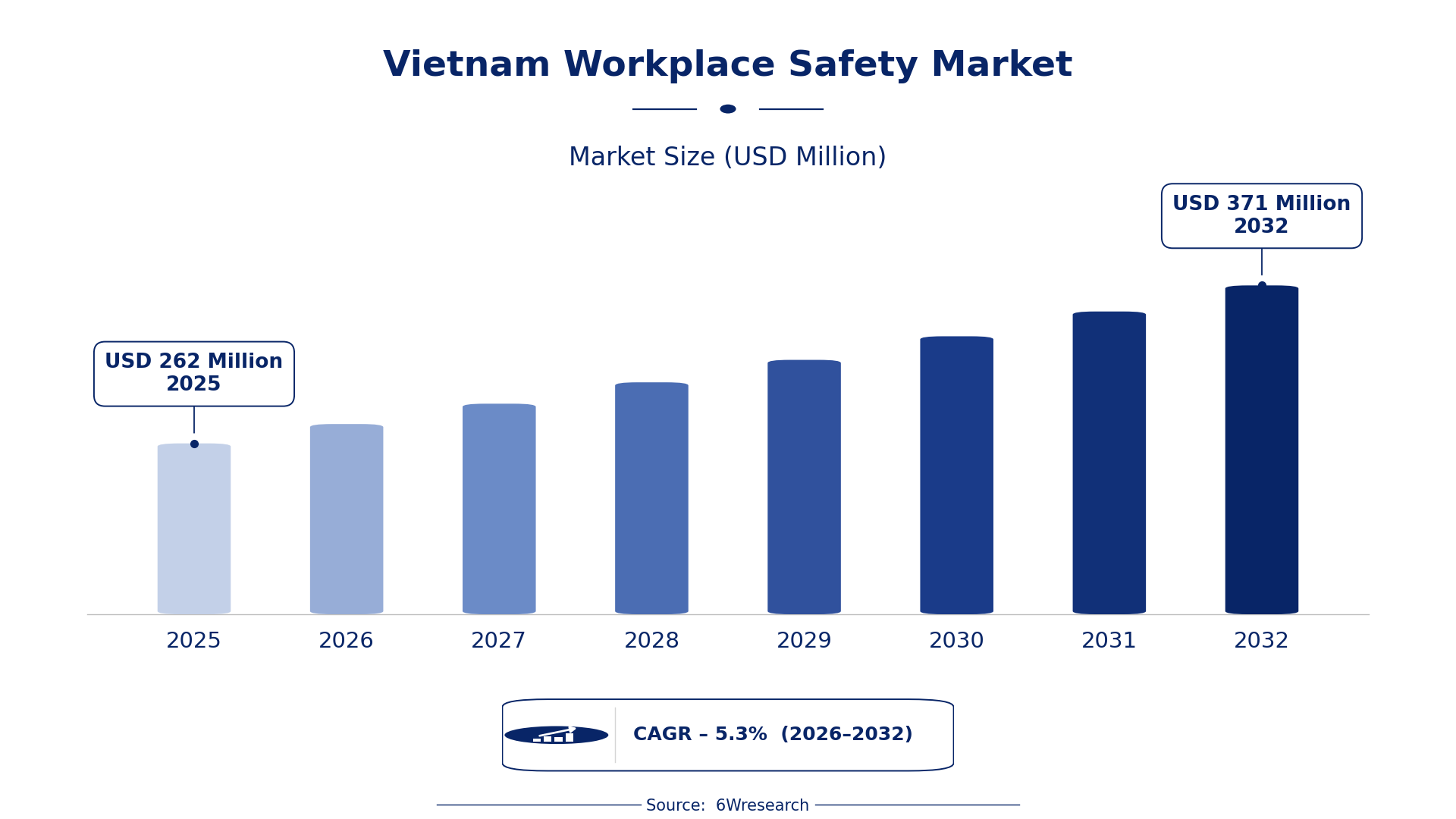
The Vietnam Workplace Safety Market was estimated at USD 262 Million in 2025 and is projected to reach USD 371 Million by 2032, growing at a CAGR of 5.3% from 2026 to 2032.
Vietnam Workplace Safety Market Synopsis
At the forefront of the Vietnam Workplace Safety market is the growing recognition of the importance of employee well-being. Organizations are increasingly prioritizing safety measures as they seek to comply with evolving occupational health regulations and promote a positive work environment.
Investments in comprehensive safety solutions, from training programs to advanced monitoring systems, are becoming commonplace. This shift reflects a broader understanding that workplace safety is directly linked to enhanced productivity and employee satisfaction, making it a non-negotiable aspect of modern business operations in Vietnam.
Vietnam Workplace Safety Market Year-wise Growth Rate and Key Drivers
This graph illustrates the annual growth rates of the Vietnam Workplace Safety Market from 2021 to 2032, highlighting a steady upward trajectory and projected expansion over the forecast period.
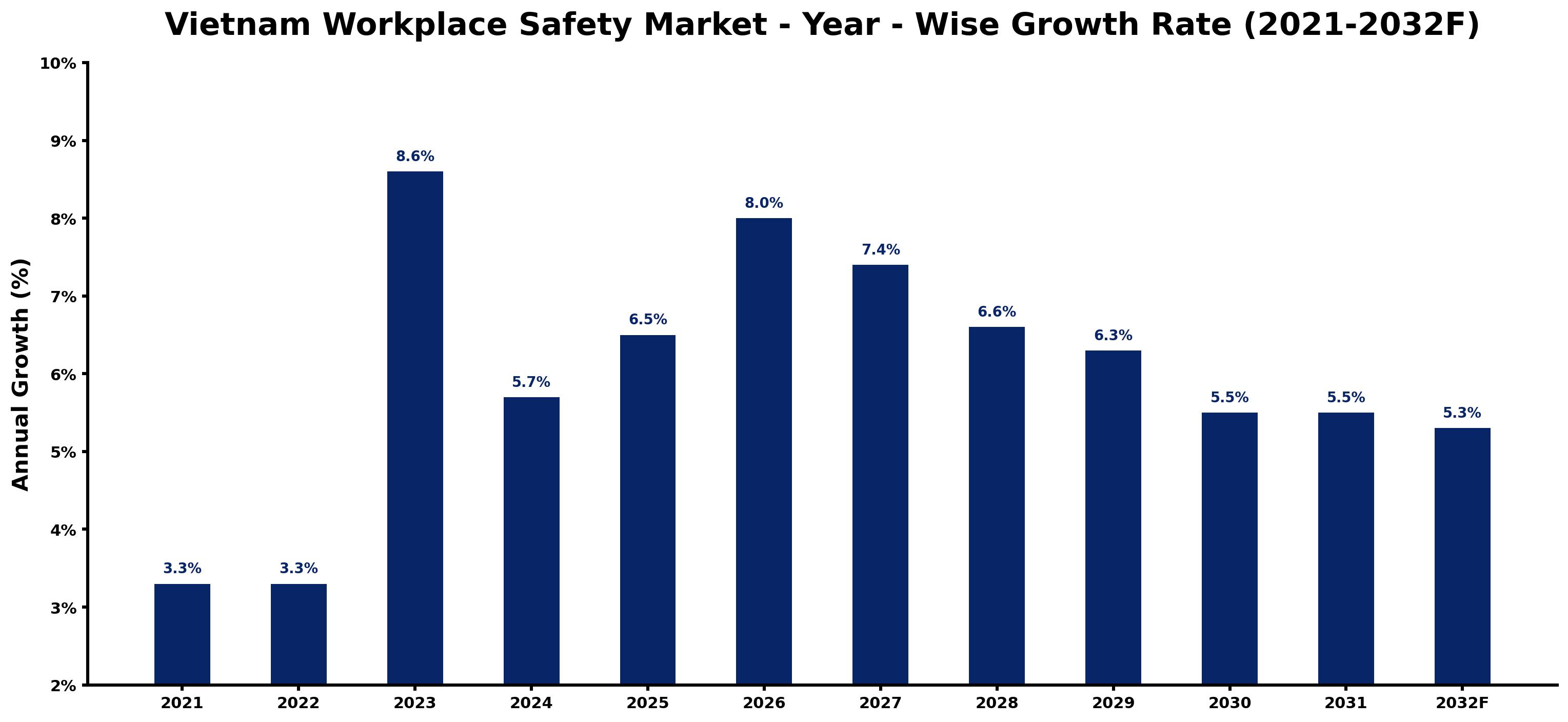
The table below presents the year‑wise growth rates along with the key drivers influencing the market
| Year | Growth Rate | Major Drivers |
| 2021 | 3.3% | Implementation of Vietnam's Occupational Safety Law revisions. |
| 2022 | 3.3% | Increased health inspections by the Ministry of Labour. |
| 2023 | 8.6% | Government incentives for safety equipment upgrades in factories. |
| 2024 | 5.7% | Growing focus on industrial safety due to climate change effects. |
| 2025 | 6.5% | Strengthened regulations from the Vietnam Occupational Safety Authority. |
| 2026 | 8.0% | Increased awareness of workplace hazards among Vietnamese workers. |
| 2027 | 7.4% | Rise in foreign companies adhering to global safety standards. |
| 2028 | 6.6% | Increased training programs by Ministry of Education for safety skills. |
| 2029 | 6.3% | Enhanced supply chain safety due to trade agreement compliance. |
| 2030 | 5.5% | Worker safety becoming a corporate responsibility focus area. |
| 2031 | 5.5% | Regulatory push for comprehensive safety audits in industries. |
| 2032 | 5.3% | Emerging safety technologies gaining traction in Vietnamese workplaces. |
Note: Market size estimations and growth projections presented in this report are based on 6Wresearch's proprietary forecasting methodology, utilizing the latest available industry data, government publications, and primary research inputs.
Vietnam Workplace Safety Market Key Takeaways
Below are some of the specific key takeaways from the market, including:
- The market is experiencing significant growth driven by stricter safety regulations and increased awareness of occupational health.
- There is a strong emphasis on personal protective equipment (PPE) and safety training programs across various industries.
- The impact of COVID-19 has accelerated the adoption of advanced safety technologies in workplaces.
- Ongoing government initiatives are shaping the regulatory framework and safety standards in Vietnam.
- Investment in workplace safety solutions is expected to continue as companies recognize their critical role in organizational success.
Evaluation of Restraints in Vietnam Workplace Safety Market
While there is a clear movement toward improving workplace safety in Vietnam, several challenges impede progress. A significant barrier is the uneven awareness and enforcement of safety standards, especially in industries with a high prevalence of informal employment. Employers often grapple with the need for resources and training to instill a culture of safety. Furthermore, the varying needs across diverse sectors create a complex environment for standardizing safety practices. Addressing these issues is critical to unlocking the full potential of the workplace safety market.
Vietnam Workplace Safety Market Trends
The Vietnam Workplace Safety market is currently witnessing a surge in technological adoption. Companies are increasingly utilizing digital solutions such as real-time monitoring systems and data analytics to enhance safety protocols. Moreover, there's a noticeable shift toward remote and hybrid working models, necessitating tailored safety solutions for diverse work environments. Training programs are evolving to integrate digital platforms, making safety education more accessible. As a result, the landscape of workplace safety is transforming to meet modern demands.
Vietnam Workplace Safety Market Opportunities
Opportunities in the Vietnam Workplace Safety market abound as businesses seek to enhance their safety standards. The demand for innovative safety technologies presents avenues for investment in areas such as AI-driven monitoring solutions and automated safety training platforms. Additionally, sectors like construction and manufacturing are ripe for growth, given their high accident rates. The ongoing push for regulatory compliance means that companies focusing on compliance-driven solutions are well-positioned for success. There's a clear incentive for organizations to allocate resources toward workplace safety, viewing it as a strategic investment rather than a cost.
Government Initiatives in the Vietnam Workplace Safety Market
Government policies play a crucial role in shaping the Vietnam Workplace Safety market. The regulatory environment has been tightening, with the government prioritizing occupational health and safety initiatives to reduce workplace incidents. These initiatives not only enforce compliance but also aim to foster a culture of safety across various industries. As such, companies must adapt to these changing regulations to remain competitive.
- A regulatory framework aimed at enhancing workplace safety standards was introduced in early 2023, mandating comprehensive safety training for all employees.
- The ongoing National Occupational Safety Campaign, initiated in mid-2024, focuses on raising awareness about safety practices among small and medium-sized enterprises.
- A planned public-private partnership set to launch by 2026 aims to develop advanced safety technology solutions tailored to the needs of different sectors.
- Recent safety audits conducted by the Ministry of Labour, Invalids and Social Affairs in late 2025 are intended to assess compliance levels across industries.
Future Insights of the Vietnam Workplace Safety Market
Looking ahead to 2026-2032, the Vietnam Workplace Safety market is set to expand further as organizations increasingly prioritize safety and compliance. The convergence of technology and safety will likely drive innovation, with predictive analytics and machine learning becoming integral in workplace safety solutions. As the regulatory framework continues to evolve, companies that proactively embrace these changes will gain a competitive edge. With rising investment in employee welfare, a culture centered around safety will become a defining characteristic of successful businesses in Vietnam.
Vietnam Workplace Safety Market Latest Developments
In the past year, the Vietnam Workplace Safety market has seen a flurry of activity as organizations respond to regulatory changes and the ongoing impact of the COVID-19 pandemic. Companies are rapidly updating their safety protocols and investing in new technologies to protect their employees. This trend reflects a growing commitment to maintaining safe work environments amid evolving challenges.
- A major technology vendor launched an AI-driven safety compliance platform in Q1 2025, enhancing monitoring capabilities for organizations across sectors.
- In early 2025, several leading firms initiated partnerships with local safety training providers to deliver enhanced employee training programs.
- A construction company announced plans in mid-2025 to implement advanced safety management systems across all its projects.
- Currently, an initiative aimed at upgrading PPE standards is underway, focusing on integrating smart technology into equipment design and functionality.
Vietnam Workplace Safety Market - Key Attractiveness of the Report
- 10 Years of Market Numbers
- Historical Data Starting from 2022 to 2025
- Base Year: 2025
- Forecast Data until 2032
- Key Performance Indicators Impacting the Market
- Major Upcoming Developments and Projects
Key Highlights of the Report:
- Vietnam Workplace Safety Market Outlook
- Market Size of Vietnam Workplace Safety Market, 2025
- Forecast of Vietnam Workplace Safety Market, 2032
- Historical Data and Forecast of Vietnam Workplace Safety Revenues & Volume for the Period 2022-2032F
- Vietnam Workplace Safety Market Trend Evolution
- Vietnam Workplace Safety Market Drivers and Challenges
- Vietnam Workplace Safety Price Trends
- Vietnam Workplace Safety Porter's Five Forces
- Vietnam Workplace Safety Industry Life Cycle
- Historical Data and Forecast of Vietnam Workplace Safety Market Revenues & Volume By Component for the Period 2022-2032F
- Historical Data and Forecast of Vietnam Workplace Safety Market Revenues & Volume By Hardware for the Period 2022-2032F
- Historical Data and Forecast of Vietnam Workplace Safety Market Revenues & Volume By Software for the Period 2022-2032F
- Historical Data and Forecast of Vietnam Workplace Safety Market Revenues & Volume By Services for the Period 2022-2032F
- Historical Data and Forecast of Vietnam Workplace Safety Market Revenues & Volume By Application for the Period 2022-2032F
- Historical Data and Forecast of Vietnam Workplace Safety Market Revenues & Volume By Incident for the Period 2022-2032F
- Historical Data and Forecast of Vietnam Workplace Safety Market Revenues & Volume By Emergency Management for the Period 2022-2032F
- Historical Data and Forecast of Vietnam Workplace Safety Market Revenues & Volume By Asset Tracking for the Period 2022-2032F
- Historical Data and Forecast of Vietnam Workplace Safety Market Revenues & Volume By PPE Detection for the Period 2022-2032F
- Historical Data and Forecast of Vietnam Workplace Safety Market Revenues & Volume By System for the Period 2022-2032F
- Historical Data and Forecast of Vietnam Workplace Safety Market Revenues & Volume By Environmental Health and Safety for the Period 2022-2032F
- Historical Data and Forecast of Vietnam Workplace Safety Market Revenues & Volume By Access Control and Surveillance System for the Period 2022-2032F
- Historical Data and Forecast of Vietnam Workplace Safety Market Revenues & Volume By Real Time Location Monitoring for the Period 2022-2032F
- Historical Data and Forecast of Vietnam Workplace Safety Market Revenues & Volume By Others for the Period 2022-2032F
- Historical Data and Forecast of Vietnam Workplace Safety Market Revenues & Volume By Deployment Mode for the Period 2022-2032F
- Historical Data and Forecast of Vietnam Workplace Safety Market Revenues & Volume By On-premise for the Period 2022-2032F
- Historical Data and Forecast of Vietnam Workplace Safety Market Revenues & Volume By Cloud for the Period 2022-2032F
- Historical Data and Forecast of Vietnam Workplace Safety Market Revenues & Volume By End User for the Period 2022-2032F
- Historical Data and Forecast of Vietnam Workplace Safety Market Revenues & Volume By Energy and Utilities for the Period 2022-2032F
- Historical Data and Forecast of Vietnam Workplace Safety Market Revenues & Volume By Construction and Engineering for the Period 2022-2032F
- Historical Data and Forecast of Vietnam Workplace Safety Market Revenues & Volume By Chemical and Materials for the Period 2022-2032F
- Historical Data and Forecast of Vietnam Workplace Safety Market Revenues & Volume By Government and Defense for the Period 2022-2032F
- Historical Data and Forecast of Vietnam Workplace Safety Market Revenues & Volume By Healthcare for the Period 2022-2032F
- Historical Data and Forecast of Vietnam Workplace Safety Market Revenues & Volume By Food and Beverages for the Period 2022-2032F
- Historical Data and Forecast of Vietnam Workplace Safety Market Revenues & Volume By Others for the Period 2022-2032F
- Vietnam Workplace Safety Import Export Trade Statistics
- Market Opportunity Assessment By Component
- Market Opportunity Assessment By Application
- Market Opportunity Assessment By System
- Market Opportunity Assessment By Deployment Mode
- Market Opportunity Assessment By End User
- Vietnam Workplace Safety Top Companies Market Share
- Vietnam Workplace Safety Competitive Benchmarking By Technical and Operational Parameters
- Vietnam Workplace Safety Company Profiles
- Vietnam Workplace Safety Key Strategic Recommendations






































