Vietnam Workspace as a Service Market Size & Growth Rate (2026-2032)
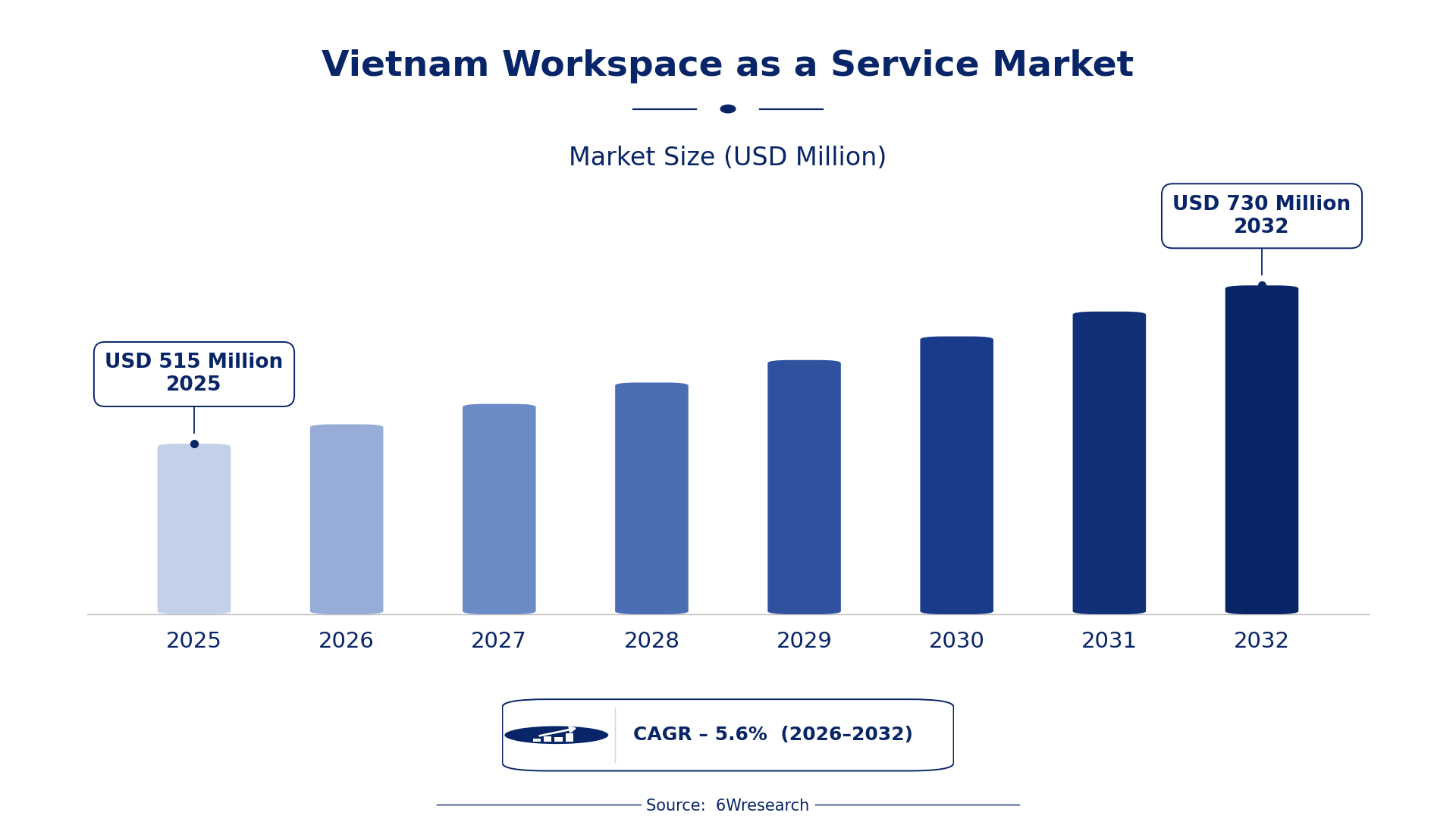
The Vietnam Workspace as a Service Market was estimated at USD 515 Million in 2025 and is projected to reach USD 730 Million by 2032, growing at a CAGR of 5.6% from 2026 to 2032.
Vietnam Workspace as a Service Market Synopsis
The ongoing shift towards remote work is the strongest force currently shaping the Vietnam Workspace as a Service (WaaS) market. As businesses adapt to new operational norms, the demand for flexible and secure digital workspaces is surging, pushing organizations to invest in WaaS solutions that enhance employee productivity and collaboration.
Vietnam's workforce is increasingly reliant on cloud-based technologies, a trend that's accelerating the integration of WaaS into everyday business practices. This evolution is not merely a response to recent events; it's a strategic move towards a more agile work environment that promises to redefine traditional office paradigms.
Vietnam Workspace as a Service Market Year-wise Growth Rate and Key Drivers
This graph illustrates the annual growth rates of the Vietnam Workspace as a Service Market from 2021 to 2032, highlighting a steady upward trajectory and projected expansion over the forecast period.
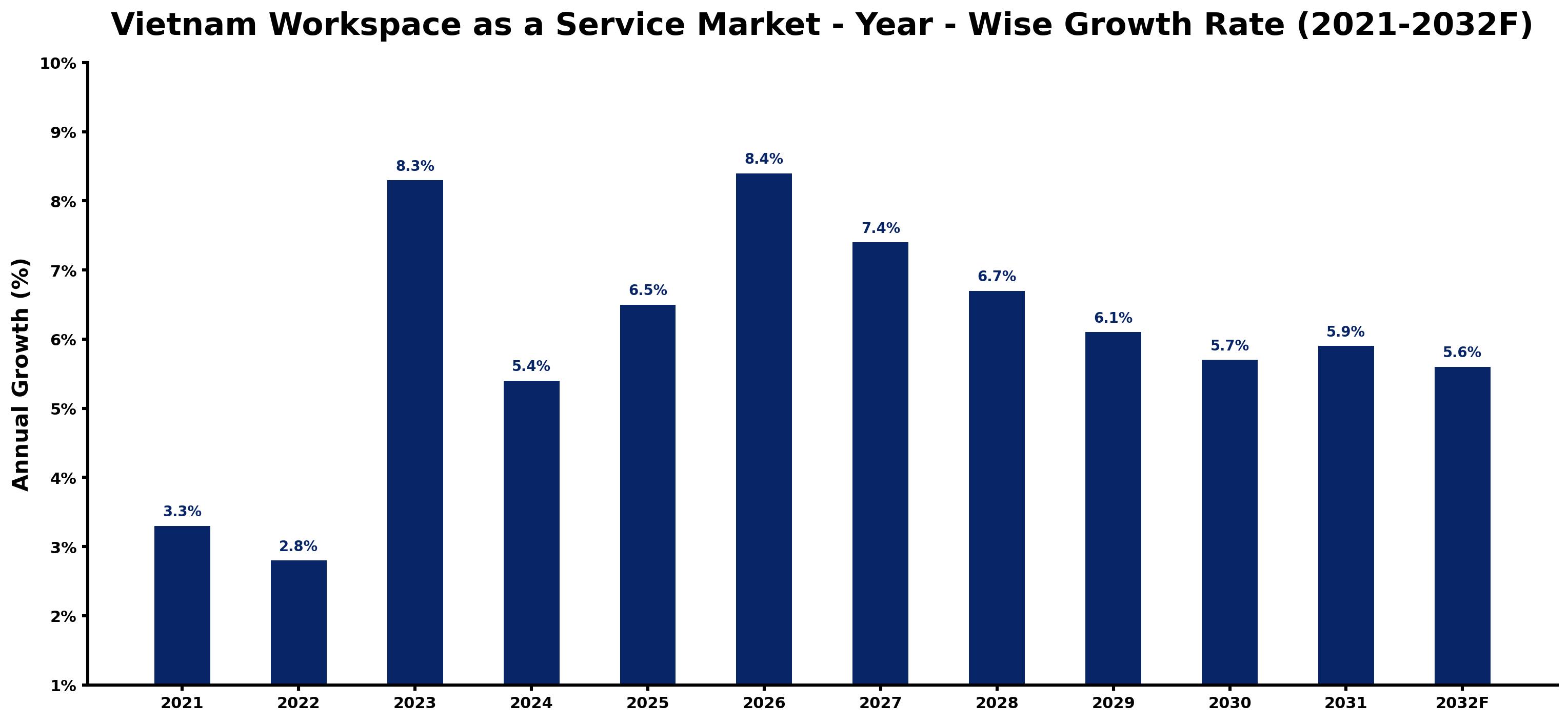
The table below presents the year‑wise growth rates along with the key drivers influencing the market
| Year | Growth Rate | Major Drivers |
| 2021 | 3.3% | Rise in remote work mandates from government agencies |
| 2022 | 2.8% | Increased demand for flexible office solutions post-pandemic |
| 2023 | 8.3% | Vietnamese start-ups adopting co-working spaces for innovation |
| 2024 | 5.4% | Government incentives for tech companies in urban areas |
| 2025 | 6.5% | Growing freelancer population in urbanized regions |
| 2026 | 8.4% | Major cities expanding commercial real estate for offices |
| 2027 | 7.4% | Enhanced digital infrastructure supporting remote collaboration |
| 2028 | 6.7% | Corporate focus on employee wellness and flexibility solutions |
| 2029 | 6.1% | International firms relocating to Vietnam for business agility |
| 2030 | 5.7% | Strong foreign investment in the tech and startup sectors |
| 2031 | 5.9% | Government partnerships promoting shared workspaces |
| 2032 | 5.6% | Increased entrepreneurship driving demand for temporary office space |
Note: Market size estimations and growth projections presented in this report are based on 6Wresearch's proprietary forecasting methodology, utilizing the latest available industry data, government publications, and primary research inputs.
Vietnam Workspace as a Service Market Key Takeaways
Below are some of the specific key takeaways from the market, including:
- The market is experiencing rapid growth driven by the rise of remote work solutions.
- Organizations are increasingly prioritizing IT infrastructure simplification and enhanced security.
- Investment in cloud technologies is reshaping the operational framework of Vietnamese businesses.
- Collaboration tools are central to the adoption of WaaS, fostering a culture of flexibility.
- Market growth is challenged by disparities in digital access across regions.
Evaluation of Restraints in Vietnam Workspace as a Service Market
The Vietnam Workspace as a Service market faces notable restraints that hinder its full potential. A significant barrier is the digital divide, which limits high-speed internet access in certain areas, preventing widespread adoption. Data security concerns also loom large, particularly in industries that handle sensitive information. on top of that, the entrenched mindset favoring traditional office environments poses a cultural challenge, making it difficult for organizations to embrace new working models. Addressing these issues is crucial for the market's successful expansion.
Vietnam Workspace as a Service Market Trends
Several key trends are influencing the Vietnam Workspace as a Service market. The first is the increasing emphasis on hybrid work models, where organizations blend remote and in-office work to maximize flexibility. Another trend is the rise of advanced collaboration tools that enhance teamwork and communication across dispersed teams. Additionally, businesses are investing in AI-driven analytics to optimize workspace performance and user experience. As these trends continue to gain traction, they will play a crucial role in shaping the future of work in Vietnam.
Vietnam Workspace as a Service Market Opportunities
Opportunities abound within the Vietnam Workspace as a Service market, particularly in sectors that are just beginning to embrace digital transformation. Small and medium-sized enterprises (SMEs) represent a significant growth area, as they seek cost-effective solutions to compete with larger firms. on top of that, industries such as education and healthcare are beginning to explore WaaS solutions, driven by the need for reliable remote access to resources. Innovations in security and compliance will also attract investment, as businesses prioritize data protection in their transition to cloud-based services.
Government Initiatives in the Vietnam Workspace as a Service Market
The Vietnamese government is actively shaping the Workspace as a Service market through various initiatives aimed at enhancing digital infrastructure and promoting cloud adoption. Regulatory frameworks are being established to encourage investment in digital technologies, which is crucial for the WaaS market's growth. As public policy evolves, it increasingly supports digital collaboration and remote work practices, reflecting a commitment to modernizing the country's work environment.
- A national digital infrastructure upgrade program launched in early 2023 is enhancing connectivity across urban and rural areas.
- Current initiatives are focused on expanding internet access to underserved regions, improving the overall digital ecosystem.
- A regulatory framework introduced in 2024 aims to streamline cloud service operations, boosting confidence among businesses.
- Upcoming public-private partnerships are expected to foster innovation in digital workspace solutions by 2025.
- A planned initiative in 2026 aims to enhance cybersecurity measures for cloud services, addressing growing concerns around data safety.
Future Insights of the Vietnam Workspace as a Service Market
Looking ahead to 2026-2032, the Vietnam Workspace as a Service market is set for continued expansion. As more businesses embrace digital transformation, the demand for WaaS solutions will only increase. The integration of artificial intelligence and machine learning into these platforms will further enhance functionality, creating smarter and more intuitive work environments. Companies that proactively adapt to these changes will find themselves at the forefront of the competitive landscape, on track to leverage the advantages of modern work solutions.
Vietnam Workspace as a Service Market Latest Developments
In the past 12-14 months, the Vietnam Workspace as a Service market has seen notable developments that signal its dynamic evolution. The push for cloud adoption has accelerated, with businesses increasingly integrating advanced WaaS solutions into their operations. This trend reflects a broader commitment to enhancing remote work capabilities while maintaining a focus on security and efficiency.
- A major technology vendor announced a comprehensive WaaS platform upgrade in early 2023, focusing on enhanced security features.
- An ongoing collaboration between local startups and international firms aims to introduce innovative cloud solutions by mid-2024.
- A rollout expected to begin in late 2025 is set to expand virtual desktop capabilities across various sectors.
- In early 2023, a leading regional operator launched a new initiative to provide SMEs with affordable WaaS solutions.
- New partnerships are forming between educational institutions and WaaS providers, focusing on digital learning environments, currently underway.
Vietnam Workspace as a Service Market - Key Attractiveness of the Report
- 10 Years of Market Numbers
- Historical Data Starting from 2022 to 2025
- Base Year: 2025
- Forecast Data until 2032
- Key Performance Indicators Impacting the Market
- Major Upcoming Developments and Projects
Key Highlights of the Report:
- Vietnam Workspace as a Service Market Outlook
- Market Size of Vietnam Workspace as a Service Market, 2025
- Forecast of Vietnam Workspace as a Service Market, 2032
- Historical Data and Forecast of Vietnam Workspace as a Service Revenues & Volume for the Period 2022-2032F
- Vietnam Workspace as a Service Market Trend Evolution
- Vietnam Workspace as a Service Market Drivers and Challenges
- Vietnam Workspace as a Service Price Trends
- Vietnam Workspace as a Service Porter's Five Forces
- Vietnam Workspace as a Service Industry Life Cycle
- Historical Data and Forecast of Vietnam Workspace as a Service Market Revenues & Volume By Solutions for the Period 2022-2032F
- Historical Data and Forecast of Vietnam Workspace as a Service Market Revenues & Volume By VDI and Applications for the Period 2022-2032F
- Historical Data and Forecast of Vietnam Workspace as a Service Market Revenues & Volume By Desktop as a Service for the Period 2022-2032F
- Historical Data and Forecast of Vietnam Workspace as a Service Market Revenues & Volume By Hosted Applications (Unified Communication Applications) for the Period 2022-2032F
- Historical Data and Forecast of Vietnam Workspace as a Service Market Revenues & Volume By Security Solutions for the Period 2022-2032F
- Historical Data and Forecast of Vietnam Workspace as a Service Market Revenues & Volume By Others (Browser-based WaaS solutions) for the Period 2022-2032F
- Historical Data and Forecast of Vietnam Workspace as a Service Market Revenues & Volume By Services for the Period 2022-2032F
- Historical Data and Forecast of Vietnam Workspace as a Service Market Revenues & Volume By System Integration for the Period 2022-2032F
- Historical Data and Forecast of Vietnam Workspace as a Service Market Revenues & Volume By Consulting services for the Period 2022-2032F
- Historical Data and Forecast of Vietnam Workspace as a Service Market Revenues & Volume By Managed services for the Period 2022-2032F
- Historical Data and Forecast of Vietnam Workspace as a Service Market Revenues & Volume By Deployment Type for the Period 2022-2032F
- Historical Data and Forecast of Vietnam Workspace as a Service Market Revenues & Volume By Public for the Period 2022-2032F
- Historical Data and Forecast of Vietnam Workspace as a Service Market Revenues & Volume By Private for the Period 2022-2032F
- Historical Data and Forecast of Vietnam Workspace as a Service Market Revenues & Volume By Hybrid for the Period 2022-2032F
- Historical Data and Forecast of Vietnam Workspace as a Service Market Revenues & Volume By End-Users for the Period 2022-2032F
- Historical Data and Forecast of Vietnam Workspace as a Service Market Revenues & Volume By Enterprises for the Period 2022-2032F
- Historical Data and Forecast of Vietnam Workspace as a Service Market Revenues & Volume By Small and medium businesses(SMB) for the Period 2022-2032F
- Historical Data and Forecast of Vietnam Workspace as a Service Market Revenues & Volume By Verticals for the Period 2022-2032F
- Historical Data and Forecast of Vietnam Workspace as a Service Market Revenues & Volume By Banking, Financial Services and Insurance (BFSI) for the Period 2022-2032F
- Historical Data and Forecast of Vietnam Workspace as a Service Market Revenues & Volume By Retail for the Period 2022-2032F
- Historical Data and Forecast of Vietnam Workspace as a Service Market Revenues & Volume By Government for the Period 2022-2032F
- Historical Data and Forecast of Vietnam Workspace as a Service Market Revenues & Volume By Healthcare for the Period 2022-2032F
- Historical Data and Forecast of Vietnam Workspace as a Service Market Revenues & Volume By Manufacturing for the Period 2022-2032F
- Historical Data and Forecast of Vietnam Workspace as a Service Market Revenues & Volume By Telecom and IT for the Period 2022-2032F
- Historical Data and Forecast of Vietnam Workspace as a Service Market Revenues & Volume By Utilities for the Period 2022-2032F
- Historical Data and Forecast of Vietnam Workspace as a Service Market Revenues & Volume By Travel and Hospitality for the Period 2022-2032F
- Vietnam Workspace as a Service Import Export Trade Statistics
- Market Opportunity Assessment By Solutions
- Market Opportunity Assessment By Services
- Market Opportunity Assessment By Deployment Type
- Market Opportunity Assessment By End-Users
- Market Opportunity Assessment By Verticals
- Vietnam Workspace as a Service Top Companies Market Share
- Vietnam Workspace as a Service Competitive Benchmarking By Technical and Operational Parameters
- Vietnam Workspace as a Service Company Profiles
- Vietnam Workspace as a Service Key Strategic Recommendations






































