Vietnam Worldwide Rolling Stock Wheel Market Size, Share & Growth Rate
The Vietnam Worldwide Rolling Stock Wheel Market was estimated at USD 412 Million in 2025 and is projected to reach USD 580 Million by 2032, growing at a CAGR of 5.0% from 2026 to 2032. This growth trajectory is primarily fueled by substantial investments in railway infrastructure as the nation modernizes its transit systems. Furthermore, the increased demand for efficient and reliable rail transport solutions—essential for supporting both passenger travel and freight transport—underpins the need for durable and high-quality rolling stock wheels.
Vietnam Worldwide Rolling Stock Wheel Market Year-wise Growth Rate and Key Drivers
This graph highlights how the Vietnam Worldwide Rolling Stock Wheel Market has steadily grown over the years, supported by major growth factors.
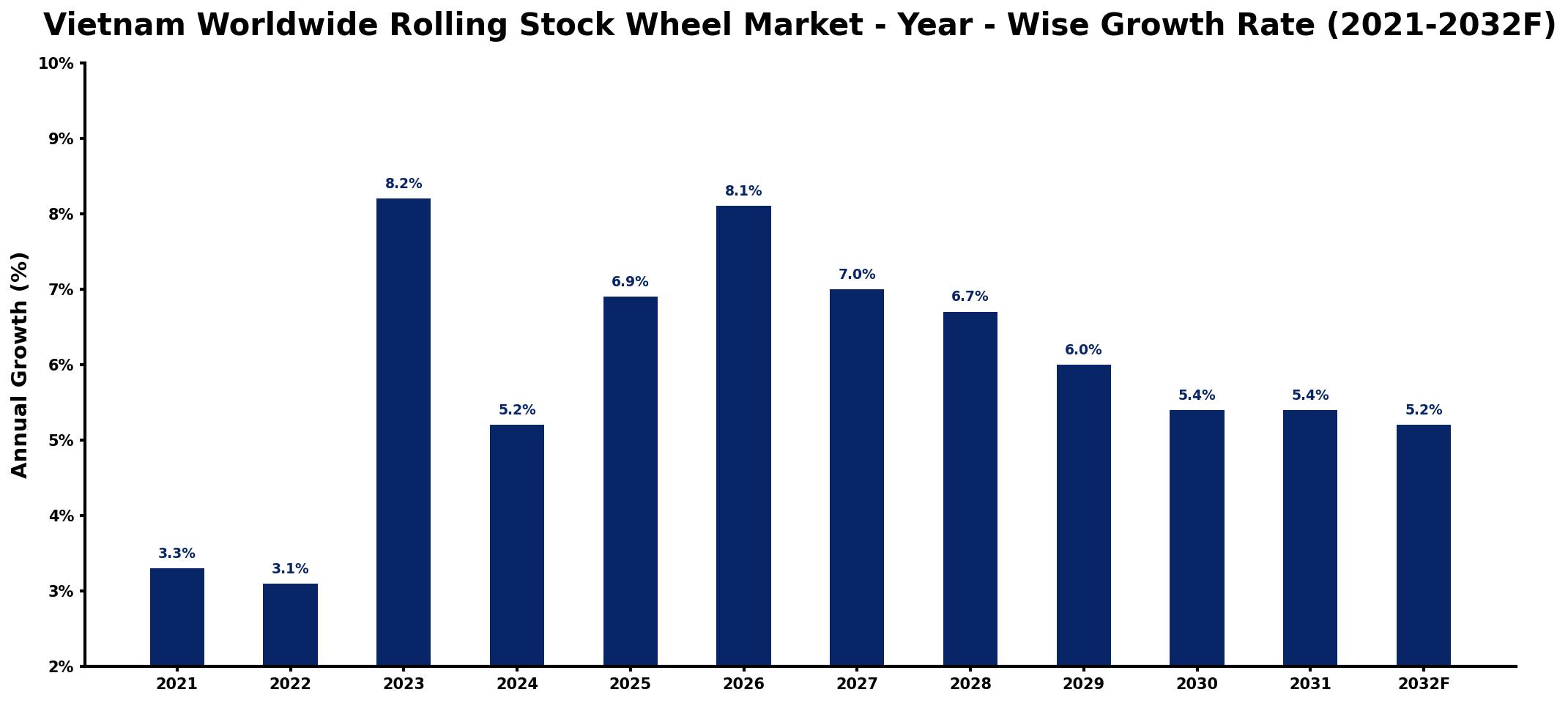
The table below presents the year‑wise growth rates along with the key drivers influencing the market
| Year | Growth Rate | Major Drivers |
| 2021 | 3.3% | Infrastructure investments drive demand growth |
| 2022 | 3.1% | Increased urbanization fuels transportation needs |
| 2023 | 8.2% | Government initiatives support rail expansion |
| 2024 | 5.2% | Rising freight transport drives investments |
| 2025 | 6.9% | Technological advancements enhance efficiency |
| 2026 | 8.1% | Sustainability trends promote cleaner transport |
| 2027 | 7.0% | Public-private partnerships boost infrastructure |
| 2028 | 6.7% | Growing tourism increases rail usage |
| 2029 | 6.0% | Investment in logistics networks expands |
| 2030 | 5.4% | Emerging markets drive regional trade |
| 2031 | 5.4% | Innovation in transportation solutions accelerates |
| 2032 | 5.2% | Global economic recovery boosts demand |
Note: Market size estimations and growth projections presented in this report are based on 6Wresearch's proprietary forecasting methodology, utilizing the latest available industry data, government publications, and primary research inputs.
Vietnam Worldwide Rolling Stock Wheel Market Synopsis
The rolling stock wheel segment in Vietnam plays a pivotal role in maintaining the safety and reliability of the country's expanding railway network. With the ongoing development of rail services catering to urban and intercity travel, the demand for robust wheels has surged, reflecting a shift towards more sustainable transportation methods.
As Vietnam's railway infrastructure evolves, manufacturers are increasingly collaborating with international suppliers to enhance product quality and adhere to global standards. This alignment not only boosts local capabilities but also fosters a competitive environment that promotes technological advancements in rolling stock wheel production.
Vietnam Worldwide Rolling Stock Wheel Market Key Takeaways
- The market is benefitting from significant government investment in railway infrastructure.
- Emerging collaborations with global manufacturers enhance product quality and reliability.
- Innovations in materials and production techniques are on the rise, driven by market demands.
- Post-pandemic recovery is catalyzing growth as transportation services resume normal operations.
- Expansion of both passenger and freight rail services significantly boosts wheel demand.
Evaluation of Restraints in Vietnam Worldwide Rolling Stock Wheel Market
Despite the promising growth prospects, the Vietnam Worldwide Rolling Stock Wheel Market faces certain restraints. One of the primary challenges is the necessity to manufacture wheels that not only meet but exceed international safety and performance standards. This requirement demands advanced production techniques and stringent quality control measures, which can be costly and complex. Additionally, market players must navigate fluctuating raw material costs and the intricacies of global supply chain dynamics that can impact the availability and pricing of essential components.
Vietnam Worldwide Rolling Stock Wheel Market Trends
Current trends in the Vietnam Worldwide Rolling Stock Wheel Market reveal a growing emphasis on sustainability and efficiency. Manufacturers are investing in eco-friendly materials and processes to align with global environmental goals. Moreover, the integration of smart technologies into rolling stock wheel designs is becoming increasingly relevant, enhancing real-time monitoring and predictive maintenance capabilities. These advancements not only improve operational efficiency but also contribute to overall safety in rail transportation.
Vietnam Worldwide Rolling Stock Wheel Market Opportunities
The market presents numerous growth and investment opportunities as Vietnam continues to bolster its railway infrastructure. Opportunities lie in the modernization of existing rail systems and the expansion of new routes, especially in rural areas. The demand for high-performance wheels suitable for both high-speed trains and heavy freight vehicles is on the rise. Additionally, advancements in wheel technology, including the development of lightweight and durable materials, offer substantial potential for innovation and market differentiation.
Government Initiatives in the Vietnam Worldwide Rolling Stock Wheel Market
The Vietnamese government has implemented various initiatives aimed at revitalizing the railway sector, which includes increased public spending on infrastructure projects. Programs focused on enhancing rail connectivity and upgrading facilities contribute directly to the growth of the rolling stock wheel market. Furthermore, policy incentives promoting sustainable transport solutions encourage investment in advanced technologies and materials, supporting the local manufacturing landscape.
Future Insights of the Vietnam Worldwide Rolling Stock Wheel Market
Looking ahead to 2026-2032, the Vietnam Worldwide Rolling Stock Wheel Market is poised for significant transformation. As urbanization accelerates and the demand for efficient public transportation grows, the market will likely expand in tandem with innovations in railway technology. The focus on eco-friendly practices will also continue to shape the development of rolling stock wheels, driving investments into research and production capabilities that prioritize sustainability and performance.
Vietnam Worldwide Rolling Stock Wheel Market Latest Developments (2025 - 2026)
Recent developments in the Vietnam Worldwide Rolling Stock Wheel Market have underscored a commitment to modernization and efficiency. Companies are increasingly adopting automation in manufacturing processes to enhance production capabilities and reduce lead times. Additionally, partnerships between local and international firms are emerging, focusing on innovation and technology transfer. These initiatives reflect a broader industry trend towards enhanced collaboration and the integration of cutting-edge technologies in rolling stock manufacturing.
Vietnam Worldwide Rolling Stock Wheel Market - Key Attractiveness of the Report
- 10 Years of Market Numbers
- Historical Data Starting from 2022 to 2025
- Base Year: 2025
- Forecast Data until 2032
- Key Performance Indicators Impacting the Market
- Major Upcoming Developments and Projects
Key Highlights of the Report:
- Vietnam Worldwide Rolling Stock Wheel Market Outlook
- Market Size of Vietnam Worldwide Rolling Stock Wheel Market, 2025
- Forecast of Vietnam Worldwide Rolling Stock Wheel Market, 2032
- Historical Data and Forecast of Vietnam Worldwide Rolling Stock Wheel Revenues & Volume for the Period 2022-2032F
- Vietnam Worldwide Rolling Stock Wheel Market Trend Evolution
- Vietnam Worldwide Rolling Stock Wheel Market Drivers and Challenges
- Vietnam Worldwide Rolling Stock Wheel Price Trends
- Vietnam Worldwide Rolling Stock Wheel Porter's Five Forces
- Vietnam Worldwide Rolling Stock Wheel Industry Life Cycle
- Historical Data and Forecast of Vietnam Worldwide Rolling Stock Wheel Market Revenues & Volume By Product Type for the Period 2022-2032F
- Historical Data and Forecast of Vietnam Worldwide Rolling Stock Wheel Market Revenues & Volume By Casting for the Period 2022-2032F
- Historical Data and Forecast of Vietnam Worldwide Rolling Stock Wheel Market Revenues & Volume By Forged for the Period 2022-2032F
- Historical Data and Forecast of Vietnam Worldwide Rolling Stock Wheel Market Revenues & Volume By Applications for the Period 2022-2032F
- Historical Data and Forecast of Vietnam Worldwide Rolling Stock Wheel Market Revenues & Volume By High Speed for the Period 2022-2032F
- Historical Data and Forecast of Vietnam Worldwide Rolling Stock Wheel Market Revenues & Volume By Freight Wagons for the Period 2022-2032F
- Historical Data and Forecast of Vietnam Worldwide Rolling Stock Wheel Market Revenues & Volume By Passenger Wagons for the Period 2022-2032F
- Historical Data and Forecast of Vietnam Worldwide Rolling Stock Wheel Market Revenues & Volume By Locos for the Period 2022-2032F
- Vietnam Worldwide Rolling Stock Wheel Import Export Trade Statistics
- Market Opportunity Assessment By Product Type
- Market Opportunity Assessment By Applications
- Vietnam Worldwide Rolling Stock Wheel Top Companies Market Share
- Vietnam Worldwide Rolling Stock Wheel Competitive Benchmarking By Technical and Operational Parameters
- Vietnam Worldwide Rolling Stock Wheel Company Profiles
- Vietnam Worldwide Rolling Stock Wheel Key Strategic Recommendations






































