Vietnam Zinc Cyanide Market Size, Share & Growth Rate
The Vietnam Zinc Cyanide Market was estimated at USD 1383 Million in 2025 and is projected to reach USD 1964 Million by 2032, growing at a CAGR of 5.1% from 2026 to 2032. This impressive growth trajectory is propelled primarily by the expansion of Vietnam's mining and electroplating industries, where zinc cyanide is crucial for the extraction of valuable metals and the enhancement of surface finishes. As industrial activities ramp up, the demand for high-quality zinc cyanide is expected to surge, driven by the need for effective and sustainable solutions in metal processing.
Vietnam Zinc Cyanide Market Year-wise Growth Rate and Key Drivers
This graph highlights how the Vietnam Zinc Cyanide Market has steadily grown over the years, supported by major growth factors.
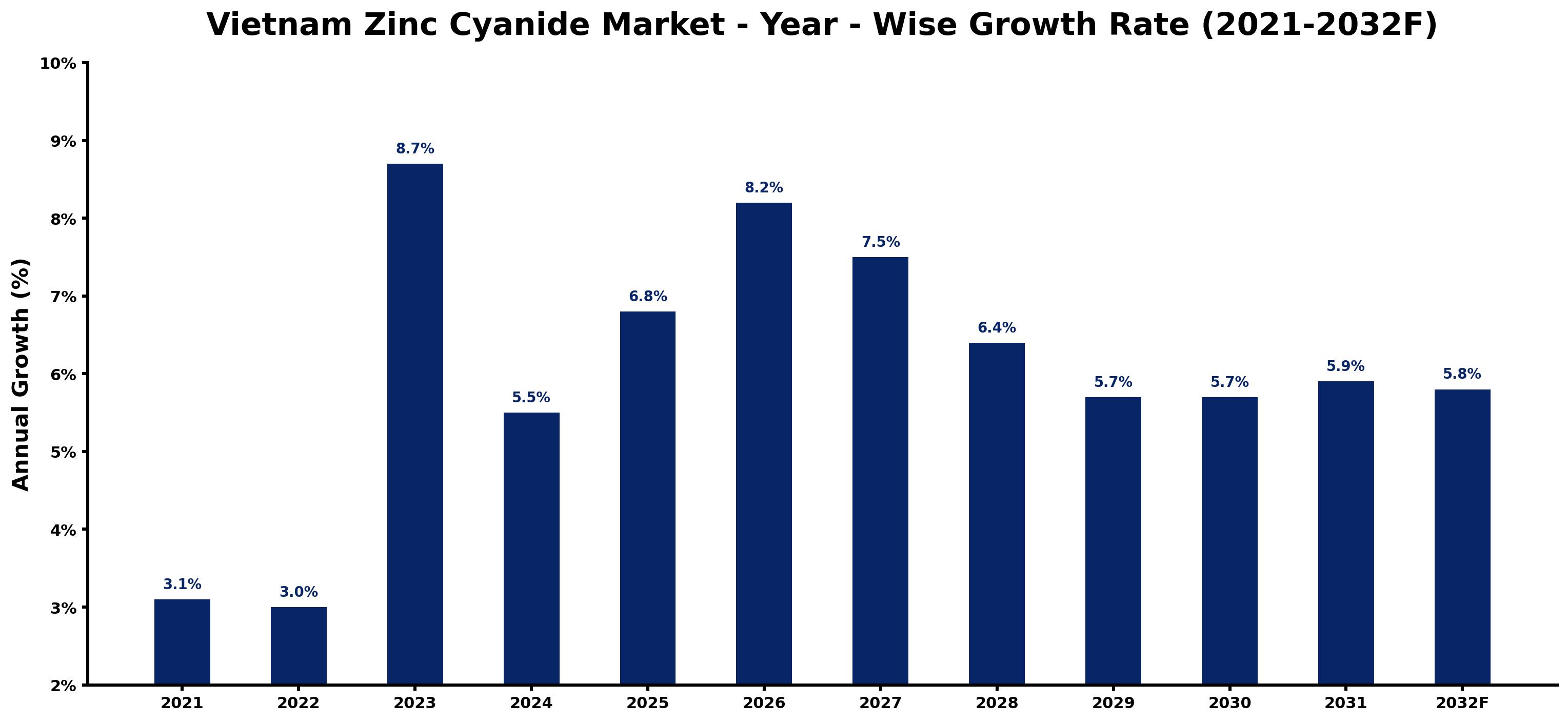
The table below presents the year‑wise growth rates along with the key drivers influencing the market
| Year | Growth Rate | Major Drivers |
| 2021 | 3.1% | Rising demand in electronics manufacturing |
| 2022 | 3.0% | Growth in metal plating applications |
| 2023 | 8.7% | Increased investment in mining sector |
| 2024 | 5.5% | Expansion of chemical production facilities |
| 2025 | 6.8% | Surge in renewable energy initiatives |
| 2026 | 8.2% | strengthening underlying market demand |
| 2027 | 7.5% | Increased focus on sustainable practices |
| 2028 | 6.4% | strengthening international trade flows |
| 2029 | 5.7% | Boom in agriculture chemicals market |
| 2030 | 5.7% | growing commercial sector adoption |
| 2031 | 5.9% | Growing popularity of specialty coatings |
| 2032 | 5.8% | Increased research in material sciences |
Note: Market size estimations and growth projections presented in this report are based on 6Wresearch's proprietary forecasting methodology, utilizing the latest available industry data, government publications, and primary research inputs.
Vietnam Zinc Cyanide Market Synopsis
Zinc cyanide is increasingly regarded as an essential compound in Vietnam's mining sector, particularly for its role in the extraction of gold and silver. This demand not only underscores its importance in traditional mining practices but also highlights the ongoing modernization of the sector, where efficiency and sustainability are becoming paramount.
Furthermore, the metal finishing and electroplating applications continue to expand, creating a robust market for zinc cyanide. The need for improved corrosion resistance and aesthetic appeal in products across various industries has positioned zinc cyanide as a vital component, thereby driving consistent growth in consumption levels.
Vietnam Zinc Cyanide Market Key Takeaways
- The market is witnessing robust growth owing to the expansion of Vietnam's mining and metal processing industries.
- Increasing emphasis on eco-friendly practices is influencing production methods and consumer preferences.
- Stringent environmental regulations are shaping operational frameworks for market participants.
- Volatility in raw material prices poses a significant challenge for sustained profitability.
- The market's recovery post-COVID-19 is expected to accelerate as industrial activity resumes and supply chains stabilize.
Evaluation of Restraints in Vietnam Zinc Cyanide Market
Despite the promising growth outlook, the Vietnam Zinc Cyanide market is constrained by various factors. Notably, environmental concerns surrounding the toxicity of zinc cyanide necessitate strict adherence to safety protocols. Companies must invest heavily in compliance and sustainable practices to mitigate potential risks. Furthermore, geopolitical issues can impact the availability and pricing of raw materials, while fluctuating currency exchange rates add layers of complexity to the financial viability of operations. Addressing these restraints effectively will be crucial for the market's sustained progress.
Vietnam Zinc Cyanide Market Trends
A notable trend in the Vietnam Zinc Cyanide market is the shift towards more sustainable production practices. Companies are increasingly prioritizing eco-friendly methods, responding to consumer demand for environmentally responsible products. This has spurred innovation in application technologies, particularly in electroplating processes, where improved formulations of zinc cyanide are being developed to enhance both safety and performance. Additionally, the integration of digital solutions in mining operations is revolutionizing traditional practices, potentially leading to a greater emphasis on efficiency and waste reduction.
Vietnam Zinc Cyanide Market Opportunities
The future of the Vietnam Zinc Cyanide market is ripe with opportunities, particularly in the context of expanding the manufacturing and construction sectors. As Vietnam positions itself as a manufacturing hub, the surge in infrastructure projects will likely increase the demand for zinc cyanide in construction materials and metal coatings. Additionally, investments in research and development can yield innovative applications, particularly in sectors such as renewable energy, where the demand for specialized metal coatings is on the rise.
Government Initiatives in the Vietnam Zinc Cyanide Market
The Vietnamese government has implemented various initiatives to promote the responsible use of chemicals, including zinc cyanide. These efforts include tightening regulations on chemical handling and disposal while encouraging industries to adopt greener practices. Through public funding and support programs, the government aims to facilitate the development of sustainable technologies that not only comply with environmental standards but also enhance the overall competitiveness of the local zinc cyanide market.
Future Insights of the Vietnam Zinc Cyanide Market
Looking ahead to 2026-2032, the Vietnam Zinc Cyanide market is poised for significant advancements. Driven by a recovery in mining activities and increased manufacturing output, demand is expected to rise steadily. Furthermore, as industries increasingly adopt automation and smarter technologies, the production processes for zinc cyanide may become more efficient and less hazardous. The market's adaptability to regulatory changes will also play a vital role in shaping its future, ensuring that it remains resilient in a rapidly evolving industrial landscape.
Vietnam Zinc Cyanide Market Latest Developments (2025 - 2026)
Recent developments within the Vietnam Zinc Cyanide market indicate a strengthening focus on safety and compliance among industry participants. Companies are implementing state-of-the-art technologies to enhance production efficiency while adhering to stricter environmental regulations. Moreover, partnerships with local governments aim to foster better community relations and promote sustainable practices. As the market begins to stabilize post-pandemic, stakeholders are actively exploring new opportunities for growth and innovation in zinc cyanide applications.
Vietnam Zinc Cyanide Market - Key Attractiveness of the Report
- 10 Years of Market Numbers
- Historical Data Starting from 2022 to 2025
- Base Year: 2025
- Forecast Data until 2032
- Key Performance Indicators Impacting the Market
- Major Upcoming Developments and Projects
Key Highlights of the Report:
- Vietnam Zinc Cyanide Market Outlook
- Market Size of Vietnam Zinc Cyanide Market, 2025
- Forecast of Vietnam Zinc Cyanide Market, 2032
- Historical Data and Forecast of Vietnam Zinc Cyanide Revenues & Volume for the Period 2022-2032F
- Vietnam Zinc Cyanide Market Trend Evolution
- Vietnam Zinc Cyanide Market Drivers and Challenges
- Vietnam Zinc Cyanide Price Trends
- Vietnam Zinc Cyanide Porter's Five Forces
- Vietnam Zinc Cyanide Industry Life Cycle
- Historical Data and Forecast of Vietnam Zinc Cyanide Market Revenues & Volume By Product Type for the Period 2022-2032F
- Historical Data and Forecast of Vietnam Zinc Cyanide Market Revenues & Volume By 0.99 for the Period 2022-2032F
- Historical Data and Forecast of Vietnam Zinc Cyanide Market Revenues & Volume By 0.999 for the Period 2022-2032F
- Historical Data and Forecast of Vietnam Zinc Cyanide Market Revenues & Volume By Application for the Period 2022-2032F
- Historical Data and Forecast of Vietnam Zinc Cyanide Market Revenues & Volume By Electroplate for the Period 2022-2032F
- Historical Data and Forecast of Vietnam Zinc Cyanide Market Revenues & Volume By Medicine for the Period 2022-2032F
- Historical Data and Forecast of Vietnam Zinc Cyanide Market Revenues & Volume By Pesticides for the Period 2022-2032F
- Vietnam Zinc Cyanide Import Export Trade Statistics
- Market Opportunity Assessment By Product Type
- Market Opportunity Assessment By Application
- Vietnam Zinc Cyanide Top Companies Market Share
- Vietnam Zinc Cyanide Competitive Benchmarking By Technical and Operational Parameters
- Vietnam Zinc Cyanide Company Profiles
- Vietnam Zinc Cyanide Key Strategic Recommendations






































