Vietnam Zinc Stearates Market Size, Share & Growth Rate
The Vietnam Zinc Stearates Market was estimated at USD 434 Million in 2025 and is projected to reach USD 618 Million by 2032, growing at a CAGR of 5.2% from 2026 to 2032. This robust growth trajectory is primarily fueled by the expanding applications of zinc stearates across various sectors, particularly in plastics, rubber, and cosmetics. As consumer demand for high-quality products increases, the market is poised to benefit from the rising need for effective lubricants and stabilizers in manufacturing processes.
Vietnam Zinc Stearates Market Year-wise Growth Rate and Key Drivers
This graph highlights how the Vietnam Zinc Stearates Market has steadily grown over the years, supported by major growth factors.
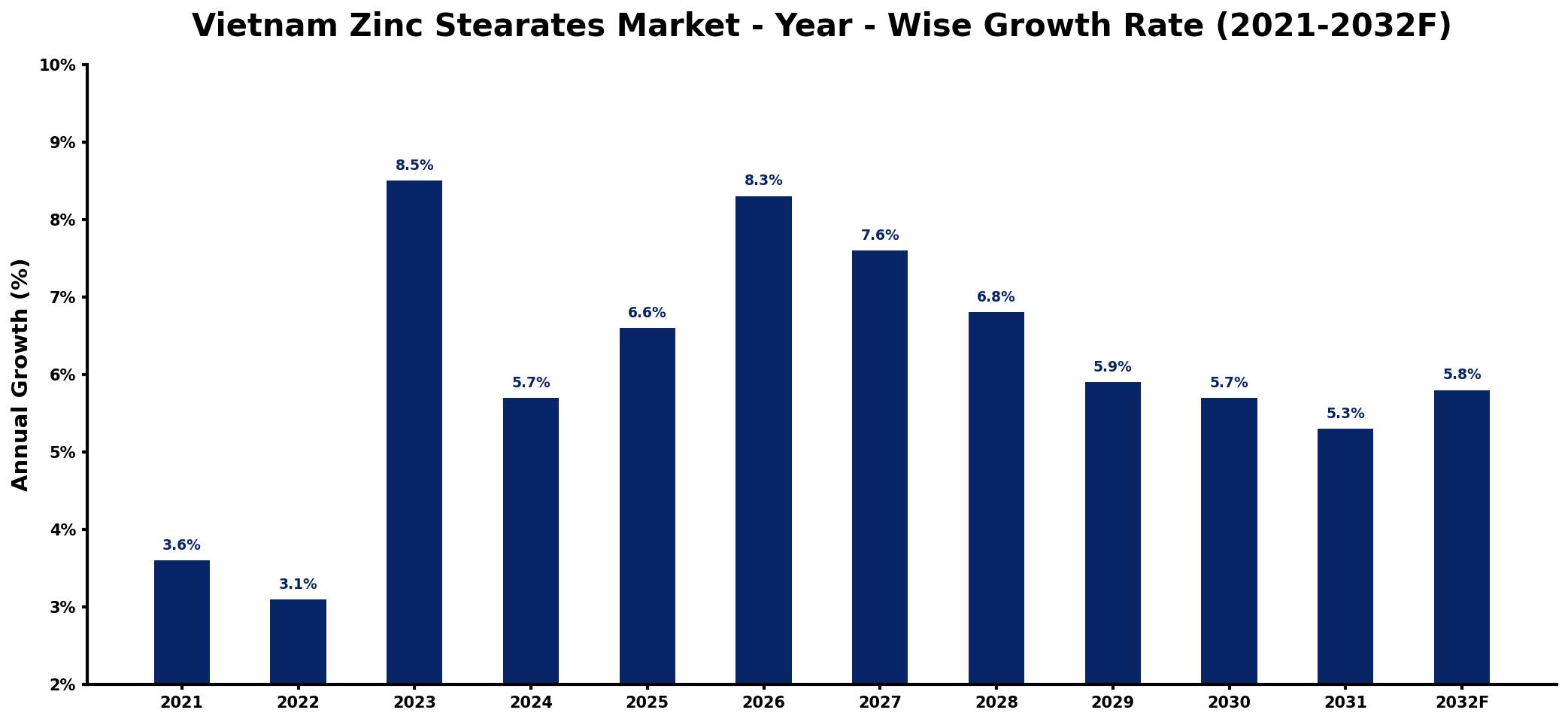
The table below presents the year‑wise growth rates along with the key drivers influencing the market
| Year | Growth Rate | Major Drivers |
| 2021 | 3.6% | Increased demand from plastics industry |
| 2022 | 3.1% | Growth in rubber manufacturing sector |
| 2023 | 8.5% | Expansion of construction activities |
| 2024 | 5.7% | Rising interest in automotive applications |
| 2025 | 6.6% | Investments in consumer goods production |
| 2026 | 8.3% | Boost in pharmaceuticals sector usage |
| 2027 | 7.6% | Surge in agricultural product applications |
| 2028 | 6.8% | growing downstream application demand |
| 2029 | 5.9% | Increase in food processing needs |
| 2030 | 5.7% | Demand from electronics sector rising |
| 2031 | 5.3% | strengthening international trade flows |
| 2032 | 5.8% | expanding industrial usage applications |
Note: Market size estimations and growth projections presented in this report are based on 6Wresearch's proprietary forecasting methodology, utilizing the latest available industry data, government publications, and primary research inputs.
Vietnam Zinc Stearates Market Synopsis
In recent years, the Vietnam zinc stearates market has witnessed a period of steady growth, driven by the resurgence of industries such as plastics and rubber. Moving forward, the market is expected to maintain this momentum as investments in these sectors continue to rise, supported by a growing consumer preference for personal care and cosmetic products.
Despite facing challenges such as fluctuating raw material prices and regulatory pressures, the market remains resilient. As manufacturers adapt to evolving consumer needs and strive to meet stringent quality standards, the outlook for the Vietnam zinc stearates market remains optimistic.
Vietnam Zinc Stearates Market Key Takeaways
- The market is driven by robust demand from the plastics, rubber, and cosmetics industries.
- Quality and regulatory compliance are critical factors influencing market dynamics.
- Investments in eco-friendly production methods are becoming increasingly necessary for market players.
- Manufacturers must focus on innovation to counter competition from alternative additives.
- The market is recovering steadily post-COVID-19 as industries regain operational stability.
Evaluation of Restraints in Vietnam Zinc Stearates Market
The Vietnam zinc stearates market encounters several constraints that limit its growth potential. A key factor is the volatility in raw material prices, particularly zinc, which can significantly affect production costs. Manufacturers are challenged to manage these fluctuations while maintaining competitive pricing. Additionally, stringent environmental regulations necessitate investments in sustainable production methods and waste management, placing financial strain on smaller players. Moreover, the increasing availability of alternative additives has intensified competition, compelling companies to innovate continually and highlight the unique advantages of zinc stearates in their applications.
Vietnam Zinc Stearates Market Trends
A notable trend within the Vietnam zinc stearates market is the increasing emphasis on sustainability. Companies are adopting eco-friendly production methods to meet regulatory requirements and consumer preferences for greener products. Furthermore, the integration of advanced technologies in manufacturing processes is enhancing the efficiency and quality of zinc stearates. Additionally, the rising popularity of personal care products is creating new avenues for growth, as these formulations increasingly utilize zinc stearates for improved performance.
Vietnam Zinc Stearates Market Opportunities
Opportunities in the Vietnam zinc stearates market are abundant, particularly in the burgeoning cosmetics sector. As consumers become more conscious of ingredient quality, there is a growing demand for premium personal care products that incorporate effective stabilizers and lubricants. Furthermore, expansion in the construction and automotive industries presents new prospects for zinc stearates as integral additives. Companies that invest in research and development to innovate and adapt their product offerings can capitalize on these growth avenues.
Government Initiatives in the Vietnam Zinc Stearates Market
The Vietnamese government has been actively promoting the growth of the chemical manufacturing sector, including zinc stearates production. Various policies are aimed at enhancing industrial capabilities while ensuring environmental sustainability. Public investments in infrastructure improvements and incentives for adopting green technologies have also been introduced, creating a favorable environment for market players. These initiatives not only support operational efficiency but also align with global sustainability trends.
Future Insights of the Vietnam Zinc Stearates Market
Looking ahead to 2026-2032, the Vietnam zinc stearates market is set to experience significant advancements. With ongoing industrial expansion and an increasing focus on quality and compliance, manufacturers are likely to benefit from steady demand. Innovations in product formulations and the development of new applications will further drive market growth. Moreover, as the nation continues to strengthen its regulatory framework and environmental policies, companies that proactively adapt to these changes will secure a competitive edge.
Vietnam Zinc Stearates Market Latest Developments (2025 - 2026)
Recent developments in the Vietnam zinc stearates market highlight a trend towards modernization and sustainability. Many manufacturers are investing in advanced production technologies to improve efficiency and product quality. Additionally, there is a noticeable shift towards eco-friendly formulations as businesses respond to increasing consumer demand for sustainable products. Collaborative initiatives between industry players and research institutions are also gaining traction, aimed at exploring new applications and enhancing the performance of zinc stearates.
Vietnam Zinc Stearates Market - Key Attractiveness of the Report
- 10 Years of Market Numbers
- Historical Data Starting from 2022 to 2025
- Base Year: 2025
- Forecast Data until 2032
- Key Performance Indicators Impacting the Market
- Major Upcoming Developments and Projects
Key Highlights of the Report:
- Vietnam Zinc Stearates Market Outlook
- Market Size of Vietnam Zinc Stearates Market, 2025
- Forecast of Vietnam Zinc Stearates Market, 2032
- Historical Data and Forecast of Vietnam Zinc Stearates Revenues & Volume for the Period 2022-2032F
- Vietnam Zinc Stearates Market Trend Evolution
- Vietnam Zinc Stearates Market Drivers and Challenges
- Vietnam Zinc Stearates Price Trends
- Vietnam Zinc Stearates Porter's Five Forces
- Vietnam Zinc Stearates Industry Life Cycle
- Historical Data and Forecast of Vietnam Zinc Stearates Market Revenues & Volume By Type for the Period 2022-2032F
- Historical Data and Forecast of Vietnam Zinc Stearates Market Revenues & Volume By Solid Zinc Stearate for the Period 2022-2032F
- Historical Data and Forecast of Vietnam Zinc Stearates Market Revenues & Volume By Aqueous Zinc Stearate for the Period 2022-2032F
- Historical Data and Forecast of Vietnam Zinc Stearates Market Revenues & Volume By Application for the Period 2022-2032F
- Historical Data and Forecast of Vietnam Zinc Stearates Market Revenues & Volume By Food, Pharma and Nutraceuticals for the Period 2022-2032F
- Historical Data and Forecast of Vietnam Zinc Stearates Market Revenues & Volume By Cosmetics for the Period 2022-2032F
- Historical Data and Forecast of Vietnam Zinc Stearates Market Revenues & Volume By Lubricants for the Period 2022-2032F
- Historical Data and Forecast of Vietnam Zinc Stearates Market Revenues & Volume By Plastics for the Period 2022-2032F
- Vietnam Zinc Stearates Import Export Trade Statistics
- Market Opportunity Assessment By Type
- Market Opportunity Assessment By Application
- Vietnam Zinc Stearates Top Companies Market Share
- Vietnam Zinc Stearates Competitive Benchmarking By Technical and Operational Parameters
- Vietnam Zinc Stearates Company Profiles
- Vietnam Zinc Stearates Key Strategic Recommendations






































