Zambia Electric Forklift Market: Top 5 Importing Countries and Market Competition (HHI) Analysis
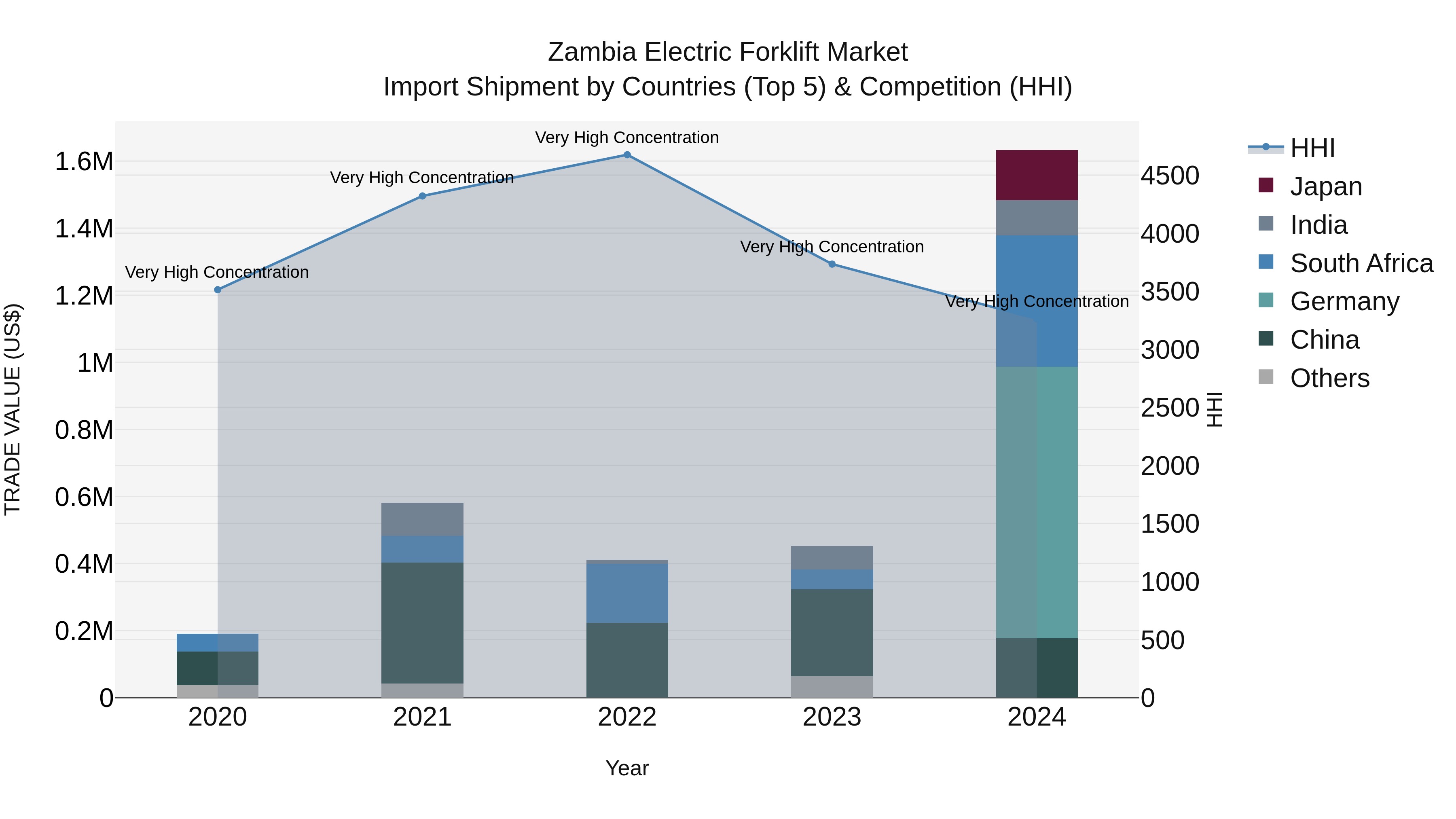
The electric forklift import market in Zambia saw significant growth in 2024, with top exporting countries being Germany, South Africa, China, Japan, and India. The high Herfindahl-Hirschman Index (HHI) indicates a concentrated market. The impressive compound annual growth rate (CAGR) of 70.96% from 2020 to 2024 underscores the strong demand for electric forklifts in Zambia. Furthermore, the remarkable growth rate of 260.72% from 2023 to 2024 suggests a rapidly expanding market with promising opportunities for both suppliers and buyers in the electric forklift industry.
Zambia Electric Forklift Market Overview
The Electric Forklift market in Zambia is experiencing growth driven by the increasing demand for efficient and environmentally friendly material handling equipment. The market is primarily dominated by key players offering a wide range of electric forklift models with varying load capacities to cater to diverse industry needs. Factors such as government initiatives promoting sustainable practices, the rising adoption of electric vehicles in the transportation sector, and the emphasis on workplace safety are contributing to the market`s expansion. Additionally, the growing awareness among businesses regarding the long-term cost savings associated with electric forklifts, such as lower maintenance requirements and operational costs, is further fueling market growth. Overall, the Zambia Electric Forklift market presents opportunities for both local and international manufacturers to capitalize on the country`s evolving industrial landscape.
Zambia Electric Forklift Market Trends and Opportunities
The Zambia Electric Forklift Market is experiencing growth driven by increasing demand for environmentally friendly and cost-effective material handling equipment. With the focus on sustainability and reducing carbon emissions, electric forklifts are gaining popularity in various industries in Zambia. The market is witnessing a trend towards advanced features such as lithium-ion batteries for longer operating hours and faster charging times. Additionally, the government`s initiatives to promote electric vehicles and the development of infrastructure for electric vehicle charging stations present opportunities for further growth in the electric forklift market in Zambia. Companies in this market can capitalize on these trends by offering innovative electric forklift models with enhanced efficiency and productivity features to meet the evolving needs of the industry.
Zambia Electric Forklift Market Challenges
In the Zambia Electric Forklift Market, several challenges are faced, including the high initial investment cost associated with electric forklifts compared to traditional diesel or LPG forklifts. Limited availability of charging infrastructure and frequent power outages in some regions also hinder the widespread adoption of electric forklifts. Additionally, concerns about battery life and replacement costs, as well as the perception of limited operational flexibility compared to internal combustion engine forklifts, pose challenges for market growth. Lack of awareness about the long-term cost savings and environmental benefits of electric forklifts further contributes to the slow uptake of these vehicles in Zambia. Overcoming these challenges will require investment in infrastructure, education, and awareness campaigns to promote the advantages of electric forklifts in the market.
Zambia Electric Forklift Market Drivers
The Zambia Electric Forklift Market is primarily driven by the increasing focus on environmental sustainability and the shift towards cleaner energy sources. Electric forklifts are seen as a more eco-friendly alternative to traditional diesel or gasoline-powered forklifts, as they produce zero emissions during operation. Additionally, the rising awareness about the long-term cost savings associated with electric forklifts, such as lower maintenance costs and reduced fuel expenses, is driving the market growth. The government initiatives promoting the adoption of electric vehicles and the growing demand for energy-efficient material handling equipment in various industries are also key drivers fueling the growth of the electric forklift market in Zambia.
Zambia Electric Forklift Market Government Policy
The Zambian government has implemented various policies to promote the use of electric forklifts in the market. These policies include tax incentives and subsidies for companies adopting electric forklifts to reduce carbon emissions and promote sustainable practices. Additionally, the government has set regulations to ensure the safety and efficiency of electric forklifts, including mandatory inspections and certifications. Furthermore, the government is actively promoting the development of charging infrastructure for electric forklifts to support their widespread adoption in the market. Overall, these policies aim to incentivize the transition towards electric forklifts to drive environmental sustainability and enhance operational efficiency in Zambia.
Zambia Electric Forklift Market Future Outlook
The Zambia Electric Forklift Market is expected to witness steady growth in the coming years due to increasing emphasis on sustainability and environmental consciousness in the region. The shift towards electric forklifts is driven by the growing awareness of the benefits of lower emissions, reduced operating costs, and overall efficiency improvements. Additionally, government initiatives promoting the adoption of electric vehicles and forklifts are likely to further boost market growth. With advancements in battery technology leading to longer operating hours and faster charging times, the electric forklift market in Zambia is poised for expansion. Overall, the market is projected to experience a positive trajectory as businesses prioritize eco-friendly solutions and seek to enhance their operational efficiency.
Key Highlights of the Report:
- Zambia Electric Forklift Market Outlook
- Market Size of Zambia Electric Forklift Market, 2024
- Forecast of Zambia Electric Forklift Market, 2031
- Historical Data and Forecast of Zambia Electric Forklift Revenues & Volume for the Period 2021- 2031
- Zambia Electric Forklift Market Trend Evolution
- Zambia Electric Forklift Market Drivers and Challenges
- Zambia Electric Forklift Price Trends
- Zambia Electric Forklift Porter's Five Forces
- Zambia Electric Forklift Industry Life Cycle
- Historical Data and Forecast of Zambia Electric Forklift Market Revenues & Volume By Product for the Period 2021- 2031
- Historical Data and Forecast of Zambia Electric Forklift Market Revenues & Volume By Counterbalanced for the Period 2021- 2031
- Historical Data and Forecast of Zambia Electric Forklift Market Revenues & Volume By Pallet Trucks for the Period 2021- 2031
- Historical Data and Forecast of Zambia Electric Forklift Market Revenues & Volume By Reach Trucks for the Period 2021- 2031
- Historical Data and Forecast of Zambia Electric Forklift Market Revenues & Volume By Pallet Stackers for the Period 2021- 2031
- Historical Data and Forecast of Zambia Electric Forklift Market Revenues & Volume By Battery Type for the Period 2021- 2031
- Historical Data and Forecast of Zambia Electric Forklift Market Revenues & Volume By Lithium-Ion for the Period 2021- 2031
- Historical Data and Forecast of Zambia Electric Forklift Market Revenues & Volume By Lead Acid for the Period 2021- 2031
- Historical Data and Forecast of Zambia Electric Forklift Market Revenues & Volume By Hydrogen Fuel-Cell for the Period 2021- 2031
- Historical Data and Forecast of Zambia Electric Forklift Market Revenues & Volume By End Use for the Period 2021- 2031
- Historical Data and Forecast of Zambia Electric Forklift Market Revenues & Volume By Chemical for the Period 2021- 2031
- Historical Data and Forecast of Zambia Electric Forklift Market Revenues & Volume By Food & Beverage for the Period 2021- 2031
- Historical Data and Forecast of Zambia Electric Forklift Market Revenues & Volume By Industrial for the Period 2021- 2031
- Historical Data and Forecast of Zambia Electric Forklift Market Revenues & Volume By Logistics for the Period 2021- 2031
- Historical Data and Forecast of Zambia Electric Forklift Market Revenues & Volume By Retail & E-Commerce for the Period 2021- 2031
- Zambia Electric Forklift Import Export Trade Statistics
- Market Opportunity Assessment By Product
- Market Opportunity Assessment By Battery Type
- Market Opportunity Assessment By End Use
- Zambia Electric Forklift Top Companies Market Share
- Zambia Electric Forklift Competitive Benchmarking By Technical and Operational Parameters
- Zambia Electric Forklift Company Profiles
- Zambia Electric Forklift Key Strategic Recommendations






































