Zambia Luxury Bath and Body Products Market: Top 5 Importing Countries and Market Competition (HHI) Analysis
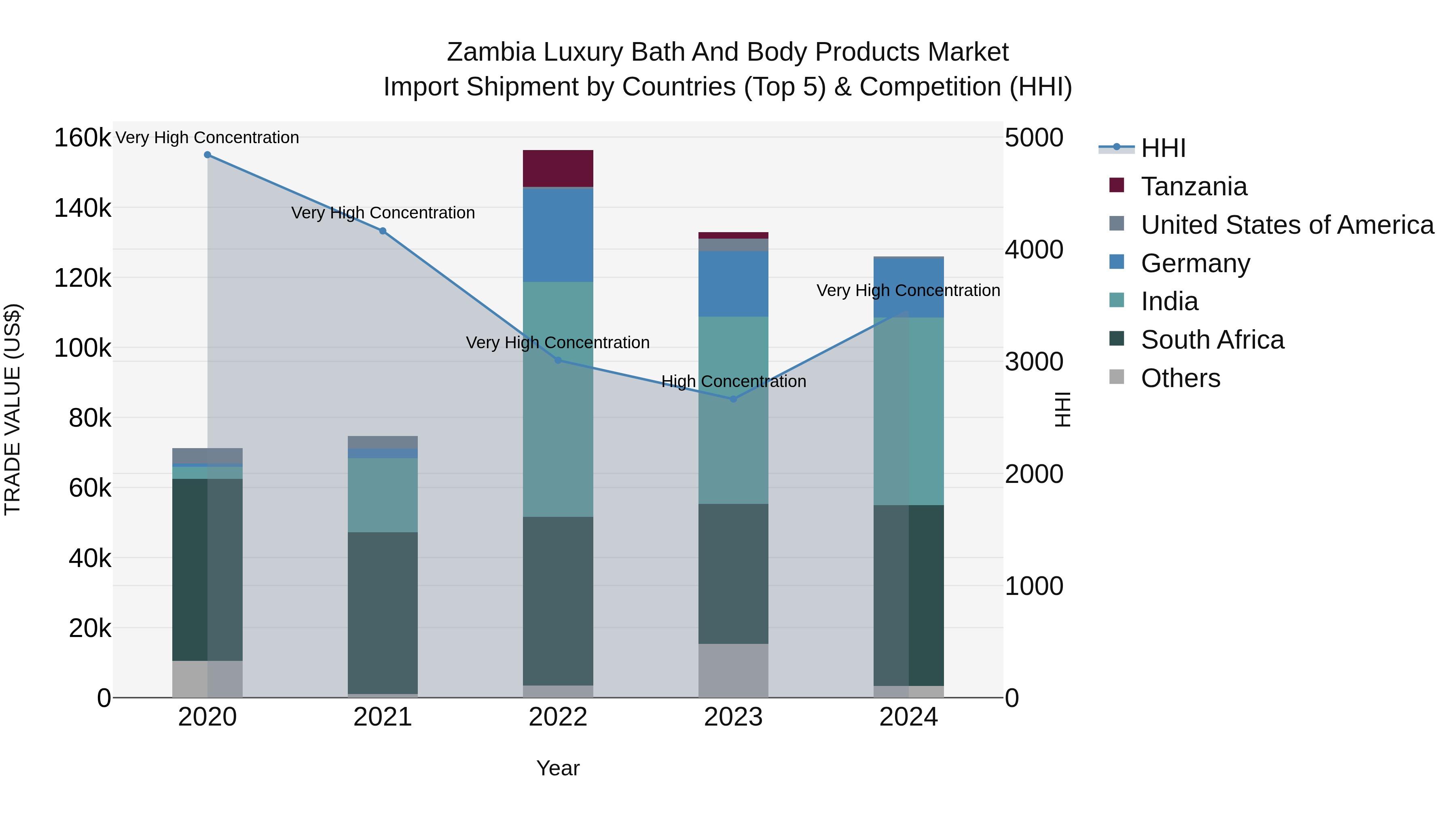
The luxury bath and body products import market in Zambia continued to see strong growth in 2024, with top exporting countries including India, South Africa, Germany, United Arab Emirates, and Turkey. The market concentration, as measured by the HHI, increased significantly from 2023 to 2024, indicating a very high level of concentration among the key players. Despite a slight decline in growth rate from 2023 to 2024, the compound annual growth rate (CAGR) over the period of 2020-2024 remained impressive at 15.31%, showcasing sustained demand for luxury bath and body products in Zambia.
Zambia Luxury Bath And Body Products Market Synopsis
The Zambia luxury bath and body products market is experiencing steady growth driven by increasing consumer preference for premium personal care products. The market is characterized by a range of high-end brands offering luxurious bath and body products, including soaps, shower gels, body lotions, and scrubs. Key factors influencing the market include rising disposable incomes, changing consumer lifestyles, and a growing awareness of the benefits of using quality bath and body products. International luxury brands as well as locally produced premium products are gaining popularity among affluent consumers in Zambia. The market is competitive, with companies focusing on product innovation, natural ingredients, and attractive packaging to appeal to the discerning consumer base. Overall, the Zambia luxury bath and body products market presents opportunities for both domestic and international players to capitalize on the increasing demand for upscale personal care products.
Zambia Luxury Bath And Body Products Market Trends
The Zambia luxury bath and body products market is experiencing a growing demand for natural and organic products, driven by increasing consumer preference for clean and sustainable beauty options. There is also a rising trend towards products infused with locally sourced ingredients, showcasing the country`s rich biodiversity. Opportunities exist for luxury brands to tap into this trend by offering premium products that cater to the specific needs and preferences of the Zambian consumer. With the growing disposable income and changing lifestyle choices of the urban population, there is a potential for expansion and diversification within the luxury bath and body products segment in Zambia. Partnering with local artisans and leveraging traditional ingredients can further enhance the appeal of these products in the market.
Zambia Luxury Bath And Body Products Market Challenges
In the Zambia Luxury Bath and Body Products Market, some of the key challenges include limited consumer awareness and purchasing power for premium products, competition from established international brands, distribution and logistical constraints in reaching remote areas, and the impact of economic fluctuations on consumer spending patterns. Additionally, lack of stringent regulations and quality control measures may pose challenges in ensuring product authenticity and quality for consumers. Building brand loyalty and trust in a relatively niche market segment, as well as effectively differentiating products to cater to diverse consumer preferences, are also critical challenges faced by companies operating in the luxury bath and body products sector in Zambia.
Zambia Luxury Bath And Body Products Market Investment Opportunities
The luxury bath and body products market in Zambia is primarily driven by a growing middle-class population with higher disposable incomes seeking premium personal care products. Increasing urbanization and exposure to global beauty trends have also fueled the demand for luxury bath and body products. Consumers in Zambia are becoming more conscious of self-care and wellness, leading to a preference for high-quality and indulgent beauty products. Additionally, the influence of social media and celebrity endorsements has played a significant role in shaping consumer preferences towards luxury brands. The emergence of e-commerce platforms has further facilitated accessibility to a wider range of luxury bath and body products, contributing to the market growth in Zambia.
Zambia Luxury Bath And Body Products Market Government Polices
The Zambian government has implemented policies aimed at promoting local manufacturing and supporting small businesses in the luxury bath and body products market. These policies include tax incentives and subsidies for local producers, as well as regulations to ensure product quality and safety standards. Additionally, the government has been focusing on promoting sustainable sourcing practices and encouraging the use of natural ingredients in these products to support the country`s rich biodiversity. The overall aim is to stimulate economic growth, create employment opportunities, and enhance the competitiveness of Zambian luxury bath and body product manufacturers in both domestic and international markets.
Zambia Luxury Bath And Body Products Market Future Outlook
The future outlook for the Zambia Luxury Bath and Body Products Market is promising, with an increasing demand for premium and high-quality products driven by a growing middle-class population and rising disposable incomes. Consumers are becoming more health-conscious and are willing to invest in luxury products that offer natural ingredients, unique formulations, and sustainable packaging. The market is also witnessing a shift towards online shopping, providing convenience and accessibility to a wider range of luxury bath and body products. To capitalize on this trend, companies in the industry will need to focus on product innovation, digital marketing strategies, and sustainability initiatives to attract and retain customers in the competitive marketplace. Overall, the Zambia Luxury Bath and Body Products Market is poised for growth and opportunities in the coming years.
Key Highlights of the Report:
- Zambia Luxury Bath And Body Products Market Outlook
- Market Size of Zambia Luxury Bath And Body Products Market, 2024
- Forecast of Zambia Luxury Bath And Body Products Market, 2031
- Historical Data and Forecast of Zambia Luxury Bath And Body Products Revenues & Volume for the Period 2021- 2031
- Zambia Luxury Bath And Body Products Market Trend Evolution
- Zambia Luxury Bath And Body Products Market Drivers and Challenges
- Zambia Luxury Bath And Body Products Price Trends
- Zambia Luxury Bath And Body Products Porter's Five Forces
- Zambia Luxury Bath And Body Products Industry Life Cycle
- Historical Data and Forecast of Zambia Luxury Bath And Body Products Market Revenues & Volume By Product for the Period 2021- 2031
- Historical Data and Forecast of Zambia Luxury Bath And Body Products Market Revenues & Volume By Body Oil for the Period 2021- 2031
- Historical Data and Forecast of Zambia Luxury Bath And Body Products Market Revenues & Volume By Body Lotions & Creams for the Period 2021- 2031
- Historical Data and Forecast of Zambia Luxury Bath And Body Products Market Revenues & Volume By Body Washes for the Period 2021- 2031
- Historical Data and Forecast of Zambia Luxury Bath And Body Products Market Revenues & Volume By Distribution Channel for the Period 2021- 2031
- Historical Data and Forecast of Zambia Luxury Bath And Body Products Market Revenues & Volume By Online for the Period 2021- 2031
- Historical Data and Forecast of Zambia Luxury Bath And Body Products Market Revenues & Volume By Offline for the Period 2021- 2031
- Zambia Luxury Bath And Body Products Import Export Trade Statistics
- Market Opportunity Assessment By Product
- Market Opportunity Assessment By Distribution Channel
- Zambia Luxury Bath And Body Products Top Companies Market Share
- Zambia Luxury Bath And Body Products Competitive Benchmarking By Technical and Operational Parameters
- Zambia Luxury Bath And Body Products Company Profiles
- Zambia Luxury Bath And Body Products Key Strategic Recommendations






































