Zambia Mining Machinery Market Growth Rate Analysis (2025 - 2031)
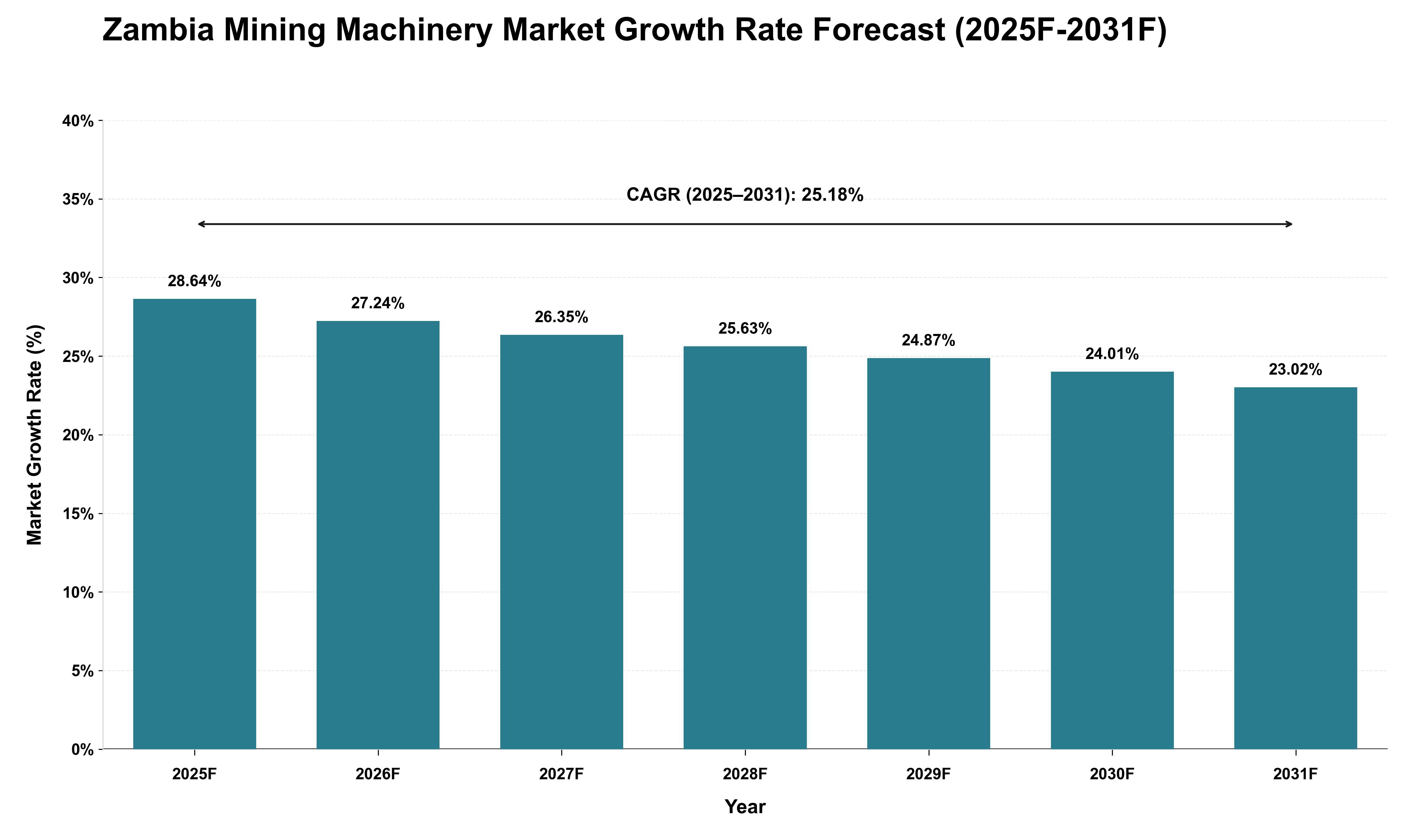
The forecasted growth trajectory for Zambia's mining machinery market will exhibit a notable deceleration from an initial 28.64% in 2025 to 23.02% by 2031, reflecting a gradual cooling of demand as the market adjusts to evolving economic conditions and import dependencies. This trend suggests that while the sector will continue to benefit from robust investment in mining infrastructure and increased mineral extraction activities, the rate of expansion will likely be influenced by global commodity price fluctuations and supply chain dynamics. As Zambia's reliance on imported machinery persists, external factors such as trade policies and currency stability will play critical roles in shaping import flows. The anticipated cyclical nature of mining investments may also contribute to this gradual decline, as operators balance capital expenditures with operational efficiencies amid changing market conditions, ultimately impacting the overall growth rate within this asset class during the forecast period.
Key Highlights of the Report:
- Zambia Mining Machinery Market Outlook
- Market Size of Zambia Mining Machinery Market, 2024
- Forecast of Zambia Mining Machinery Market, 2031
- Historical Data and Forecast of Zambia Mining Machinery Revenues & Volume for the Period 2021-2031
- Zambia Mining Machinery Market Trend Evolution
- Zambia Mining Machinery Market Drivers and Challenges
- Zambia Mining Machinery Price Trends
- Zambia Mining Machinery Porter`s Five Forces
- Zambia Mining Machinery Industry Life Cycle
- Historical Data and Forecast of Zambia Mining Machinery Market Revenues & Volume By Category for the Period 2021-2031
- Historical Data and Forecast of Zambia Mining Machinery Market Revenues & Volume By Crushing for the Period 2021-2031
- Historical Data and Forecast of Zambia Mining Machinery Market Revenues & Volume By Pulverizing for the Period 2021-2031
- Historical Data and Forecast of Zambia Mining Machinery Market Revenues & Volume By Screening for the Period 2021-2031
- Historical Data and Forecast of Zambia Mining Machinery Market Revenues & Volume By Mineral Processing for the Period 2021-2031
- Historical Data and Forecast of Zambia Mining Machinery Market Revenues & Volume By Surface & Underground for the Period 2021-2031
- Historical Data and Forecast of Zambia Mining Machinery Market Revenues & Volume By Electric Machinery for the Period 2021-2031
- Historical Data and Forecast of Zambia Mining Machinery Market Revenues & Volume By Mining Truck for the Period 2021-2031
- Historical Data and Forecast of Zambia Mining Machinery Market Revenues & Volume By LHD for the Period 2021-2031
- Historical Data and Forecast of Zambia Mining Machinery Market Revenues & Volume By Application for the Period 2021-2031
- Historical Data and Forecast of Zambia Mining Machinery Market Revenues & Volume By Metal mining for the Period 2021-2031
- Historical Data and Forecast of Zambia Mining Machinery Market Revenues & Volume By Mineral Mining for the Period 2021-2031
- Historical Data and Forecast of Zambia Mining Machinery Market Revenues & Volume By Coal mining for the Period 2021-2031
- Historical Data and Forecast of Zambia Mining Machinery Market Revenues & Volume By Solution for the Period 2021-2031
- Historical Data and Forecast of Zambia Mining Machinery Market Revenues & Volume By Products for the Period 2021-2031
- Historical Data and Forecast of Zambia Mining Machinery Market Revenues & Volume By Services for the Period 2021-2031
- Zambia Mining Machinery Import Export Trade Statistics
- Market Opportunity Assessment By Category
- Market Opportunity Assessment By Electric Machinery
- Market Opportunity Assessment By Application
- Market Opportunity Assessment By Solution
- Zambia Mining Machinery Top Companies Market Share
- Zambia Mining Machinery Competitive Benchmarking By Technical and Operational Parameters
- Zambia Mining Machinery Company Profiles
- Zambia Mining Machinery Key Strategic Recommendations






































