Zambia Oscillator Market: Top 5 Importing Countries and Market Competition (HHI) Analysis
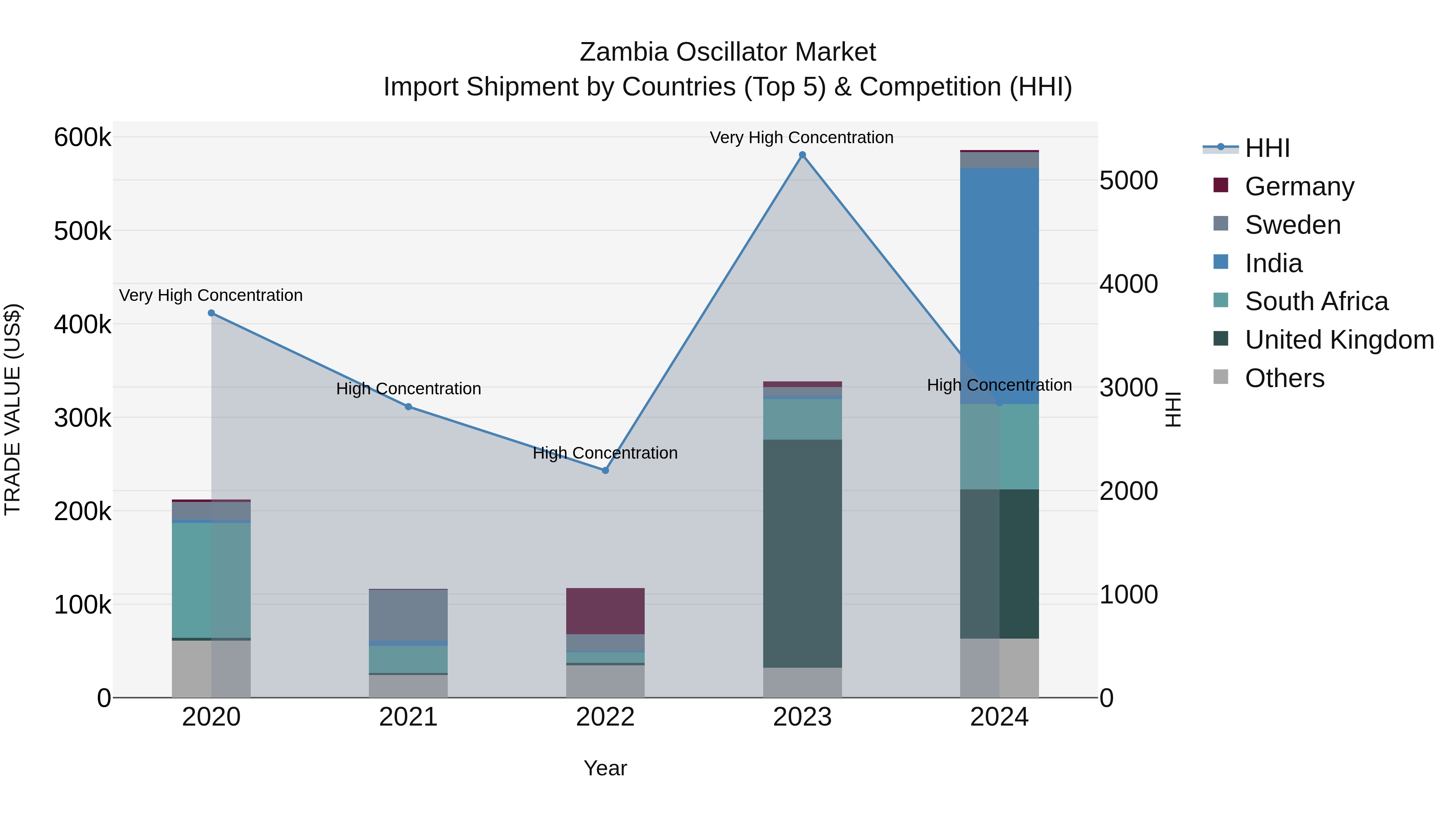
Zambia`s oscillator import market in 2024 saw a significant increase in concentration, with top exporters being India, UK, South Africa, Taiwan, and Sweden. The HHI remained at a high level, indicating strong market dominance. The impressive CAGR of 28.95% from 2020-2024 highlights the market`s rapid expansion, with a remarkable growth rate of 73.18% from 2023-2024. This data suggests a thriving demand for oscillators in Zambia, driven by imports from diverse countries, further solidifying its position as a key player in the global market.
Zambia Oscillator Market Overview
The Zambia Oscillator Market is experiencing moderate growth driven by increasing demand from various industries such as telecommunications, electronics, and healthcare. The market is characterized by the presence of both local and international oscillator manufacturers offering a wide range of products to cater to the diverse requirements of customers. Technological advancements, particularly in the field of frequency control and signal generation, are influencing market growth by providing more precise and efficient oscillator solutions. Key players in the market are focusing on product innovation, strategic partnerships, and expanding their distribution networks to gain a competitive edge. However, challenges such as fluctuating raw material prices and intense competition among market players may hinder the market`s growth to some extent. Overall, the Zambia Oscillator Market shows promising opportunities for growth in the coming years.
Zambia Oscillator Market Trends and Opportunities
The Zambia Oscillator Market is witnessing a growing demand for advanced oscillation technology across various industries such as telecommunications, healthcare, and automotive. Key trends include the increasing adoption of MEMS oscillators for their smaller size and lower power consumption, as well as the rising integration of oscillators into IoT devices. Opportunities in the market lie in the development of high-frequency oscillators for 5G networks, as well as the expansion of the automotive sector driving the need for precision timing solutions. Additionally, the increasing focus on renewable energy sources like solar power is creating a demand for oscillators in power inverters and energy storage systems. Overall, the Zambia Oscillator Market is poised for growth with advancements in technology and increasing applications across diverse sectors.
Zambia Oscillator Market Challenges
In the Zambia oscillator market, one of the main challenges faced is the limited availability of high-quality components and materials required for manufacturing oscillators. This can result in a lack of product consistency and reliability, hindering the overall performance of the oscillators. Additionally, the market may also face challenges related to fluctuating currency exchange rates, which can impact the cost of imported components and materials. Another challenge is the presence of counterfeit products in the market, which can tarnish the reputation of genuine oscillator manufacturers and lead to customer distrust. Overall, addressing these challenges requires a focus on sourcing reliable components, managing currency risks effectively, and implementing stringent measures to combat counterfeit products in order to ensure a thriving and competitive oscillator market in Zambia.
Zambia Oscillator Market Drivers
The Zambia Oscillator Market is primarily driven by the increasing demand for electronic devices across various sectors such as telecommunications, consumer electronics, and automotive industries. With the growing adoption of advanced technologies like 5G networks, IoT devices, and autonomous vehicles, the need for high-performance oscillators to ensure precise timing and frequency control is on the rise. Additionally, the expanding industrial automation sector in Zambia is fueling the demand for oscillators to support various automated processes. Furthermore, the government initiatives to promote digitalization and technological advancements in the country are expected to boost the market for oscillators in Zambia. Overall, the increasing focus on technological advancements and the rising demand for electronic devices are key drivers propelling the growth of the Zambia Oscillator Market.
Zambia Oscillator Market Government Policies
Government policies related to the Zambia Oscillator Market aim to promote domestic production and innovation in the industry. The government offers incentives such as tax breaks and subsidies to local manufacturers of oscillators to boost their competitiveness. Additionally, regulations are in place to ensure quality standards and compliance with international trade agreements. The government also supports research and development initiatives in the oscillator market to drive technological advancements and enhance the country`s standing in the global market. Overall, the policies are designed to foster growth and sustainability in the Zambia Oscillator Market while protecting consumer interests and promoting local businesses.
Zambia Oscillator Market Future Outlook
The future outlook for the Zambia Oscillator Market appears promising, with steady growth anticipated in the coming years. Factors such as increasing demand for electronic devices, advancements in technology, and rising investments in the healthcare sector are expected to drive market expansion. Additionally, the growing emphasis on wireless communication networks and the Internet of Things (IoT) will further boost the demand for oscillators in various industries. With a focus on innovation and product development, key players in the market are likely to introduce new and advanced oscillator technologies to cater to evolving consumer needs. Overall, the Zambia Oscillator Market is poised for growth, presenting opportunities for market players to capitalize on the increasing demand for oscillators in a variety of applications.
Key Highlights of the Report:
- Zambia Oscillator Market Outlook
- Market Size of Zambia Oscillator Market, 2024
- Forecast of Zambia Oscillator Market, 2031
- Historical Data and Forecast of Zambia Oscillator Revenues & Volume for the Period 2021- 2031
- Zambia Oscillator Market Trend Evolution
- Zambia Oscillator Market Drivers and Challenges
- Zambia Oscillator Price Trends
- Zambia Oscillator Porter's Five Forces
- Zambia Oscillator Industry Life Cycle
- Historical Data and Forecast of Zambia Oscillator Market Revenues & Volume By Type for the Period 2021- 2031
- Historical Data and Forecast of Zambia Oscillator Market Revenues & Volume By Temperature Compensated Crystal Oscillator (TCXO) for the Period 2021- 2031
- Historical Data and Forecast of Zambia Oscillator Market Revenues & Volume By Voltage-controlled Crystal Oscillator (VCXO) for the Period 2021- 2031
- Historical Data and Forecast of Zambia Oscillator Market Revenues & Volume By Oven-controlled Crystal Oscillator (OCXO) for the Period 2021- 2031
- Historical Data and Forecast of Zambia Oscillator Market Revenues & Volume By MEMS Oscillators for the Period 2021- 2031
- Historical Data and Forecast of Zambia Oscillator Market Revenues & Volume By Mounting Type for the Period 2021- 2031
- Historical Data and Forecast of Zambia Oscillator Market Revenues & Volume By Surface Mount for the Period 2021- 2031
- Historical Data and Forecast of Zambia Oscillator Market Revenues & Volume By Thru-hole for the Period 2021- 2031
- Historical Data and Forecast of Zambia Oscillator Market Revenues & Volume By Others for the Period 2021- 2031
- Historical Data and Forecast of Zambia Oscillator Market Revenues & Volume By End-user Industry for the Period 2021- 2031
- Historical Data and Forecast of Zambia Oscillator Market Revenues & Volume By Consumer Electronics for the Period 2021- 2031
- Historical Data and Forecast of Zambia Oscillator Market Revenues & Volume By Automotive for the Period 2021- 2031
- Historical Data and Forecast of Zambia Oscillator Market Revenues & Volume By Telecom and Networking for the Period 2021- 2031
- Historical Data and Forecast of Zambia Oscillator Market Revenues & Volume By Aerospace and Defense for the Period 2021- 2031
- Historical Data and Forecast of Zambia Oscillator Market Revenues & Volume By Research and Medical for the Period 2021- 2031
- Historical Data and Forecast of Zambia Oscillator Market Revenues & Volume By Industrial for the Period 2021- 2031
- Zambia Oscillator Import Export Trade Statistics
- Market Opportunity Assessment By Type
- Market Opportunity Assessment By Mounting Type
- Market Opportunity Assessment By End-user Industry
- Zambia Oscillator Top Companies Market Share
- Zambia Oscillator Competitive Benchmarking By Technical and Operational Parameters
- Zambia Oscillator Company Profiles
- Zambia Oscillator Key Strategic Recommendations






































