Zimbabwe Cooking Appliances Market Growth Rate Analysis (2025 - 2031)
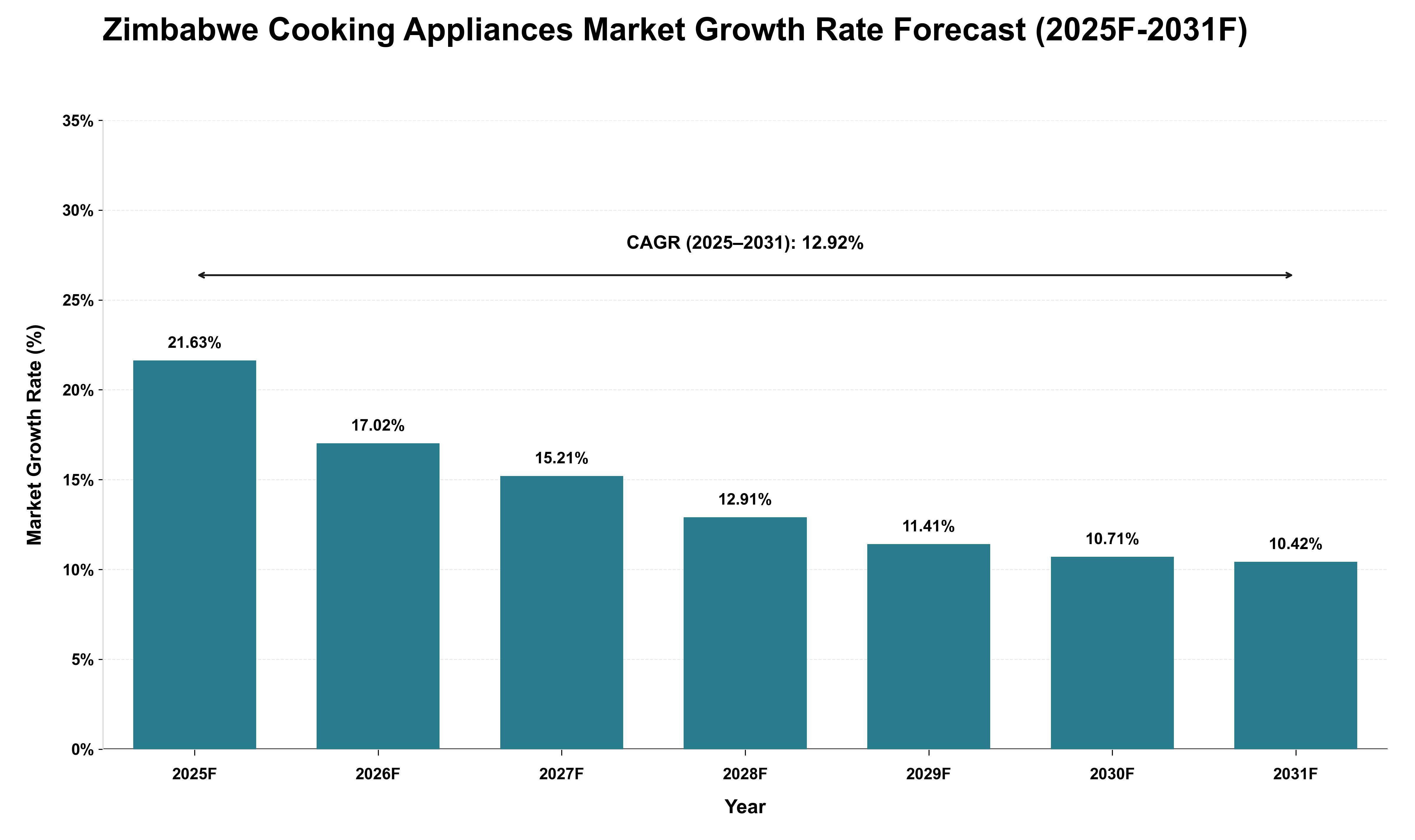
The Zimbabwe cooking appliances market will experience robust growth driven by evolving regulatory frameworks and trade policies that favor local manufacturing and import facilitation. With a projected CAGR of 12.92% from 2025 to 2031, the market will benefit from increased consumer demand for energy-efficient and modern cooking solutions, particularly as urbanization accelerates. The anticipated annual growth rates, peaking at 21.63% in 2025, will reflect a surge in disposable incomes and a shift towards more sustainable cooking technologies. Import dependencies are expected to influence pricing dynamics, as tariffs may be adjusted to protect nascent local industries while also ensuring competitive pricing for imported goods. As global supply chains stabilize post-pandemic, cyclical trends in consumer behavior will likely favor innovative appliance features, further propelling market expansion through the forecast period.
Key Highlights of the Report:
- Zimbabwe Cooking Appliances Market Outlook
- Market Size of Zimbabwe Cooking Appliances Market, 2024
- Forecast of Zimbabwe Cooking Appliances Market, 2031
- Historical Data and Forecast of Zimbabwe Cooking Appliances Revenues & Volume for the Period 2021-2031
- Zimbabwe Cooking Appliances Market Trend Evolution
- Zimbabwe Cooking Appliances Market Drivers and Challenges
- Zimbabwe Cooking Appliances Price Trends
- Zimbabwe Cooking Appliances Porter`s Five Forces
- Zimbabwe Cooking Appliances Industry Life Cycle
- Historical Data and Forecast of Zimbabwe Cooking Appliances Market Revenues & Volume By Types for the Period 2021-2031
- Historical Data and Forecast of Zimbabwe Cooking Appliances Market Revenues & Volume By Microwaves for the Period 2021-2031
- Historical Data and Forecast of Zimbabwe Cooking Appliances Market Revenues & Volume By Ovens for the Period 2021-2031
- Historical Data and Forecast of Zimbabwe Cooking Appliances Market Revenues & Volume By Cooktops for the Period 2021-2031
- Historical Data and Forecast of Zimbabwe Cooking Appliances Market Revenues & Volume By Range Hoods for the Period 2021-2031
- Historical Data and Forecast of Zimbabwe Cooking Appliances Market Revenues & Volume By Small Appliances for the Period 2021-2031
- Historical Data and Forecast of Zimbabwe Cooking Appliances Market Revenues & Volume By Parts & Accessories for the Period 2021-2031
- Historical Data and Forecast of Zimbabwe Cooking Appliances Market Revenues & Volume By Applications for the Period 2021-2031
- Historical Data and Forecast of Zimbabwe Cooking Appliances Market Revenues & Volume By Household for the Period 2021-2031
- Historical Data and Forecast of Zimbabwe Cooking Appliances Market Revenues & Volume By Commercial for the Period 2021-2031
- Historical Data and Forecast of Zimbabwe Cooking Appliances Market Revenues & Volume By Fuel Type for the Period 2021-2031
- Historical Data and Forecast of Zimbabwe Cooking Appliances Market Revenues & Volume By Cooking gas for the Period 2021-2031
- Historical Data and Forecast of Zimbabwe Cooking Appliances Market Revenues & Volume By Electricity for the Period 2021-2031
- Historical Data and Forecast of Zimbabwe Cooking Appliances Market Revenues & Volume By Distribution Channel for the Period 2021-2031
- Historical Data and Forecast of Zimbabwe Cooking Appliances Market Revenues & Volume By Online for the Period 2021-2031
- Historical Data and Forecast of Zimbabwe Cooking Appliances Market Revenues & Volume By Offline for the Period 2021-2031
- Zimbabwe Cooking Appliances Import Export Trade Statistics
- Market Opportunity Assessment By Types
- Market Opportunity Assessment By Applications
- Market Opportunity Assessment By Fuel Type
- Market Opportunity Assessment By Distribution Channel
- Zimbabwe Cooking Appliances Top Companies Market Share
- Zimbabwe Cooking Appliances Competitive Benchmarking By Technical and Operational Parameters
- Zimbabwe Cooking Appliances Company Profiles
- Zimbabwe Cooking Appliances Key Strategic Recommendations






































