Zimbabwe Nonmetallic Mineral Product Market Growth Rate Analysis (2025 - 2031)
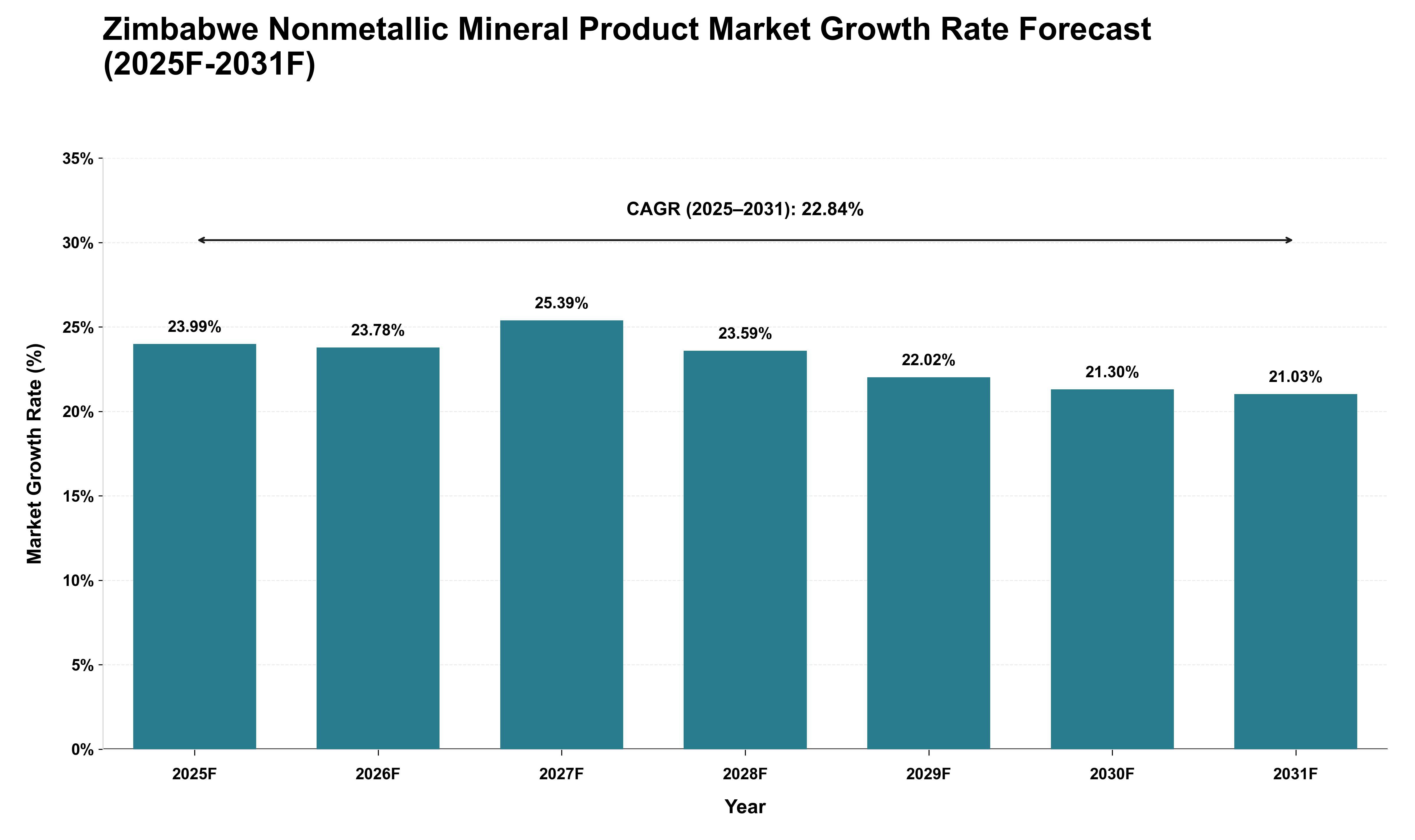
The Zimbabwe nonmetallic mineral product market will experience significant growth driven by increasing global demand for construction materials and industrial applications, with a projected CAGR of 22.84% from 2025 to 2031. This robust expansion will be underpinned by rising export opportunities as regional economies invest in infrastructure development, enhancing Zimbabwe's position as a key supplier. The annual growth rates will fluctuate, peaking at 25.39% in 2027, reflecting cyclical trends influenced by global commodity prices and trade dynamics. Import dependencies on specific nonmetallic minerals may also shape trade flows, as domestic production ramps up to meet both local and international needs. As the market evolves, shifts in regulatory frameworks and trade agreements will further impact export capabilities, positioning Zimbabwe favorably within the broader context of regional mineral supply chains throughout this forecast period.
Key Highlights of the Report:
- Zimbabwe Nonmetallic Mineral Product Market Outlook
- Market Size of Zimbabwe Nonmetallic Mineral Product Market, 2025
- Forecast of Zimbabwe Nonmetallic Mineral Product Market, 2032
- Historical Data and Forecast of Zimbabwe Nonmetallic Mineral Product Revenues & Volume for the Period 2022-2032F
- Zimbabwe Nonmetallic Mineral Product Market Trend Evolution
- Zimbabwe Nonmetallic Mineral Product Market Drivers and Challenges
- Zimbabwe Nonmetallic Mineral Product Price Trends
- Zimbabwe Nonmetallic Mineral Product Porter`s Five Forces
- Zimbabwe Nonmetallic Mineral Product Industry Life Cycle
- Historical Data and Forecast of Zimbabwe Nonmetallic Mineral Product Market Revenues & Volume By Form Type for the Period 2022-2032F
- Historical Data and Forecast of Zimbabwe Nonmetallic Mineral Product Market Revenues & Volume By Powder Form for the Period 2022-2032F
- Historical Data and Forecast of Zimbabwe Nonmetallic Mineral Product Market Revenues & Volume By Liquid Form for the Period 2022-2032F
- Historical Data and Forecast of Zimbabwe Nonmetallic Mineral Product Market Revenues & Volume By End User for the Period 2022-2032F
- Historical Data and Forecast of Zimbabwe Nonmetallic Mineral Product Market Revenues & Volume By Jewellery for the Period 2022-2032F
- Historical Data and Forecast of Zimbabwe Nonmetallic Mineral Product Market Revenues & Volume By Construction for the Period 2022-2032F
- Historical Data and Forecast of Zimbabwe Nonmetallic Mineral Product Market Revenues & Volume By Iron & Ore for the Period 2022-2032F
- Zimbabwe Nonmetallic Mineral Product Import Export Trade Statistics
- Market Opportunity Assessment By Form Type
- Market Opportunity Assessment By End User
- Zimbabwe Nonmetallic Mineral Product Top Companies Market Share
- Zimbabwe Nonmetallic Mineral Product Competitive Benchmarking By Technical and Operational Parameters
- Zimbabwe Nonmetallic Mineral Product Company Profiles
- Zimbabwe Nonmetallic Mineral Product Key Strategic Recommendations






































