Zimbabwe Oscillator Market: Import Trend Analysis
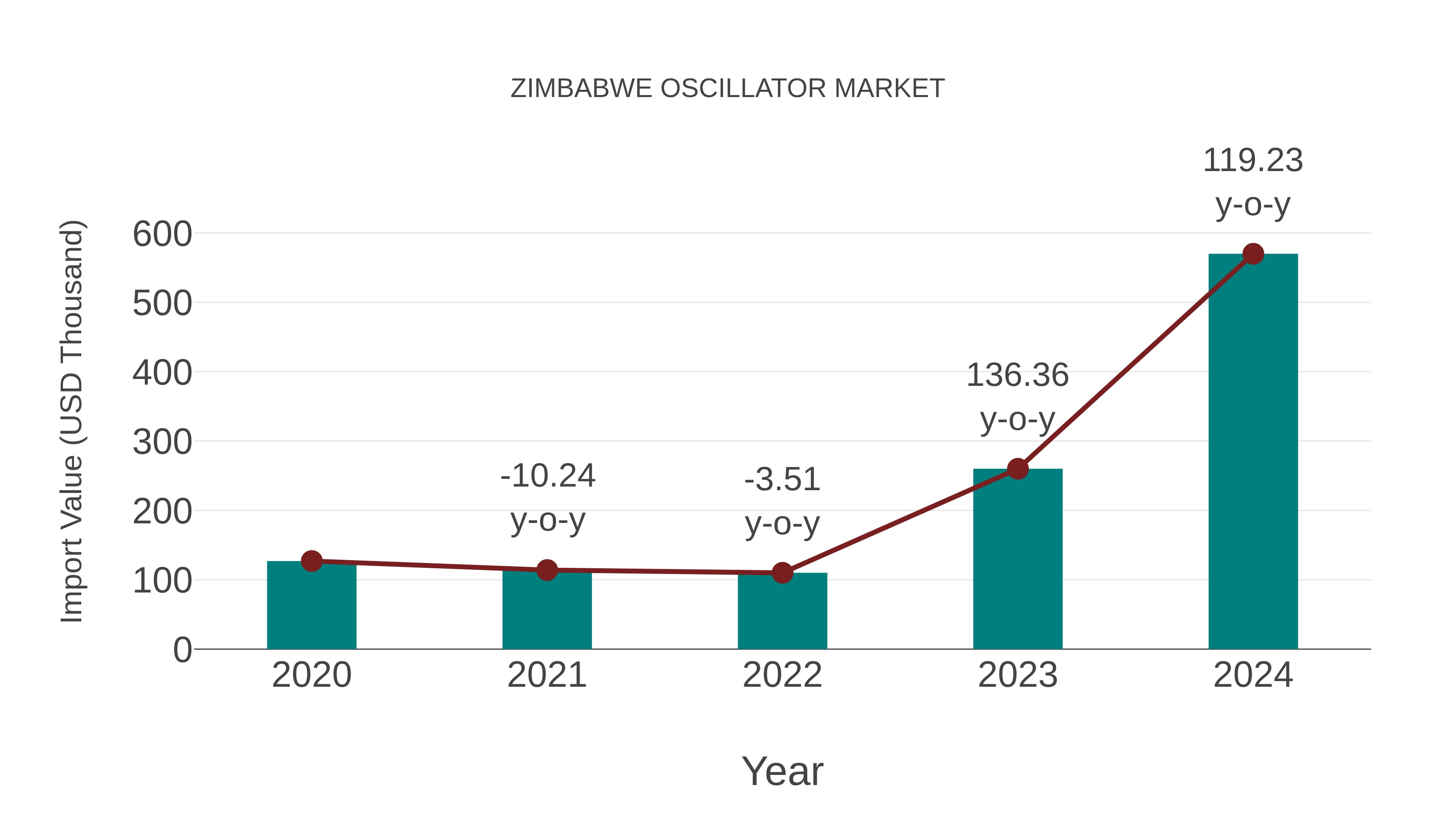
During 2020-2024, Zimbabwe experienced a significant increase in imports of oscillator market products. The Compound Annual Growth Rate (CAGR) for this period was 45.55%. Notably, in 2023-2024, there was a year-on-year growth rate of 119.23%, indicating a substantial surge in imports during that specific year.
Zimbabwe Oscillator Market Overview
The Zimbabwe Oscillator Market is witnessing steady growth driven by increasing demand across various industries such as telecommunications, healthcare, and aerospace. Oscillators are vital components used for generating electronic signals in devices like radios, computers, and mobile phones. The market is benefiting from technological advancements leading to the development of more efficient and reliable oscillators. Key players in the Zimbabwe market include RFMW Ltd, Oscillator Inc., and Euroquartz Ltd, offering a wide range of products catering to diverse applications. The market is also influenced by factors like the growing adoption of wireless communication technologies, expanding industrial automation sector, and rising investments in research and development. With a positive outlook for the electronics industry in Zimbabwe, the oscillator market is poised for further growth in the coming years.
Zimbabwe Oscillator Market Trends and Opportunities
The Zimbabwe oscillator market is experiencing growth due to increasing demand for precision timing devices in various industries such as telecommunications, healthcare, and automotive. Key trends in the market include the adoption of advanced technologies like MEMS-based oscillators and the development of compact, energy-efficient oscillator solutions. Opportunities in the market lie in the rising need for high-performance oscillators in emerging applications like Internet of Things (IoT) devices, 5G networks, and autonomous vehicles. Additionally, the growing focus on improving communication and network infrastructure in Zimbabwe is driving the demand for oscillators for use in base stations and other telecommunications equipment. Overall, the Zimbabwe oscillator market presents lucrative prospects for manufacturers to innovate and expand their product offerings to cater to the evolving needs of industries in the country.
Zimbabwe Oscillator Market Challenges
In the Zimbabwe Oscillator Market, one of the key challenges faced is the limited availability of high-quality components and materials for manufacturing oscillators. This scarcity often leads to increased production costs and can impact the overall quality and reliability of the oscillators produced in the country. Additionally, the market is heavily influenced by fluctuations in foreign exchange rates, making it challenging for manufacturers to maintain competitive pricing. Another obstacle is the lack of skilled labor and technical expertise in designing and producing advanced oscillators, hindering innovation and product development. Furthermore, the market is highly competitive, with both domestic and international players vying for market share, leading to pricing pressures and the need for differentiation through technological advancements or unique value propositions.
Zimbabwe Oscillator Market Drivers
The Zimbabwe oscillator market is primarily driven by the increasing demand for electronic devices and equipment across various industries such as telecommunications, automotive, healthcare, and consumer electronics. The growing adoption of advanced technologies like 5G networks, IoT devices, and autonomous vehicles is fueling the need for precise and stable oscillators for timing and frequency control. Additionally, the expanding telecommunication sector, rising consumer disposable income, and the trend towards miniaturization of electronic components are further driving the market growth. The increasing focus on research and development activities to enhance oscillator performance, reduce power consumption, and improve reliability is also contributing to the market expansion in Zimbabwe.
Zimbabwe Oscillator Market Government Policies
The Zimbabwe government has implemented various policies related to the oscillator market to support local manufacturing and economic development. These policies include import restrictions on certain oscillation products to promote domestic production and reduce reliance on foreign imports. Additionally, the government has provided incentives such as tax breaks and subsidies to local oscillator manufacturers to encourage growth and investment in the sector. Regulations on product quality and safety standards are also enforced to protect consumers and ensure compliance with international trade requirements. Overall, these policies aim to stimulate the local oscillator market, create employment opportunities, and strengthen the country`s industrial base.
Zimbabwe Oscillator Market Future Outlook
The Zimbabwe oscillator market is expected to witness steady growth in the coming years driven by increasing industrialization and technological advancements in the country. The demand for oscillators, particularly in sectors such as telecommunications, automotive, and consumer electronics, is projected to rise as Zimbabwe continues to develop and modernize its infrastructure. Additionally, the growing trend of automation and IoT devices is likely to further boost the demand for oscillators in various applications. However, factors such as economic instability, political uncertainties, and fluctuating currency values may pose challenges to market growth. Overall, with the right investment in research and development, as well as strategic partnerships with global oscillator manufacturers, the Zimbabwe oscillator market has the potential for significant expansion in the foreseeable future.
Key Highlights of the Report:
- Zimbabwe Oscillator Market Outlook
- Market Size of Zimbabwe Oscillator Market, 2025
- Forecast of Zimbabwe Oscillator Market, 2032
- Historical Data and Forecast of Zimbabwe Oscillator Revenues & Volume for the Period 2022 - 2032F
- Zimbabwe Oscillator Market Trend Evolution
- Zimbabwe Oscillator Market Drivers and Challenges
- Zimbabwe Oscillator Price Trends
- Zimbabwe Oscillator Porter's Five Forces
- Zimbabwe Oscillator Industry Life Cycle
- Historical Data and Forecast of Zimbabwe Oscillator Market Revenues & Volume By Type for the Period 2022 - 2032F
- Historical Data and Forecast of Zimbabwe Oscillator Market Revenues & Volume By Temperature Compensated Crystal Oscillator (TCXO) for the Period 2022 - 2032F
- Historical Data and Forecast of Zimbabwe Oscillator Market Revenues & Volume By Voltage-controlled Crystal Oscillator (VCXO) for the Period 2022 - 2032F
- Historical Data and Forecast of Zimbabwe Oscillator Market Revenues & Volume By Oven-controlled Crystal Oscillator (OCXO) for the Period 2022 - 2032F
- Historical Data and Forecast of Zimbabwe Oscillator Market Revenues & Volume By MEMS Oscillators for the Period 2022 - 2032F
- Historical Data and Forecast of Zimbabwe Oscillator Market Revenues & Volume By Mounting Type for the Period 2022 - 2032F
- Historical Data and Forecast of Zimbabwe Oscillator Market Revenues & Volume By Surface Mount for the Period 2022 - 2032F
- Historical Data and Forecast of Zimbabwe Oscillator Market Revenues & Volume By Thru-hole for the Period 2022 - 2032F
- Historical Data and Forecast of Zimbabwe Oscillator Market Revenues & Volume By Others for the Period 2022 - 2032F
- Historical Data and Forecast of Zimbabwe Oscillator Market Revenues & Volume By End-user Industry for the Period 2022 - 2032F
- Historical Data and Forecast of Zimbabwe Oscillator Market Revenues & Volume By Consumer Electronics for the Period 2022 - 2032F
- Historical Data and Forecast of Zimbabwe Oscillator Market Revenues & Volume By Automotive for the Period 2022 - 2032F
- Historical Data and Forecast of Zimbabwe Oscillator Market Revenues & Volume By Telecom and Networking for the Period 2022 - 2032F
- Historical Data and Forecast of Zimbabwe Oscillator Market Revenues & Volume By Aerospace and Defense for the Period 2022 - 2032F
- Historical Data and Forecast of Zimbabwe Oscillator Market Revenues & Volume By Research and Medical for the Period 2022 - 2032F
- Historical Data and Forecast of Zimbabwe Oscillator Market Revenues & Volume By Industrial for the Period 2022 - 2032F
- Zimbabwe Oscillator Import Export Trade Statistics
- Market Opportunity Assessment By Type
- Market Opportunity Assessment By Mounting Type
- Market Opportunity Assessment By End-user Industry
- Zimbabwe Oscillator Top Companies Market Share
- Zimbabwe Oscillator Competitive Benchmarking By Technical and Operational Parameters
- Zimbabwe Oscillator Company Profiles
- Zimbabwe Oscillator Key Strategic Recommendations






































