Thailand Phosphate Fertilizer Market (2026-2032) Outlook | Revenue, Size, Value, Forecast, Analysis, Companies, Share, Industry, Trends & Growth
Market Forecast By Product Type (Monoammonium Phosphate (MAP), Diammonium Phosphate (DAP), Single Superphosphate (SSP), Triple Superphosphate (TSP), Others), By Application (Cereals & Grains, Oilseeds & Pulses, Fruits & Vegetables, Others) And Competitive Landscape
| Product Code: ETC417741 | Publication Date: Oct 2022 | Updated Date: Jul 2026 | Product Type: Market Research Report | |
| Publisher: 6Wresearch | Author: Ravi Bhandari | No. of Pages: 75 | No. of Figures: 35 | No. of Tables: 20 |
Thailand Phosphate Fertilizer Market Size, Share & Growth Rate
The Thailand Phosphate Fertilizer Market was estimated at USD 175 Million in 2025 and is projected to reach USD 200 Million by 2032, growing at a CAGR of 1.9% from 2026 to 2032. This growth trajectory is primarily fueled by the pressing need for enhanced agricultural productivity to meet the rising global food demand. With Thailand's agriculture sector increasingly emphasizing sustainability and efficient resource use, phosphate fertilizers are becoming indispensable for improving crop yields and ensuring soil fertility.
Thailand Phosphate Fertilizer Market Year-wise Growth Rate and Key Drivers
This graph highlights how the Thailand Phosphate Fertilizer Market has steadily grown over the years, supported by major growth factors.
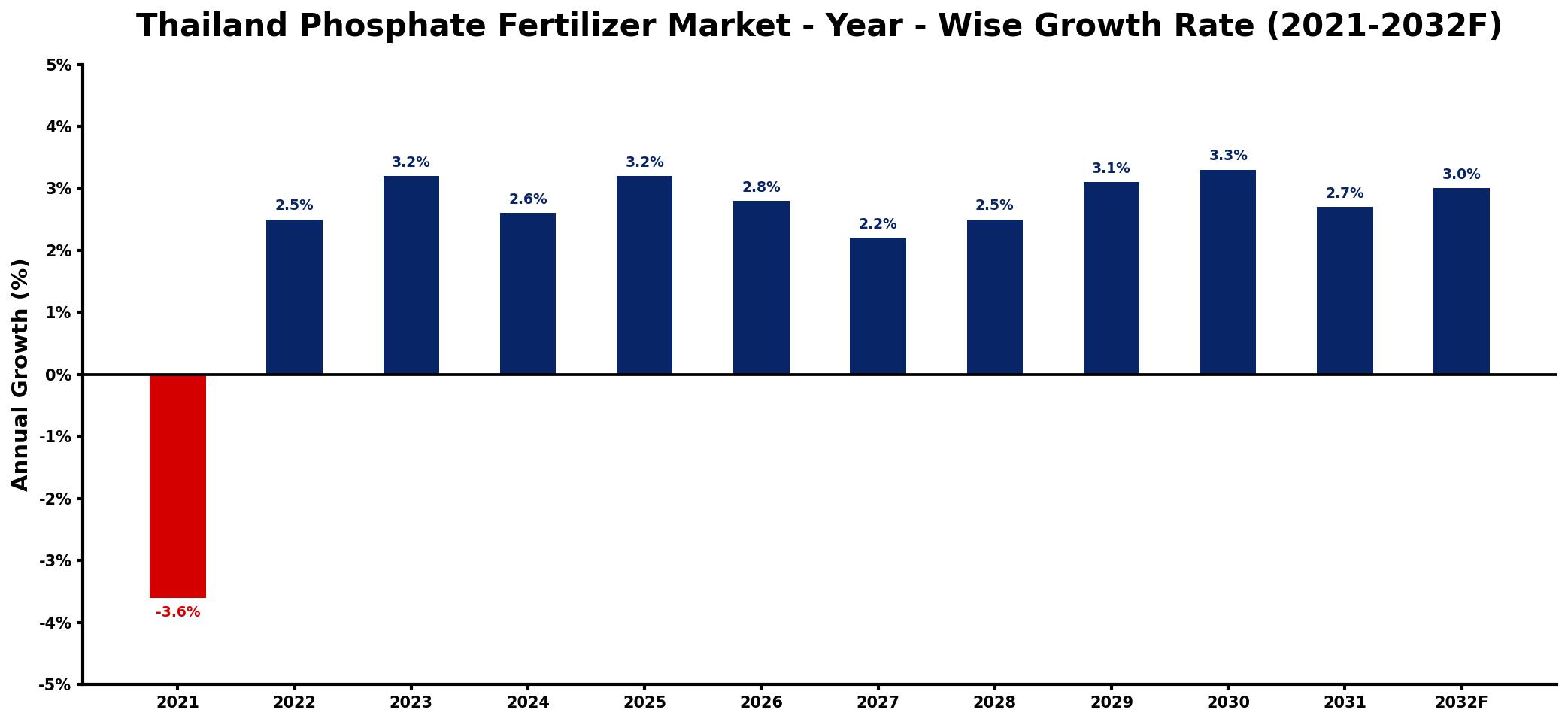
The table below presents the year‑wise growth rates along with the key drivers influencing the market
| Year | Growth Rate | Major Drivers |
| 2021 | -3.6% | decreased agricultural production levels |
| 2022 | 2.5% | rising demand from farmers |
| 2023 | 3.2% | expansion of local manufacturing facilities |
| 2024 | 2.6% | increased investments in agriculture |
| 2025 | 3.2% | growing export opportunities abroad |
| 2026 | 2.8% | enhanced distribution network efficiency |
| 2027 | 2.2% | increased crop yield expectations |
| 2028 | 2.5% | higher adoption of modern techniques |
| 2029 | 3.1% | strengthened agricultural policy support |
| 2030 | 3.3% | growing awareness of sustainability |
| 2031 | 2.7% | increased funding for research initiatives |
| 2032 | 3.0% | expanding manufacturing base activity |
Note: Market size estimations and growth projections presented in this report are based on 6Wresearch's proprietary forecasting methodology, utilizing the latest available industry data, government publications, and primary research inputs.
Thailand Phosphate Fertilizer Market Synopsis
In Thailand, the phosphate fertilizer market is vital to the agricultural framework, impacting crops like rice, sugarcane, and rubber. These fertilizers are not merely supplements but essential inputs that enhance crop growth, ensuring food security for the growing population.
As the country strives to optimize its agricultural output amidst environmental sustainability concerns, the phosphate fertilizer market continues to evolve. Strong governmental support and the increasing focus on sustainable farming practices are further shaping this dynamic market landscape.
Thailand Phosphate Fertilizer Market Key Takeaways
- The market is experiencing steady growth driven by increasing food demand and sustainable agricultural practices.
- Government initiatives play a crucial role in promoting phosphate fertilizer usage among farmers.
- Challenges related to resource depletion and environmental regulations impact production and pricing.
- Leading companies are innovating to address sustainability concerns in fertilizer production.
- The COVID-19 pandemic highlighted the resilience and adaptability of the agriculture sector, maintaining demand for fertilizers.
Evaluation of Restraints in Thailand Phosphate Fertilizer Market
Despite its growth potential, the Thailand phosphate fertilizer market faces several significant restraints. One of the primary concerns is the finite nature of phosphate rock, which raises critical questions about the long-term sustainability of fertilizer production. Additionally, stringent environmental regulations impose operational challenges on manufacturers striving to balance efficiency with ecological responsibility. Price volatility and competitive pressures further complicate the landscape, prompting companies to innovate continuously and adjust their strategies to maintain market viability.
Thailand Phosphate Fertilizer Market Trends
A prominent trend in the Thailand phosphate fertilizer market is the growing emphasis on precision agriculture. Farmers are increasingly adopting data-driven approaches to optimize fertilizer application, reducing waste and enhancing crop productivity. Moreover, there is a noticeable shift towards organic and bio-based fertilizers as consumers and producers alike prioritize environmental sustainability. The integration of technology in fertilizer formulation, including slow-release products, is also gaining traction, promising to revolutionize nutrient management in agriculture.
Thailand Phosphate Fertilizer Market Opportunities
The Thailand phosphate fertilizer market presents several robust growth and investment opportunities. As the government promotes sustainable farming practices, initiatives to improve fertilizer efficiency and reduce environmental impact are likely to gain traction. Additionally, the rising demand for organic fertilizers opens new avenues for innovation, creating a niche market for products that meet these criteria. Collaborations between agricultural technology firms and fertilizer manufacturers may lead to breakthrough solutions that enhance crop yields while addressing sustainability challenges.
Government Initiatives in the Thailand Phosphate Fertilizer Market
The Thai government has implemented several initiatives to support the phosphate fertilizer market, focusing on enhancing agricultural productivity and sustainability. Programs aimed at educating farmers about efficient fertilizer use are crucial in promoting optimal application methods. Additionally, government-backed research initiatives explore innovative practices and technologies to improve fertilizer efficiency, thereby aligning agricultural practices with environmental sustainability goals. These efforts underscore the commitment to ensuring food security while promoting responsible farming.
Future Insights of the Thailand Phosphate Fertilizer Market
Looking ahead to 2026-2032, the Thailand phosphate fertilizer market is poised for moderate growth, fueled by ongoing shifts towards sustainable agriculture and technological advancements. As farmers increasingly recognize the importance of nutrient management, the demand for phosphate fertilizers will likely remain strong. The integration of eco-friendly practices, along with government support for sustainable initiatives, will shape market dynamics. Companies that prioritize innovation and sustainability are expected to thrive in this evolving landscape, adapting to both regulatory frameworks and consumer preferences.
Thailand Phosphate Fertilizer Market Latest Developments (2025 - 2026)
Recent developments in the Thailand phosphate fertilizer market indicate a growing trend towards localized production to ensure supply chain resilience. The industry has seen increased collaboration between agricultural and technological sectors, focusing on the development of smarter fertilizer products that cater to precision farming needs. Furthermore, research into sustainable practices and alternative nutrient sources is gathering momentum as stakeholders seek to mitigate environmental impacts while enhancing productivity.
Thailand Phosphate Fertilizer Market - Key Attractiveness of the Report
- 10 Years of Market Numbers
- Historical Data Starting from 2022 to 2025
- Base Year: 2025
- Forecast Data until 2032
- Key Performance Indicators Impacting the Market
- Major Upcoming Developments and Projects
Key Highlights of the Report:
- Thailand Phosphate Fertilizer Market Outlook
- Market Size of Thailand Phosphate Fertilizer Market, 2025
- Forecast of Thailand Phosphate Fertilizer Market, 2032
- Historical Data and Forecast of Thailand Phosphate Fertilizer Revenues & Volume for the Period 2022-2032F
- Thailand Phosphate Fertilizer Market Trend Evolution
- Thailand Phosphate Fertilizer Market Drivers and Challenges
- Thailand Phosphate Fertilizer Price Trends
- Thailand Phosphate Fertilizer Porter's Five Forces
- Thailand Phosphate Fertilizer Industry Life Cycle
- Historical Data and Forecast of Thailand Phosphate Fertilizer Market Revenues & Volume By Product Type for the Period 2022-2032F
- Historical Data and Forecast of Thailand Phosphate Fertilizer Market Revenues & Volume By Monoammonium Phosphate (MAP) for the Period 2022-2032F
- Historical Data and Forecast of Thailand Phosphate Fertilizer Market Revenues & Volume By Diammonium Phosphate (DAP) for the Period 2022-2032F
- Historical Data and Forecast of Thailand Phosphate Fertilizer Market Revenues & Volume By Single Superphosphate (SSP) for the Period 2022-2032F
- Historical Data and Forecast of Thailand Phosphate Fertilizer Market Revenues & Volume By Triple Superphosphate (TSP) for the Period 2022-2032F
- Historical Data and Forecast of Thailand Phosphate Fertilizer Market Revenues & Volume By Others for the Period 2022-2032F
- Historical Data and Forecast of Thailand Phosphate Fertilizer Market Revenues & Volume By Application for the Period 2022-2032F
- Historical Data and Forecast of Thailand Phosphate Fertilizer Market Revenues & Volume By Cereals & Grains for the Period 2022-2032F
- Historical Data and Forecast of Thailand Phosphate Fertilizer Market Revenues & Volume By Oilseeds & Pulses for the Period 2022-2032F
- Historical Data and Forecast of Thailand Phosphate Fertilizer Market Revenues & Volume By Fruits & Vegetables for the Period 2022-2032F
- Historical Data and Forecast of Thailand Phosphate Fertilizer Market Revenues & Volume By Others for the Period 2022-2032F
- Thailand Phosphate Fertilizer Import Export Trade Statistics
- Market Opportunity Assessment By Product Type
- Market Opportunity Assessment By Application
- Thailand Phosphate Fertilizer Top Companies Market Share
- Thailand Phosphate Fertilizer Competitive Benchmarking By Technical and Operational Parameters
- Thailand Phosphate Fertilizer Company Profiles
- Thailand Phosphate Fertilizer Key Strategic Recommendations
Frequently Asked Questions About the Market Study (FAQs):
The market was estimated at USD 175 Million in 2025 and is projected to reach USD 200 Million by 2032, growing at a CAGR of 1.9% from 2026 to 2032.
The government is actively promoting initiatives aimed at educating farmers about efficient fertilizer use and investing in research to develop sustainable farming practices.
Key trends include a shift towards precision agriculture, increased adoption of organic fertilizers, and the integration of advanced technologies to enhance fertilizer efficiency.
Manufacturers encounter challenges related to resource depletion, strict environmental regulations, and fluctuating prices, necessitating continuous innovation.
The reliance on phosphate fertilizers to boost yields in critical crops like rice and sugarcane is driving steady demand, particularly as food security becomes increasingly important.
6Wresearch actively monitors the Thailand Phosphate Fertilizer Market and publishes its comprehensive annual report, highlighting emerging trends, growth drivers, revenue analysis, and forecast outlook. Our insights help businesses to make data-backed strategic decisions with ongoing market dynamics. Our analysts track relevent industries related to the Thailand Phosphate Fertilizer Market, allowing our clients with actionable intelligence and reliable forecasts tailored to emerging regional needs.
Yes, we provide customisation as per your requirements. To learn more, feel free to contact us on sales@6wresearch.com
1 Executive Summary |
2 Introduction |
2.1 Key Highlights of the Report |
2.2 Report Description |
2.3 Market Scope & Segmentation |
2.4 Research Methodology |
2.5 Assumptions |
3 Thailand Phosphate Fertilizer Market Overview |
3.1 Thailand Country Macro Economic Indicators |
3.2 Thailand Phosphate Fertilizer Market Revenues & Volume, 2022 & 2032F |
3.3 Thailand Phosphate Fertilizer Market - Industry Life Cycle |
3.4 Thailand Phosphate Fertilizer Market - Porter's Five Forces |
3.5 Thailand Phosphate Fertilizer Market Revenues & Volume Share, By Product Type, 2022 & 2032F |
3.6 Thailand Phosphate Fertilizer Market Revenues & Volume Share, By Application, 2022 & 2032F |
4 Thailand Phosphate Fertilizer Market Dynamics |
4.1 Impact Analysis |
4.2 Market Drivers |
4.2.1 Increasing demand for food production due to growing population |
4.2.2 Government initiatives to promote agricultural productivity |
4.2.3 Technological advancements in fertilizer production and application techniques |
4.3 Market Restraints |
4.3.1 Fluctuating prices of raw materials |
4.3.2 Environmental concerns related to excessive fertilizer usage |
4.3.3 Competition from alternative organic fertilizers |
5 Thailand Phosphate Fertilizer Market Trends |
6 Thailand Phosphate Fertilizer Market, By Types |
6.1 Thailand Phosphate Fertilizer Market, By Product Type |
6.1.1 Overview and Analysis |
6.1.2 Thailand Phosphate Fertilizer Market Revenues & Volume, By Product Type, 2022-2032F |
6.1.3 Thailand Phosphate Fertilizer Market Revenues & Volume, By Monoammonium Phosphate (MAP), 2022-2032F |
6.1.4 Thailand Phosphate Fertilizer Market Revenues & Volume, By Diammonium Phosphate (DAP), 2022-2032F |
6.1.5 Thailand Phosphate Fertilizer Market Revenues & Volume, By Single Superphosphate (SSP), 2022-2032F |
6.1.6 Thailand Phosphate Fertilizer Market Revenues & Volume, By Triple Superphosphate (TSP), 2022-2032F |
6.1.7 Thailand Phosphate Fertilizer Market Revenues & Volume, By Others, 2022-2032F |
6.2 Thailand Phosphate Fertilizer Market, By Application |
6.2.1 Overview and Analysis |
6.2.2 Thailand Phosphate Fertilizer Market Revenues & Volume, By Cereals & Grains, 2022-2032F |
6.2.3 Thailand Phosphate Fertilizer Market Revenues & Volume, By Oilseeds & Pulses, 2022-2032F |
6.2.4 Thailand Phosphate Fertilizer Market Revenues & Volume, By Fruits & Vegetables, 2022-2032F |
6.2.5 Thailand Phosphate Fertilizer Market Revenues & Volume, By Others, 2022-2032F |
7 Thailand Phosphate Fertilizer Market Import-Export Trade Statistics |
7.1 Thailand Phosphate Fertilizer Market Export to Major Countries |
7.2 Thailand Phosphate Fertilizer Market Imports from Major Countries |
8 Thailand Phosphate Fertilizer Market Key Performance Indicators |
8.1 Soil health improvement index (measuring the impact of phosphate fertilizers on soil quality) |
8.2 Adoption rate of precision agriculture techniques in fertilizer application |
8.3 Percentage of agricultural land using phosphate fertilizers based on recommended dosage |
9 Thailand Phosphate Fertilizer Market - Opportunity Assessment |
9.1 Thailand Phosphate Fertilizer Market Opportunity Assessment, By Product Type, 2022 & 2032F |
9.2 Thailand Phosphate Fertilizer Market Opportunity Assessment, By Application, 2022 & 2032F |
10 Thailand Phosphate Fertilizer Market - Competitive Landscape |
10.1 Thailand Phosphate Fertilizer Market Revenue Share, By Companies, 2025 |
10.2 Thailand Phosphate Fertilizer Market Competitive Benchmarking, By Operating and Technical Parameters |
11 Company Profiles |
12 Recommendations |
13 Disclaimer |
Global Go To Market Strategy - 2030
Export potential enables firms to identify high-growth global markets with greater confidence by combining advanced trade intelligence with a structured quantitative methodology. The framework analyzes emerging demand trends and country-level import patterns while integrating macroeconomic and trade datasets such as GDP and population forecasts, bilateral import–export flows, tariff structures, elasticity differentials between developed and developing economies, geographic distance, and import demand projections. Using weighted trade values from 2020–2024 as the base period to project country-to-country export potential for 2030, these inputs are operationalized through calculated drivers such as gravity model parameters, tariff impact factors, and projected GDP per-capita growth. Through an analysis of hidden potentials, demand hotspots, and market conditions that are most favorable to success, this method enables firms to focus on target countries, maximize returns, and global expansion with data, backed by accuracy.
By factoring in the projected importer demand gap that is currently unmet and could be potential opportunity, it identifies the potential for the Exporter (Country) among 190 countries, against the general trade analysis, which identifies the biggest importer or exporter.
To discover high-growth global markets and optimize your business strategy:
Click Here
Pricing
- Single User License$ 1,995
- Department License$ 2,400
- Site License$ 3,120
- Global License$ 3,795

Leadership Perspectives from Industry Events
Search
Thought Leadership and Analyst Meet





Our Clients








6WResearch In News
- India Export Attractiveness Tracker 2026
- India Air Conditioner Market Set for Strong Rebound in 2026 After Weather-Led Correction and GST-Driven Recovery: 6Wresearch
- ADAS in India: How Automatic Emergency Braking, Blind Spot Detection & Driver Monitoring are Transforming Road Safety
- Doha a strategic location for EV manufacturing hub: IPA Qatar
- Demand for luxury TVs surging in the GCC, says Samsung
- Empowering Growth: The Thriving Journey of Bangladesh’s Cable Industry
Latest Reports
- Nicaragua RPG Gaming Market (2026-2032)
- New Zealand RPG Gaming Market (2026-2032)
- Netherlands RPG Gaming Market (2026-2032)
- Nauru RPG Gaming Market (2026-2032)
- Namibia RPG Gaming Market (2026-2032)
- Mozambique RPG Gaming Market (2026-2032)
- Montenegro RPG Gaming Market (2026-2032)
- Mongolia RPG Gaming Market (2026-2032)
- Monaco RPG Gaming Market (2026-2032)
- Micronesia RPG Gaming Market (2026-2032)
Industry Events and Analyst Meet

EV India Expo 2026

HIMTEX 2026

India Refining Summit 2026

India EV Show 2026

EV tech India Expo 2026
Whitepaper
- Middle East & Africa Commercial Security Market Click here to view more.
- Middle East & Africa Fire Safety Systems & Equipment Market Click here to view more.
- GCC Drone Market Click here to view more.
- Middle East Lighting Fixture Market Click here to view more.
- GCC Physical & Perimeter Security Market Click here to view more.


