Thailand Shrimp Feed Market (2026-2032) | Size & Revenue, Growth, Competitive Landscape, Forecast, Analysis, Value, Segmentation, Companies, Trends, Share, Outlook, Industry
Market Forecast By Type (Grower, Finisher, Starter), By Ingredients (Soybean Meal, Fish Meal, Wheat Flour, Fish Oil), By Additives (Vitamin and Protein, Fatty Acid, Antioxidant, Feed Enzyme, Antibiotics) And Competitive Landscape
| Product Code: ETC9683655 | Publication Date: Sep 2024 | Updated Date: May 2026 | Product Type: Market Research Report | |
| Publisher: 6Wresearch | Author: Vasudha | No. of Pages: 75 | No. of Figures: 35 | No. of Tables: 20 |
Thailand Shrimp Feed Market: Import Trend Analysis
Thailand shrimp feed market witnessed a significant import momentum from 2023 to 2024, with a growth rate of 50.7%. The compound annual growth rate (CAGR) from 2020 to 2024 stood at 62.55%. This robust growth can be attributed to increased demand for shrimp feed products in response to evolving aquaculture practices and market dynamics.
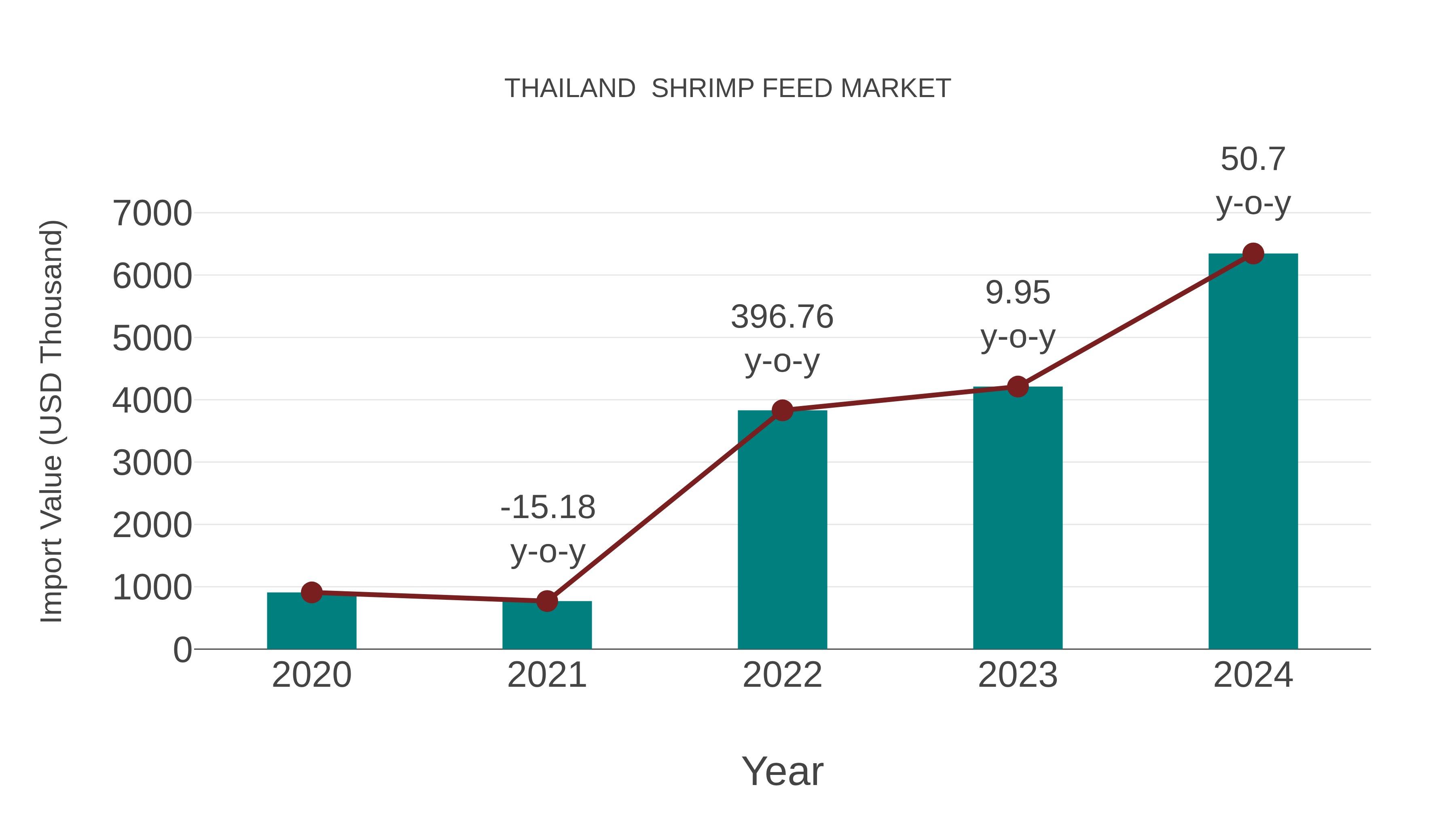
Thailand Shrimp Feed Market Growth Rate
According to 6Wresearch internal database and industry insights, the Thailand Shrimp Feed Market is projected to grow at a compound annual growth rate (CAGR) of 7.4% during the forecast period (2026–2032).
Topics Covered in the Thailand Shrimp Feed Market Report
The Thailand Shrimp Feed Market report comprehensively covers the market by type, ingredients, and additives. This report provides an in-depth analysis of ongoing market trends, opportunities, and market drivers that will be vital for decision makers to align their strategies based on current and future market trends.
Thailand Shrimp Feed Market Highlights
| Report Name |
Thailand Shrimp Feed Market |
| Forecast period | 2026-2032 |
| CAGR | 7.4% |
| Market Size |
Aquaculture & Animal Nutrition |
Thailand Shrimp Feed Market Synopsis
The Thailand Shrimp Feed Market has been registering a massive growth over the past few years as it is supported by country’s position as one of the world's leading shrimp exporters and its large and well-established aquaculture industry. Shrimp farming remains a cornerstone of Thailand's agricultural export economy, and the quality of feed used directly determines the health, growth rate, and profitability of shrimp farms. The demand high-quality, nutritionally complete feed formulations is on the rise in the country as farmers look to improve productivity and reduce losses from disease.
Evaluation of Growth Drivers in Thailand Shrimp Feed Market (2026–2032)
Below mentioned is the table listing major drivers responsible for Thailand Shrimp Feed Market Growth and their influence on market dynamics:
| Drivers | Primary Segment Affected | Why It Matters (Evidence) |
| Strong Shrimp Export Demand | All Feed Types | Country’s position as a major global shrimp exporter keeps commercial farming activity and feed consumption high. |
| Rising Focus on Feed Quality | Grower, Finisher, Starter | To improve shrimp survival rates and reduce overall production costs, farmers look for better quality feeds. |
| Growth in Intensive Farming Practices | Grower, Finisher | There is a high requirement for more nutritionally precise and performance-oriented feed formulations with the rising shift toward high-density shrimp farming. |
| Disease Management Through Nutrition | Additives (Vitamins, Antibiotics, Antioxidants) | Growing disease pressure is pushing farmers to use functional additives that strengthen shrimp immunity and health. |
| Government Support for Aquaculture | All Segments | Thai government programmes promoting sustainable aquaculture are encouraging investment in feed research and quality improvement. |
The Thailand Shrimp Feed Market is projected to exhibit a CAGR of 7.4% during the forecast period (2026–2032). Factors like strong global seafood demand, growing domestic aquaculture investment, and increasing farmer awareness about the nutritional needs of shrimp at different growth stages are likely to drive the market forward. Along with that, advancements in feed formulation technologies and the growing availability of functional feed additives are further improving feed efficiency and shrimp productivity across the country’s farming communities.
Evaluation of Restraints in Thailand Shrimp Feed Market
Below mentioned is the tabular representation of some major restraints and their influence on market dynamics:
| Restraints | Primary Segment Affected | What This Means (Evidence) |
| Volatile Raw Material Prices | Fish Meal, Fish Oil, Soybean Meal | Variations in the cost of key feed ingredients directly increase feed production costs. |
| Disease Outbreaks in Shrimp Farming | All Feed Types | Due to recurring disease episodes such as EMS, there can be a reduction in farm productivity and overall feed demand in affected regions. |
| Environmental Regulations on Farming | All Segments | Stricter aquaculture rules around water use and effluent management may limit farm expansion and feed consumption. |
| Availability of Quality Fish Meal | Fish Meal, Fish Oil | Global fish stocks are declining, and supply constraints on marine-based feed ingredients are creating sourcing challenges for manufacturers. |
| High Cost of Premium Feed Formulations | Additives, Finisher, Grower | The higher price of nutritionally advanced feeds can discourage small-scale farmers from upgrading their feeding programmes. |
Thailand Shrimp Feed Market Challenges
The Thailand Shrimp Feed Market has a number of challenges. The fluctuating prices of important raw materials such as fish meal and soybean meal make it difficult for feed manufacturers to maintain stable pricing and profit margins. Along with that, smaller and independent shrimp farmers typically lack the financial resources to invest in premium feed products which slows the adoption of high-quality formulations. Lastly, disease outbreaks, especially early mortality syndrome, continue to disrupt shrimp farming cycles and reduce feed demand in affected regions.
Thailand Shrimp Feed Market Trends
Below mentioned are some of the major trends in the Thailand Shrimp Feed Market:
- Plant-Based Ingredient Substitution: Rising costs and supply constraints of fish meal are driving its partial replacement with soybean meal and other plant-based proteins without affecting nutrition quality.
- Sustainability & Traceability in Feed Sourcing: Increasing demand from buyers and exporters is pushing feed manufacturers toward certified, transparent, and responsibly sourced ingredient supply chains.
- Digital Feeding Management Tools: There is a rising adoption of automated and data-driven feeding systems in large shrimp farms to reduce feed waste and improve cost efficiency.
Investment Opportunities in the Thailand Shrimp Feed Market
Given below is the comprehensive look at the investment opportunities in the Thailand Shrimp Feed Market:
- Premium & Functional Feed Development: Growing demand for high-performance shrimp feed combining nutrition and disease-prevention additives is driving R&D opportunities and strong commercial returns.
- Alternative Protein Ingredients: Supply constraints in fish meal are accelerating the adoption of alternative protein sources, which include single-cell protein and fermented plant proteins in shrimp feed.
- Feed Additive Manufacturing: Rising awareness of antioxidants, enzymes, and fatty acid supplements is boosting demand for locally produced feed additives with strong margin potential.
Top 5 Leading Players in Thailand Shrimp Feed Market
Below are some of the leading companies holding majority of Thailand Shrimp Feed Market Shares:
1. Charoen Pokphand Foods (CPF)
| Company Name | Charoen Pokphand Foods (CPF) |
|---|---|
| Established Year | 1978 |
| Headquarters | Bangkok, Thailand |
| Official Website | Click Here |
Charoen Pokphand Foods is Thailand's largest agri-food conglomerate and the dominant player in the domestic shrimp feed market. CPF manufactures a comprehensive range of shrimp feeds covering starter, and supplies both its own integrated shrimp farms and independent farmers across the country.
2. Thai Union Group
| Company Name | Thai Union Group |
|---|---|
| Established Year | 1977 |
| Headquarters | Samut Sakhon, Thailand |
| Official Website | Click Here |
Thai Union Group is one of the world's largest seafood companies and an influential player in Thailand's shrimp aquaculture value chain. The company invests actively in sustainable shrimp farming practices and supplies high-quality feed products through its aquaculture division.
3. Betagro Group
| Company Name | Betagro Group |
|---|---|
| Established Year | 1967 |
| Headquarters | Bangkok, Thailand |
| Official Website | Click Here |
Betagro Group is a well-established Thai agribusiness company with a growing aquaculture feed division. It produces shrimp feeds formulated with quality ingredients and functional additives to support healthy shrimp growth across different farming systems.
4. Grobest Group (Thailand)
| Company Name | Grobest Group (Thailand) |
|---|---|
| Established Year | 1991 (Thailand operations) |
| Headquarters | Taipei, Taiwan (Thailand Operations: Samut Sakhon) |
| Official Website | Click Here |
Grobest is a leading specialised aquaculture feed manufacturer with a significant presence in Thailand's shrimp feed market. The company focuses exclusively on aquatic animal nutrition and offers a well-regarded range of shrimp feeds with strong technical support for farmers.
5. Uni-President (Thailand)
| Company Name | Uni-President (Thailand) |
|---|---|
| Established Year | 1990s (Thailand operations) |
| Headquarters | Tainan, Taiwan (Thailand Operations: Bangkok) |
| Official Website | Click Here |
Uni-President is a major regional aquaculture feed producer operating across Southeast Asia, including Thailand. Its shrimp feed range is widely used by commercial farmers and is recognised for offering reliable nutritional performance at competitive price points.
Government Initiatives Implemented in the Thailand Shrimp Feed Market
According to Thai government data, a number of significant programs are implemented to fuel the growth of Thailand’s shrimp aquaculture and feed sector. The Department of Fisheries, within the Ministry of Agriculture and Cooperatives, plays an important role in the regulation of shrimp feed standards, with all commercially available feed products required to fulfill minimum nutritional and safety standards. The National Aquaculture Development Plan promotes sustainable and disease-resilient farming practices, which is indirectly supporting the adoption of higher quality functional feeds.
Future Insights of the Thailand Shrimp Feed Market
The future outlook of the Thailand Shrimp Feed Market is positive with steady growth projected in all feed types and ingredient segments. The demand for nutritionally advanced shrimp feeds is expected to grow as farmers are under increasing pressure to improve productivity and reduce disease-related losses. Alternative proteins will gradually gain ground as replacements for traditional fish meal, while functional additives will become a standard feature of mainstream feed formulations rather than a premium option.
Market Segmentation Analysis
The report offers a detailed study of the following market segments and their leading categories in the Thailand Shrimp Feed Market:
By Type – Grower Feed to Lead the Market
According to Priya, Senior Research Analyst, 6Wresearch, Grower feed holds the largest share of Thailand's shrimp feed market, as it is used during the longest and most feed-intensive phase of the shrimp production cycle. Commercial farmers consume significantly higher volumes of grower feed compared to starter and finisher feeds, making it the dominant category by both volume and revenue.
By Additives – Vitamins and Protein to Lead the Market
Vitamins and protein additives dominate the additives segment, as they are considered essential components of virtually all commercially produced shrimp feeds. Their role in supporting immune function and overall shrimp health makes them a standard inclusion across starter, and finisher feed types.
Key Attractiveness of the Report:
- 10 Years of Market Numbers
- Historical Data Starting from 2022 to 2025
- Base Year: 2025
- Forecast Data until 2032
- Key Performance Indicators Impacting the Market
- Major Upcoming Developments and Projects
Key Highlights of the Report:
- Thailand Shrimp Feed Market Outlook
- Market Size of Thailand Shrimp Feed Market, 2025
- Forecast of Thailand Shrimp Feed Market, 2032
- Historical Data and Forecast of Thailand Shrimp Feed Revenues & Volume for the Period 2022-2032F
- Thailand Shrimp Feed Market Trend Evolution
- Thailand Shrimp Feed Market Drivers and Challenges
- Thailand Shrimp Feed Price Trends
- Thailand Shrimp Feed Porter's Five Forces
- Thailand Shrimp Feed Industry Life Cycle
- Historical Data and Forecast of Thailand Shrimp Feed Market Revenues & Volume By Type for the Period 2022-2032F
- Historical Data and Forecast of Thailand Shrimp Feed Market Revenues & Volume By Grower for the Period 2022-2032F
- Historical Data and Forecast of Thailand Shrimp Feed Market Revenues & Volume By Finisher for the Period 2022-2032F
- Historical Data and Forecast of Thailand Shrimp Feed Market Revenues & Volume By Starter for the Period 2022-2032F
- Historical Data and Forecast of Thailand Shrimp Feed Market Revenues & Volume By Ingredients for the Period 2022-2032F
- Historical Data and Forecast of Thailand Shrimp Feed Market Revenues & Volume By Soybean Meal for the Period 2022-2032F
- Historical Data and Forecast of Thailand Shrimp Feed Market Revenues & Volume By Fish Meal for the Period 2022-2032F
- Historical Data and Forecast of Thailand Shrimp Feed Market Revenues & Volume By Wheat Flour for the Period 2022-2032F
- Historical Data and Forecast of Thailand Shrimp Feed Market Revenues & Volume By Fish Oil for the Period 2022-2032F
- Historical Data and Forecast of Thailand Shrimp Feed Market Revenues & Volume By Additives for the Period 2022-2032F
- Historical Data and Forecast of Thailand Shrimp Feed Market Revenues & Volume By Vitamin and Protein for the Period 2022-2032F
- Historical Data and Forecast of Thailand Shrimp Feed Market Revenues & Volume By Fatty Acid for the Period 2022-2032F
- Historical Data and Forecast of Thailand Shrimp Feed Market Revenues & Volume By Antioxidant for the Period 2022-2032F
- Historical Data and Forecast of Thailand Shrimp Feed Market Revenues & Volume By Feed Enzyme for the Period 2022-2032F
- Historical Data and Forecast of Thailand Shrimp Feed Market Revenues & Volume By Antibiotics for the Period 2022-2032F
- Thailand Shrimp Feed Import Export Trade Statistics
- Market Opportunity Assessment By Type
- Market Opportunity Assessment By Ingredients
- Market Opportunity Assessment By Additives
- Thailand Shrimp Feed Top Companies Market Share
- Thailand Shrimp Feed Competitive Benchmarking By Technical and Operational Parameters
- Thailand Shrimp Feed Company Profiles
- Thailand Shrimp Feed Key Strategic Recommendations
Market Covered
The report offers an extensive study of the following market segments:
By Type
- Grower
- Finisher
- Starter
By Ingredients
- Soybean Meal
- Fish Meal
- Wheat Flour
- Fish Oil
By Additives
- Vitamin and Protein
- Fatty Acid
- Antioxidant
- Feed Enzyme
- Antibiotics
Thailand Shrimp Feed Market (2026-2032): FAQs
Thailand Shrimp Feed Market is anticipated to grow at the compound annual growth rate (CAGR) of 7.4% during the forecast period (2026–2032).
Thailand's Shrimp Feed Market offers strong investment opportunities in premium functional feed development and alternative protein ingredient sourcing.
The Thailand Shrimp Feed Market faces challenges such as volatile raw material prices and recurring disease outbreaks in shrimp farms.
Some of the leading players in the Thailand Shrimp Feed Market are Charoen Pokphand Foods (CPF), Thai Union Group, Betagro Group, Grobest Group, and Uni-President Thailand.
6Wresearch actively monitors the Thailand Shrimp Feed Market and publishes its comprehensive annual report, highlighting emerging trends, growth drivers, revenue analysis, and forecast outlook. Our insights help businesses to make data-backed strategic decisions with ongoing market dynamics. Our analysts track relevent industries related to the Thailand Shrimp Feed Market, allowing our clients with actionable intelligence and reliable forecasts tailored to emerging regional needs.
Yes, we provide customisation as per your requirements. To learn more, feel free to contact us on sales@6wresearch.com
| 1 Executive Summary |
| 2 Introduction |
| 2.1 Key Highlights of the Report |
| 2.2 Report Description |
| 2.3 Market Scope & Segmentation |
| 2.4 Research Methodology |
| 2.5 Assumptions |
| 3 Thailand Shrimp Feed Market Overview |
| 3.1 Thailand Country Macro Economic Indicators |
| 3.2 Thailand Shrimp Feed Market Revenues & Volume, 2022 & 2032F |
| 3.3 Thailand Shrimp Feed Market - Industry Life Cycle |
| 3.4 Thailand Shrimp Feed Market - Porter's Five Forces |
| 3.5 Thailand Shrimp Feed Market Revenues & Volume Share, By Type, 2022 & 2032F |
| 3.6 Thailand Shrimp Feed Market Revenues & Volume Share, By Ingredients, 2022 & 2032F |
| 3.7 Thailand Shrimp Feed Market Revenues & Volume Share, By Additives, 2022 & 2032F |
| 4 Thailand Shrimp Feed Market Dynamics |
| 4.1 Impact Analysis |
| 4.2 Market Drivers |
| 4.3 Market Restraints |
| 5 Thailand Shrimp Feed Market Trends |
| 6 Thailand Shrimp Feed Market, By Types |
| 6.1 Thailand Shrimp Feed Market, By Type |
| 6.1.1 Overview and Analysis |
| 6.1.2 Thailand Shrimp Feed Market Revenues & Volume, By Type, 2022-2032F |
| 6.1.3 Thailand Shrimp Feed Market Revenues & Volume, By Grower, 2022-2032F |
| 6.1.4 Thailand Shrimp Feed Market Revenues & Volume, By Finisher, 2022-2032F |
| 6.1.5 Thailand Shrimp Feed Market Revenues & Volume, By Starter, 2022-2032F |
| 6.2 Thailand Shrimp Feed Market, By Ingredients |
| 6.2.1 Overview and Analysis |
| 6.2.2 Thailand Shrimp Feed Market Revenues & Volume, By Soybean Meal, 2022-2032F |
| 6.2.3 Thailand Shrimp Feed Market Revenues & Volume, By Fish Meal, 2022-2032F |
| 6.2.4 Thailand Shrimp Feed Market Revenues & Volume, By Wheat Flour, 2022-2032F |
| 6.2.5 Thailand Shrimp Feed Market Revenues & Volume, By Fish Oil, 2022-2032F |
| 6.3 Thailand Shrimp Feed Market, By Additives |
| 6.3.1 Overview and Analysis |
| 6.3.2 Thailand Shrimp Feed Market Revenues & Volume, By Vitamin and Protein, 2022-2032F |
| 6.3.3 Thailand Shrimp Feed Market Revenues & Volume, By Fatty Acid, 2022-2032F |
| 6.3.4 Thailand Shrimp Feed Market Revenues & Volume, By Antioxidant, 2022-2032F |
| 6.3.5 Thailand Shrimp Feed Market Revenues & Volume, By Feed Enzyme, 2022-2032F |
| 6.3.6 Thailand Shrimp Feed Market Revenues & Volume, By Antibiotics, 2022-2032F |
| 7 Thailand Shrimp Feed Market Import-Export Trade Statistics |
| 7.1 Thailand Shrimp Feed Market Export to Major Countries |
| 7.2 Thailand Shrimp Feed Market Imports from Major Countries |
| 8 Thailand Shrimp Feed Market Key Performance Indicators |
| 9 Thailand Shrimp Feed Market - Opportunity Assessment |
| 9.1 Thailand Shrimp Feed Market Opportunity Assessment, By Type, 2022 & 2032F |
| 9.2 Thailand Shrimp Feed Market Opportunity Assessment, By Ingredients, 2022 & 2032F |
| 9.3 Thailand Shrimp Feed Market Opportunity Assessment, By Additives, 2022 & 2032F |
| 10 Thailand Shrimp Feed Market - Competitive Landscape |
| 10.1 Thailand Shrimp Feed Market Revenue Share, By Companies, 2025 |
| 10.2 Thailand Shrimp Feed Market Competitive Benchmarking, By Operating and Technical Parameters |
| 11 Company Profiles |
| 12 Recommendations |
| 13 Disclaimer |
Global Go To Market Strategy - 2030
Export potential enables firms to identify high-growth global markets with greater confidence by combining advanced trade intelligence with a structured quantitative methodology. The framework analyzes emerging demand trends and country-level import patterns while integrating macroeconomic and trade datasets such as GDP and population forecasts, bilateral import–export flows, tariff structures, elasticity differentials between developed and developing economies, geographic distance, and import demand projections. Using weighted trade values from 2020–2024 as the base period to project country-to-country export potential for 2030, these inputs are operationalized through calculated drivers such as gravity model parameters, tariff impact factors, and projected GDP per-capita growth. Through an analysis of hidden potentials, demand hotspots, and market conditions that are most favorable to success, this method enables firms to focus on target countries, maximize returns, and global expansion with data, backed by accuracy.
By factoring in the projected importer demand gap that is currently unmet and could be potential opportunity, it identifies the potential for the Exporter (Country) among 190 countries, against the general trade analysis, which identifies the biggest importer or exporter.
To discover high-growth global markets and optimize your business strategy:
Click Here
Pricing
- Single User License$ 1,995
- Department License$ 2,400
- Site License$ 3,120
- Global License$ 3,795

Leadership Perspectives from Industry Events
Search
Thought Leadership and Analyst Meet





Our Clients








6WResearch In News
- India Air Conditioner Market Set for Strong Rebound in 2026 After Weather-Led Correction and GST-Driven Recovery: 6Wresearch
- ADAS in India: How Automatic Emergency Braking, Blind Spot Detection & Driver Monitoring are Transforming Road Safety
- Doha a strategic location for EV manufacturing hub: IPA Qatar
- Demand for luxury TVs surging in the GCC, says Samsung
- Empowering Growth: The Thriving Journey of Bangladesh’s Cable Industry
- Demand for luxury TVs surging in the GCC, says Samsung
Latest Reports
- Nicaragua RPG Gaming Market (2026-2032)
- New Zealand RPG Gaming Market (2026-2032)
- Netherlands RPG Gaming Market (2026-2032)
- Nauru RPG Gaming Market (2026-2032)
- Namibia RPG Gaming Market (2026-2032)
- Mozambique RPG Gaming Market (2026-2032)
- Montenegro RPG Gaming Market (2026-2032)
- Mongolia RPG Gaming Market (2026-2032)
- Monaco RPG Gaming Market (2026-2032)
- Micronesia RPG Gaming Market (2026-2032)
Industry Events and Analyst Meet

EV India Expo 2026

HIMTEX 2026

India Refining Summit 2026

India EV Show 2026

EV tech India Expo 2026
Whitepaper
- Middle East & Africa Commercial Security Market Click here to view more.
- Middle East & Africa Fire Safety Systems & Equipment Market Click here to view more.
- GCC Drone Market Click here to view more.
- Middle East Lighting Fixture Market Click here to view more.
- GCC Physical & Perimeter Security Market Click here to view more.


