Algeria Cigarette Market Size, Share & Growth Rate
The Algeria Cigarette Market was estimated at USD 400 Million in 2025 and is projected to reach USD 540 Million by 2032, growing at a CAGR of 4.4% from 2026 to 2032. This growth trajectory is fueled by a substantial smoking prevalence rate among the adult population, coupled with the steady introduction of premium cigarette brands catering to evolving consumer preferences. Additionally, despite regulatory pressures, the persistent demand for tobacco products reflects the entrenched smoking culture in Algeria, providing a resilient market landscape for manufacturers.
Algeria Cigarette Market Year-wise Growth Rate and Key Drivers
This graph highlights how the Algeria Cigarette Market has steadily grown over the years, supported by major growth factors.
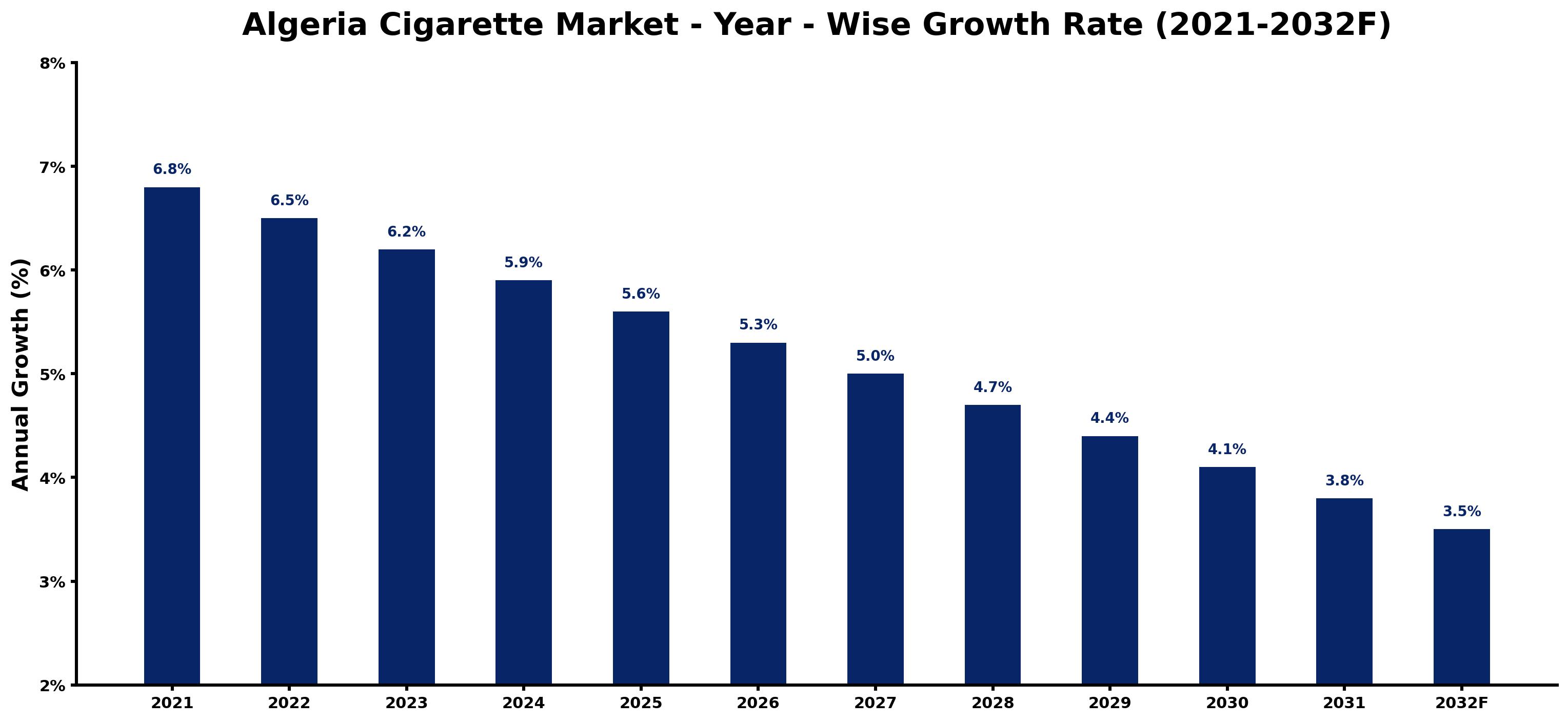
The table below presents the year‑wise growth rates along with the key drivers influencing the market
| Year | Growth Rate | Major Drivers |
| 2021 | 6.8% | Expansion of commercial construction activities |
| 2022 | 6.5% | Growing urbanization and commercial development |
| 2023 | 6.2% | Rapid growth in telecom and data center sectors |
| 2024 | 5.9% | Increasing industrial automation investments |
| 2025 | 5.6% | Increasing smart city development projects |
| 2026 | 5.3% | Technology transition toward sustainable alternatives |
| 2027 | 5.0% | Technology transition toward sustainable alternatives |
| 2028 | 4.7% | Technology transition toward sustainable alternatives |
| 2029 | 4.4% | Environmental regulations reducing traditional demand |
| 2030 | 4.1% | Technology transition toward sustainable alternatives |
| 2031 | 3.8% | Growing adoption of energy efficient systems |
| 2032 | 3.5% | Declining investments in legacy infrastructure |
Note - Market size estimations and growth projections presented in this report are based on 6Wresearch’s advanced forecasting approach, validated with industry datasets as of June 2026.
Algeria Cigarette Market Synopsis
A notable characteristic of the Algeria Cigarette Market is the significant consumption of international cigarette brands. With a growing segment of affluent consumers seeking premium options, brands are increasingly diversifying their offerings to capture this niche market. This trend is indicative of a broader shift towards more sophisticated consumer preferences, even amidst regulatory challenges.
Furthermore, Algeria's regulatory environment is evolving as the government attempts to curb smoking through higher taxes and restrictions on advertising. While these measures aim to reduce consumption and promote public health, they simultaneously create a dynamic marketplace where legitimate manufacturers must innovate to maintain their share amidst rising illicit trade.
Algeria Cigarette Market Key Takeaways
- The market is heavily influenced by international brands meeting diverse consumer demands.
- Government regulations are reshaping advertising practices and consumption patterns.
- Consumer preferences are gradually shifting towards premium and reduced-risk products.
- The prevalence of illicit trade poses significant challenges to legitimate sales.
- Investment opportunities remain robust due to Algeria's substantial smoking population and lower price points compared to global markets.
Evaluation of Restraints in Algeria Cigarette Market
One of the most pressing constraints in the Algeria Cigarette Market is the robust black market for tobacco products. This illegal trade significantly undermines the revenue of lawful manufacturers by providing cheaper alternatives to consumers who are increasingly sensitive to price. Additionally, the high taxation imposed on cigarettes, intended to dissuade smoking, has ironically fueled this black market, making it challenging for legitimate brands to compete effectively. The government's enforcement efforts, while well-intentioned, have met with limited success, complicating the landscape for market participants.
Algeria Cigarette Market Trends
Current trends in the Algeria Cigarette Market indicate a decline in traditional cigarette consumption due to increasing health consciousness among consumers. Stricter government regulations on advertising and smoking in public spaces are also contributing to this shift towards healthier lifestyles. Concurrently, there is a noticeable growth in the demand for alternative nicotine products, reflecting a broader global trend towards reduced-risk options. As a result, manufacturers are investing in research and development to innovate their product lines, catering to these emerging consumer preferences.
Algeria Cigarette Market Opportunities
Despite the challenges posed by regulations and market dynamics, the Algeria Cigarette Market offers substantial growth opportunities. The high prevalence of smoking, coupled with a population exceeding 40 million, creates a considerable consumer base for tobacco products. Investors can capitalize on this by introducing innovative products and leveraging marketing strategies aimed at specific demographics. Moreover, the relatively underdeveloped state of the market compared to global standards presents a fertile ground for new entrants looking to make a mark.
Government Initiatives in the Algeria Cigarette Market
The Algerian government is actively pursuing policies aimed at reducing tobacco consumption and protecting public health. This includes high taxation on tobacco products to deter smoking, as well as stringent regulations on advertising and promotional activities. Smoke-free laws in public areas are intended to safeguard non-smokers from secondhand smoke, reflecting a commitment to public health. Additionally, the government is taking steps to combat illicit trade through various initiatives, aiming to enhance the integrity of the cigarette market.
Future Insights of the Algeria Cigarette Market
Looking ahead to 2026-2032, the Algeria Cigarette Market is anticipated to undergo significant transformations. The ongoing public health campaign against smoking and stringent government regulations are likely to exert continued pressure on traditional cigarette sales. However, growth may be sustained through population increases and the steady demand from existing smokers. Companies that adapt by diversifying their product offerings and focusing on alternative tobacco products will likely find themselves in a position to thrive in this evolving environment.
Algeria Cigarette Market Latest Developments (May 2025 - June 2026)
Recent developments in the Algeria Cigarette Market indicate a growing emphasis on product innovation and marketing strategies tailored to shifting consumer preferences. Manufacturers are increasingly investing in research to develop reduced-risk products and premium offerings that resonate with health-conscious consumers. Additionally, the government's enforcement of anti-smoking laws continues to evolve, impacting advertising strategies and market entry approaches for new brands. Overall, the market landscape is dynamic, characterized by both regulatory adaptations and consumer shifts.
Algeria Cigarette Market - Key Attractiveness of the Report
- 10 Years of Market Numbers
- Historical Data Starting from 2022 to 2025
- Base Year: 2025
- Forecast Data until 2032
- Key Performance Indicators Impacting the Market
- Major Upcoming Developments and Projects
Key Highlights of the Report:
- Algeria Cigarette? Market Outlook
- Market Size of Algeria Cigarette? Market, 2025
- Forecast of Algeria Cigarette? Market, 2032
- Historical Data and Forecast of Algeria Cigarette? Revenues & Volume for the Period 2022-2032F
- Algeria Cigarette? Market Trend Evolution
- Algeria Cigarette? Market Drivers and Challenges
- Algeria Cigarette? Price Trends
- Algeria Cigarette? Porter's Five Forces
- Algeria Cigarette? Industry Life Cycle
- Historical Data and Forecast of Algeria Cigarette? Market Revenues & Volume By Type for the Period 2022-2032F
- Historical Data and Forecast of Algeria Cigarette? Market Revenues & Volume By Light for the Period 2022-2032F
- Historical Data and Forecast of Algeria Cigarette? Market Revenues & Volume By Medium for the Period 2022-2032F
- Historical Data and Forecast of Algeria Cigarette? Market Revenues & Volume By Others for the Period 2022-2032F
- Historical Data and Forecast of Algeria Cigarette? Market Revenues & Volume By Distribution Channel for the Period 2022-2032F
- Historical Data and Forecast of Algeria Cigarette? Market Revenues & Volume By Tobacco Shops for the Period 2022-2032F
- Historical Data and Forecast of Algeria Cigarette? Market Revenues & Volume By Supermarket and Hypermarkets for the Period 2022-2032F
- Historical Data and Forecast of Algeria Cigarette? Market Revenues & Volume By Convenience Stores for the Period 2022-2032F
- Historical Data and Forecast of Algeria Cigarette? Market Revenues & Volume By Online Stores for the Period 2022-2032F
- Historical Data and Forecast of Algeria Cigarette? Market Revenues & Volume By Others for the Period 2022-2032F
- Algeria Cigarette? Import Export Trade Statistics
- Market Opportunity Assessment By Type
- Market Opportunity Assessment By Distribution Channel
- Algeria Cigarette? Top Companies Market Share
- Algeria Cigarette? Competitive Benchmarking By Technical and Operational Parameters
- Algeria Cigarette? Company Profiles
- Algeria Cigarette? Key Strategic Recommendations






































