Algeria Cloud Security Market Size & Growth Rate (2026-2032)
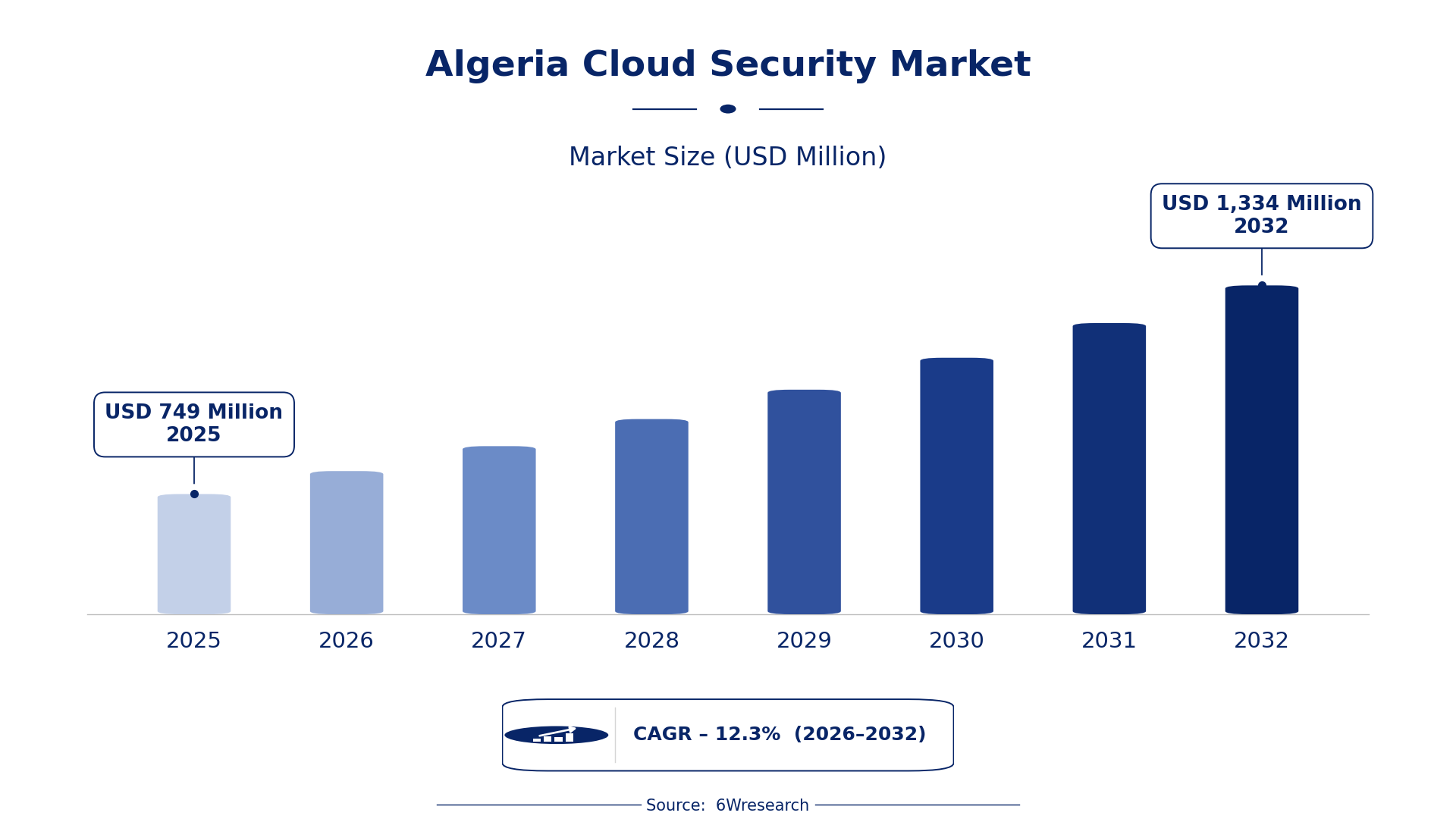
The Algeria Cloud Security Market was estimated at USD 749 Million in 2025 and is projected to reach USD 1334 Million by 2032, growing at a CAGR of 12.3% from 2026 to 2032.
Algeria Cloud Security Market Synopsis
As Algeria's organizations increasingly embrace digital transformation, there is a distinct uptick in demand for cloud-native security solutions. This shift is spurred by the urgent need to protect sensitive data and applications that are increasingly migrating to the cloud.
The adoption of cloud security measures is essential for organizations facing mounting pressure from regulatory compliance and the threat of cyberattacks. Solutions that incorporate encryption, access controls, and threat intelligence are becoming critical assets in ensuring data integrity and security in these environments.
Algeria Cloud Security Market Year-wise Growth Rate and Key Drivers
This graph illustrates the annual growth rates of the Algeria Cloud Security Market from 2021 to 2032, highlighting a steady upward trajectory and projected expansion over the forecast period.
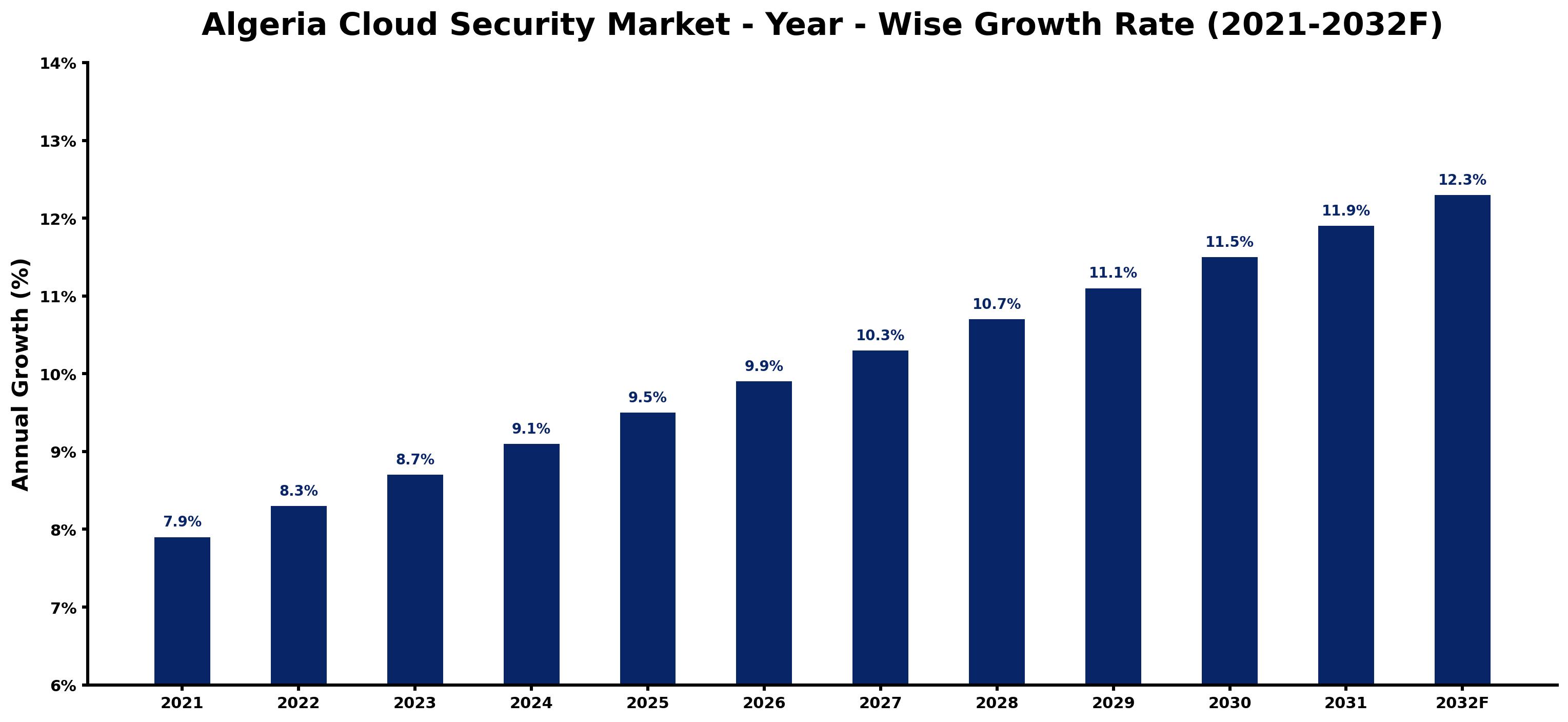
The table below presents the year‑wise growth rates along with the key drivers influencing the market
| Year | Growth Rate | Major Drivers |
| 2021 | 7.9% | Algerian government mandates cybersecurity measures for digital services |
| 2022 | 8.3% | Growth in remote work driving cloud security needs |
| 2023 | 8.7% | Increased mobile banking usage prompting security enhancements |
| 2024 | 9.1% | Cybersecurity awareness campaigns influence enterprise security investments |
| 2025 | 9.5% | Regulatory pressure on data protection spurs cloud adoption |
| 2026 | 9.9% | Telecom sector expansion boosts secure cloud infrastructure demand |
| 2027 | 10.3% | Partnerships with global tech firms strengthen local security capabilities |
| 2028 | 10.7% | Growing e-commerce sector amplifies need for cloud security solutions |
| 2029 | 11.1% | Government incentives for digital transformation drive cloud security purchases |
| 2030 | 11.5% | Rising cyber threat landscape prompts security upgrades |
| 2031 | 11.9% | Increased digitalization of public services demands enhanced security |
| 2032 | 12.3% | Local startups prioritize security in cloud-based innovations |
Note: Market size estimations and growth projections presented in this report are based on 6Wresearch's proprietary forecasting methodology, utilizing the latest available industry data, government publications, and primary research inputs.
Algeria Cloud Security Market Key Takeaways
Below are some of the specific key takeaways from the market, including:
- Significant growth in cloud security adoption driven by increased digital transformation initiatives.
- Organizations are prioritizing solutions that enhance data protection and compliance management.
- The need for threat detection and response capabilities is becoming a major focus.
- Concerns over evolving cyber threats continue to shape security investments in cloud environments.
- Government policies are actively pushing for enhanced cybersecurity measures among enterprises.
Evaluation of Restraints in Algeria Cloud Security Market
Despite the strong market potential, several constraints hinder growth in Algeria's cloud security sector. One major issue is the difficulty organizations face in keeping pace with rapidly evolving cybersecurity threats. on top of that, many enterprises struggle to comply with data protection regulations effectively. Issues such as misconfigurations in cloud-native applications and balancing security with operational performance present ongoing challenges. Companies must also invest in robust identity and access management systems to secure their cloud environments effectively.
Algeria Cloud Security Market Trends
Current trends in the Algeria Cloud Security Market reveal a strong inclination towards automation in threat detection and response. Organizations are increasingly utilizing artificial intelligence and machine learning to enhance their security postures. on top of that, the shift towards hybrid cloud environments necessitates solutions that provide visibility and security across diverse infrastructures. As regulatory frameworks tighten, there is a growing emphasis on compliance management capabilities within cloud security solutions.
Algeria Cloud Security Market Opportunities
Genuine growth opportunities are emerging in sectors such as financial services and healthcare, where sensitive data protection is paramount. Companies can capitalize on the demand for tailored cloud security solutions that meet industry-specific compliance requirements. Additionally, partnerships with technology vendors to enhance service offerings can lead to competitive advantages. The rising awareness of cybersecurity among Algerian businesses further drives the need for comprehensive security frameworks.
Government Initiatives in the Algeria Cloud Security Market
The Algerian government is actively engaged in shaping the cloud security market by implementing robust policies aimed at enhancing cybersecurity. With increasing cyber threats, public sector priorities are centered around ensuring the safety of cloud-based assets through established standards and practices. Such initiatives are vital for building confidence in cloud solutions and fostering a secure digital ecosystem.
- A recently completed national cybersecurity framework introduced stringent regulations for data protection in cloud services.
- Ongoing government-backed training programs aim to enhance skills in cybersecurity among IT professionals.
- A planned public-private partnership initiative set to launch in 2026 aims to bolster cloud infrastructure and security capabilities across sectors.
- The introduction of compliance mandates expected in late 2025 will require companies to adhere to updated encryption and access control standards.
Future Insights of the Algeria Cloud Security Market
Looking ahead to the period from 2026 to 2032, the Algeria Cloud Security Market is positioned for substantial growth. Increasing digitalization efforts among businesses will drive demand for sophisticated security solutions. As organizations transition to more complex cloud environments, their need for advanced threat detection and response capabilities will intensify. Those providers who can deliver innovative, scalable solutions tailored to local regulatory requirements will likely capture significant market share.
Algeria Cloud Security Market Latest Developments
In the past year, the Algeria Cloud Security Market has witnessed notable developments focusing on enhanced cybersecurity measures and technological advancements. With growing recognition of the threats to data integrity, organizations are increasingly prioritizing investments in security solutions.
- A major technology vendor rolled out a new cloud security platform in early 2025, featuring advanced encryption and threat intelligence capabilities.
- An ongoing initiative started in mid-2025 aims to upgrade existing cloud infrastructure across governmental organizations to improve security standards.
- By late 2026, a consortium of local IT firms plans to launch a cloud-native security service designed to address specific compliance needs.
- A regional operator announced its commitment to enhancing data privacy measures in its cloud offerings, with implementation set to occur by mid-2026.
Algeria Cloud Security Market - Key Attractiveness of the Report
- 10 Years of Market Numbers
- Historical Data Starting from 2022 to 2025
- Base Year: 2025
- Forecast Data until 2032
- Key Performance Indicators Impacting the Market
- Major Upcoming Developments and Projects
Key Highlights of the Report:
- Algeria Cloud Security Market Outlook
- Market Size of Algeria Cloud Security Market, 2025
- Forecast of Algeria Cloud Security Market, 2032
- Historical Data and Forecast of Algeria Cloud Security Revenues & Volume for the Period 2022-2032F
- Algeria Cloud Security Market Trend Evolution
- Algeria Cloud Security Market Drivers and Challenges
- Algeria Cloud Security Price Trends
- Algeria Cloud Security Porter's Five Forces
- Algeria Cloud Security Industry Life Cycle
- Historical Data and Forecast of Algeria Cloud Security Market Revenues & Volume By Application for the Period 2022-2032F
- Historical Data and Forecast of Algeria Cloud Security Market Revenues & Volume By Visibility for the Period 2022-2032F
- Historical Data and Forecast of Algeria Cloud Security Market Revenues & Volume By Risk Assessment for the Period 2022-2032F
- Historical Data and Forecast of Algeria Cloud Security Market Revenues & Volume By User for the Period 2022-2032F
- Historical Data and Forecast of Algeria Cloud Security Market Revenues & Volume By Data Governance for the Period 2022-2032F
- Historical Data and Forecast of Algeria Cloud Security Market Revenues & Volume By Vertical for the Period 2022-2032F
- Historical Data and Forecast of Algeria Cloud Security Market Revenues & Volume By BFSI for the Period 2022-2032F
- Historical Data and Forecast of Algeria Cloud Security Market Revenues & Volume By IT for the Period 2022-2032F
- Historical Data and Forecast of Algeria Cloud Security Market Revenues & Volume By ITeS for the Period 2022-2032F
- Historical Data and Forecast of Algeria Cloud Security Market Revenues & Volume By Retail for the Period 2022-2032F
- Historical Data and Forecast of Algeria Cloud Security Market Revenues & Volume By Organization Size for the Period 2022-2032F
- Historical Data and Forecast of Algeria Cloud Security Market Revenues & Volume By Large Enterprises for the Period 2022-2032F
- Historical Data and Forecast of Algeria Cloud Security Market Revenues & Volume By SMEs for the Period 2022-2032F
- Historical Data and Forecast of Algeria Cloud Security Market Revenues & Volume By Security Type for the Period 2022-2032F
- Historical Data and Forecast of Algeria Cloud Security Market Revenues & Volume By Perimeter Security for the Period 2022-2032F
- Historical Data and Forecast of Algeria Cloud Security Market Revenues & Volume By Network Security for the Period 2022-2032F
- Historical Data and Forecast of Algeria Cloud Security Market Revenues & Volume By Endpoint Security for the Period 2022-2032F
- Historical Data and Forecast of Algeria Cloud Security Market Revenues & Volume By Application Security for the Period 2022-2032F
- Historical Data and Forecast of Algeria Cloud Security Market Revenues & Volume By Others for the Period 2022-2032F
- Historical Data and Forecast of Algeria Cloud Security Market Revenues & Volume By Service Model for the Period 2022-2032F
- Historical Data and Forecast of Algeria Cloud Security Market Revenues & Volume By IaaS for the Period 2022-2032F
- Historical Data and Forecast of Algeria Cloud Security Market Revenues & Volume By PaaS for the Period 2022-2032F
- Historical Data and Forecast of Algeria Cloud Security Market Revenues & Volume By SaaS for the Period 2022-2032F
- Algeria Cloud Security Import Export Trade Statistics
- Market Opportunity Assessment By Application
- Market Opportunity Assessment By Vertical
- Market Opportunity Assessment By Organization Size
- Market Opportunity Assessment By Security Type
- Market Opportunity Assessment By Service Model
- Algeria Cloud Security Top Companies Market Share
- Algeria Cloud Security Competitive Benchmarking By Technical and Operational Parameters
- Algeria Cloud Security Company Profiles
- Algeria Cloud Security Key Strategic Recommendations






































