Algeria Industrial Gases Market Summary
The algeria industrial gases market was estimated at USD 116 Million in 2025 and is projected to reach USD 128 Million by 2032, growing at a CAGR of 1.2% from 2026 to 2032.
Algeria Industrial Gases Market Year-wise Growth Rate and Key Drivers
This graph highlights how the Algeria Industrial Gases Market has steadily grown over the past five years, supported by major growth factors.
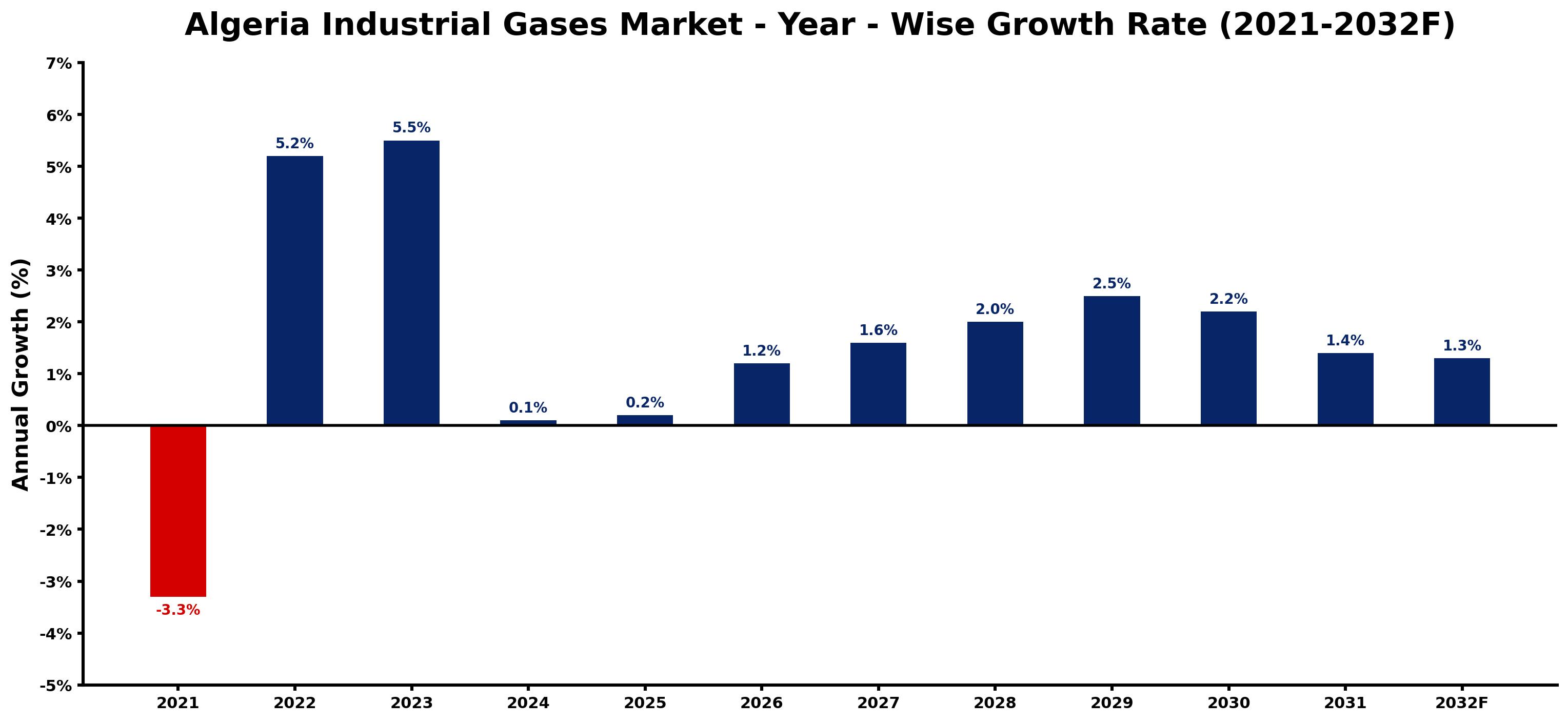
The table below presents the year wise growth rates along with the key drivers influencing the market
| Year | Growth Rate | Major Drivers |
| 2021 | -3.3% | Supply chain disruptions due to global logistical challenges hindered timely distribution of industrial gases in Algeria. |
| 2022 | 5.2% | Local industries increasingly seek efficient solutions to support their operational needs. |
| 2023 | 5.5% | International partnerships expand technological access and enhance production capabilities. |
| 2024 | 0.1% | Investment in infrastructure projects enhances the need for industrial gas supplies. |
| 2025 | 0.2% | Oil and gas sector reform drives interest in innovative processing technologies. |
| 2026 | 1.2% | Construction activity surges due to urbanization, creating higher gas consumption rates. |
| 2027 | 1.6% | Global supply chain adjustments promote local gas production and processing initiatives. |
| 2028 | 2.0% | Increased focus on cleaner production methods drives demand for specialty gases. |
| 2029 | 2.5% | Regional competition among industrial gas companies stimulates market innovation and efficiency. |
| 2030 | 2.2% | Development of renewable energy projects demands specialized gas applications and logistics. |
| 2031 | 1.4% | Technological breakthroughs in gas separation methods enhance production efficiency significantly. |
| 2032 | 1.3% | Evolving customer needs require tailored gas solutions across diverse industrial applications. |
Note - Market size estimations and growth projections presented in this report are based on 6Wresearch's advanced forecasting approach, validated with industry datasets as of June 2026.
Algeria Industrial Gases Market Synopsis
The Algeria Industrial Gases Market is projected to reach 1.2% and witness significant growth during the forecast period (2026-2032). A combination of robust industrial activities and infrastructural advancements is propelling the demand for industrial gases across multiple sectors. Key industries such as healthcare, manufacturing, and metallurgy are increasingly utilizing these gases, driving the market's steady expansion.
Algeria Industrial Gases Market Growth Drivers
The growth of the Algeria Industrial Gases Market is primarily fueled by various factors. Firstly, the surge in industrialization across the country is creating higher demand for gases in manufacturing processes. Secondly, ongoing infrastructure development initiatives are enhancing the capacity for gas production and distribution. Thirdly, government policies aimed at attracting foreign investment are encouraging new entrants into the market. Furthermore, the healthcare sector's increasing use of industrial gases for medical applications is contributing to sustained demand. Lastly, the rising need for industrial gases in applications such as welding, cutting, and packaging is further driving market growth.
Algeria Industrial Gases Market Trends and Opportunities
Several notable trends are shaping the Algeria Industrial Gases Market. A significant trend is the growing emphasis on sustainable practices, prompting industries to adopt eco-friendly gases and technologies. Moreover, advancements in gas production and supply chain technologies are promoting greater efficiency and cost-effectiveness. Another emerging trend is the collaboration between industrial gas suppliers and end-user industries focusing on tailored solutions that meet specific needs. The increasing demand for high-purity gases in electronics manufacturing also presents opportunities for market players to innovate and cater to this niche. Overall, the market is positioning itself for growth amid evolving industry demands and technological advancements.
Algeria Industrial Gases Market Challenges and Restraints
Despite the positive trajectory, the Algeria Industrial Gases Market faces several challenges. Regulatory constraints often lead to slow approval processes for new projects, which can hinder market entry and expansion efforts. Additionally, the existing infrastructure for gas distribution is underdeveloped in comparison to other regions, complicating logistics for suppliers. The presence of well-established international competitors can also pose a challenge for local companies, making it difficult for them to gain market share. Furthermore, economic fluctuations and political uncertainties can impact investment decisions, adding another layer of complexity to market operations. Addressing these challenges will require strategic investments and proactive engagement with regulatory bodies.
Algeria Industrial Gases Market Investment Opportunities
The Algeria Industrial Gases Market offers an array of investment opportunities fueled by the growing industrial base. Key opportunities include establishing new production plants for essential industrial gases like oxygen, nitrogen, and argon to meet escalating demand. Expanding distribution networks is crucial for reaching a broader customer base, particularly in remote regions. Additionally, investments in research and development to pioneer innovative gas applications can provide a competitive advantage in a rapidly changing market landscape. The government's support for industrial growth further enhances the potential for long-term profitability in the industrial gases sector.
Algeria Industrial Gases Market Government Investment and Initiatives
The Algerian government is actively promoting the industrial gases market through various initiatives designed to enhance local production capabilities and ensure supply security. Current policies focus on encouraging public-private partnerships to foster technological advances in gas production. Additionally, the government has introduced regulations aimed at simplifying the operational framework for industrial gas companies, aiming to attract foreign investment and promote local content in production processes. Incentives such as tax breaks and subsidies are also being offered to stimulate investment in the sector, enhancing the overall competitiveness of Algeria's industrial gases market. Furthermore, quality standards and safety regulations are being enforced to ensure safe handling and distribution practices within the market.
Algeria Industrial Gases Market Latest Developments (May 2025 - June 2026)
In the period between May 2025 and June 2026, the Algeria Industrial Gases Market has observed several important developments. Industry stakeholders are increasingly prioritizing sustainability, reflecting a shift towards the adoption of greener technologies in gas production. Moreover, advancements in distribution logistics are being implemented to enhance efficiency and customer service across various sectors. Collaborative efforts between local industries and international technology partners are emerging to create innovative gas applications tailored to specific industrial needs. Additionally, the government's recent initiatives to streamline regulatory processes have resulted in increased investment interest from both domestic and international firms, further energizing the market's development landscape.
Algeria Industrial Gases Market - Key Attractiveness of the Report
- 10 Years of Market Numbers
- Historical Data Starting from 2022 to 2025
- Base Year: 2025
- Forecast Data until 2032
- Key Performance Indicators Impacting the Market
- Major Upcoming Developments and Projects
Key Highlights of the Report:
- Algeria Industrial Gases Market Outlook
- Market Size of Algeria Industrial Gases Market, 2025
- Forecast of Algeria Industrial Gases Market, 2032F
- Historical Data and Forecast of Algeria Industrial Gases Revenues & Volume for the Period 2022-2032F
- Algeria Industrial Gases Market Trend Evolution
- Algeria Industrial Gases Market Drivers and Challenges
- Algeria Industrial Gases Price Trends
- Algeria Industrial Gases Porter's Five Forces
- Algeria Industrial Gases Industry Life Cycle
- Historical Data and Forecast of Algeria Industrial Gases Market Revenues & Volume By Product Type for the Period 2022-2032F
- Historical Data and Forecast of Algeria Industrial Gases Market Revenues & Volume By Oxygen for the Period 2022-2032F
- Historical Data and Forecast of Algeria Industrial Gases Market Revenues & Volume By Nitrogen for the Period 2022-2032F
- Historical Data and Forecast of Algeria Industrial Gases Market Revenues & Volume By Hydrogen for the Period 2022-2032F
- Historical Data and Forecast of Algeria Industrial Gases Market Revenues & Volume By Carbon Dioxide for the Period 2022-2032F
- Historical Data and Forecast of Algeria Industrial Gases Market Revenues & Volume By Acetylene for the Period 2022-2032F
- Historical Data and Forecast of Algeria Industrial Gases Market Revenues & Volume By Argon for the Period 2022-2032F
- Historical Data and Forecast of Algeria Industrial Gases Market Revenues & Volume By Others for the Period 2022-2032F
- Historical Data and Forecast of Algeria Industrial Gases Market Revenues & Volume By Application for the Period 2022-2032F
- Historical Data and Forecast of Algeria Industrial Gases Market Revenues & Volume By Healthcare for the Period 2022-2032F
- Historical Data and Forecast of Algeria Industrial Gases Market Revenues & Volume By Manufacturing for the Period 2022-2032F
- Historical Data and Forecast of Algeria Industrial Gases Market Revenues & Volume By Metallurgy & Glasses for the Period 2022-2032F
- Historical Data and Forecast of Algeria Industrial Gases Market Revenues & Volume By Food & Beverage for the Period 2022-2032F
- Historical Data and Forecast of Algeria Industrial Gases Market Revenues & Volume By Retail for the Period 2022-2032F
- Historical Data and Forecast of Algeria Industrial Gases Market Revenues & Volume By Chemicals & Energy for the Period 2022-2032F
- Historical Data and Forecast of Algeria Industrial Gases Market Revenues & Volume By Others for the Period 2022-2032F
- Historical Data and Forecast of Algeria Industrial Gases Market Revenues & Volume By Distribution for the Period 2022-2032F
- Historical Data and Forecast of Algeria Industrial Gases Market Revenues & Volume By On-site for the Period 2022-2032F
- Historical Data and Forecast of Algeria Industrial Gases Market Revenues & Volume By Bulk (Liquid Gas Transport) for the Period 2022-2032F
- Historical Data and Forecast of Algeria Industrial Gases Market Revenues & Volume By Cylinder (Merchant) for the Period 2022-2032F
- Algeria Industrial Gases Import Export Trade Statistics
- Market Opportunity Assessment By Product Type
- Market Opportunity Assessment By Application
- Market Opportunity Assessment By Distribution
- Algeria Industrial Gases Top Companies Market Share
- Algeria Industrial Gases Competitive Benchmarking By Technical and Operational Parameters
- Algeria Industrial Gases Company Profiles
- Algeria Industrial Gases Key Strategic Recommendations






































