Algeria LTE IoT Market Size & Growth Rate (2026-2032)
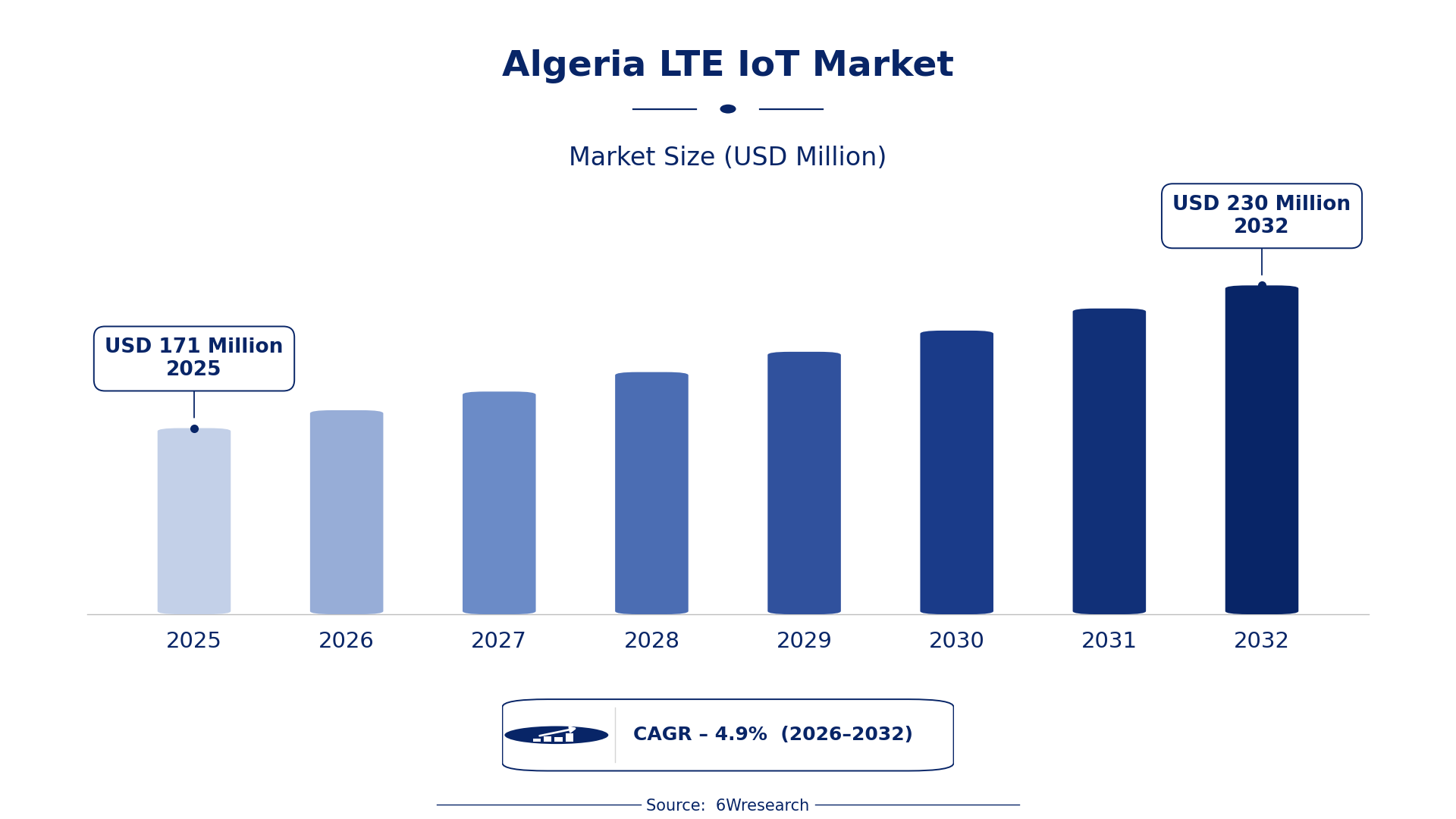
The Algeria LTE IoT Market was estimated at USD 171 Million in 2025 and is projected to reach USD 230 Million by 2032, growing at a CAGR of 4.9% from 2026 to 2032.
Algeria LTE IoT Market Synopsis
Algeria's adoption of LTE IoT technology is being driven by its growing agricultural sector, which relies on smart farming solutions for improved yields. As businesses in agriculture, healthcare, and transportation embrace IoT applications, the demand for reliable connectivity intensifies, pushing market growth forward.
The expansion of LTE networks across Algeria facilitates this rapid uptake, ensuring robust communication for a myriad of IoT devices. As the government emphasizes digital transformation initiatives, local enterprises increasingly recognize the advantages of implementing LTE IoT solutions to streamline operations and enhance service delivery.
Algeria LTE IoT Market Year-wise Growth Rate and Key Drivers
This graph illustrates the annual growth rates of the Algeria LTE IoT Market from 2021 to 2032, highlighting a steady upward trajectory and projected expansion over the forecast period.
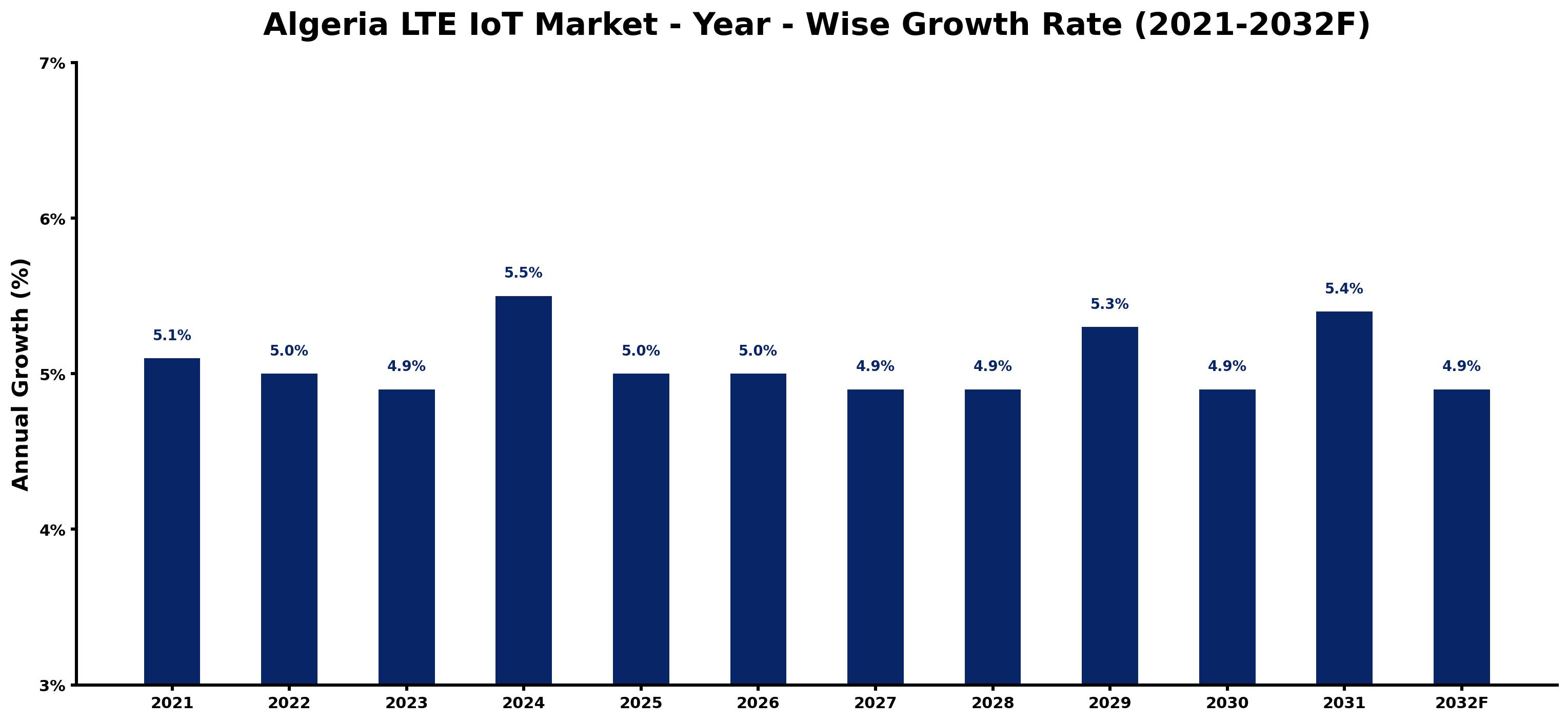
The table below presents the year‑wise growth rates along with the key drivers influencing the market
| Year | Growth Rate | Major Drivers |
| 2021 | 5.1% | Algeria's national IoT strategy promotes LTE network expansion. |
| 2022 | 5.0% | Increased demand for remote agricultural monitoring applications. |
| 2023 | 4.9% | Government incentives for smart city IoT projects boost adoption. |
| 2024 | 5.5% | Telecom Algeria enhances LTE coverage for IoT connectivity. |
| 2025 | 5.0% | Rising smart home technology adoption increases IoT usage. |
| 2026 | 5.0% | Growing urbanization drives demand for IoT-enabled services. |
| 2027 | 4.9% | Local startups innovate IoT solutions for logistics optimization. |
| 2028 | 4.9% | Telecommunications regulations favor expanded LTE IoT infrastructure. |
| 2029 | 5.3% | Public-private partnerships fund smart grid IoT developments. |
| 2030 | 4.9% | Consumer interest in connected devices sustains market momentum. |
| 2031 | 5.4% | Government-backed initiatives support digital transformation in industries. |
| 2032 | 4.9% | Expanding industrial IoT applications enhance operational efficiency. |
Note: Market size estimations and growth projections presented in this report are based on 6Wresearch's proprietary forecasting methodology, utilizing the latest available industry data, government publications, and primary research inputs.
Algeria LTE IoT Market Key Takeaways
Below are some of the specific key takeaways from the market, including:
- Growing demand for IoT solutions in agriculture, healthcare, and smart cities.
- Government initiatives are actively supporting LTE IoT development and deployment.
- Challenges like limited rural LTE coverage and high data costs persist.
- Investment in infrastructure and tailored IoT solutions remains crucial for market growth.
- Emerging technologies such as LTE-M and NB-IoT are enabling cost-effective connectivity.
Evaluation of Restraints in Algeria LTE IoT Market
Algeria’s LTE IoT market faces significant hurdles that could curtail its full potential. Limited LTE network coverage in rural regions poses a major challenge, inhibiting IoT devices from functioning optimally where connectivity is weak. High data costs further deter adoption, particularly for businesses looking to invest in these technologies. Additionally, concerns regarding security and data privacy linger, raising apprehensions among potential users. The scarcity of skilled professionals to develop and manage IoT solutions compounds these issues, indicating a need for a focus on education and workforce training in this sector.
Algeria LTE IoT Market Trends
Several trends are shaping the Algeria LTE IoT market. The implementation of LTE-M and NB-IoT technologies is proving instrumental in providing efficient and cost-effective connectivity for applications such as asset tracking and remote monitoring. Furthermore, an increasing awareness of the operational efficiencies IoT can bring to various sectors is driving adoption. Telecom operators are ramping up efforts to expand LTE networks, which is essential to support a burgeoning ecosystem of connected devices.
Algeria LTE IoT Market Opportunities
The Algeria LTE IoT market presents a range of investment opportunities, particularly as the nation continues its push towards enhancing telecommunications infrastructure. The rise in IoT adoption across sectors such as manufacturing and transportation signals strong demand for reliable connectivity solutions. There is significant potential for partnerships in the implementation of smart city projects and digital transformation initiatives. As Algeria’s economy continues to digitalize, the need for innovative IoT solutions tailored to local businesses will grow.
Government Initiatives in the Algeria LTE IoT Market
The Algerian government is increasingly prioritizing the development and deployment of LTE IoT technology, reflected in several strategic initiatives. Regulatory frameworks have been established to support the integration of IoT solutions across industries. This effort includes addressing cybersecurity and data protection measures crucial for user trust in IoT applications. Such policy actions are pivotal for driving growth in the LTE IoT sector.
- A national regulatory framework implemented in 2025 to promote IoT deployment.
- Ongoing initiatives aimed at expanding LTE network coverage into rural areas.
- Recent allocation of spectrum specifically for IoT devices to enhance connectivity.
- A planned cybersecurity enhancement program set to commence in 2026 to safeguard IoT infrastructures.
- Government incentives for private companies investing in IoT infrastructure currently underway.
Future Insights of the Algeria LTE IoT Market
Looking ahead to 2026-2032, the Algeria LTE IoT market appears well-positioned for growth, driven by an increasing inclination among businesses to adopt IoT solutions. With advancements in connected devices and a greater focus on efficiency, the uptake of LTE IoT technologies is expected to accelerate. Government-supported initiatives aimed at digital transformation will further bolster market expansion. As more stakeholders recognize the operational benefits of IoT, the market will likely see a surge in investment and innovation.
Algeria LTE IoT Market Latest Developments
Recent developments in the Algeria LTE IoT market showcase an industry in transition, actively embracing new technologies and partnerships. Over the past year, key players in the telecommunications sector have ramped up their efforts to enhance infrastructure capabilities, aligning with the government's digital agenda. This momentum is indicative of a growing recognition of the value of IoT solutions.
- A major technology vendor launched an IoT platform designed for smart agriculture solutions in early 2025.
- An ongoing partnership between telecom operators to expand network coverage into underserved areas was initiated in mid-2025.
- A rollout of a new IoT security framework began in late 2025 to bolster data protection measures.
- Current efforts focus on establishing pilot projects for smart city applications, set to launch by early 2026.
- A planned public-private collaboration is expected to enhance data connectivity for IoT devices by 2027.
Algeria LTE IoT Market - Key Attractiveness of the Report
- 10 Years of Market Numbers
- Historical Data Starting from 2022 to 2025
- Base Year: 2025
- Forecast Data until 2032
- Key Performance Indicators Impacting the Market
- Major Upcoming Developments and Projects
The growth in the Algeria LTE IoT market is primarily driven by the increasing adoption of IoT technologies across sectors such as agriculture, healthcare, and smart cities. The government’s digital transformation initiatives are also pivotal.
Limited LTE network coverage, particularly in rural regions, high data costs, and security concerns around data privacy are primary challenges that could impede the market’s growth.
Key Highlights of the Report:
- Algeria LTE IoT Market Outlook
- Market Size of Algeria LTE IoT Market, 2025
- Forecast of Algeria LTE IoT Market, 2032
- Historical Data and Forecast of Algeria LTE IoT Revenues & Volume for the Period 2022-2032F
- Algeria LTE IoT Market Trend Evolution
- Algeria LTE IoT Market Drivers and Challenges
- Algeria LTE IoT Price Trends
- Algeria LTE IoT Porter's Five Forces
- Algeria LTE IoT Industry Life Cycle
- Historical Data and Forecast of Algeria LTE IoT Market Revenues & Volume By Technology for the Period 2022-2032F
- Historical Data and Forecast of Algeria LTE IoT Market Revenues & Volume By NB-IoT for the Period 2022-2032F
- Historical Data and Forecast of Algeria LTE IoT Market Revenues & Volume By LTE-M for the Period 2022-2032F
- Historical Data and Forecast of Algeria LTE IoT Market Revenues & Volume By Service for the Period 2022-2032F
- Historical Data and Forecast of Algeria LTE IoT Market Revenues & Volume By Professional Services for the Period 2022-2032F
- Historical Data and Forecast of Algeria LTE IoT Market Revenues & Volume By Managed Services for the Period 2022-2032F
- Historical Data and Forecast of Algeria LTE IoT Market Revenues & Volume By Industry for the Period 2022-2032F
- Historical Data and Forecast of Algeria LTE IoT Market Revenues & Volume By Manufacturing for the Period 2022-2032F
- Historical Data and Forecast of Algeria LTE IoT Market Revenues & Volume By Energy and utilities for the Period 2022-2032F
- Historical Data and Forecast of Algeria LTE IoT Market Revenues & Volume By Transportation and logistics for the Period 2022-2032F
- Historical Data and Forecast of Algeria LTE IoT Market Revenues & Volume By Healthcare for the Period 2022-2032F
- Historical Data and Forecast of Algeria LTE IoT Market Revenues & Volume By Agriculture for the Period 2022-2032F
- Algeria LTE IoT Import Export Trade Statistics
- Market Opportunity Assessment By Technology
- Market Opportunity Assessment By Service
- Market Opportunity Assessment By Industry
- Algeria LTE IoT Top Companies Market Share
- Algeria LTE IoT Competitive Benchmarking By Technical and Operational Parameters
- Algeria LTE IoT Company Profiles
- Algeria LTE IoT Key Strategic Recommendations






































