Algeria Military Night Vision Device Market (2026-2032) Outlook | Industry, Value, Analysis, Trends, Growth, Forecast, Companies, Size, Share & Revenue
Market Forecast By Type (Goggles, Cameras, Scopes/Tubes), By Technology (Image intensifier, Thermal imaging), By Application (Infantry Weapon Sights, Gunner Sights, Naval Trackers, Remotely Piloted Vehicles, Driving Sights) And Competitive Landscape
| Product Code: ETC367311 | Publication Date: Aug 2022 | Updated Date: Jul 2026 | Product Type: Market Research Report | |
| Publisher: 6Wresearch | Author: Sumit Sagar | No. of Pages: 75 | No. of Figures: 35 | No. of Tables: 20 |
Algeria Military Night Vision Device Market Size, Share & Growth Rate
The Algeria Military Night Vision Device Market was estimated at USD 1238 Million in 2025 and is projected to reach USD 2303 Million by 2032, growing at a CAGR of 9.3% from 2026 to 2032. This remarkable growth trajectory is primarily driven by Algeria's intensified defense spending and ongoing modernization initiatives, which prioritize enhancing the military's surveillance and reconnaissance capabilities. As border security concerns and counterterrorism efforts escalate, the demand for sophisticated night vision technologies is becoming increasingly critical for the Algerian military.
Algeria Military Night Vision Device Market Year-wise Growth Rate and Key Drivers
This graph highlights how the Algeria Military Night Vision Device Market has steadily grown over the years, supported by major growth factors.
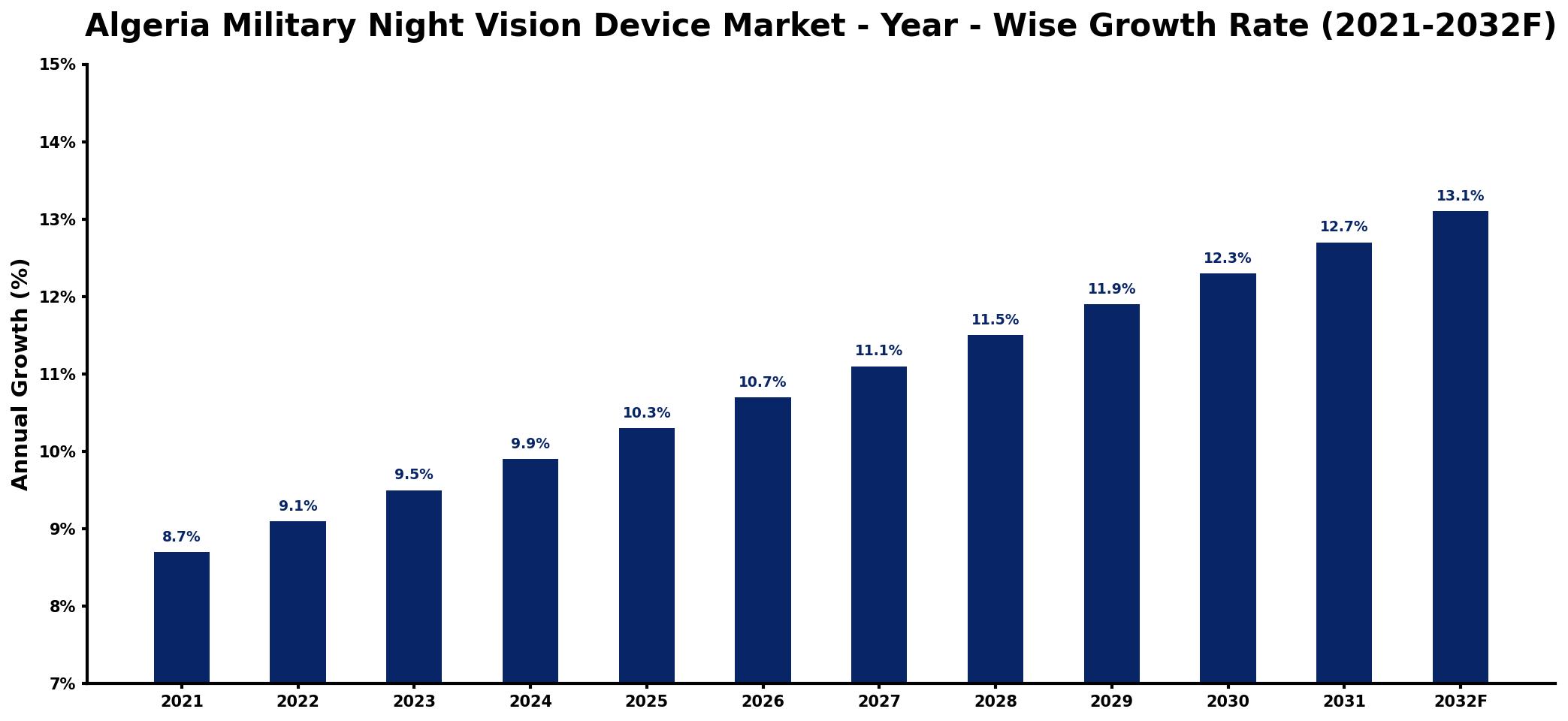
The table below presents the year‑wise growth rates along with the key drivers influencing the market
| Year | Growth Rate | Major Drivers |
| 2021 | 8.7% | growing regional consumption patterns |
| 2022 | 9.1% | strengthening international trade flows |
| 2023 | 9.5% | Rising demand for surveillance technology |
| 2024 | 9.9% | expanding healthcare application demand |
| 2025 | 10.3% | Strategic partnerships with foreign entities |
| 2026 | 10.7% | Expansion of local manufacturing capabilities |
| 2027 | 11.1% | Investment in research and development |
| 2028 | 11.5% | Increased focus on border security |
| 2029 | 11.9% | Growing interest in advanced technologies |
| 2030 | 12.3% | Strengthened international cooperation agreements |
| 2031 | 12.7% | Emerging threats driving procurement strategies |
| 2032 | 13.1% | Focus on dual-use technology applications |
Note: Market size estimations and growth projections presented in this report are based on 6Wresearch's proprietary forecasting methodology, utilizing the latest available industry data, government publications, and primary research inputs.
Algeria Military Night Vision Device Market Synopsis
The strongest force currently shaping the Algeria Military Night Vision Device Market is the government's commitment to modernizing its defense infrastructure. With the rising need for improved operational effectiveness, the Algerian military is actively seeking advanced night vision technologies to bolster its capabilities in surveillance and reconnaissance.
This evolving landscape is marked by a growing emphasis on lightweight and durable designs, suitable for diverse combat scenarios. Collaborations between local manufacturers and international suppliers are also emerging, which facilitate the introduction of tailored innovations that align closely with the specific requirements of Algeria's armed forces.
Algeria Military Night Vision Device Market Key Takeaways
- The market is set for sustained growth, driven by increased defense expenditure and modernization efforts.
- Investment in research and development is fostering the creation of advanced, compact night vision solutions.
- Technological advancements, including thermal imaging and digital night vision, are reshaping operational capabilities.
- Strategic partnerships between local and international players are vital for introducing innovative products.
- Government policies are focused on improving the procurement process and ensuring effective training for military personnel.
Evaluation of Restraints in Algeria Military Night Vision Device Market
The growth of the Algeria Military Night Vision Device Market is tempered by several constraints. Notably, the high cost of advanced night vision technology limits accessibility for the military. Additionally, international trade restrictions can hinder the acquisition of state-of-the-art equipment. Training challenges also persist, as military personnel require specialized instruction to effectively utilize advanced night vision systems. Furthermore, the harsh environmental conditions prevalent in Algeria, such as extreme temperatures and varied terrains, pose operational difficulties for the effectiveness of night vision devices. Addressing these limitations will necessitate strategic collaborations and investments in indigenous technology.
Algeria Military Night Vision Device Market Trends
A significant trend in the Algeria Military Night Vision Device Market is the increasing demand for lightweight and compact devices that enhance mobility without compromising functionality. The integration of thermal imaging technology is becoming commonplace, offering improved visibility in low-light conditions and adverse weather. Additionally, the adoption of digital night vision systems is on the rise, providing superior image clarity and target detection capabilities, crucial for modern military operations. Investment in R&D is also yielding innovative features like augmented reality overlays and wireless connectivity, further enhancing the effectiveness of night vision devices.
Algeria Military Night Vision Device Market Opportunities
The Algeria Military Night Vision Device Market presents numerous investment opportunities, particularly as the government increases defense spending to modernize its military capabilities. Companies that can offer innovative and tailored solutions will find fertile ground for growth. Collaborating with local defense contractors offers a strategic advantage for international firms seeking to penetrate the market. Additionally, as technological advancements continue, there is ample potential for developing indigenous night vision technologies that cater specifically to the needs of the Algerian armed forces.
Government Initiatives in the Algeria Military Night Vision Device Market
The Algerian government is actively promoting policies aimed at enhancing the operational capabilities of its armed forces through the procurement of advanced military equipment, including night vision devices. These initiatives focus on securing budget allocations for high-quality products while ensuring that equipment is compatible with existing military frameworks. Moreover, regulations are in place to facilitate proper training and maintenance practices, which are crucial for maximizing the effectiveness of night vision technologies within military operations.
Future Insights of the Algeria Military Night Vision Device Market
Looking ahead to 2026-2032, the Algeria Military Night Vision Device Market is poised for significant expansion, fueled by increasing defense budgets and a commitment to enhancing military capabilities. Ongoing security challenges necessitate heightened investment in advanced night vision technologies, particularly for surveillance and reconnaissance. The expected rise in partnerships with international suppliers and the continued development of innovative technologies indicate a positive future for the market. The integration of modern features will likely redefine operational standards within Algeria's military landscape.
Algeria Military Night Vision Device Market Latest Developments (2025 - 2026)
Recent developments in the Algeria Military Night Vision Device Market highlight a trend toward greater collaboration between domestic and international manufacturers. New initiatives are being launched to enhance the capabilities of night vision technologies, including advancements in thermal imaging and digital enhancements. The military is also increasing focus on training programs to ensure personnel can effectively operate and maintain new technologies, reinforcing their readiness for diverse operational scenarios.
Algeria Military Night Vision Device Market - Key Attractiveness of the Report
- 10 Years of Market Numbers
- Historical Data Starting from 2022 to 2025
- Base Year: 2025
- Forecast Data until 2032
- Key Performance Indicators Impacting the Market
- Major Upcoming Developments and Projects
Key Highlights of the Report:
- Algeria Military Night Vision Device Market Outlook
- Market Size of Algeria Military Night Vision Device Market, 2025
- Forecast of Algeria Military Night Vision Device Market, 2032
- Historical Data and Forecast of Algeria Military Night Vision Device Revenues & Volume for the Period 2022-2032F
- Algeria Military Night Vision Device Market Trend Evolution
- Algeria Military Night Vision Device Market Drivers and Challenges
- Algeria Military Night Vision Device Price Trends
- Algeria Military Night Vision Device Porter's Five Forces
- Algeria Military Night Vision Device Industry Life Cycle
- Historical Data and Forecast of Algeria Military Night Vision Device Market Revenues & Volume By Type for the Period 2022-2032F
- Historical Data and Forecast of Algeria Military Night Vision Device Market Revenues & Volume By Goggles for the Period 2022-2032F
- Historical Data and Forecast of Algeria Military Night Vision Device Market Revenues & Volume By Cameras for the Period 2022-2032F
- Historical Data and Forecast of Algeria Military Night Vision Device Market Revenues & Volume By Scopes/Tubes for the Period 2022-2032F
- Historical Data and Forecast of Algeria Military Night Vision Device Market Revenues & Volume By Technology for the Period 2022-2032F
- Historical Data and Forecast of Algeria Military Night Vision Device Market Revenues & Volume By Image intensifier for the Period 2022-2032F
- Historical Data and Forecast of Algeria Military Night Vision Device Market Revenues & Volume By Thermal imaging for the Period 2022-2032F
- Historical Data and Forecast of Algeria Military Night Vision Device Market Revenues & Volume By Application for the Period 2022-2032F
- Historical Data and Forecast of Algeria Military Night Vision Device Market Revenues & Volume By Infantry Weapon Sights for the Period 2022-2032F
- Historical Data and Forecast of Algeria Military Night Vision Device Market Revenues & Volume By Gunner Sights for the Period 2022-2032F
- Historical Data and Forecast of Algeria Military Night Vision Device Market Revenues & Volume By Naval Trackers for the Period 2022-2032F
- Historical Data and Forecast of Algeria Military Night Vision Device Market Revenues & Volume By Remotely Piloted Vehicles for the Period 2022-2032F
- Historical Data and Forecast of Algeria Military Night Vision Device Market Revenues & Volume By Driving Sights for the Period 2022-2032F
- Algeria Military Night Vision Device Import Export Trade Statistics
- Market Opportunity Assessment By Type
- Market Opportunity Assessment By Technology
- Market Opportunity Assessment By Application
- Algeria Military Night Vision Device Top Companies Market Share
- Algeria Military Night Vision Device Competitive Benchmarking By Technical and Operational Parameters
- Algeria Military Night Vision Device Company Profiles
- Algeria Military Night Vision Device Key Strategic Recommendations
Frequently Asked Questions About the Market Study (FAQs):
Key factors include heightened defense spending, the modernization of military capabilities, and a growing need for improved surveillance and reconnaissance technologies.
The market is projected to reach USD 2303 Million by 2032, with an estimated size of USD 1238 Million in 2025, reflecting a CAGR of 9.3% from 2026 to 2032.
Advancements in thermal imaging and digital night vision technologies are leading to enhanced operational capabilities, which are increasingly sought after by the Algerian military.
Government policies facilitate budget allocations and ensure quality standards, thus supporting the acquisition of advanced night vision devices from both domestic and international suppliers.
Current trends include a shift towards compact, lightweight designs, the integration of augmented reality features, and the use of wireless technology to enhance operational efficiency.
Collaborations with local manufacturers can provide valuable insights into specific military needs, enhance distribution capabilities, and improve compliance with government regulations, thereby facilitating smoother market entry.
6Wresearch actively monitors the Algeria Military Night Vision Device Market and publishes its comprehensive annual report, highlighting emerging trends, growth drivers, revenue analysis, and forecast outlook. Our insights help businesses to make data-backed strategic decisions with ongoing market dynamics. Our analysts track relevent industries related to the Algeria Military Night Vision Device Market, allowing our clients with actionable intelligence and reliable forecasts tailored to emerging regional needs.
Yes, we provide customisation as per your requirements. To learn more, feel free to contact us on sales@6wresearch.com
Global Go To Market Strategy - 2030
Export potential enables firms to identify high-growth global markets with greater confidence by combining advanced trade intelligence with a structured quantitative methodology. The framework analyzes emerging demand trends and country-level import patterns while integrating macroeconomic and trade datasets such as GDP and population forecasts, bilateral import–export flows, tariff structures, elasticity differentials between developed and developing economies, geographic distance, and import demand projections. Using weighted trade values from 2020–2024 as the base period to project country-to-country export potential for 2030, these inputs are operationalized through calculated drivers such as gravity model parameters, tariff impact factors, and projected GDP per-capita growth. Through an analysis of hidden potentials, demand hotspots, and market conditions that are most favorable to success, this method enables firms to focus on target countries, maximize returns, and global expansion with data, backed by accuracy.
By factoring in the projected importer demand gap that is currently unmet and could be potential opportunity, it identifies the potential for the Exporter (Country) among 190 countries, against the general trade analysis, which identifies the biggest importer or exporter.
To discover high-growth global markets and optimize your business strategy:
Click Here
Pricing
- Single User License$ 1,995
- Department License$ 2,400
- Site License$ 3,120
- Global License$ 3,795

Leadership Perspectives from Industry Events
Search
Thought Leadership and Analyst Meet





Our Clients








6WResearch In News
- India Air Conditioner Market Set for Strong Rebound in 2026 After Weather-Led Correction and GST-Driven Recovery: 6Wresearch
- ADAS in India: How Automatic Emergency Braking, Blind Spot Detection & Driver Monitoring are Transforming Road Safety
- Doha a strategic location for EV manufacturing hub: IPA Qatar
- Demand for luxury TVs surging in the GCC, says Samsung
- Empowering Growth: The Thriving Journey of Bangladesh’s Cable Industry
- Demand for luxury TVs surging in the GCC, says Samsung
Latest Reports
- Nicaragua RPG Gaming Market (2026-2032)
- New Zealand RPG Gaming Market (2026-2032)
- Netherlands RPG Gaming Market (2026-2032)
- Nauru RPG Gaming Market (2026-2032)
- Namibia RPG Gaming Market (2026-2032)
- Mozambique RPG Gaming Market (2026-2032)
- Montenegro RPG Gaming Market (2026-2032)
- Mongolia RPG Gaming Market (2026-2032)
- Monaco RPG Gaming Market (2026-2032)
- Micronesia RPG Gaming Market (2026-2032)
Industry Events and Analyst Meet

EV India Expo 2026

HIMTEX 2026

India Refining Summit 2026

India EV Show 2026

EV tech India Expo 2026
Whitepaper
- Middle East & Africa Commercial Security Market Click here to view more.
- Middle East & Africa Fire Safety Systems & Equipment Market Click here to view more.
- GCC Drone Market Click here to view more.
- Middle East Lighting Fixture Market Click here to view more.
- GCC Physical & Perimeter Security Market Click here to view more.


