Algeria Natural Extracts Market Size, Share & Growth Rate
The Algeria Natural Extracts Market was estimated at USD 394 Million in 2025 and is projected to reach USD 564 Million by 2032, growing at a CAGR of 5.3% from 2026 to 2032. This growth trajectory is propelled by the increasing consumer preference for natural and organic ingredients across sectors, particularly in food, cosmetics, and pharmaceuticals. The push for sustainable products and heightened health consciousness among consumers are significant drivers fuelling this upward trend.
Algeria Natural Extracts Market Year-wise Growth Rate and Key Drivers
This graph highlights how the Algeria Natural Extracts Market has steadily grown over the years, supported by major growth factors.
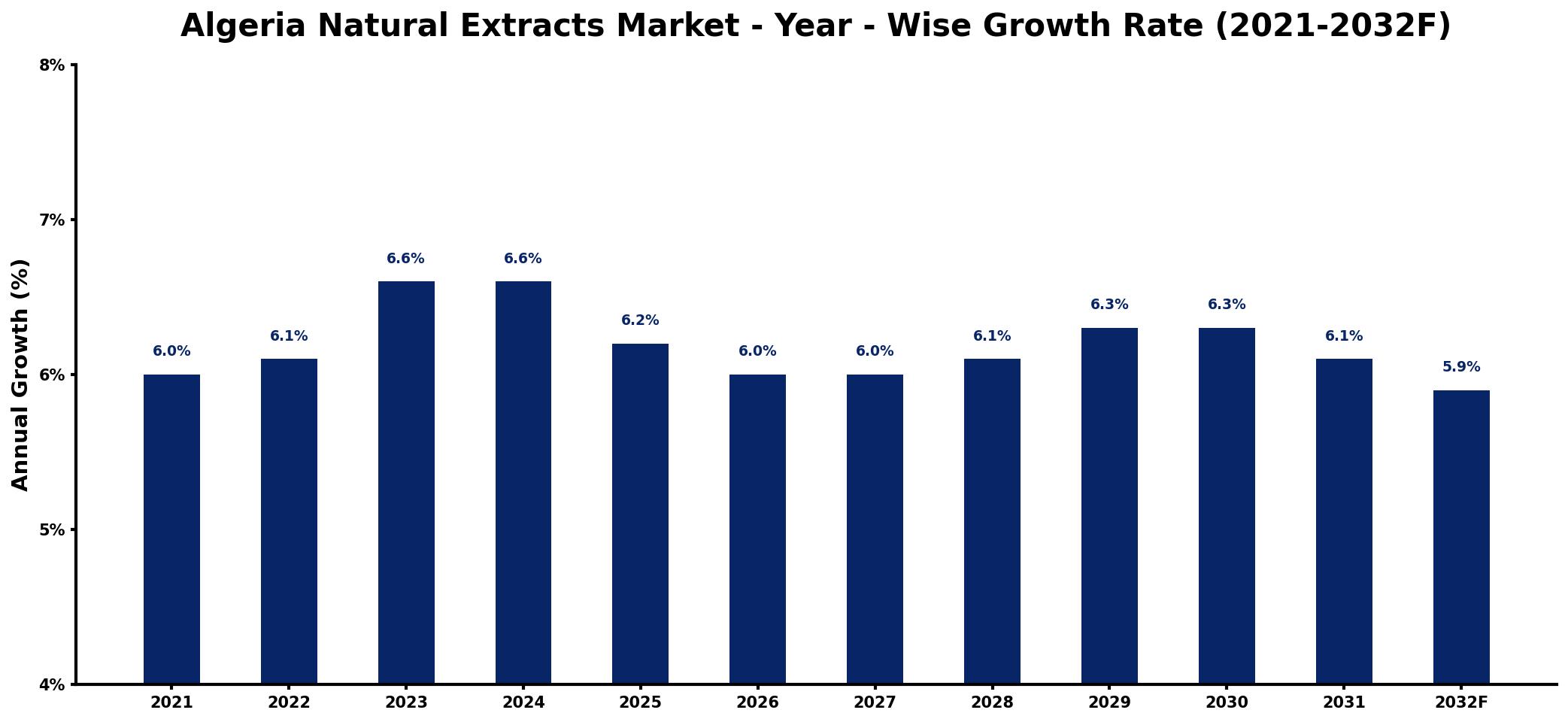
The table below presents the year‑wise growth rates along with the key drivers influencing the market
| Year | Growth Rate | Major Drivers |
| 2021 | 6.0% | Rising consumer health consciousness |
| 2022 | 6.1% | Growing trend in organic products |
| 2023 | 6.6% | Increase in wellness tourism activities |
| 2024 | 6.6% | Expansion of food supplement market |
| 2025 | 6.2% | Higher demand for herbal remedies |
| 2026 | 6.0% | Investment in sustainable sourcing practices |
| 2027 | 6.0% | Emergence of new application areas |
| 2028 | 6.1% | Strengthening of local production capabilities |
| 2029 | 6.3% | Adoption of clean label products |
| 2030 | 6.3% | Growth in e-commerce distribution channels |
| 2031 | 6.1% | Increased focus on sustainable packaging |
| 2032 | 5.9% | Rising interest in holistic health |
Note: Market size estimations and growth projections presented in this report are based on 6Wresearch's proprietary forecasting methodology, utilizing the latest available industry data, government publications, and primary research inputs.
Algeria Natural Extracts Market Synopsis
The Algeria Natural Extracts Market is thriving, with a notable surge in demand for natural ingredients among health-conscious consumers. This shift has been further accelerated by governmental support aimed at promoting local producers and natural sourcing, fostering a burgeoning industry. Key products such as olive oil, argan oil, and prickly pear extract are witnessing heightened popularity, reflecting a broader global trend towards natural alternatives.
Despite this robust demand, the market grapples with challenges including limited infrastructure and variability in quality standards, which may hinder growth. Nevertheless, the increasing awareness of the health benefits offered by natural extracts positions Algeria as a growing player in the global natural products market, inviting both local and international investment.
Algeria Natural Extracts Market Key Takeaways
- The market is experiencing a notable shift towards organic and sustainably sourced products.
- Key natural extracts such as argan oil and prickly pear are in high demand across multiple sectors.
- Government initiatives are actively promoting the use of natural ingredients and supporting local production.
- Investments in technology and research are essential to overcome existing infrastructure challenges.
- Consumer awareness regarding the benefits of natural extracts is driving market growth.
Evaluation of Restraints in Algeria Natural Extracts Market
The Algeria Natural Extracts Market faces several restraints that can impede its growth trajectory. Limited infrastructure for extraction and processing means that many producers struggle to meet market demand. Additionally, the lack of standardized quality control measures leads to inconsistent product offerings, which can diminish consumer trust. Accessing international markets is complicated by regulatory barriers and certification requirements, making it difficult for local producers to expand their reach. Lastly, fluctuating prices of raw materials, exacerbated by climate change, present further challenges that could impact profitability and stability.
Algeria Natural Extracts Market Trends
The market is witnessing a distinct trend towards incorporating traditional Algerian ingredients, such as cactus extract and rose water, into modern skincare and beauty products. Consumers are increasingly opting for plant-based extracts, driven by a preference for products devoid of synthetic chemicals. Moreover, theres a growing recognition of the health benefits associated with ingredients like saffron and ginger, particularly in dietary supplements. This trend towards clean, green products reflects a larger cultural shift towards sustainability and health-conscious choices in consumer purchasing behavior.
Algeria Natural Extracts Market Opportunities
Investment opportunities in the Algeria Natural Extracts Market are ripe, particularly in the development of innovative products that align with consumer demand for organic and sustainable solutions. Companies can capitalize on the popularity of local natural extracts by expanding production capacities and forming strategic partnerships with local suppliers. The governments initiatives aimed at boosting the competitiveness of natural extracts further enhance the markets potential, presenting lucrative avenues for both domestic and foreign investors looking to engage in this burgeoning sector.
Government Initiatives in the Algeria Natural Extracts Market
The Algerian government has implemented several policies to bolster the natural extracts market, including regulations promoting sustainable harvesting practices and value addition. These initiatives are designed to ensure quality standards and foster an environment conducive to growth. Additionally, investment incentives are in place to attract both domestic and foreign stakeholders, thereby enhancing the overall competitiveness of the sector. Such policies not only aim to strengthen local production but also to elevate the market's contribution to the national economy.
Future Insights of the Algeria Natural Extracts Market
Looking ahead to 2026-2032, the Algeria Natural Extracts Market is poised for sustained growth driven by an expanding consumer base that increasingly prioritizes natural and organic products. The continuous rise in disposable income among Algerians, coupled with an evolving marketplace favoring eco-friendly options, underscores the positive outlook. As awareness surrounding the health benefits of natural extracts grows, and government support continues, the market will likely attract more investments, paving the way for innovative product developments and enhancements in production technology.
Algeria Natural Extracts Market Latest Developments (2025 - 2026)
Recent developments in the Algeria Natural Extracts Market indicate a clear momentum towards adopting innovative processing techniques aimed at improving extract quality. There has been a noticeable increase in collaboration between local farmers and research institutions, focusing on developing sustainable farming practices. Furthermore, awareness campaigns emphasizing the health benefits of natural extracts are gaining traction, helping to further educate consumers. The market landscape is evolving with a growing emphasis on transparency and authenticity in product sourcing.
Algeria Natural Extracts Market - Key Attractiveness of the Report
- 10 Years of Market Numbers
- Historical Data Starting from 2022 to 2025
- Base Year: 2025
- Forecast Data until 2032
- Key Performance Indicators Impacting the Market
- Major Upcoming Developments and Projects
Key Highlights of the Report:
- Algeria Natural Extracts Market Outlook
- Market Size of Algeria Natural Extracts Market, 2025
- Forecast of Algeria Natural Extracts Market, 2032
- Historical Data and Forecast of Algeria Natural Extracts Revenues & Volume for the Period 2022-2032F
- Algeria Natural Extracts Market Trend Evolution
- Algeria Natural Extracts Market Drivers and Challenges
- Algeria Natural Extracts Price Trends
- Algeria Natural Extracts Porter's Five Forces
- Algeria Natural Extracts Industry Life Cycle
- Historical Data and Forecast of Algeria Natural Extracts Market Revenues & Volume By Product for the Period 2022-2032F
- Historical Data and Forecast of Algeria Natural Extracts Market Revenues & Volume By Essential Oils for the Period 2022-2032F
- Historical Data and Forecast of Algeria Natural Extracts Market Revenues & Volume By Oleoresins for the Period 2022-2032F
- Historical Data and Forecast of Algeria Natural Extracts Market Revenues & Volume By Herbal Extracts for the Period 2022-2032F
- Historical Data and Forecast of Algeria Natural Extracts Market Revenues & Volume By Natural Colors for the Period 2022-2032F
- Historical Data and Forecast of Algeria Natural Extracts Market Revenues & Volume By Dried Crops for the Period 2022-2032F
- Historical Data and Forecast of Algeria Natural Extracts Market Revenues & Volume By Application for the Period 2022-2032F
- Historical Data and Forecast of Algeria Natural Extracts Market Revenues & Volume By Personal Care & Cosmetics for the Period 2022-2032F
- Historical Data and Forecast of Algeria Natural Extracts Market Revenues & Volume By Food & Beverage for the Period 2022-2032F
- Historical Data and Forecast of Algeria Natural Extracts Market Revenues & Volume By Animal Feed for the Period 2022-2032F
- Historical Data and Forecast of Algeria Natural Extracts Market Revenues & Volume By Pharmaceuticals for the Period 2022-2032F
- Historical Data and Forecast of Algeria Natural Extracts Market Revenues & Volume By Nutraceuticals for the Period 2022-2032F
- Historical Data and Forecast of Algeria Natural Extracts Market Revenues & Volume By Others for the Period 2022-2032F
- Algeria Natural Extracts Import Export Trade Statistics
- Market Opportunity Assessment By Product
- Market Opportunity Assessment By Application
- Algeria Natural Extracts Top Companies Market Share
- Algeria Natural Extracts Competitive Benchmarking By Technical and Operational Parameters
- Algeria Natural Extracts Company Profiles
- Algeria Natural Extracts Key Strategic Recommendations






































