Algeria Sports Equipment Market Size, Share & Growth Rate
The Algeria Sports Equipment Market was estimated at USD 248 Million in 2025 and is projected to reach USD 330 Million by 2032, growing at a CAGR of 4.2% from 2026 to 2032. This growth trajectory is primarily driven by a burgeoning awareness of health and fitness among the Algerian population, coupled with government initiatives aimed at enhancing sports participation. Additionally, rising disposable incomes and urbanization contribute to an expanding consumer base eager to invest in a variety of sports and recreational activities.
Algeria Sports Equipment Market Year-wise Growth Rate and Key Drivers
This graph highlights how the Algeria Sports Equipment Market has steadily grown over the years, supported by major growth factors.
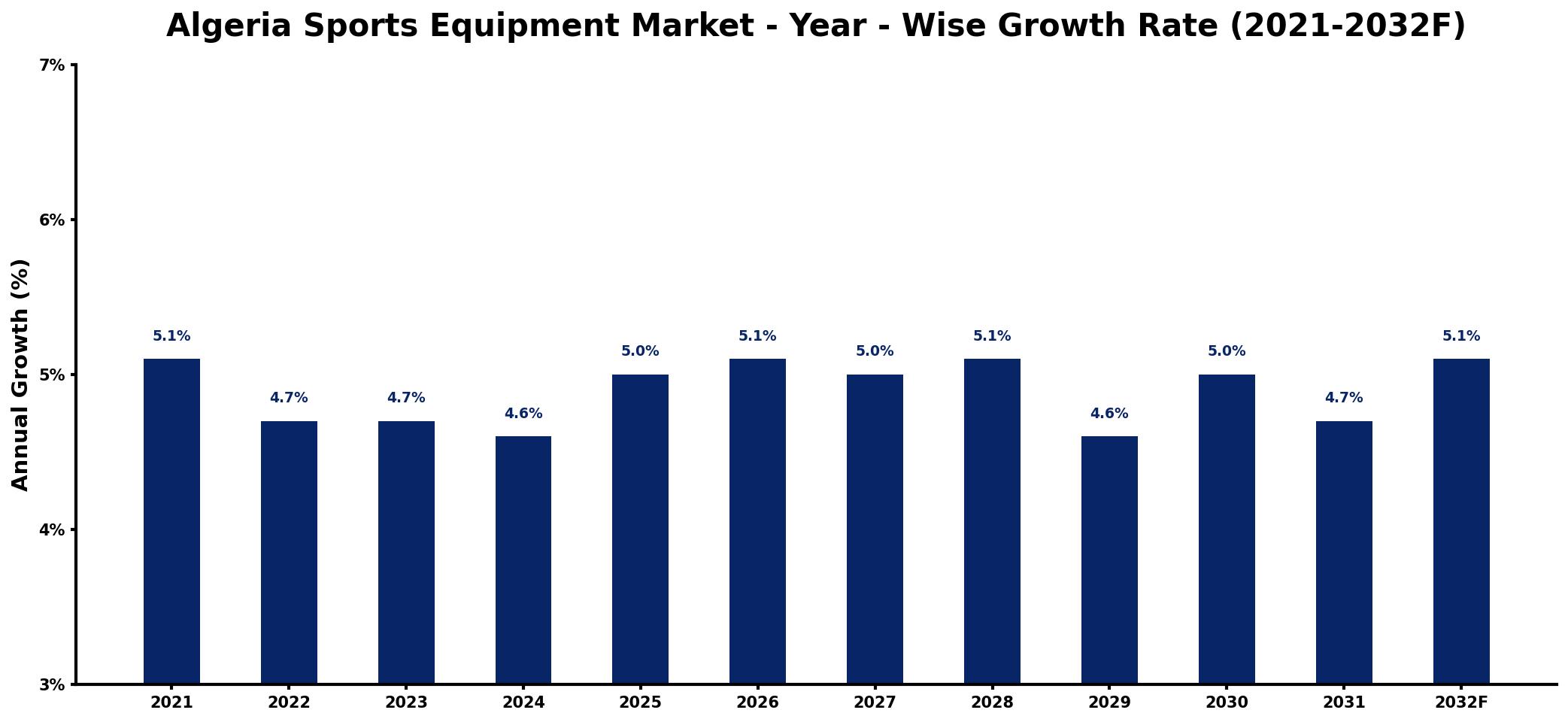
The table below presents the year‑wise growth rates along with the key drivers influencing the market
| Year | Growth Rate | Major Drivers |
| 2021 | 5.1% | Increase in youth participation rates |
| 2022 | 4.7% | Growing fitness awareness among consumers |
| 2023 | 4.7% | Expansion of local retail outlets |
| 2024 | 4.6% | Rise in health consciousness trends |
| 2025 | 5.0% | Increased investments in recreational facilities |
| 2026 | 5.1% | rising procurement volume requirements |
| 2027 | 5.0% | Surge in online shopping platforms |
| 2028 | 5.1% | Boost in government funding initiatives |
| 2029 | 4.6% | Enhancement of urban sporting infrastructure |
| 2030 | 5.0% | growing downstream application demand |
| 2031 | 4.7% | growing emerging market penetration |
| 2032 | 5.1% | rising infrastructure development spending |
Note: Market size estimations and growth projections presented in this report are based on 6Wresearch's proprietary forecasting methodology, utilizing the latest available industry data, government publications, and primary research inputs.
Algeria Sports Equipment Market Synopsis
The most significant force shaping the Algeria Sports Equipment Market today is the increasing health consciousness among consumers. More Algerians are recognizing the importance of physical fitness, leading to a surge in demand for quality sports gear, apparel, and accessories.
Moreover, the growing interest in various sports, particularly football, athletics, and fitness activities, is driving market dynamics. This evolving sports culture is further enhanced by urbanization, which facilitates greater access to sports facilities and recreational areas.
Algeria Sports Equipment Market Key Takeaways
- The market is set to grow steadily due to increasing disposable incomes and urbanization.
- There is a rising demand for innovative and technologically advanced sports gear.
- Online retail channels are becoming essential for market access and product variety.
- Government initiatives are bolstering infrastructure and promoting sports culture.
- Environmental consciousness is leading to demand for sustainable sports equipment.
Evaluation of Restraints in Algeria Sports Equipment Market
Despite its growth potential, the Algeria Sports Equipment Market faces notable challenges. One significant restraint is the limited availability of high-quality products, largely stemming from import restrictions and insufficient domestic manufacturing capabilities. As a result, the market relies heavily on imports, which can elevate costs and limit affordability for a wider consumer demographic. Additionally, the prevalence of counterfeit products compromises brand integrity and undermines consumer trust, posing a critical challenge to genuine brands striving to establish a foothold in this competitive landscape.
Algeria Sports Equipment Market Trends
In recent years, there has been a marked shift towards the adoption of fitness and wellness products. The demand for smart wearables, fitness trackers, and home gym equipment has surged, reflecting a sophisticated consumer base that prioritizes quality and technological advancement. Furthermore, social media influencers play a crucial role in shaping consumer preferences, as they promote health-conscious lifestyles and innovative fitness routines.
Another notable trend is the increasing interest in outdoor sports such as hiking and cycling, leading to higher demand for specialized gear. Furthermore, sustainability is becoming a key consideration, with more consumers gravitating toward eco-friendly brands and products.
Algeria Sports Equipment Market Opportunities
The Algeria Sports Equipment Market is ripe with investment opportunities, particularly in the distribution and retail sectors. Major urban centers like Algiers, Oran, and Constantine present lucrative prospects for those looking to enter the market. Collaborations with local sports clubs, educational institutions, and fitness centers can further enhance market penetration. Moreover, as the government continues to advocate for sports and fitness initiatives, potential investors have an opportunity to align their offerings with national objectives, thereby enhancing market visibility and customer engagement.
Government Initiatives in the Algeria Sports Equipment Market
Government policies in Algeria are fundamentally geared towards promoting sports participation and enhancing public health through physical activity. Initiatives aimed at improving sports infrastructure are coupled with efforts to encourage local manufacturing of sports equipment. Additionally, the government actively supports various sports events and competitions, which not only foster a vibrant sports culture but also stimulate demand for diverse sports gear. Quality and safety regulations are also enforced to protect consumers and elevate standards within the market.
Future Insights of the Algeria Sports Equipment Market
Looking ahead to 2026-2032, the Algeria Sports Equipment Market appears poised for robust expansion. Factors such as a youthful demographic increasingly inclined towards active living, rising disposable incomes, and enhanced government support for sports activities are expected to sustain this growth trajectory. As more individuals embrace fitness and recreational activities, the demand for diverse and high-quality sports equipment will continue to escalate, presenting both domestic and international manufacturers and retailers with a wealth of opportunities in this evolving market.
Algeria Sports Equipment Market Latest Developments (2025 - 2026)
In the recent months, there has been a noticeable uptick in product innovation within the Algeria Sports Equipment Market. Companies are increasingly focusing on integrating technology into their products to cater to health-conscious consumers. Meanwhile, promotional activities and marketing campaigns around national sports events have bolstered consumer interest in fitness products. Additionally, a number of retailers have enhanced their e-commerce platforms to provide better accessibility and product variety, aligning with the growing trend toward online shopping.
Algeria Sports Equipment Market - Key Attractiveness of the Report
- 10 Years of Market Numbers
- Historical Data Starting from 2022 to 2025
- Base Year: 2025
- Forecast Data until 2032
- Key Performance Indicators Impacting the Market
- Major Upcoming Developments and Projects
Key Highlights of the Report:
- Algeria Sports Equipment Market Outlook
- Market Size of Algeria Sports Equipment Market, 2025
- Forecast of Algeria Sports Equipment Market, 2032
- Historical Data and Forecast of Algeria Sports Equipment Revenues & Volume for the Period 2022-2032F
- Algeria Sports Equipment Market Trend Evolution
- Algeria Sports Equipment Market Drivers and Challenges
- Algeria Sports Equipment Price Trends
- Algeria Sports Equipment Porter's Five Forces
- Algeria Sports Equipment Industry Life Cycle
- Historical Data and Forecast of Algeria Sports Equipment Market Revenues & Volume By Product for the Period 2022-2032F
- Historical Data and Forecast of Algeria Sports Equipment Market Revenues & Volume By Ball over net games for the Period 2022-2032F
- Historical Data and Forecast of Algeria Sports Equipment Market Revenues & Volume By Ball games for the Period 2022-2032F
- Historical Data and Forecast of Algeria Sports Equipment Market Revenues & Volume By Fitness/Strength equipment for the Period 2022-2032F
- Historical Data and Forecast of Algeria Sports Equipment Market Revenues & Volume By Athletic training equipment for the Period 2022-2032F
- Historical Data and Forecast of Algeria Sports Equipment Market Revenues & Volume By Others for the Period 2022-2032F
- Historical Data and Forecast of Algeria Sports Equipment Market Revenues & Volume By Distribution Channel for the Period 2022-2032F
- Historical Data and Forecast of Algeria Sports Equipment Market Revenues & Volume By Online retail for the Period 2022-2032F
- Historical Data and Forecast of Algeria Sports Equipment Market Revenues & Volume By Specialty & sports shops for the Period 2022-2032F
- Historical Data and Forecast of Algeria Sports Equipment Market Revenues & Volume By Department & discount stores for the Period 2022-2032F
- Algeria Sports Equipment Import Export Trade Statistics
- Market Opportunity Assessment By Product
- Market Opportunity Assessment By Distribution Channel
- Algeria Sports Equipment Top Companies Market Share
- Algeria Sports Equipment Competitive Benchmarking By Technical and Operational Parameters
- Algeria Sports Equipment Company Profiles
- Algeria Sports Equipment Key Strategic Recommendations






































