Algeria Web Application Firewall Market Size & Growth Rate (2026-2032)
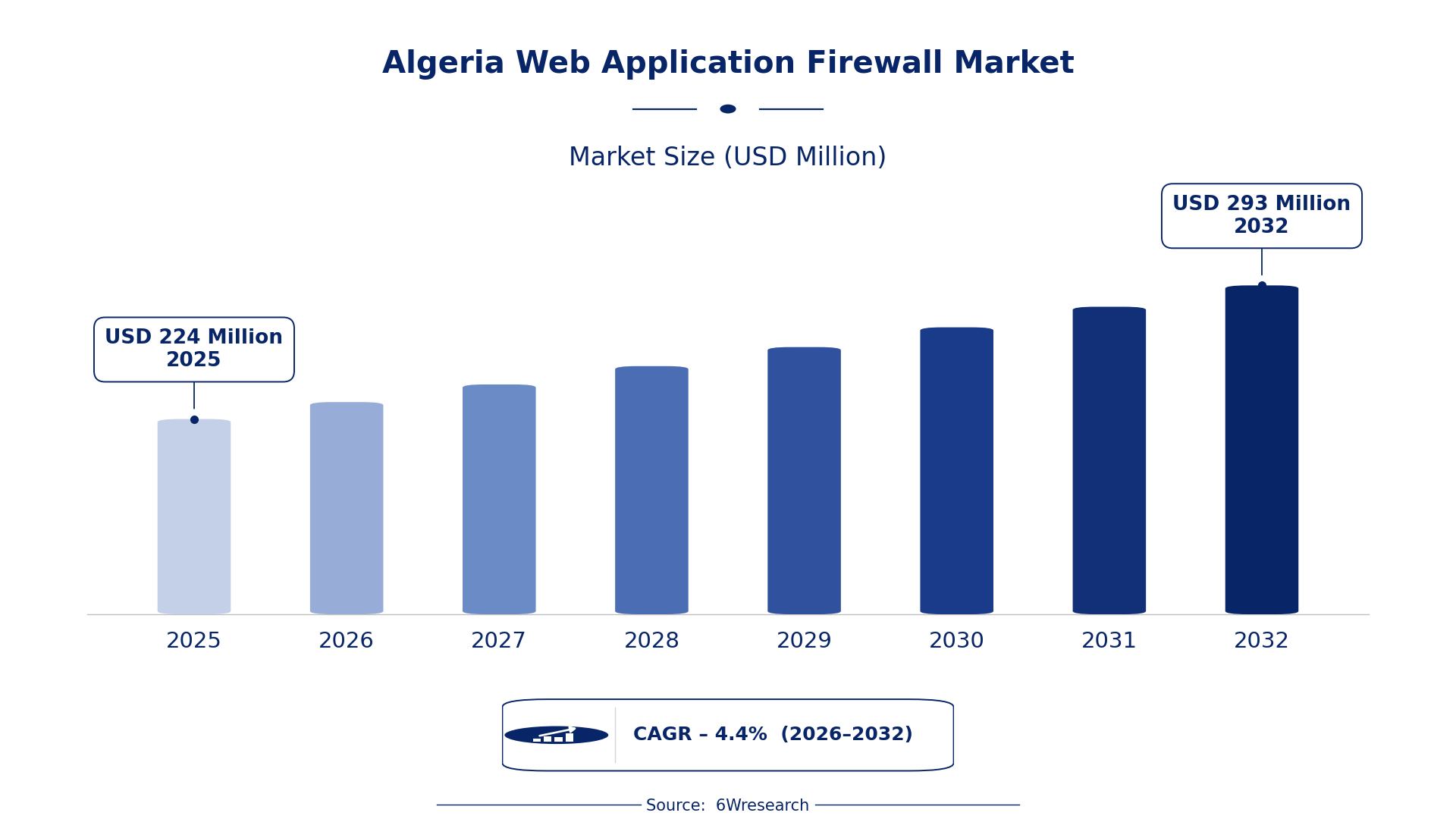
The Algeria Web Application Firewall Market was estimated at USD 224 Million in 2025 and is projected to reach USD 293 Million by 2032, growing at a CAGR of 4.4% from 2026 to 2032.
Algeria Web Application Firewall Market Synopsis
The demand for web application firewalls in Algeria is escalating, driven by increasing cyber threats that jeopardize the integrity and confidentiality of web applications. Organizations across sectors such as banking, healthcare, and e-commerce are prioritizing cybersecurity, leading to heightened investments in advanced WAF solutions to secure digital assets.
As the adoption of cloud-based services grows, businesses seek solutions that ensure effective threat detection and response. WAF vendors in Algeria are innovating their products, offering features that encompass automatic updates and centralized management, which are essential for defending against complex cyber attacks.
Algeria Web Application Firewall Market Year-wise Growth Rate and Key Drivers
This graph illustrates the annual growth rates of the Algeria Web Application Firewall Market from 2021 to 2032, highlighting a steady upward trajectory and projected expansion over the forecast period.
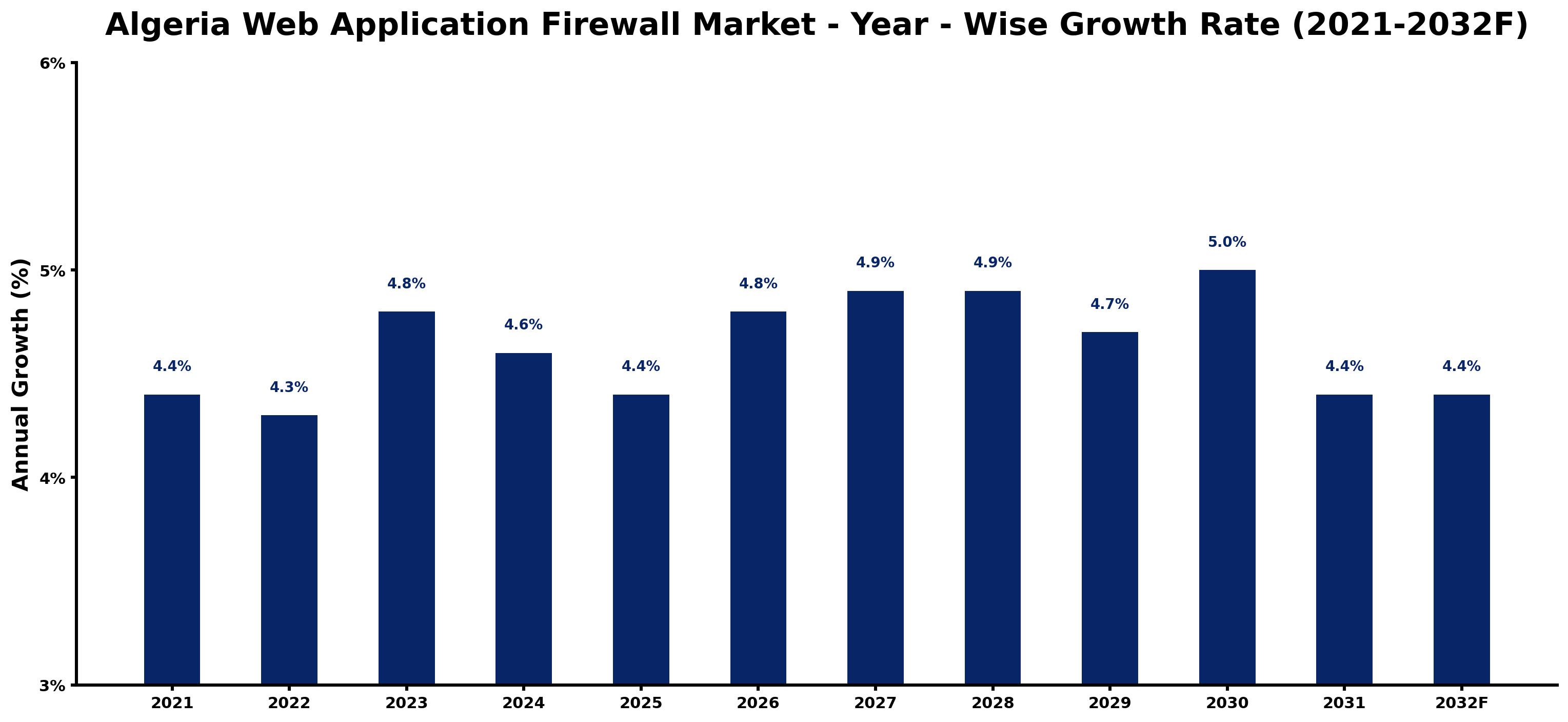
The table below presents the year‑wise growth rates along with the key drivers influencing the market
| Year | Growth Rate | Major Drivers |
| 2021 | 4.4% | Cybersecurity regulations by Algeria's Ministry of Post. |
| 2022 | 4.3% | Growth in digital transformation and e-commerce adoption. |
| 2023 | 4.8% | Increase in cloud service providers in North Africa. |
| 2024 | 4.6% | Government initiative promoting national cybersecurity policies. |
| 2025 | 4.4% | Rising need for data protection amid digital financial services. |
| 2026 | 4.8% | Increased investments in local startup tech ecosystems. |
| 2027 | 4.9% | Growing concerns over cyber threats from regional instability. |
| 2028 | 4.9% | Enhanced focus on GDPR-like data privacy frameworks. |
| 2029 | 4.7% | Shift towards remote work creating higher security demands. |
| 2030 | 5.0% | Strengthening of local ISPs offering secured web solutions. |
| 2031 | 4.4% | Rising incidents of cyberattacks necessitating robust defenses. |
| 2032 | 4.4% | Emerging tech adoption driving complexity in web applications. |
Note: Market size estimations and growth projections presented in this report are based on 6Wresearch's proprietary forecasting methodology, utilizing the latest available industry data, government publications, and primary research inputs.
Algeria Web Application Firewall Market Key Takeaways
Below are some of the specific key takeaways from the market, including:
- The surge in online transactions is a critical driver for WAF adoption in Algeria.
- Regulatory compliance requirements are pushing organizations towards investment in WAF solutions.
- Advanced threat detection capabilities are becoming the standard expectation from WAF vendors.
- There is a notable shortage of skilled cybersecurity professionals in the region, complicating WAF implementation.
Evaluation of Restraints in Algeria Web Application Firewall Market
Despite the market's growth, several factors hinder its full potential. The increasing sophistication of cyber threats poses a challenge for organizations attempting to stay ahead in cybersecurity measures. Coupled with a shortage of skilled professionals capable of implementing and managing these systems, businesses often struggle to find WAF solutions that fit their specific needs and budget. Furthermore, the lack of comprehensive cybersecurity regulations amplifies existing vulnerabilities in web applications.
Algeria Web Application Firewall Market Trends
Current trends in the Algeria Web Application Firewall Market highlight a shift towards integrated security solutions that address not only web application threats but also overall cybersecurity strategies. Organizations are increasingly looking for firewalls that provide advanced machine learning capabilities for real-time threat detection. Additionally, as more businesses transition to cloud environments, there is a rising demand for scalable WAF solutions that seamlessly integrate with cloud services.
Algeria Web Application Firewall Market Opportunities
The market is ripe with growth opportunities, especially in sectors heavily reliant on digital platforms. For instance, the e-commerce sector is booming, creating a pressing need for robust WAF solutions. Furthermore, with the Algerian government investing in digital infrastructure, there is potential for partnerships and collaborations between public and private sectors to enhance cybersecurity frameworks across industries.
Government Initiatives in the Algeria Web Application Firewall Market
Government initiatives are shaping the Algeria Web Application Firewall Market by setting forth regulations and programs aimed at bolstering cybersecurity. With rising cyber threats, authorities are prioritizing the enhancement of the national cybersecurity infrastructure, creating an environment conducive to WAF adoption among organizations.
- A recently completed initiative focused on establishing baseline cybersecurity standards for financial institutions, mandating the implementation of WAFs by mid-2025.
- Currently ongoing is a government-led program that aims to educate businesses on cybersecurity best practices, including the integration of WAF solutions.
- Planned for 2027 is a public-private partnership program intended to develop a comprehensive national cybersecurity framework that includes WAF implementations across various sectors.
Future Insights of the Algeria Web Application Firewall Market
Looking ahead, the Algeria Web Application Firewall Market is expected to expand significantly through 2032. As organizations recognize the critical importance of cybersecurity, investments in WAF solutions will become a standard part of their IT budgets. Technological advancements, such as artificial intelligence and machine learning, are likely to be further integrated into WAF products, enhancing their effectiveness against emerging threats. This trajectory indicates a more secure digital environment and stronger compliance with evolving regulations.
Algeria Web Application Firewall Market Latest Developments
Recent months have seen a flurry of activity in the Algeria Web Application Firewall Market, as organizations scramble to fortify their digital defenses. This urgency has prompted vendors to innovate and roll out new offerings tailored to local needs. As cyber threats continue to rise, companies are increasingly focused on finding solutions that can meet these challenges head-on.
- Launched in early 2025, a new WAF solution specifically designed for the Algerian e-commerce sector has gained rapid adoption among local businesses.
- An initiative that began in late 2024 aims to enhance the cybersecurity capabilities of government websites, focusing on deploying WAFs to protect sensitive data.
- A rollout expected to begin in the first quarter of 2026 will introduce a comprehensive training program for IT professionals to manage and operate WAF solutions effectively.
- Currently ongoing is a collaborative project between several technology firms to develop a locally hosted WAF solution that complies with national cybersecurity regulations.
Algeria Web Application Firewall Market - Key Attractiveness of the Report
- 10 Years of Market Numbers
- Historical Data Starting from 2022 to 2025
- Base Year: 2025
- Forecast Data until 2032
- Key Performance Indicators Impacting the Market
- Major Upcoming Developments and Projects
Key Highlights of the Report:
- Algeria Web Application Firewall Market Outlook
- Market Size of Algeria Web Application Firewall Market, 2025
- Forecast of Algeria Web Application Firewall Market, 2032
- Historical Data and Forecast of Algeria Web Application Firewall Revenues & Volume for the Period 2022-2032F
- Algeria Web Application Firewall Market Trend Evolution
- Algeria Web Application Firewall Market Drivers and Challenges
- Algeria Web Application Firewall Price Trends
- Algeria Web Application Firewall Porter's Five Forces
- Algeria Web Application Firewall Industry Life Cycle
- Historical Data and Forecast of Algeria Web Application Firewall Market Revenues & Volume By Component for the Period 2022-2032F
- Historical Data and Forecast of Algeria Web Application Firewall Market Revenues & Volume By Solutions (Hardware Appliances, Virtual Appliances, Cloud-Based) for the Period 2022-2032F
- Historical Data and Forecast of Algeria Web Application Firewall Market Revenues & Volume By Services (Professional and Managed) for the Period 2022-2032F
- Historical Data and Forecast of Algeria Web Application Firewall Market Revenues & Volume By Organization Size for the Period 2022-2032F
- Historical Data and Forecast of Algeria Web Application Firewall Market Revenues & Volume By SMEs for the Period 2022-2032F
- Historical Data and Forecast of Algeria Web Application Firewall Market Revenues & Volume By Large Enterprises for the Period 2022-2032F
- Historical Data and Forecast of Algeria Web Application Firewall Market Revenues & Volume By Vertical for the Period 2022-2032F
- Historical Data and Forecast of Algeria Web Application Firewall Market Revenues & Volume By Banking, Financial Services & Insurance for the Period 2022-2032F
- Historical Data and Forecast of Algeria Web Application Firewall Market Revenues & Volume By Retail for the Period 2022-2032F
- Historical Data and Forecast of Algeria Web Application Firewall Market Revenues & Volume By IT & Telecommunications for the Period 2022-2032F
- Historical Data and Forecast of Algeria Web Application Firewall Market Revenues & Volume By Government & Defense for the Period 2022-2032F
- Historical Data and Forecast of Algeria Web Application Firewall Market Revenues & Volume By Healthcare for the Period 2022-2032F
- Historical Data and Forecast of Algeria Web Application Firewall Market Revenues & Volume By Energy & Utilities for the Period 2022-2032F
- Historical Data and Forecast of Algeria Web Application Firewall Market Revenues & Volume By Education for the Period 2022-2032F
- Historical Data and Forecast of Algeria Web Application Firewall Market Revenues & Volume By Other Verticals for the Period 2022-2032F
- Algeria Web Application Firewall Import Export Trade Statistics
- Market Opportunity Assessment By Component
- Market Opportunity Assessment By Organization Size
- Market Opportunity Assessment By Vertical
- Algeria Web Application Firewall Top Companies Market Share
- Algeria Web Application Firewall Competitive Benchmarking By Technical and Operational Parameters
- Algeria Web Application Firewall Company Profiles
- Algeria Web Application Firewall Key Strategic Recommendations






































