Angola Forklift Market Growth Rate Analysis (2021 - 2031)
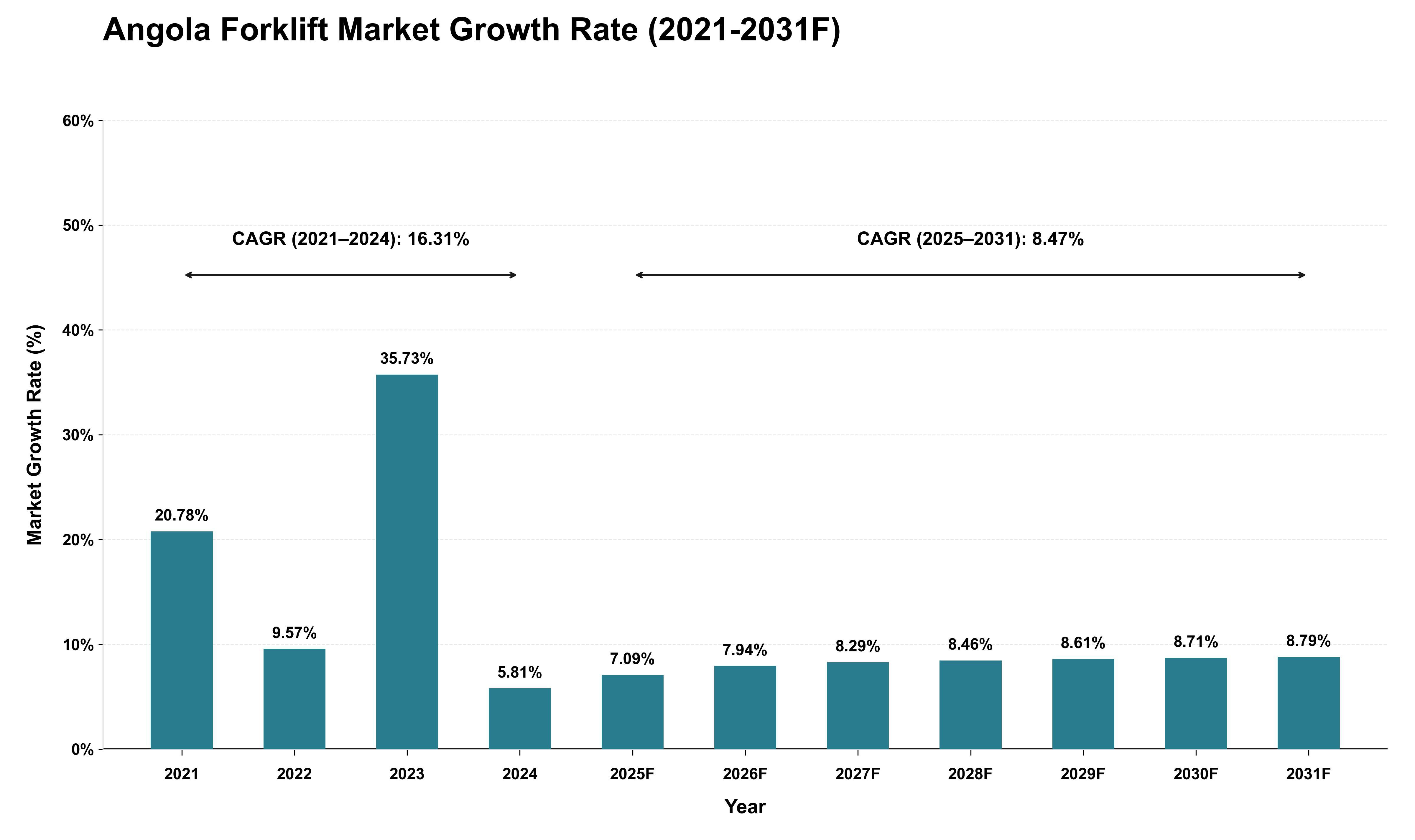
The Angola forklift market experienced significant fluctuations from 2021 to 2024, with a historical CAGR of 16.31%, driven by post-pandemic recovery and increased demand for logistics and construction equipment. The sharp growth in 2023 (35.73%) can be attributed to global supply chain disruptions that heightened the need for efficient material handling solutions, while the decline in growth rates in subsequent years reflects a normalization phase as import reliance adjusted to new economic realities. As Angola's economy stabilizes, the forecasted CAGR of 8.47% from 2025 to 2031 suggests a more sustainable growth trajectory, influenced by ongoing infrastructure investments and regional trade agreements that enhance competitive dynamics. This period will likely see gradual capacity expansions among key players, aligning with broader trends in global commodity prices and shifts towards automation in logistics, ensuring continued demand for forklifts amidst evolving market conditions.
Key Highlights of the Report:
- Angola Forklift Market Outlook
- Market Size of Angola Forklift Market, 2024
- Forecast of Angola Forklift Market, 2031
- Historical Data and Forecast of Angola Forklift Revenues & Volume for the Period 2021-2031
- Angola Forklift Market Trend Evolution
- Angola Forklift Market Drivers and Challenges
- Angola Forklift Price Trends
- Angola Forklift Porter`s Five Forces
- Angola Forklift Industry Life Cycle
- Historical Data and Forecast of Angola Forklift Market Revenues & Volume By Class for the Period 2021-2031
- Historical Data and Forecast of Angola Forklift Market Revenues & Volume By Class 1 for the Period 2021-2031
- Historical Data and Forecast of Angola Forklift Market Revenues & Volume By 2 for the Period 2021-2031
- Historical Data and Forecast of Angola Forklift Market Revenues & Volume By 3 for the Period 2021-2031
- Historical Data and Forecast of Angola Forklift Market Revenues & Volume By 4/5 for the Period 2021-2031
- Historical Data and Forecast of Angola Forklift Market Revenues & Volume By Propulsion for the Period 2021-2031
- Historical Data and Forecast of Angola Forklift Market Revenues & Volume By Electric for the Period 2021-2031
- Historical Data and Forecast of Angola Forklift Market Revenues & Volume By ICE for the Period 2021-2031
- Historical Data and Forecast of Angola Forklift Market Revenues & Volume By Battery Type for the Period 2021-2031
- Historical Data and Forecast of Angola Forklift Market Revenues & Volume By Li-Ion for the Period 2021-2031
- Historical Data and Forecast of Angola Forklift Market Revenues & Volume By Lead Acid for the Period 2021-2031
- Angola Forklift Import Export Trade Statistics
- Market Opportunity Assessment By Class
- Market Opportunity Assessment By Propulsion
- Market Opportunity Assessment By Battery Type
- Angola Forklift Top Companies Market Share
- Angola Forklift Competitive Benchmarking By Technical and Operational Parameters
- Angola Forklift Company Profiles
- Angola Forklift Key Strategic Recommendations






































