Portland Cement Market: Angola vs Top 5 Major Economies in 2027 (Africa)
In the Africa region, the Portland Cement market in Angola is projected to expand at a growing growth rate of 5.43% by 2027. The largest economy is Egypt, followed by South Africa, Ethiopia, Algeria and Nigeria.
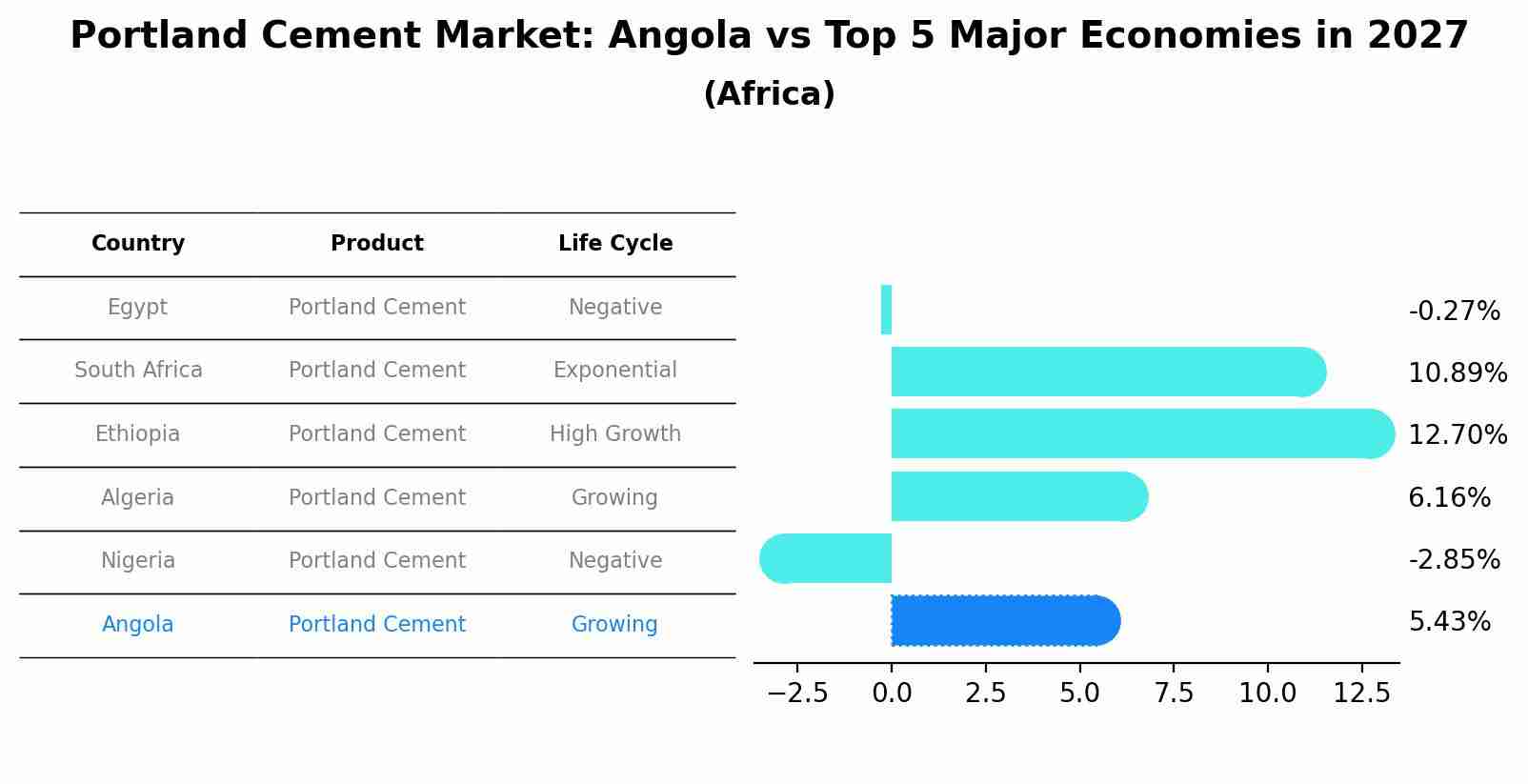
Angola Portland Cement Market Growth Rate
According to 6Wresearch internal database and industry insights, the Angola Portland Cement Market is projected to grow at a compound annual growth rate (CAGR) of 7.5% during the forecast period 2026–2032.
Topics Covered in the Angola Portland Cement Market Report
The Angola Portland Cement Market report thoroughly covers the market by type and application. It provides an unbiased and detailed analysis of ongoing market trends, opportunities, challenges, and market drivers, helping stakeholders align their strategies with current and future market dynamics.
Angola Portland Cement Market Highlights
| Report Name |
Angola Portland Cement Market |
| Forecast period | 2026-2032 |
| CAGR | 7.5% |
| Growing Sector |
Construction & Building Materials |
Angola Portland Cement Market Synopsis
The Angola Portland Cement Market is predicted to undergo steady growth owing to the rising need for cement in large-scale infrastructure projects and urbanization. The country’s growing construction sector, along with government and private sector investments, is proliferating the need for durable, high-quality cement. Major players are growing their capacities to align with the demand and provide distinctive products in response to emerging construction needs. Advancements in cement manufacturing technologies are predicted to augment production efficiency and sustainability in the sector.
Evaluation of Growth Drivers in the Angola Portland Cement Market
Below mentioned are some prominent drivers and their influence on the Angola Portland Cement Market dynamics:
| Drivers | Primary Segment Affected | Why It Matters (Evidence) |
| Government Infrastructure Projects | All Types | Government’s focus on large infrastructure projects increases cement demand. |
| Urbanization and Population Growth | All Types | Rising urbanization proliferates construction and cement consumption. |
| Rising Private Sector Investment | All Types | Rising fund allocation in commercial and residential buildings boost cement consumption. |
| Demand for High-Quality Cement | Portland Cement | Focus on durable and quality construction leads to higher for specialized cement. |
| Increased Foreign Investments in Construction | All Types | Foreign investment in the country's infrastructure contribute majorly to the demand for cement. |
The Angola Portland Cement Market is projected to grow at a CAGR of 7.5% from 2026 to 2032. Growth is proliferated by government fund allocation in infrastructure, population growth, and the rising focus on high-quality cement for construction. The rising requirement from residential, commercial, and industrial sectors is predicted to proliferate market expansion. The requirement for cement is expected to continue to surge, making ample opportunities for both local and international cement manufacturers and this is owing to continuous urbanization and the government's commitment to augmenting the country's infrastructure.
Evaluation of Restraints in the Angola Portland Cement Market
Below mentioned are some major restraints and their influence on the Angola Portland Cement Market dynamics:
| Restraints | Primary Segment Affected | What This Means (Evidence) |
| High Cost of Cement | All Types | The high price of cement may limit its consumption in cost-sensitive projects. |
| Supply Chain Disruptions | All Types | Delays in raw material imports could obstruct cement obtainability. |
| Limited Skilled Labor | All Types | Limited trained professionals may impact cement manufacturing quality. |
| Competition from Alternative Materials | All Types | Rising preference for substitute construction materials may affect cement market share. |
| Environmental Regulations on Cement Production | All Types | Strict environmental regulations governing cement production could increase production prices. |
Angola Portland Cement Market Challenges
The Angola Portland Cement Industry encounters challenges. It consists of the increased price of cement, which can restrict the market's obtainability for small-scale construction projects. Supply chain disruptions and shortage of skilled labor can further obstruct production capabilities. Rising competition from substitute building materials like steel or precast concrete may challenge cement market dominance. Changes in the price of raw materials and transportation price could also affect profit margins and hinder Angola Portland Cement Market Growth.
Angola Portland Cement Market Trends
Several notable trends are shaping the Angola Portland Cement Market dynamics:
- Rise in Demand for High-Quality Cement: The requirement for high-quality Portland cement is increasing as construction projects are becoming more complicated.
- Shift Toward Sustainable Construction Practices: Sustainable production of cement is spurred by environmental issues.
- Integration of Technology in Cement Manufacturing: Cement manufacturers are deploying advanced technologies such as automation and AI to augment efficiency and decrease prices.
- Increase in Government Construction Initiatives: Demand of Portland cement is increasing owing to Angola’s government allocating funds largely in large-scale infrastructure projects.
Investment Opportunities in the Angola Portland Cement Industry
Some notable investment opportunities in the Angola Portland Cement Market include:
- Expansion of Cement Manufacturing Plants: To align with the rising need, spurred by urbanization there is a major prospect in allocating funds in cement plants.
- Production of Eco-friendly Cement: To provide to the rising need for green building materials, allocation of funds in research and development will help to create and environmentally friendly cement
- Cement Distribution Networks: To guarantee timely delivery of cement to remote construction sites expanding distribution chains will help and it will also help to create a lucrative opportunity.
Top 5 Leading Players in the Angola Portland Cement Market
Below is the list of prominent companies leading in the Angola Portland Cement Market:
1. Nova Cimangola, SA
| Company Name | Nova Cimangola, SA |
|---|---|
| Established Year | 1957 |
| Headquarters | Luanda, Angola |
| Official Website | - |
Nova Cimangola is a leading cement manufacturer in Angola, producing over 2.5 million tons of cement annually.
2. Secil - Companhia Geral de Cal e Cimento, S.A.
| Company Name | Secil - Companhia Geral de Cal e Cimento, S.A. ("Secil") |
|---|---|
| Established Year | - |
| Headquarters | Lobito, Angola |
| Official Website | - |
Secil holds a robust position in the Angola Portland Cement Market, particularly through its Secil Lobito plant.
3. CIF (Angola) Cement Company, Limitada
| Company Name | CIF (Angola) Cement Company, Limitada |
|---|---|
| Established Year | - |
| Headquarters | Luanda, Angola |
| Official Website | - |
CIF Angola functions significant manufacturing facilities and is a major player in supplying cement for large-scale infrastructure projects, including the Sequele housing project.
4. Cimenfort (Cimento Forte de Angola)
| Company Name | Cimenfort (Cimento Forte de Angola) |
|---|---|
| Established Year | - |
| Headquarters | Benguela, Angola |
| Official Website | Click Here |
Headquartered in the Benguela province near Lobito port, Cimenfort is a leading manufacturer producing Portland cement, agricultural limestone, and plaster putty.
5. Fábrica de Cimento do Kwanza-Sul, SA (FCKS)
| Company Name | Fábrica de Cimento do Kwanza-Sul, SA (FCKS) |
|---|---|
| Established Year | - |
| Headquarters | Kwanza Sul Province, Angola |
| Official Website | - |
FCKS produces over 1.7 million tons of cement annually under the 'Yetu' brand. Based in the Kwanza Sul province, the company concentrate on using modern production technologies to meet the growing demand for cement in the region.
Government Regulations Introduced in the Angola Portland Cement Market
According to Angola government data, they have imposed various regulations to govern the production and sale of cement. The Ministry of Industry and Commerce has enforced strict licensing and quality control regulations for cement manufacturers to ensure the production of high-quality products. All cement companies should adhere laws regarding environmental sustainability and workplace safety. To deploy green production technologies and decrease carbon emissions the government has launched incentives for companies. The government is also working on augmenting infrastructure for the cement supply chain. This helps to guarantee timely delivery of raw materials to manufacturers and helping to stabilize market costs.
Future Insights of the Angola Portland Cement Market
The Angola Portland Cement Market is expected to experience sustained growth. thi is owing to acceleration in infrastructure development. With an emphasis on eco-friendly and high-strength products there is rising requirement for sustainable construction materials. This will proliferate creative innovation in cement production. The need for cement will remain robust, owing to rise in government spending on public projects. This will showcase major growth opportunities for major players in the industry. Cement manufacturers are likely to deploy more efficient production techniques owing to advancements in digital technologies. This will augment both quality and cost-effectiveness, further contributing to market expansion.
Market Segmentation Analysis
The report offers a comprehensive study of the following market segments and their leading categories:
By Type – Portland Cement to dominate the market:
According to Mansi Ahuja, Senior Research Analyst at 6Wresearch, Portland Cement is expected to lead the Angola Portland Cement Market Share owing to its wide application in all types of construction projects, from residential buildings to large infrastructure developments.
Key Attractiveness of the Report
- 10 Years of Market Numbers
- Historical Data Starting from 2022 to 2025
- Base Year: 2025
- Forecast Data until 2032
- Key Performance Indicators Impacting the Market
- Major Upcoming Developments and Projects
Key Highlights of the Report:
- Angola Portland Cement Market Outlook
- Market Size of Angola Portland Cement Market, 2025
- Forecast of Angola Portland Cement Market, 2032
- Historical Data and Forecast of Angola Portland Cement Revenues & Volume for the Period 2022-2032
- Angola Portland Cement Market Trend Evolution
- Angola Portland Cement Market Drivers and Challenges
- Angola Portland Cement Price Trends
- Angola Portland Cement Porter`s Five Forces
- Angola Portland Cement Industry Life Cycle
- Historical Data and Forecast of Angola Portland Cement Market Revenues & Volume By Type for the Period 2022-2032
- Historical Data and Forecast of Angola Portland Cement Market Revenues & Volume By Type 1 for the Period 2022-2032
- Historical Data and Forecast of Angola Portland Cement Market Revenues & Volume By Type 2 for the Period 2022-2032
- Historical Data and Forecast of Angola Portland Cement Market Revenues & Volume By Type 3 for the Period 2022-2032
- Historical Data and Forecast of Angola Portland Cement Market Revenues & Volume By Type 4 for the Period 2022-2032
- Historical Data and Forecast of Angola Portland Cement Market Revenues & Volume By Type 5 for the Period 2022-2032
- Historical Data and Forecast of Angola Portland Cement Market Revenues & Volume By for the Period 2022-2032
- Historical Data and Forecast of Angola Portland Cement Market Revenues & Volume By Application for the Period 2022-2032
- Historical Data and Forecast of Angola Portland Cement Market Revenues & Volume By Residential for the Period 2022-2032
- Historical Data and Forecast of Angola Portland Cement Market Revenues & Volume By Commercial for the Period 2022-2032
- Historical Data and Forecast of Angola Portland Cement Market Revenues & Volume By Industrial for the Period 2022-2032
- Historical Data and Forecast of Angola Portland Cement Market Revenues & Volume By for the Period 2022-2032
- Historical Data and Forecast of Angola Portland Cement Market Revenues & Volume By Packing Type for the Period 2022-2032
- Historical Data and Forecast of Angola Portland Cement Market Revenues & Volume By 10 KG for the Period 2022-2032
- Historical Data and Forecast of Angola Portland Cement Market Revenues & Volume By 15 KG for the Period 2022-2032
- Historical Data and Forecast of Angola Portland Cement Market Revenues & Volume By 25 KG for the Period 2022-2032
- Historical Data and Forecast of Angola Portland Cement Market Revenues & Volume By Others for the Period 2022-2032
- Angola Portland Cement Import Export Trade Statistics
- Market Opportunity Assessment By Type
- Market Opportunity Assessment By Application
- Market Opportunity Assessment By Packing Type
- Angola Portland Cement Top Companies Market Share
- Angola Portland Cement Competitive Benchmarking By Technical and Operational Parameters
- Angola Portland Cement Company Profiles
- Angola Portland Cement Key Strategic Recommendations
Market Covered
The report offers a comprehensive study of the following segments:
By Type:
- Portland Cement
By Application:
- Residential
- Commercial
- Industrial
By Packing Type:
- 10 KG
- 15 KG
- 25 KG
- Others






































