Argentina Armored Vehicle Market Size, Share & Growth Rate
The Argentina Armored Vehicle Market was estimated at USD 199 Million in 2025 and is projected to reach USD 265 Million by 2032, growing at a CAGR of 4.2% from 2026 to 2032. This anticipated growth is largely fueled by increased investment in national defense and an urgent need for enhanced security measures amid rising threats, particularly in urban environments. Additionally, the drive for modernization within military and law enforcement sectors is further propelling demand for advanced armored vehicle technologies.
Argentina Armored Vehicle Market Year-wise Growth Rate and Key Drivers
This graph highlights how the Argentina Armored Vehicle Market has steadily grown over the years, supported by major growth factors.
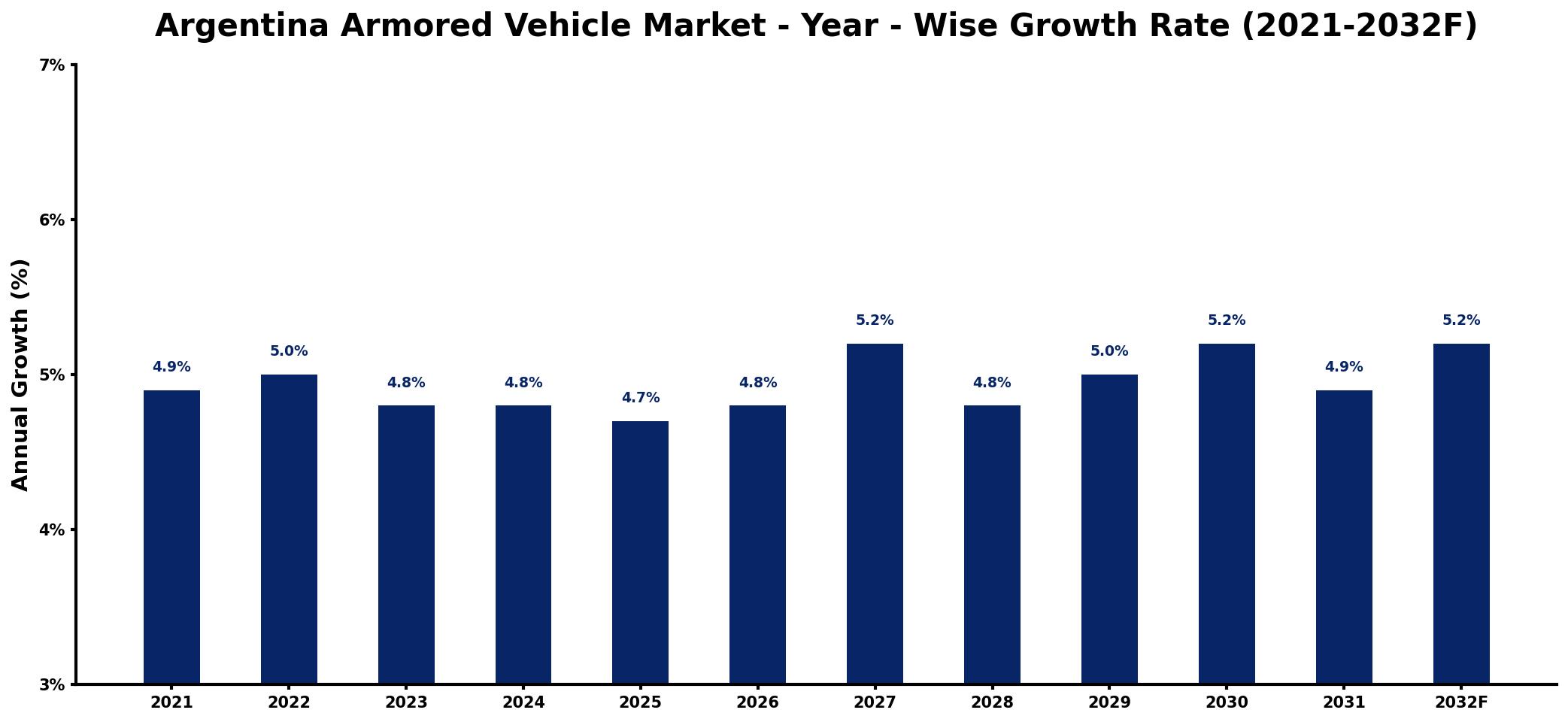
The table below presents the year‑wise growth rates along with the key drivers influencing the market
| Year | Growth Rate | Major Drivers |
| 2021 | 4.9% | Rising security concerns drive demand |
| 2022 | 5.0% | Government investments in defense increase |
| 2023 | 4.8% | Private sector security spending rises |
| 2024 | 4.8% | Urban crime rates fuel investments |
| 2025 | 4.7% | Increased military modernization initiatives |
| 2026 | 4.8% | Public safety initiatives gain traction |
| 2027 | 5.2% | International collaborations enhance capabilities |
| 2028 | 4.8% | Technological advancements attract investment |
| 2029 | 5.0% | Growing demand for personal protection |
| 2030 | 5.2% | Strategic partnerships expand market reach |
| 2031 | 4.9% | Investment in emergency response systems |
| 2032 | 5.2% | Enhanced regulatory frameworks support industry |
Note: Market size estimations and growth projections presented in this report are based on 6Wresearch's proprietary forecasting methodology, utilizing the latest available industry data, government publications, and primary research inputs.
Argentina Armored Vehicle Market Synopsis
Currently, the Argentina Armored Vehicle Market reflects a dynamic interplay between domestic manufacturing and international supply, highlighting a growing commitment to security and defense modernization. The market is evolving, with an evident shift towards more technologically advanced and agile vehicles designed to counter sophisticated threats.
As security challenges multiply, Argentina's defense strategy increasingly prioritizes the procurement of vehicles that offer enhanced mobility and protection. This trend is matched by a rising interest in partnerships with global manufacturers, facilitating knowledge transfer and technological advancements to better equip local forces.
Argentina Armored Vehicle Market Key Takeaways
- Continuous modernization efforts are vital for strengthening Argentina's military and law enforcement capabilities.
- Urban-centric vehicle designs are gaining traction, catering to the need for rapid response in densely populated areas.
- Technological enhancements, such as integrated communication systems, are shaping the future of armored vehicles.
- Economic factors and procurement processes are influencing market dynamics, requiring strategic planning from manufacturers.
- Investment opportunities in maintenance and upgrade services for existing fleets present significant potential for growth.
Evaluation of Restraints in Argentina Armored Vehicle Market
Despite positive growth prospects, the Argentina Armored Vehicle Market faces challenges that could hinder its momentum. Economic volatility poses a significant risk, as fluctuations in defense budgets can directly impact demand for new vehicles. Additionally, the bureaucratic procurement landscape often results in delays, complicating the acquisition process for both public entities and private manufacturers. As security threats evolve, there is also a pressing need for constant innovation, requiring substantial investments in research and development that not all players can sustain.
Argentina Armored Vehicle Market Trends
The market is currently witnessing several transformative trends. There is a marked shift towards lighter, more maneuverable armored vehicles that can effectively navigate urban settings, reflecting the need for agility in law enforcement operations. Moreover, the integration of advanced surveillance and communication technologies is becoming increasingly prevalent, enabling improved situational awareness. Furthermore, a heightened emphasis on vehicle protection is evident, particularly against threats such as improvised explosive devices (IEDs) and ballistic attacks, further driving demand for advanced engineering solutions.
Argentina Armored Vehicle Market Opportunities
As the market evolves, numerous investment opportunities emerge, particularly within the military, law enforcement, and private security sectors. The growing emphasis on national security is prompting urgent needs for enhanced armored personnel carriers and tactical vehicles equipped with cutting-edge technology. Additionally, the provision of aftermarket services such as maintenance and fleet upgrades presents an attractive avenue for investors looking to capitalize on ongoing market demand. Collaborating with local manufacturers can also yield strategic advantages, facilitating a deeper understanding of local market conditions and regulatory environments.
Government Initiatives in the Argentina Armored Vehicle Market
The Argentine government has enacted a series of policies aimed at enhancing the integrity and safety of the Armored Vehicle Market. These regulations govern the manufacturing, sale, and operation of armored vehicles, seeking to mitigate misuse and illegal activities. By establishing quality standards, the government aims to ensure that all vehicles meet stringent safety requirements, while import and export regulations are enforced to manage the international flow of armored vehicles, reinforcing national security priorities.
Future Insights of the Argentina Armored Vehicle Market
Looking ahead to 2026-2032, the Argentina Armored Vehicle Market is poised for steady growth, underpinned by an escalating focus on national defense and security. Modernization initiatives within the military are expected to drive significant investments in armored vehicles, particularly in response to organized crime and border security concerns. Technological advancements in materials and systems will continue to shape product offerings, enhancing operational efficiency. However, industry players must navigate economic constraints with strategic foresight to fully leverage emerging market opportunities.
Argentina Armored Vehicle Market Latest Developments (2025 - 2026)
Recent developments in the Argentina Armored Vehicle Market showcase a commitment to advancing national defense capabilities. Ongoing procurement programs reflect increased budget allocations aimed at modernizing military assets. Additionally, industry stakeholders are focusing on technological partnerships to integrate innovative features into new vehicle designs, emphasizing enhanced safety and operational versatility. Initiatives to streamline procurement processes are also gaining traction, aiming to facilitate quicker access to advanced armored solutions.
Argentina Armored Vehicle Market - Key Attractiveness of the Report
- 10 Years of Market Numbers
- Historical Data Starting from 2022 to 2025
- Base Year: 2025
- Forecast Data until 2032
- Key Performance Indicators Impacting the Market
- Major Upcoming Developments and Projects
Key Highlights of the Report:
- Argentina Armored Vehicle Market Outlook
- Market Size of Argentina Armored Vehicle Market, 2025
- Forecast of Argentina Armored Vehicle Market, 2032
- Historical Data and Forecast of Argentina Armored Vehicle Revenues & Volume for the Period 2022-2032F
- Argentina Armored Vehicle Market Trend Evolution
- Argentina Armored Vehicle Market Drivers and Challenges
- Argentina Armored Vehicle Price Trends
- Argentina Armored Vehicle Porter's Five Forces
- Argentina Armored Vehicle Industry Life Cycle
- Historical Data and Forecast of Argentina Armored Vehicle Market Revenues & Volume By Platform for the Period 2022-2032F
- Historical Data and Forecast of Argentina Armored Vehicle Market Revenues & Volume By Combat Vehicles for the Period 2022-2032F
- Historical Data and Forecast of Argentina Armored Vehicle Market Revenues & Volume By Combat Support Vehicles for the Period 2022-2032F
- Historical Data and Forecast of Argentina Armored Vehicle Market Revenues & Volume By Unmanned Armored Ground Vehicles for the Period 2022-2032F
- Historical Data and Forecast of Argentina Armored Vehicle Market Revenues & Volume By Mobility for the Period 2022-2032F
- Historical Data and Forecast of Argentina Armored Vehicle Market Revenues & Volume By Wheeled for the Period 2022-2032F
- Historical Data and Forecast of Argentina Armored Vehicle Market Revenues & Volume By Tracked for the Period 2022-2032F
- Historical Data and Forecast of Argentina Armored Vehicle Market Revenues & Volume By System for the Period 2022-2032F
- Historical Data and Forecast of Argentina Armored Vehicle Market Revenues & Volume By Engine for the Period 2022-2032F
- Historical Data and Forecast of Argentina Armored Vehicle Market Revenues & Volume By Drive System for the Period 2022-2032F
- Historical Data and Forecast of Argentina Armored Vehicle Market Revenues & Volume By Ballistic Armor for the Period 2022-2032F
- Historical Data and Forecast of Argentina Armored Vehicle Market Revenues & Volume By Turret Drives for the Period 2022-2032F
- Historical Data and Forecast of Argentina Armored Vehicle Market Revenues & Volume By Ammunition Handling System for the Period 2022-2032F
- Historical Data and Forecast of Argentina Armored Vehicle Market Revenues & Volume By Fire Control Systems (FCS) for the Period 2022-2032F
- Historical Data and Forecast of Argentina Armored Vehicle Market Revenues & Volume By Armaments for the Period 2022-2032F
- Historical Data and Forecast of Argentina Armored Vehicle Market Revenues & Volume By Countermeasure System for the Period 2022-2032F
- Argentina Armored Vehicle Import Export Trade Statistics
- Market Opportunity Assessment By Platform
- Market Opportunity Assessment By Mobility
- Market Opportunity Assessment By System
- Argentina Armored Vehicle Top Companies Market Share
- Argentina Armored Vehicle Competitive Benchmarking By Technical and Operational Parameters
- Argentina Armored Vehicle Company Profiles
- Argentina Armored Vehicle Key Strategic Recommendations






































