Argentina Cattle Feed Market: Import Trend Analysis
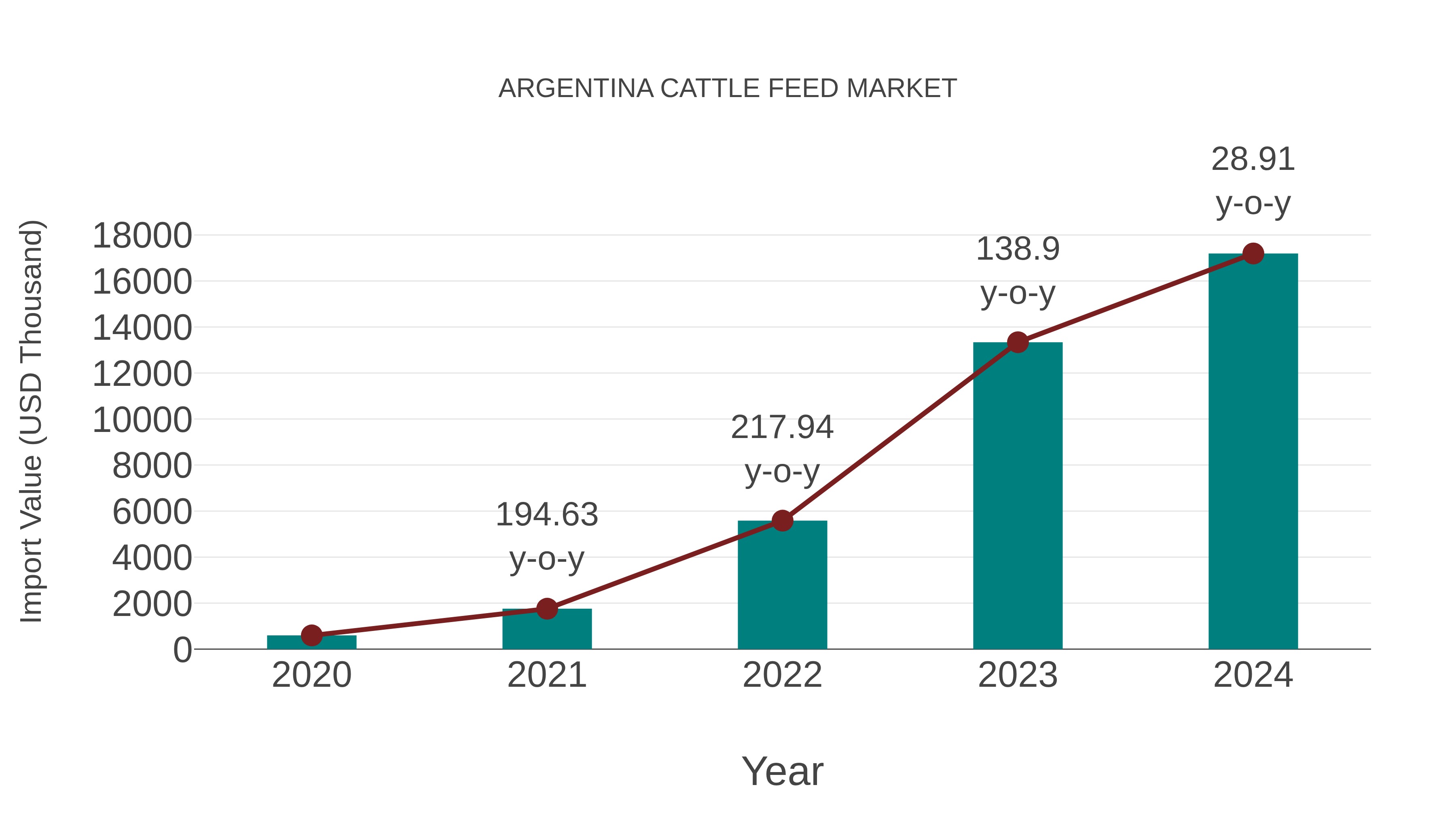
In the Argentina cattle feed market, the import trend exhibited a notable growth rate of 28.96% from 2023 to 2024, with a compound annual growth rate (CAGR) of 128.29% from 2020 to 2024. This surge in imports can be attributed to a significant shift in demand dynamics, likely influenced by evolving livestock production practices or changing market preferences.
Argentina Cattle Feed Market Synopsis
Argentina cattle feed market is experiencing robust growth driven by the country`s prominent livestock industry and the increasing demand for high-quality animal nutrition solutions. With Argentina being one of the world`s leading beef producers, the livestock sector relies heavily on nutritious and balanced cattle feed to ensure optimal growth, health, and productivity of cattle. Market players are focusing on developing innovative feed formulations enriched with essential nutrients, vitamins, and minerals to address specific nutritional requirements and improve overall animal performance, thereby driving market expansion.
Drivers of the market
The cattle feed market in Argentina is experiencing steady growth driven by several key factors. Firstly, the country`s strong agricultural sector, particularly its beef industry, is driving the demand for cattle feed. Additionally, the increasing demand for high-quality meat products, both domestically and internationally, is fueling the growth of this market. Moreover, advancements in feed technology, leading to the development of nutritionally balanced and cost-effective feed formulations, are further driving market expansion.
Challenges of the market
In Argentina, the cattle feed market grapples with challenges arising from fluctuating commodity prices, environmental sustainability concerns, and regulatory constraints. Volatility in grain prices, a key component of cattle feed, directly impacts production costs and profitability for feed manufacturers and livestock producers. Moreover, increasing awareness of environmental sustainability prompts the demand for feed formulations that minimize carbon footprint and resource consumption, driving the need for innovative solutions. Additionally, regulatory measures concerning feed safety and quality standards influence market dynamics, requiring compliance efforts from industry players. Adapting to market fluctuations, sustainability requirements, and regulatory changes while maintaining product affordability presents a multifaceted challenge for participants in the Argentina cattle feed market.
Government Policy of the market
Argentina Cattle Feed Market is thriving, supported by the country`s robust livestock industry and agricultural sector. Government policies aimed at enhancing livestock productivity and promoting sustainable farming practices are driving demand for cattle feed. Additionally, incentives for domestic feed production and measures to ensure feed quality contribute to market growth. The government`s focus on bolstering the agricultural sector through policy interventions fosters a conducive environment for the cattle feed market to flourish in Argentina.
Key Highlights of the Report:
- Argentina Cattle Feed Market Outlook
- Market Size of Argentina Cattle Feed Market, 2024
- Forecast of Argentina Cattle Feed Market, 2031
- Historical Data and Forecast of Argentina Cattle Feed Revenues & Volume for the Period 2018 - 2031
- Argentina Cattle Feed Market Trend Evolution
- Argentina Cattle Feed Market Drivers and Challenges
- Argentina Cattle Feed Price Trends
- Argentina Cattle Feed Porter's Five Forces
- Argentina Cattle Feed Industry Life Cycle
- Historical Data and Forecast of Argentina Cattle Feed Market Revenues & Volume By Source for the Period 2018 - 2031
- Historical Data and Forecast of Argentina Cattle Feed Market Revenues & Volume By Organic for the Period 2018 - 2031
- Historical Data and Forecast of Argentina Cattle Feed Market Revenues & Volume By Conventional for the Period 2018 - 2031
- Historical Data and Forecast of Argentina Cattle Feed Market Revenues & Volume By Application for the Period 2018 - 2031
- Historical Data and Forecast of Argentina Cattle Feed Market Revenues & Volume By Agriculture for the Period 2018 - 2031
- Historical Data and Forecast of Argentina Cattle Feed Market Revenues & Volume By Industrial for the Period 2018 - 2031
- Historical Data and Forecast of Argentina Cattle Feed Market Revenues & Volume By Sales Channel for the Period 2018 - 2031
- Historical Data and Forecast of Argentina Cattle Feed Market Revenues & Volume By Direct Sales for the Period 2018 - 2031
- Historical Data and Forecast of Argentina Cattle Feed Market Revenues & Volume By Indirect Sales for the Period 2018 - 2031
- Argentina Cattle Feed Import Export Trade Statistics
- Market Opportunity Assessment By Source
- Market Opportunity Assessment By Application
- Market Opportunity Assessment By Sales Channel
- Argentina Cattle Feed Top Companies Market Share
- Argentina Cattle Feed Competitive Benchmarking By Technical and Operational Parameters
- Argentina Cattle Feed Company Profiles
- Argentina Cattle Feed Key Strategic Recommendations






































