Argentina Cultured Meat Market Size, Share & Growth Rate
The Argentina Cultured Meat Market was estimated at USD 668 Million in 2025 and is projected to reach USD 949 Million by 2032, growing at a CAGR of 5.1% from 2026 to 2032. This promising trajectory is primarily driven by a rising consumer base that is increasingly aware of the environmental and ethical implications of traditional meat production. As the government bolsters research initiatives, advancements in biotechnologies are paving the way for more cost-effective cultured meat solutions.
Argentina Cultured Meat Market Year-wise Growth Rate and Key Drivers
This graph highlights how the Argentina Cultured Meat Market has steadily grown over the years, supported by major growth factors.
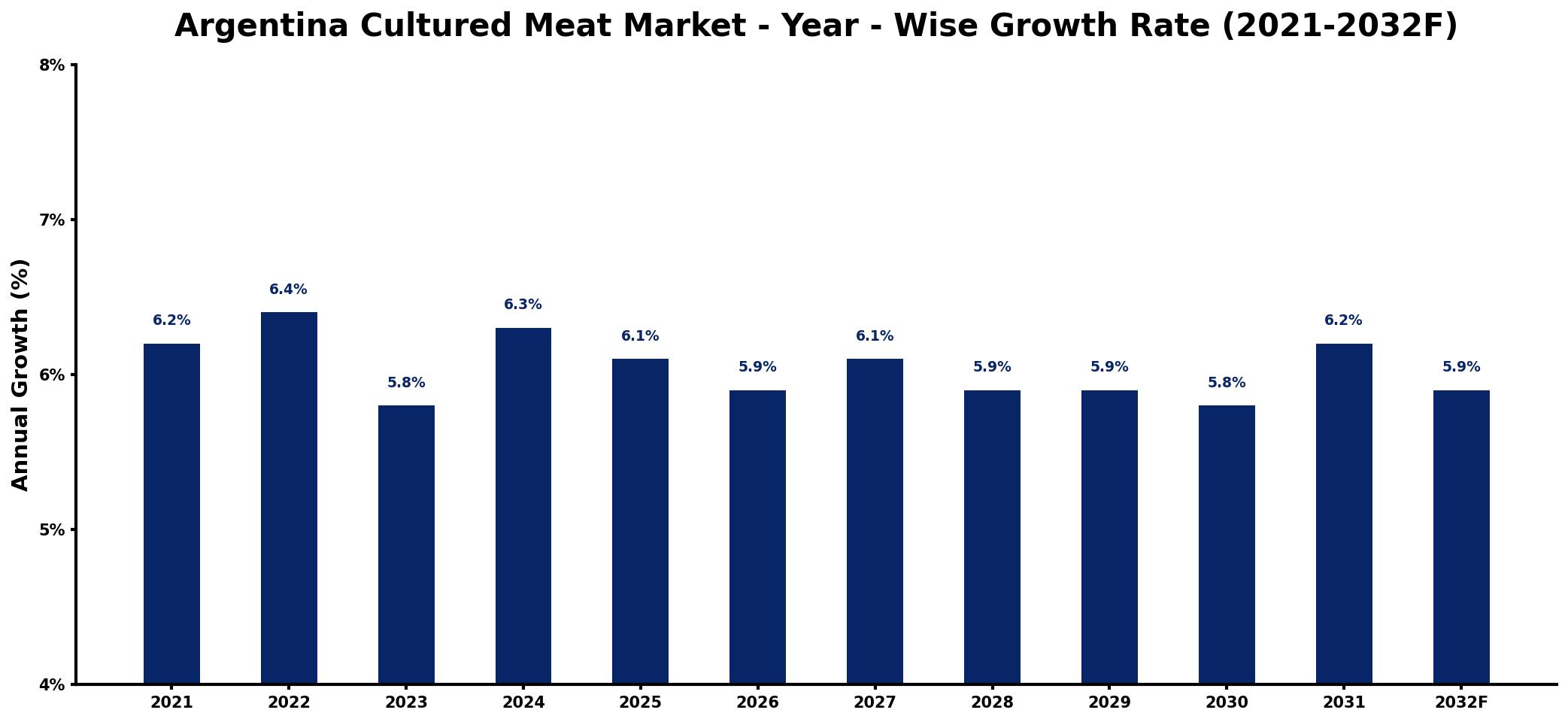
The table below presents the year‑wise growth rates along with the key drivers influencing the market
| Year | Growth Rate | Major Drivers |
| 2021 | 6.2% | Increased consumer awareness sustainability |
| 2022 | 6.4% | Rising investment alternative proteins |
| 2023 | 5.8% | Growing demand ethical food options |
| 2024 | 6.3% | Expansion in production facilities |
| 2025 | 6.1% | Innovations in food technology |
| 2026 | 5.9% | Strengthening supply chain partnerships |
| 2027 | 6.1% | Emerging markets exploring alternatives |
| 2028 | 5.9% | Collaborations with food distributors |
| 2029 | 5.9% | Enhanced marketing strategies implemented |
| 2030 | 5.8% | Regulatory support for innovations |
| 2031 | 6.2% | Consumer preference plant based diets |
| 2032 | 5.9% | Increased focus on health benefits |
Note: Market size estimations and growth projections presented in this report are based on 6Wresearch's proprietary forecasting methodology, utilizing the latest available industry data, government publications, and primary research inputs.
Argentina Cultured Meat Market Synopsis
In Argentina, the demand for cultured meat products is gaining momentum, particularly among younger consumers who are keen on sustainable dietary choices. The intersection of environmental awareness and animal welfare concerns is driving this shift toward lab-grown protein alternatives.
Moreover, the traditional meat industry in Argentina, known for its beef production, is under increasing scrutiny for its environmental impact. As a result, there is a noticeable push from consumers and producers alike to explore innovative solutions like cultured meat that could redefine the country's food landscape.
Argentina Cultured Meat Market Key Takeaways
- The Argentina cultured meat market is positioned for steady growth as consumer demand for sustainable protein sources rises.
- Government initiatives are focused on enhancing research and development capabilities in the biotechnology sector.
- Technological advancements in cultured meat production are reducing costs and improving scalability.
- Concerns regarding food safety and consumer acceptance present challenges to market penetration.
- Collaboration among stakeholders is essential for driving innovation and addressing regulatory hurdles.
Evaluation of Restraints in Argentina Cultured Meat Market
Despite the promising outlook, the Argentina cultured meat market faces notable restraints that hinder its expansion. Consumer skepticism surrounding the safety and taste of lab-grown meat remains a significant barrier, with many potential buyers expressing reluctance to shift away from traditional options. Additionally, regulatory frameworks surrounding the approval and commercialization of cultured meat products can be complex and protracted, creating uncertainty for businesses. Furthermore, the high costs associated with production and the challenges related to scaling operations are critical hurdles that need to be addressed to facilitate broader market acceptance and penetration.
Argentina Cultured Meat Market Trends
Several key trends are emerging in the Argentina cultured meat market. First, there is a growing emphasis on sustainability among consumers, which is increasing demand for products that are perceived as environmentally friendly. Additionally, the development of novel marketing strategies targeting health-conscious and environmentally aware consumers is gaining traction. Collaboration between food technology firms and agricultural sectors is also becoming more prevalent, fostering innovation in product development and commercial viability. Finally, consumer education campaigns focused on the benefits of cultured meat are beginning to take root, potentially easing apprehensions about these alternative proteins.
Argentina Cultured Meat Market Opportunities
The cultured meat sector in Argentina is rife with opportunities for growth and investment. One of the most promising areas lies in partnerships between startups and established food companies, which can leverage existing supply chains and market access. Additionally, as consumer awareness increases, there is potential for premium-priced cultured meat products that cater to niche markets. Moreover, advancements in production technologies can lead to economies of scale, further enhancing market viability. The increasing prioritization of ethical consumption offers a unique landscape where culturally integrated lab-grown meat can thrive.
Government Initiatives in the Argentina Cultured Meat Market
The Argentine government is increasingly recognizing the potential of cultured meat as a sustainable food source. Initiatives to boost research in cellular agriculture and biotechnology are underway, aimed at facilitating a favorable regulatory environment for cultured meat production. Public funding for research projects, along with incentives for companies venturing into this innovative space, indicate a proactive approach to integrating alternative protein sources into the national food system. While significant strides have been made, continuous engagement with stakeholders will be essential for refining policies and addressing market challenges.
Future Insights of the Argentina Cultured Meat Market
Looking ahead to 2026-2032, the Argentina cultured meat market is poised for transformative growth. As consumer preferences shift and the market begins to stabilize, increased investment in technology and production processes is likely to yield more affordable products. Furthermore, successful public education campaigns may reduce consumer hesitancy, creating an environment ripe for acceptance. Over the next several years, innovations in biotechnology will be key drivers of market expansion, with collaborative efforts among industry players shaping a robust ecosystem for cultured meat.
Argentina Cultured Meat Market Latest Developments (2025 - 2026)
Recent developments in the Argentina cultured meat market reflect a growing commitment to innovation and sustainability. Numerous partnerships between technology firms and agricultural stakeholders have emerged, focusing on streamlining production processes. Consumer outreach efforts have intensified, aimed at educating the public about the benefits of lab-grown meat. Additionally, there has been an uptick in participation at trade shows and industry forums, facilitating dialogue on regulatory advancements and market challenges. These actions signal an optimistic trajectory for the market, underscoring a collective interest in promoting alternative protein sources.
Argentina Cultured Meat Market - Key Attractiveness of the Report
- 10 Years of Market Numbers
- Historical Data Starting from 2022 to 2025
- Base Year: 2025
- Forecast Data until 2032
- Key Performance Indicators Impacting the Market
- Major Upcoming Developments and Projects
Key Highlights of the Report:
- Argentina Cultured Meat Market Outlook
- Market Size of Argentina Cultured Meat Market, 2025
- Forecast of Argentina Cultured Meat Market, 2032
- Historical Data and Forecast of Argentina Cultured Meat Revenues & Volume for the Period 2022-2032F
- Argentina Cultured Meat Market Trend Evolution
- Argentina Cultured Meat Market Drivers and Challenges
- Argentina Cultured Meat Price Trends
- Argentina Cultured Meat Porter's Five Forces
- Argentina Cultured Meat Industry Life Cycle
- Historical Data and Forecast of Argentina Cultured Meat Market Revenues & Volume By Product Type for the Period 2022-2032F
- Historical Data and Forecast of Argentina Cultured Meat Market Revenues & Volume By Poultry for the Period 2022-2032F
- Historical Data and Forecast of Argentina Cultured Meat Market Revenues & Volume By Beef for the Period 2022-2032F
- Historical Data and Forecast of Argentina Cultured Meat Market Revenues & Volume By Seafood for the Period 2022-2032F
- Historical Data and Forecast of Argentina Cultured Meat Market Revenues & Volume By Pork for the Period 2022-2032F
- Historical Data and Forecast of Argentina Cultured Meat Market Revenues & Volume By Duck for the Period 2022-2032F
- Historical Data and Forecast of Argentina Cultured Meat Market Revenues & Volume By End-Use for the Period 2022-2032F
- Historical Data and Forecast of Argentina Cultured Meat Market Revenues & Volume By Nuggets for the Period 2022-2032F
- Historical Data and Forecast of Argentina Cultured Meat Market Revenues & Volume By Burgers for the Period 2022-2032F
- Historical Data and Forecast of Argentina Cultured Meat Market Revenues & Volume By Meatballs for the Period 2022-2032F
- Historical Data and Forecast of Argentina Cultured Meat Market Revenues & Volume By Sausage for the Period 2022-2032F
- Historical Data and Forecast of Argentina Cultured Meat Market Revenues & Volume By Hot dogs for the Period 2022-2032F
- Historical Data and Forecast of Argentina Cultured Meat Market Revenues & Volume By Others for the Period 2022-2032F
- Argentina Cultured Meat Import Export Trade Statistics
- Market Opportunity Assessment By Product Type
- Market Opportunity Assessment By End-Use
- Argentina Cultured Meat Top Companies Market Share
- Argentina Cultured Meat Competitive Benchmarking By Technical and Operational Parameters
- Argentina Cultured Meat Company Profiles
- Argentina Cultured Meat Key Strategic Recommendations






































