Argentina Decentralized Identity Market Size & Growth Rate (2026-2032)
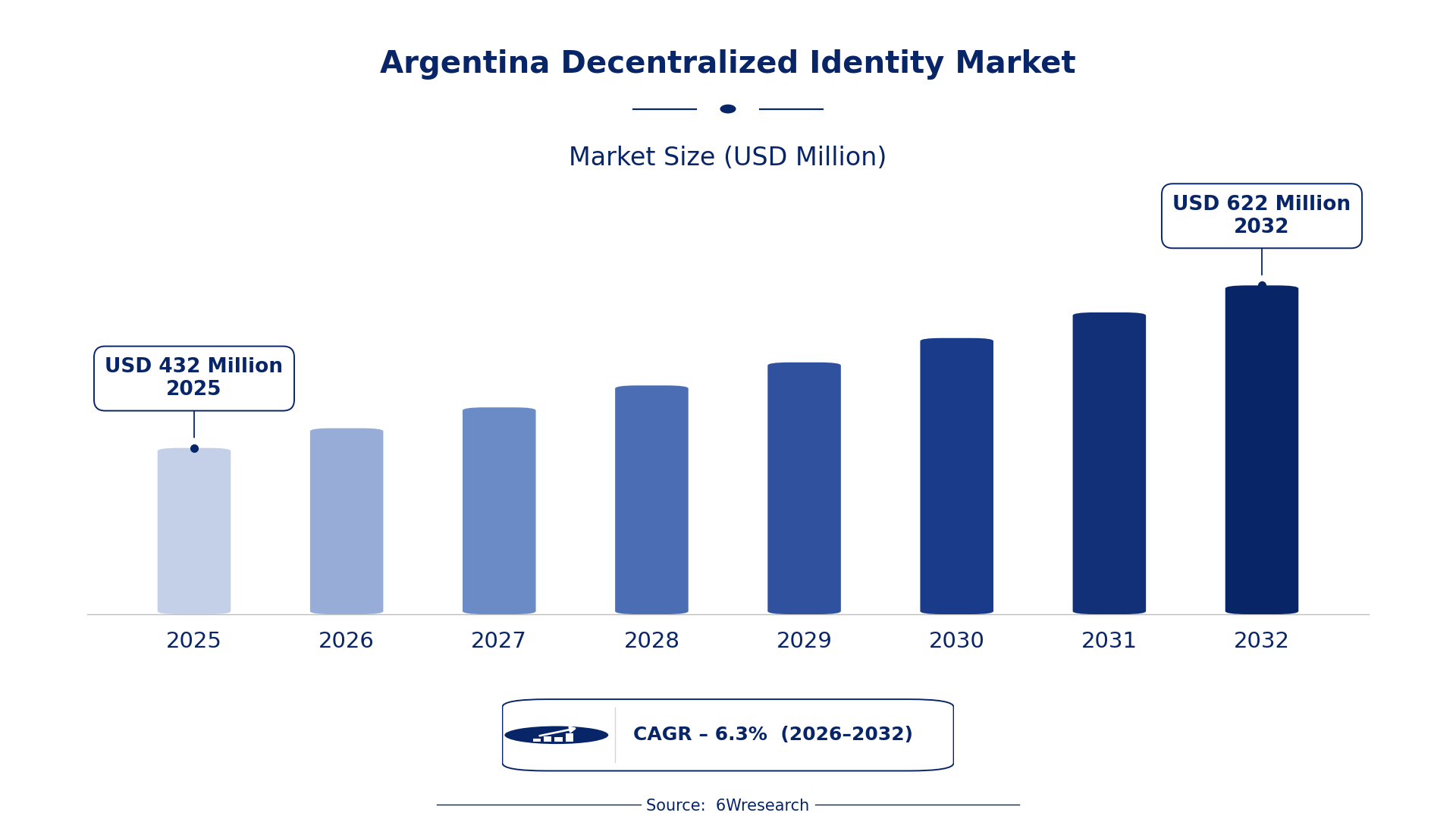
The Argentina Decentralized Identity Market was estimated at USD 432 Million in 2025 and is projected to reach USD 622 Million by 2032, growing at a CAGR of 6.3% from 2026 to 2032.
Argentina Decentralized Identity Market Synopsis
The push for user-centric identity solutions is the dominant force currently shaping the Argentina Decentralized Identity Market. As issues surrounding data privacy and identity theft become more prominent, individuals and organizations are increasingly turning to decentralized identity platforms that leverage blockchain technology.
The drive for self-sovereign identity is gaining traction among users who value greater control over their personal information. With a focus on secure, privacy-preserving management solutions, the market is experiencing a notable uptick in adoption across various sectors, from finance to healthcare.
Argentina Decentralized Identity Market Year-wise Growth Rate and Key Drivers
This graph illustrates the annual growth rates of the Argentina Decentralized Identity Market from 2021 to 2032, highlighting a steady upward trajectory and projected expansion over the forecast period.
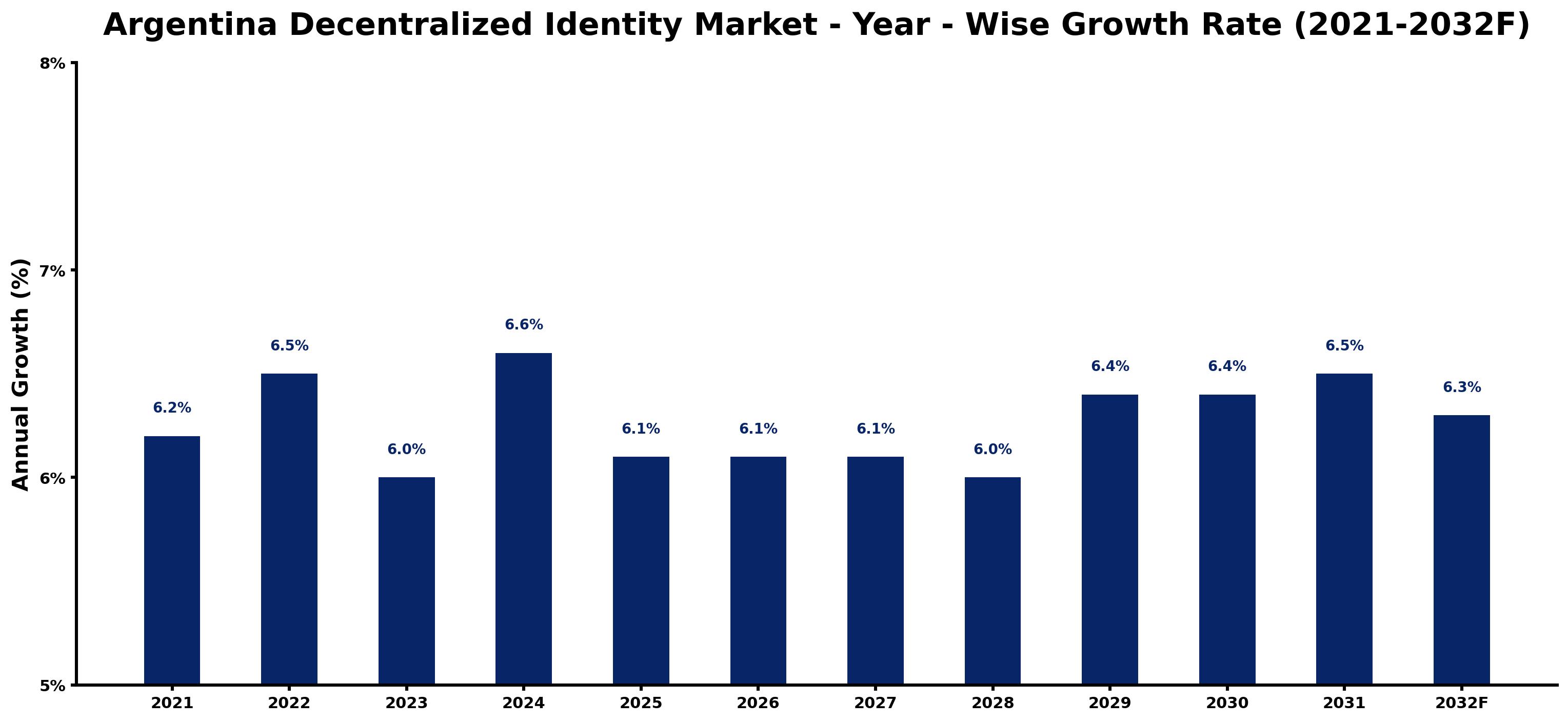
The table below presents the year‑wise growth rates along with the key drivers influencing the market
| Year | Growth Rate | Major Drivers |
| 2021 | 6.2% | Argentinian government's push for digital identity regulations. |
| 2022 | 6.5% | Growing adoption of biometrics for secure transaction verification. |
| 2023 | 6.0% | Rise in consumer demand for privacy-focused verification solutions. |
| 2024 | 6.6% | Local tech startups innovating in decentralized identity applications. |
| 2025 | 6.1% | Increased collaboration between banks and identity verification providers. |
| 2026 | 6.1% | Healthcare sector's need for secure patient identity management. |
| 2027 | 6.1% | Educational institutions implementing digital IDs for students. |
| 2028 | 6.0% | Emergence of blockchain initiatives supporting identity solutions. |
| 2029 | 6.4% | E-commerce boom driving verification needs for online transactions. |
| 2030 | 6.4% | Regulatory compliance requirements enhancing identity security standards. |
| 2031 | 6.5% | Government digitalization initiatives boosting identity management systems. |
| 2032 | 6.3% | Local NGOs promoting digital inclusion with identity solutions. |
Note: Market size estimations and growth projections presented in this report are based on 6Wresearch's proprietary forecasting methodology, utilizing the latest available industry data, government publications, and primary research inputs.
Argentina Decentralized Identity Market Key Takeaways
Below are some of the specific key takeaways from the market, including:
- Growing concerns about data privacy are fueling demand for decentralized identity solutions.
- Blockchain and distributed ledger technologies provide a secure framework for identity management.
- Regulatory initiatives, including compliance with GDPR, are prompting further adoption.
- User trust remains a significant challenge for the uptake of decentralized identity solutions.
- Healthcare and financial services are leading sectors in the adoption of decentralized identity technologies.
Evaluation of Restraints in Argentina Decentralized Identity Market
Interoperability presents a major challenge for the decentralized identity market in Argentina. The need for collaboration among governments, technology providers, and businesses is crucial, yet often lacking. User adoption also lags, as skepticism about new technologies and data privacy issues persist. This hesitance can stall the deployment of decentralized identity systems that require widespread acceptance to be effective.
Argentina Decentralized Identity Market Trends
Emerging trends in the Argentina Decentralized Identity Market reflect a growing alignment with self-sovereign identity principles. More users are seeking solutions that offer not just security but also transparency in data sharing. Collaborative initiatives between public and private sectors are becoming more common as stakeholders recognize the potential for decentralized identity to enhance service delivery.
Innovations in blockchain technologies are also shaping the future of identity solutions. These advancements promise to address existing limitations around user control and data ownership, driving the demand for solutions that are not only secure but also user-friendly.
Argentina Decentralized Identity Market Opportunities
The Argentina Decentralized Identity Market presents substantial growth opportunities, particularly within healthcare and finance. Organizations that can develop trusted and interoperable identity frameworks will likely attract significant investments. Additionally, the increasing focus on regulatory compliance offers a unique entry point for technology providers aiming to enhance user trust in decentralized systems.
Government Initiatives in the Argentina Decentralized Identity Market
The Argentine government recognizes the transformative potential of decentralized identity solutions. By promoting initiatives that encourage research and development, the government is laying the groundwork for a more secure digital identity landscape. Public sector priorities are focused on enhancing citizens' control over their personal data while ensuring compliance with global standards.
- A national pilot program launched in early 2025, aimed at evaluating the application of decentralized identity in healthcare services.
- Currently ongoing is a public-private partnership focusing on building interoperability standards for decentralized identity frameworks.
- Planned for late 2026 is an initiative that will test decentralized identity technologies in financial services, targeting enhanced customer verification processes.
- The government is actively encouraging collaboration between local tech startups and educational institutions to drive innovation in identity management.
- An upcoming regulatory framework anticipated for early 2027 will set guidelines for the responsible use of decentralized identity solutions.
Future Insights of the Argentina Decentralized Identity Market
From 2026 to 2032, the Argentina Decentralized Identity Market is expected to evolve significantly. As users become more informed about their data rights, solutions that prioritize transparency and security will be in demand. Companies that can deliver not only technological advancements but also establish trust will thrive. The alignment of regulatory frameworks will further solidify the market’s foundations, facilitating broader adoption across sectors.
Argentina Decentralized Identity Market Latest Developments
In the past year, the Argentina Decentralized Identity Market has witnessed several key developments reflecting growing industry momentum. Stakeholders across sectors are increasingly collaborating to explore the applications of decentralized identity technology in various contexts.
- A major regional technology provider announced a successful rollout of a decentralized identity pilot program in Q2 2025, aimed at streamlining user verification in financial transactions.
- An initiative launched in early 2025 is ongoing, focusing on integrating decentralized identity features into existing healthcare systems to improve patient data management.
- By mid-2026, a consortium of local startups plans to release a comprehensive toolkit for businesses looking to implement decentralized identity solutions.
- New partnerships between academic institutions and tech firms are currently underway, focusing on research into user-friendly decentralized identity interfaces.
- An upcoming public awareness campaign scheduled for late 2026 aims to educate the public on the benefits of decentralized identity, thereby fostering user adoption.
Argentina Decentralized Identity Market - Key Attractiveness of the Report
- 10 Years of Market Numbers
- Historical Data Starting from 2022 to 2025
- Base Year: 2025
- Forecast Data until 2032
- Key Performance Indicators Impacting the Market
- Major Upcoming Developments and Projects
Key Highlights of the Report:
- Argentina Decentralized Identity Market Outlook
- Market Size of Argentina Decentralized Identity Market, 2025
- Forecast of Argentina Decentralized Identity Market, 2032
- Historical Data and Forecast of Argentina Decentralized Identity Revenues & Volume for the Period 2022-2032F
- Argentina Decentralized Identity Market Trend Evolution
- Argentina Decentralized Identity Market Drivers and Challenges
- Argentina Decentralized Identity Price Trends
- Argentina Decentralized Identity Porter's Five Forces
- Argentina Decentralized Identity Industry Life Cycle
- Historical Data and Forecast of Argentina Decentralized Identity Market Revenues & Volume By Vertical for the Period 2022-2032F
- Historical Data and Forecast of Argentina Decentralized Identity Market Revenues & Volume By BFSI for the Period 2022-2032F
- Historical Data and Forecast of Argentina Decentralized Identity Market Revenues & Volume By Government for the Period 2022-2032F
- Historical Data and Forecast of Argentina Decentralized Identity Market Revenues & Volume By Healthcare and Life Sciences for the Period 2022-2032F
- Historical Data and Forecast of Argentina Decentralized Identity Market Revenues & Volume By Retail and eCommerce for the Period 2022-2032F
- Historical Data and Forecast of Argentina Decentralized Identity Market Revenues & Volume By Telecom and IT for the Period 2022-2032F
- Historical Data and Forecast of Argentina Decentralized Identity Market Revenues & Volume By Transport and Logistics for the Period 2022-2032F
- Historical Data and Forecast of Argentina Decentralized Identity Market Revenues & Volume By Real Estate for the Period 2022-2032F
- Historical Data and Forecast of Argentina BFSI Decentralized Identity Market Revenues & Volume By Others for the Period 2022-2032F
- Historical Data and Forecast of Argentina Decentralized Identity Market Revenues & Volume By Identity Type for the Period 2022-2032F
- Historical Data and Forecast of Argentina Decentralized Identity Market Revenues & Volume By Non- biometrics for the Period 2022-2032F
- Historical Data and Forecast of Argentina Decentralized Identity Market Revenues & Volume By Biometrics for the Period 2022-2032F
- Historical Data and Forecast of Argentina Decentralized Identity Market Revenues & Volume By End User for the Period 2022-2032F
- Historical Data and Forecast of Argentina Decentralized Identity Market Revenues & Volume By Enterprises for the Period 2022-2032F
- Historical Data and Forecast of Argentina Decentralized Identity Market Revenues & Volume By Individual for the Period 2022-2032F
- Historical Data and Forecast of Argentina Decentralized Identity Market Revenues & Volume By Organization Size for the Period 2022-2032F
- Historical Data and Forecast of Argentina Decentralized Identity Market Revenues & Volume By Large Enterprises for the Period 2022-2032F
- Historical Data and Forecast of Argentina Decentralized Identity Market Revenues & Volume By SMEs for the Period 2022-2032F
- Argentina Decentralized Identity Import Export Trade Statistics
- Market Opportunity Assessment By Vertical
- Market Opportunity Assessment By Identity Type
- Market Opportunity Assessment By End User
- Market Opportunity Assessment By Organization Size
- Argentina Decentralized Identity Top Companies Market Share
- Argentina Decentralized Identity Competitive Benchmarking By Technical and Operational Parameters
- Argentina Decentralized Identity Company Profiles
- Argentina Decentralized Identity Key Strategic Recommendations






































