Argentina Digital Lending Market Size & Growth Rate (2026-2032)
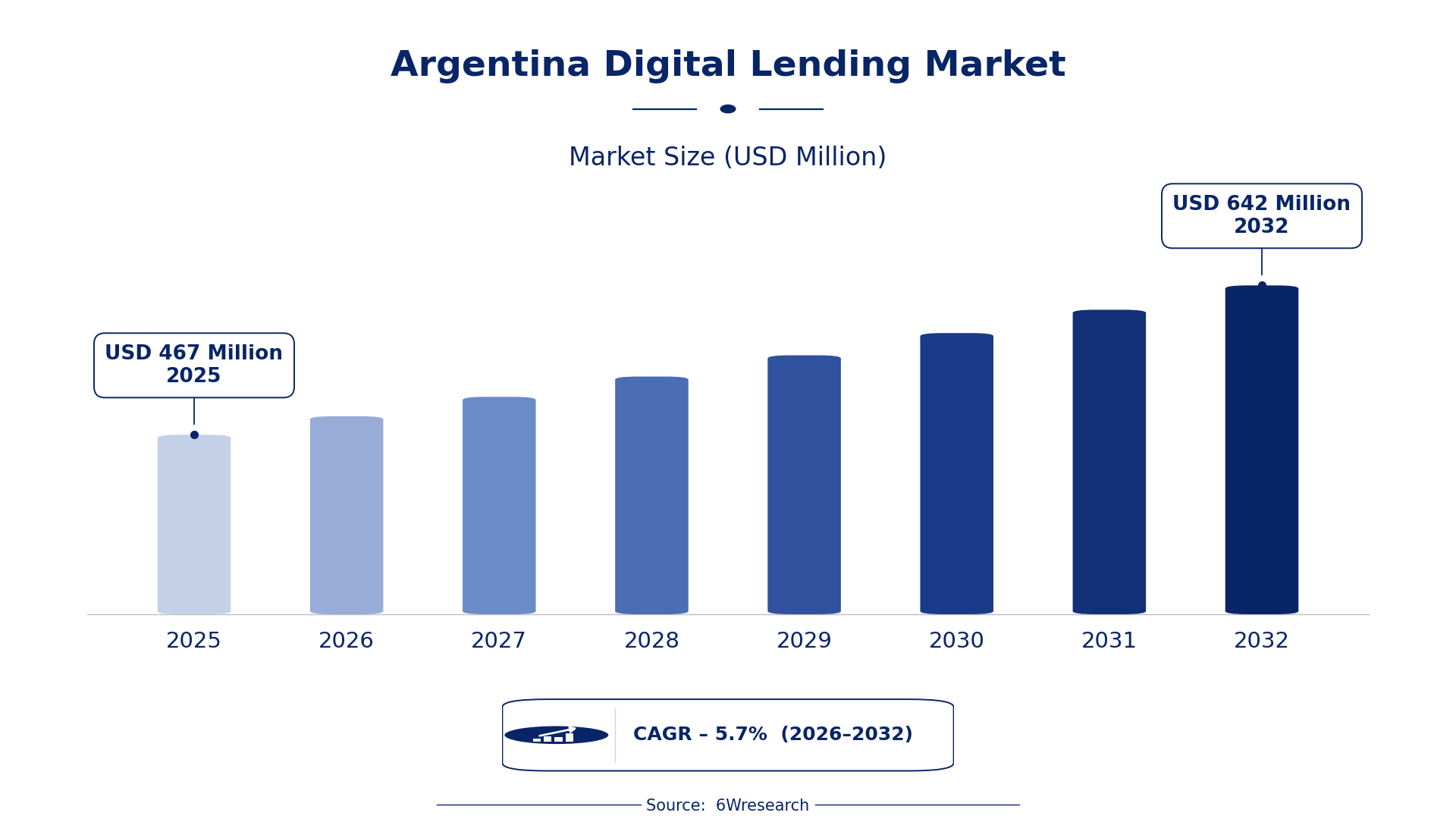
The Argentina Digital Lending Market was estimated at USD 467 Million in 2025 and is projected to reach USD 642 Million by 2032, growing at a CAGR of 5.7% from 2026 to 2032.
Argentina Digital Lending Market Synopsis
The Argentina Digital Lending Market is witnessing a remarkable transformation, fueled by the increasing embrace of digital technologies among consumers and businesses alike. Fintech companies are rapidly emerging as key players, offering a range of innovative lending solutions that cater to the evolving financial needs of the population.
Digital lending services, such as peer-to-peer lending and online payday loans, are gaining traction, thanks to their convenience and efficiency. Despite the promising growth trajectory, challenges such as regulatory hurdles and data security concerns persist, necessitating a collaborative approach among stakeholders to foster a sustainable market environment.
Argentina Digital Lending Market Year-wise Growth Rate and Key Drivers
This graph illustrates the annual growth rates of the Argentina Digital Lending Market from 2021 to 2032, highlighting a steady upward trajectory and projected expansion over the forecast period.
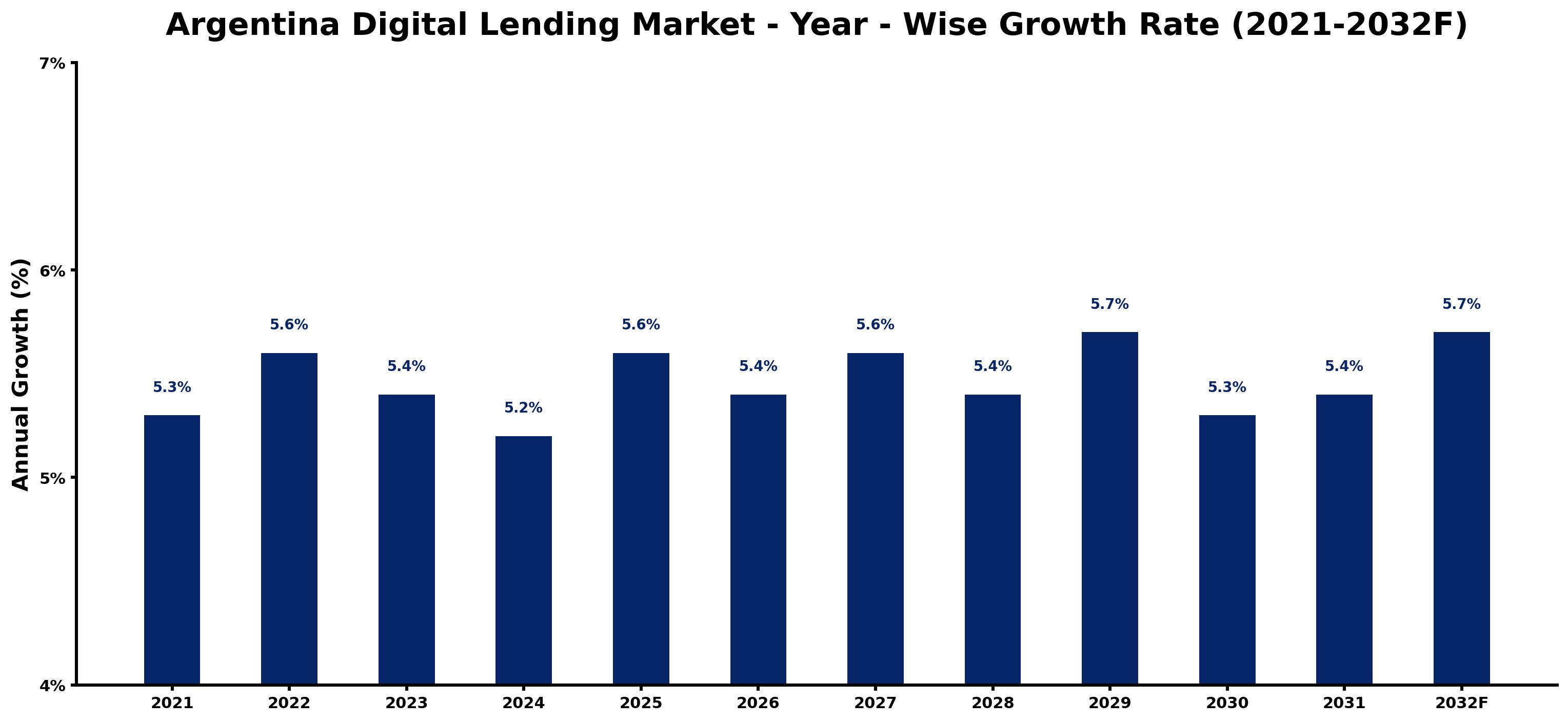
The table below presents the year‑wise growth rates along with the key drivers influencing the market
| Year | Growth Rate | Major Drivers |
| 2021 | 5.3% | Rise of fintech platforms like Ualá and Mercado Crédito. |
| 2022 | 5.6% | Increased smartphone penetration facilitating digital loan access. |
| 2023 | 5.4% | Regulatory support from BCRA on digital credit services. |
| 2024 | 5.2% | Growing preference for cashless transactions amid inflation fears. |
| 2025 | 5.6% | Digital financial literacy programs enhancing consumer understanding. |
| 2026 | 5.4% | Emergence of AI-driven underwriting processes improving efficiency. |
| 2027 | 5.6% | Young population embracing technology for financial solutions. |
| 2028 | 5.4% | Local partnerships boosting trust in digital lending options. |
| 2029 | 5.7% | Economic recovery driving demand for personal loans online. |
| 2030 | 5.3% | Improved internet infrastructure enhancing service reachability. |
| 2031 | 5.4% | Government initiatives promoting financial inclusion through technology. |
| 2032 | 5.7% | Increased collaboration with retailers offering financing options. |
Note: Market size estimations and growth projections presented in this report are based on 6Wresearch's proprietary forecasting methodology, utilizing the latest available industry data, government publications, and primary research inputs.
Argentina Digital Lending Market Key Takeaways
Below are some of the specific key takeaways from the market, including:
- Rapid growth driven by increasing smartphone penetration and internet accessibility.
- Emergence of fintech solutions focusing on underserved demographics and small businesses.
- Integration of advanced technologies, such as AI and machine learning, enhancing risk assessment.
- Regulatory frameworks being established to ensure transparency and consumer protection.
- Potential for significant innovation as players adapt to changing consumer preferences.
Evaluation of Restraints in Argentina Digital Lending Market
Despite the growth potential, the Argentina Digital Lending Market faces notable constraints. Regulatory uncertainty remains a primary concern, as evolving policies can impact operational frameworks for digital lenders. Additionally, the lack of comprehensive credit scoring mechanisms creates barriers for both borrowers and lenders, complicating risk assessment processes. High interest rates also act as a deterrent for many potential borrowers, limiting market penetration and growth.
Argentina Digital Lending Market Trends
Several trends are shaping the Argentina Digital Lending Market. The rise of peer-to-peer lending platforms is creating new avenues for borrowers, allowing individuals to connect directly with lenders. on top of that, the adoption of artificial intelligence for credit scoring is streamlining the lending process, making it faster and more efficient. Mobile lending solutions are also gaining popularity, catering to a tech-savvy population that values convenience and quick access to funds.
Argentina Digital Lending Market Opportunities
The market offers numerous opportunities, particularly in targeting underserved segments like small businesses and individuals with limited access to traditional banking services. There’s significant potential for leveraging data analytics to create personalized lending products that meet specific consumer needs. Collaborations between fintech companies and traditional banks can also enhance customer experiences, driving further growth in the digital lending space.
Government Initiatives in the Argentina Digital Lending Market
The Argentine government is actively shaping the digital lending sector through various initiatives aimed at fostering a stable and competitive market. Regulations introduced by the Central Bank of Argentina are focused on transparency and consumer protection, ensuring that digital lenders adhere to strict reporting standards. These efforts are crucial for maintaining trust and facilitating growth in the industry.
- A regulatory framework established in early 2025 mandating transparency in loan terms and conditions.
- Current initiatives aimed at enhancing financial literacy among potential borrowers to promote informed decision-making.
- A national program launched to improve digital infrastructure, supporting fintech growth and service accessibility.
- Ongoing discussions on updating consumer protection laws to adapt to the evolving digital landscape.
- Planned initiatives to expand access to credit for underserved populations by 2028.
Future Insights of the Argentina Digital Lending Market
Looking ahead to 2026-2032, the Argentina Digital Lending Market is set for continued expansion. Increasing internet penetration and smartphone adoption will drive demand for digital lending solutions. The unbanked population presents a substantial opportunity for fintech companies to offer tailored financial services. However, firms will need to navigate regulatory challenges and consumer concerns about data privacy to fully capitalize on this potential. As competition intensifies, innovation will be key to staying relevant and meeting consumer expectations.
Argentina Digital Lending Market Latest Developments
Recent activity in the Argentina Digital Lending Market indicates a vibrant and rapidly evolving sector. Over the past year, several significant developments have emerged, reflecting the market's dynamic nature and the ongoing commitment of stakeholders to enhance service offerings.
- A major fintech company launched a new mobile lending application in early 2025, simplifying the loan application process for users.
- An ongoing partnership between several digital lenders and tech firms aims to integrate AI solutions for improved credit risk assessment.
- A recent initiative began in Q2 2025 to establish a centralized credit scoring system, enhancing the assessment capabilities for lenders.
- Plans are in place for a public-private partnership to expand digital lending services to rural areas, expected to begin rollout by mid-2026.
- Ongoing research projects are examining the impact of financial literacy programs on borrowing habits, with preliminary findings anticipated by late 2025.
Argentina Digital Lending Market - Key Attractiveness of the Report
- 10 Years of Market Numbers
- Historical Data Starting from 2022 to 2025
- Base Year: 2025
- Forecast Data until 2032
- Key Performance Indicators Impacting the Market
- Major Upcoming Developments and Projects
Key Highlights of the Report:
- Argentina Digital Lending Market Outlook
- Market Size of Argentina Digital Lending Market, 2025
- Forecast of Argentina Digital Lending Market, 2032
- Historical Data and Forecast of Argentina Digital Lending Revenues & Volume for the Period 2022-2032F
- Argentina Digital Lending Market Trend Evolution
- Argentina Digital Lending Market Drivers and Challenges
- Argentina Digital Lending Price Trends
- Argentina Digital Lending Porter's Five Forces
- Argentina Digital Lending Industry Life Cycle
- Historical Data and Forecast of Argentina Digital Lending Market Revenues & Volume By Offering for the Period 2022-2032F
- Historical Data and Forecast of Argentina Digital Lending Market Revenues & Volume By Solutions for the Period 2022-2032F
- Historical Data and Forecast of Argentina Digital Lending Market Revenues & Volume By Services for the Period 2022-2032F
- Historical Data and Forecast of Argentina Digital Lending Market Revenues & Volume By Deployment Mode for the Period 2022-2032F
- Historical Data and Forecast of Argentina Digital Lending Market Revenues & Volume By Cloud for the Period 2022-2032F
- Historical Data and Forecast of Argentina Digital Lending Market Revenues & Volume By On-premises for the Period 2022-2032F
- Historical Data and Forecast of Argentina Digital Lending Market Revenues & Volume By End User for the Period 2022-2032F
- Historical Data and Forecast of Argentina Digital Lending Market Revenues & Volume By Banks for the Period 2022-2032F
- Historical Data and Forecast of Argentina Digital Lending Market Revenues & Volume By Credit Unions for the Period 2022-2032F
- Historical Data and Forecast of Argentina Digital Lending Market Revenues & Volume By NBFCs for the Period 2022-2032F
- Argentina Digital Lending Import Export Trade Statistics
- Market Opportunity Assessment By Offering
- Market Opportunity Assessment By Deployment Mode
- Market Opportunity Assessment By End User
- Argentina Digital Lending Top Companies Market Share
- Argentina Digital Lending Competitive Benchmarking By Technical and Operational Parameters
- Argentina Digital Lending Company Profiles
- Argentina Digital Lending Key Strategic Recommendations






































