Argentina Enterprise Firewall Market Size & Growth Rate (2026-2032)
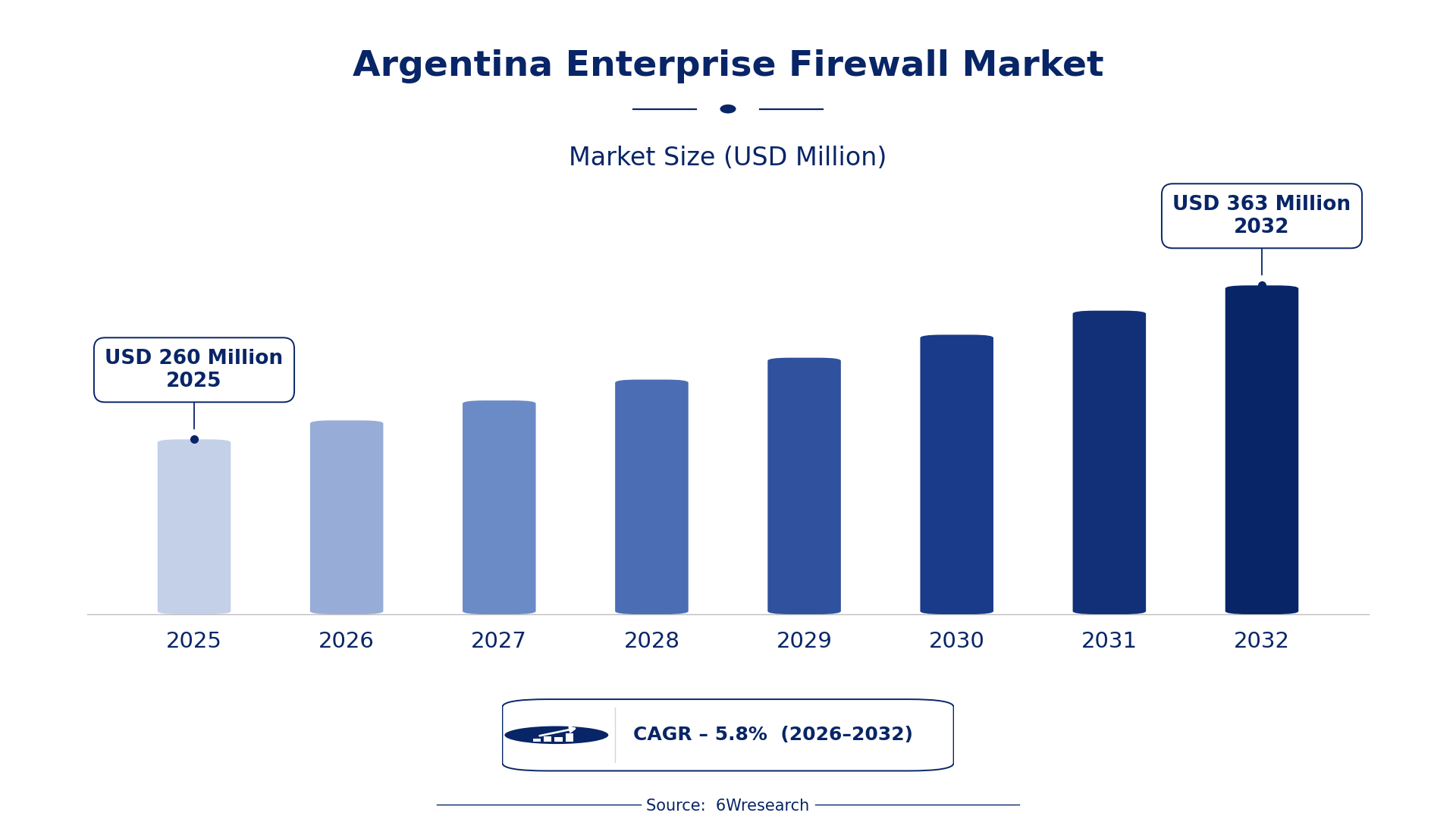
The Argentina Enterprise Firewall Market was estimated at USD 260 Million in 2025 and is projected to reach USD 363 Million by 2032, growing at a CAGR of 5.8% from 2026 to 2032.
Argentina Enterprise Firewall Market Synopsis
The increasing frequency of cyber threats is the dominant force reshaping the Argentina Enterprise Firewall Market. Organizations across various sectors are recognizing that standard security measures are no longer sufficient, necessitating a shift towards advanced firewall technologies.
As businesses embrace digital transformation and cloud computing, the demand for integrated security solutions grows. This has spurred an interest in next-generation firewalls that provide a multifaceted approach to cybersecurity, aligning with the complex challenges faced by enterprises today.
Argentina Enterprise Firewall Market Year-wise Growth Rate and Key Drivers
This graph illustrates the annual growth rates of the Argentina Enterprise Firewall Market from 2021 to 2032, highlighting a steady upward trajectory and projected expansion over the forecast period.
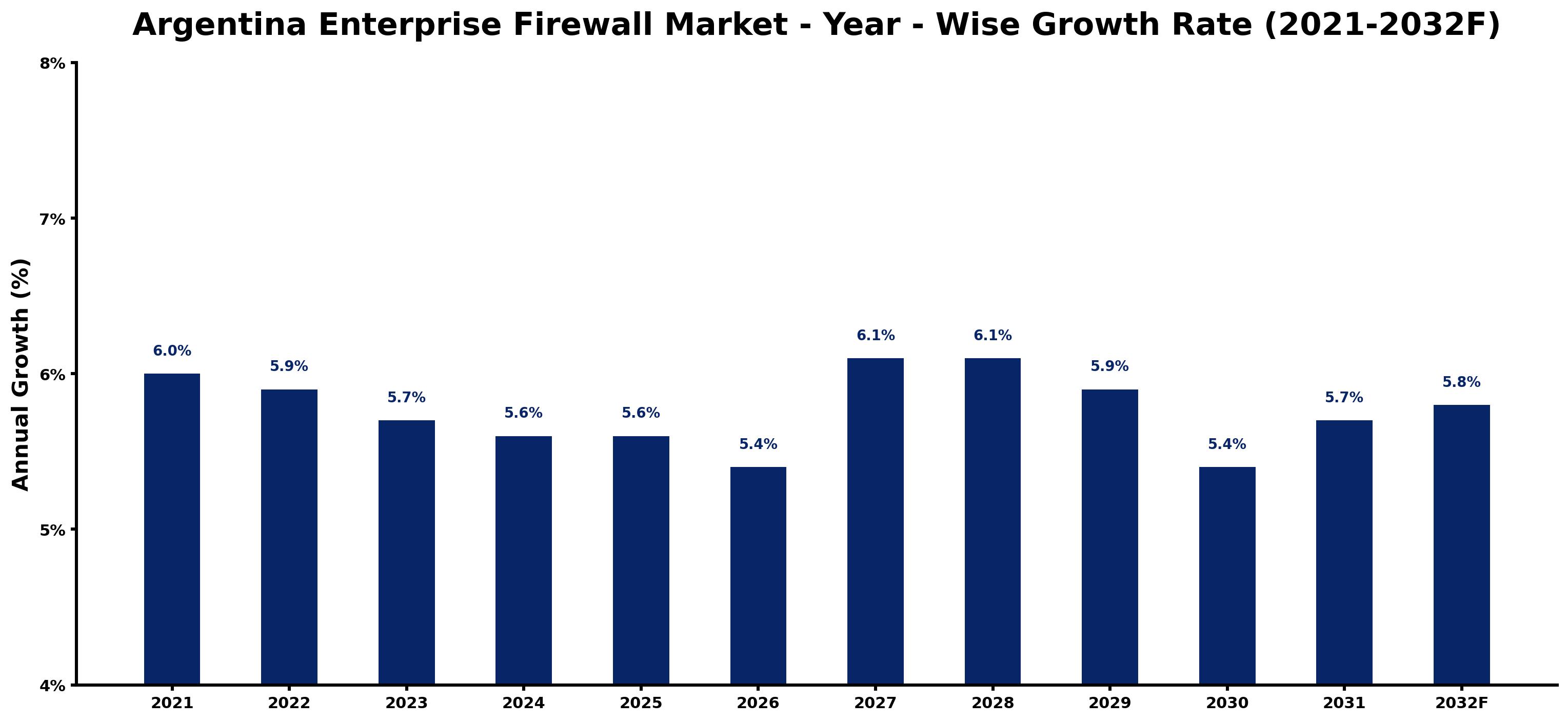
The table below presents the year‑wise growth rates along with the key drivers influencing the market
| Year | Growth Rate | Major Drivers |
| 2021 | 6.0% | Cybersecurity regulations from Argentina's Central Bank enhance adoption. |
| 2022 | 5.9% | Rising cyber threats prompting businesses to upgrade firewalls. |
| 2023 | 5.7% | Increased government focus on data protection legislation. |
| 2024 | 5.6% | Local manufacturing growth demands improved enterprise security measures. |
| 2025 | 5.6% | Shift towards cloud services requires stronger perimeter defenses. |
| 2026 | 5.4% | Growing awareness of ransomware risks boosts firewall investment. |
| 2027 | 6.1% | Collaboration between tech firms and universities enhances cybersecurity skills. |
| 2028 | 6.1% | Investment in digital transformation increases demand for firewalls. |
| 2029 | 5.9% | Regulatory compliance pressures spur enterprise security upgrades. |
| 2030 | 5.4% | Emerging IoT technology creates complex security needs. |
| 2031 | 5.7% | Healthcare sector digitalization drives need for enhanced firewalls. |
| 2032 | 5.8% | Adoption of e-commerce solutions increases cybersecurity requirements. |
Note: Market size estimations and growth projections presented in this report are based on 6Wresearch's proprietary forecasting methodology, utilizing the latest available industry data, government publications, and primary research inputs.
Argentina Enterprise Firewall Market Key Takeaways
Below are some of the specific key takeaways from the market, including:
- The market is driven by an escalating number of cyberattacks and data breaches.
- Next-generation firewalls are becoming the preferred choice for many enterprises seeking advanced security features.
- Compliance with government regulations is a crucial factor influencing purchasing decisions.
- The shift towards remote work is reshaping firewall requirements, emphasizing secure connectivity.
- Investments in integrated security platforms are on the rise, merging firewall capabilities with additional security technologies.
Evaluation of Restraints in Argentina Enterprise Firewall Market
Despite its growth, the Argentina Enterprise Firewall Market faces notable constraints. Chief among them is the persistent shortage of skilled cybersecurity professionals, which hampers organizations' ability to implement and manage advanced firewall solutions effectively. Additionally, many firms are constrained by limited cybersecurity budgets, making it challenging to invest in cutting-edge technologies. The complexities of rapidly evolving technology and intricate network infrastructures further complicate effective security management, compelling companies to continuously adapt their strategies.
Argentina Enterprise Firewall Market Trends
The demand for advanced threat protection is surging, driven by an uptick in sophisticated cyber threats. Enterprises are prioritizing features like intrusion prevention, application control, and SSL inspection, which next-generation firewalls provide. There’s also a noticeable trend towards the integration of firewall capabilities with other security measures, such as endpoint protection and threat intelligence, to create a more comprehensive security posture.
on top of that, the growth in remote work and cloud-based services has led to a higher emphasis on secure access and connectivity. Companies are increasingly looking for firewall solutions that not only protect networks but also ensure that remote workforces can operate securely.
Argentina Enterprise Firewall Market Opportunities
Vendors have a wealth of growth opportunities in the Argentina Enterprise Firewall Market. As organizations invest in digital transformation, the demand for integrated security solutions that combine firewall capabilities with other technologies is likely to increase. on top of that, the focus on compliance with strict data protection regulations opens avenues for companies offering advanced firewall solutions tailored to meet these regulatory requirements. There's an undeniable push for continuous monitoring and real-time threat detection, creating a landscape ripe for innovation.
Government Initiatives in the Argentina Enterprise Firewall Market
Government initiatives are significantly influencing the Argentina Enterprise Firewall Market, with policies aimed at enhancing cybersecurity measures across sectors. By emphasizing compliance with data protection laws and the use of advanced firewall technologies, the government is creating a conducive environment for market growth. These initiatives are not only about regulation but also about empowering businesses to invest in robust cybersecurity infrastructures.
- A national cybersecurity framework recently launched to promote best practices among businesses.
- Ongoing initiatives aimed at providing training and resources to improve the cybersecurity workforce in Argentina.
- Plans for a public-private partnership focused on upgrading critical digital infrastructure to better withstand cyber threats.
- Current incentives for small and medium enterprises to adopt advanced firewall solutions as part of their compliance strategies.
- Upcoming regulatory guidelines expected to be introduced by mid-2026, mandating stronger cybersecurity protocols.
Future Insights of the Argentina Enterprise Firewall Market
Looking ahead to 2026-2032, the Argentina Enterprise Firewall Market is set to expand steadily. The interplay of increased cloud adoption and persistent cyber threats will drive demand for sophisticated firewall solutions. As enterprises prioritize cybersecurity investments, there will be a focus on developing innovative features and capabilities. Collaborations and partnerships between technology vendors and enterprises will likely play a key role in meeting the evolving security needs of the market.
Argentina Enterprise Firewall Market Latest Developments
Recent developments within the Argentina Enterprise Firewall Market reflect a growing recognition of the need for comprehensive security solutions. Over the past year, various initiatives have been launched to enhance network security and address escalating cyber threats. The landscape is marked by significant technological advancements and an urgent focus on compliance.
- A major technology vendor launched a new next-generation firewall with integrated threat intelligence capabilities in early 2023.
- An initiative promoting cybersecurity awareness among small businesses began in Q1 2023 and is ongoing.
- Currently, a regulatory body is reviewing standards for enterprise firewalls, expected to conclude by late 2023.
- Plans for a comprehensive upgrade of national cybersecurity infrastructure are set to commence in early 2024.
- A partnership between public and private sectors focused on enhancing cybersecurity training programs is scheduled for rollout by mid-2024.
Argentina Enterprise Firewall Market - Key Attractiveness of the Report
- 10 Years of Market Numbers
- Historical Data Starting from 2022 to 2025
- Base Year: 2025
- Forecast Data until 2032
- Key Performance Indicators Impacting the Market
- Major Upcoming Developments and Projects
Key Highlights of the Report:
- Argentina Enterprise Firewall Market Outlook
- Market Size of Argentina Enterprise Firewall Market, 2025
- Forecast of Argentina Enterprise Firewall Market, 2032
- Historical Data and Forecast of Argentina Enterprise Firewall Revenues & Volume for the Period 2022-2032F
- Argentina Enterprise Firewall Market Trend Evolution
- Argentina Enterprise Firewall Market Drivers and Challenges
- Argentina Enterprise Firewall Price Trends
- Argentina Enterprise Firewall Porter's Five Forces
- Argentina Enterprise Firewall Industry Life Cycle
- Historical Data and Forecast of Argentina Enterprise Firewall Market Revenues & Volume By Types for the Period 2022-2032F
- Historical Data and Forecast of Argentina Enterprise Firewall Market Revenues & Volume By Next Generation for the Period 2022-2032F
- Historical Data and Forecast of Argentina Enterprise Firewall Market Revenues & Volume By Application for the Period 2022-2032F
- Historical Data and Forecast of Argentina Enterprise Firewall Market Revenues & Volume By Conventional for the Period 2022-2032F
- Historical Data and Forecast of Argentina Enterprise Firewall Market Revenues & Volume By Industry vertical for the Period 2022-2032F
- Historical Data and Forecast of Argentina Enterprise Firewall Market Revenues & Volume By Government & Public Utilities for the Period 2022-2032F
- Historical Data and Forecast of Argentina Enterprise Firewall Market Revenues & Volume By Healthcare for the Period 2022-2032F
- Historical Data and Forecast of Argentina Enterprise Firewall Market Revenues & Volume By Telecommunication for the Period 2022-2032F
- Historical Data and Forecast of Argentina Enterprise Firewall Market Revenues & Volume By Education for the Period 2022-2032F
- Historical Data and Forecast of Argentina Enterprise Firewall Market Revenues & Volume By Retail for the Period 2022-2032F
- Historical Data and Forecast of Argentina Enterprise Firewall Market Revenues & Volume By Entertainment & Media for the Period 2022-2032F
- Historical Data and Forecast of Argentina Enterprise Firewall Market Revenues & Volume By Manufacturing for the Period 2022-2032F
- Historical Data and Forecast of Argentina Enterprise Firewall Market Revenues & Volume By Education for the Period 2022-2032F
- Historical Data and Forecast of Argentina Enterprise Firewall Market Revenues & Volume By Organization Size for the Period 2022-2032F
- Historical Data and Forecast of Argentina Enterprise Firewall Market Revenues & Volume By Small and Medium Sized Enterprises (SMBs) for the Period 2022-2032F
- Historical Data and Forecast of Argentina Enterprise Firewall Market Revenues & Volume By Large Enterprises for the Period 2022-2032F
- Argentina Enterprise Firewall Import Export Trade Statistics
- Market Opportunity Assessment By Types
- Market Opportunity Assessment By Industry vertical
- Market Opportunity Assessment By Organization Size
- Argentina Enterprise Firewall Top Companies Market Share
- Argentina Enterprise Firewall Competitive Benchmarking By Technical and Operational Parameters
- Argentina Enterprise Firewall Company Profiles
- Argentina Enterprise Firewall Key Strategic Recommendations






































