Argentina Gold Bullion Market Size, Share & Growth Rate
The Argentina Gold Bullion Market was estimated at USD 492 Million in 2025 and is projected to reach USD 645 Million by 2032, growing at a CAGR of 3.9% from 2026 to 2032. This growth trajectory is largely driven by the need for reliable investment alternatives amid ongoing economic instability and high inflation rates. As Argentina continues to face currency devaluation, the allure of physical gold as a wealth-preserving asset becomes increasingly pronounced among investors.
Argentina Gold Bullion Market Year-wise Growth Rate and Key Drivers
This graph highlights how the Argentina Gold Bullion Market has steadily grown over the years, supported by major growth factors.
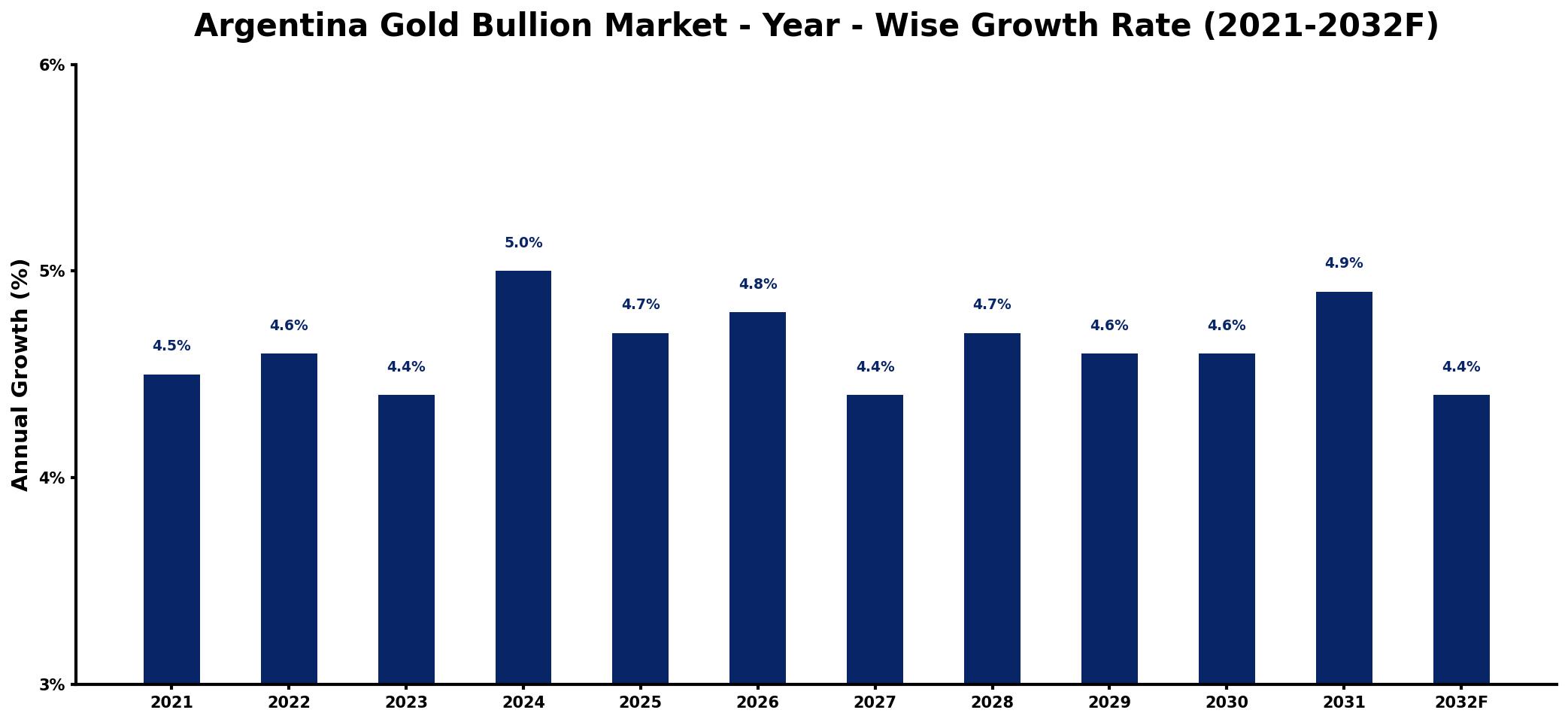
The table below presents the year‑wise growth rates along with the key drivers influencing the market
| Year | Growth Rate | Major Drivers |
| 2021 | 4.5% | Increased investor interest in assets |
| 2022 | 4.6% | Rising demand from jewelry sector |
| 2023 | 4.4% | Growing wealth among affluent individuals |
| 2024 | 5.0% | Surge in global economic uncertainty |
| 2025 | 4.7% | Expansion of mining operations globally |
| 2026 | 4.8% | Higher demand from electronics industry |
| 2027 | 4.4% | Increased adoption in financial portfolios |
| 2028 | 4.7% | Strengthening of alternative investment trends |
| 2029 | 4.6% | Rising interest in sustainable investments |
| 2030 | 4.6% | Growing popularity of wealth preservation |
| 2031 | 4.9% | Increased funding for exploration projects |
| 2032 | 4.4% | strengthening international trade flows |
Note: Market size estimations and growth projections presented in this report are based on 6Wresearch's proprietary forecasting methodology, utilizing the latest available industry data, government publications, and primary research inputs.
Argentina Gold Bullion Market Synopsis
The Argentina Gold Bullion Market is gaining momentum, underscoring a significant cultural affinity for gold that transcends mere investment. With historical roots embedded deeply in the Argentine psyche, gold is viewed not only as a safeguard against economic downturns but also as a cherished commodity that symbolizes stability and value.
The market is primarily fueled by individual investors, including high-net-worth individuals who prefer tangible assets. As inflation soars and the economic landscape remains uncertain, more Argentines are turning to gold bullion to hedge against financial risks, which is reshaping the investment landscape in the country.
Argentina Gold Bullion Market Key Takeaways
- Gold's cultural significance in Argentina drives consistent demand among individual investors.
- Investment in physical gold bullion is increasingly viewed as a hedge against economic instability and inflation.
- Digital platforms are facilitating easier access to gold bullion for retail investors and collectors.
- The market is poised for growth, despite challenges such as regulatory constraints and economic fluctuations.
- Investment opportunities extend to gold mining companies, bolstered by Argentina's rich mineral resources.
Evaluation of Restraints in Argentina Gold Bullion Market
The Argentina Gold Bullion Market faces several restraints that could temper its growth. Economic instability remains a significant challenge, as historical fluctuations can undermine investor confidence and affect gold prices. The depreciation of the Argentine peso further complicates purchasing decisions, as currency fluctuations impact the affordability of gold bullion. Government regulations concerning gold imports and exports may also create additional hurdles for investors, affecting market access and operational transparency. Political uncertainty and the potential for shifting policies add another layer of complexity, requiring market participants to navigate these dynamics carefully.
Argentina Gold Bullion Market Trends
A rising trend in the Argentina Gold Bullion Market is the increasing preference for high-purity gold bars and coins, particularly among retail investors and collectors. This shift reflects a desire for quality and authenticity. Additionally, the emergence of online marketplaces is revolutionizing how gold is bought and sold, providing enhanced accessibility and convenience for investors. As economic conditions continue to fluctuate, the demand for gold as a safe-haven asset is likely to persist, reinforcing its role in portfolio diversification.
Argentina Gold Bullion Market Opportunities
Investment opportunities in the Argentina Gold Bullion Market are promising, primarily due to the countrys rich mineral resources and potential growth in the mining sector. Retail investors can consider purchasing physical gold bullion as a reliable store of value. Furthermore, investing in local gold mining companies offers an avenue for capital appreciation, especially as global demand for gold remains strong. With many seeking to diversify their investment portfolios, the market presents substantial opportunities for growth and long-term returns.
Government Initiatives in the Argentina Gold Bullion Market
Government policies governing the Argentina Gold Bullion Market are designed to regulate the buying and selling of gold. These regulations control the import and export of gold bullion to ensure market integrity and economic stability. Moreover, authorities monitor transactions to combat illicit activities, thereby promoting transparency in the market. The government's focus on fostering foreign investment in mining and exploring new initiatives to boost the sector could further enhance market dynamics and opportunities for growth.
Future Insights of the Argentina Gold Bullion Market
Looking ahead to 2026-2032, the Argentina Gold Bullion Market is set to capitalize on ongoing global economic uncertainty and domestic inflationary pressures. As more investors recognize the value of gold as a hedge against volatility, demand is likely to rise. The government's efforts to stabilize the economy and promote mining activities may also provide favorable conditions for market expansion. Nevertheless, stakeholders must remain vigilant of political developments and regulatory changes, as these factors could influence market dynamics in the years to come.
Argentina Gold Bullion Market Latest Developments (2025 - 2026)
Recent developments in the Argentina Gold Bullion Market indicate a shift towards increased accessibility for retail investors, driven by technological advancements in digital trading platforms. This evolution enhances the buying and selling experience for investors seeking physical gold. Additionally, the government is reportedly considering new policies to streamline the regulatory framework, aimed at attracting foreign investment in the gold mining sector. Such moves could signal a turning point for the market, opening doors for new participants and broader investment opportunities.
Argentina Gold Bullion Market - Key Attractiveness of the Report
- 10 Years of Market Numbers
- Historical Data Starting from 2022 to 2025
- Base Year: 2025
- Forecast Data until 2032
- Key Performance Indicators Impacting the Market
- Major Upcoming Developments and Projects
Key Highlights of the Report:
- Argentina Gold Bullion Market Outlook
- Market Size of Argentina Gold Bullion Market, 2025
- Forecast of Argentina Gold Bullion Market, 2032
- Historical Data and Forecast of Argentina Gold Bullion Revenues & Volume for the Period 2022-2032F
- Argentina Gold Bullion Market Trend Evolution
- Argentina Gold Bullion Market Drivers and Challenges
- Argentina Gold Bullion Price Trends
- Argentina Gold Bullion Porter's Five Forces
- Argentina Gold Bullion Industry Life Cycle
- Historical Data and Forecast of Argentina Gold Bullion Market Revenues & Volume By Type for the Period 2022-2032F
- Historical Data and Forecast of Argentina Gold Bullion Market Revenues & Volume By Gold Bar for the Period 2022-2032F
- Historical Data and Forecast of Argentina Gold Bullion Market Revenues & Volume By Gold Coin for the Period 2022-2032F
- Historical Data and Forecast of Argentina Gold Bullion Market Revenues & Volume By Distribution Channel for the Period 2022-2032F
- Historical Data and Forecast of Argentina Gold Bullion Market Revenues & Volume By Online for the Period 2022-2032F
- Historical Data and Forecast of Argentina Gold Bullion Market Revenues & Volume By Offline for the Period 2022-2032F
- Argentina Gold Bullion Import Export Trade Statistics
- Market Opportunity Assessment By Type
- Market Opportunity Assessment By Distribution Channel
- Argentina Gold Bullion Top Companies Market Share
- Argentina Gold Bullion Competitive Benchmarking By Technical and Operational Parameters
- Argentina Gold Bullion Company Profiles
- Argentina Gold Bullion Key Strategic Recommendations






































