Argentina High Strength Steel Market Size, Share & Growth Rate
The Argentina High Strength Steel Market was estimated at USD 440 Million in 2025 and is projected to reach USD 580 Million by 2032, growing at a CAGR of 4.0% from 2026 to 2032. This upward trajectory is primarily driven by significant investments in infrastructure and automotive manufacturing, coupled with a burgeoning demand for durable yet lightweight materials. As industries increasingly recognize the benefits of high strength steel in enhancing performance and reducing weight, the market is poised for considerable expansion.
Argentina High Strength Steel Market Year-wise Growth Rate and Key Drivers
This graph highlights how the Argentina High Strength Steel Market has steadily grown over the years, supported by major growth factors.
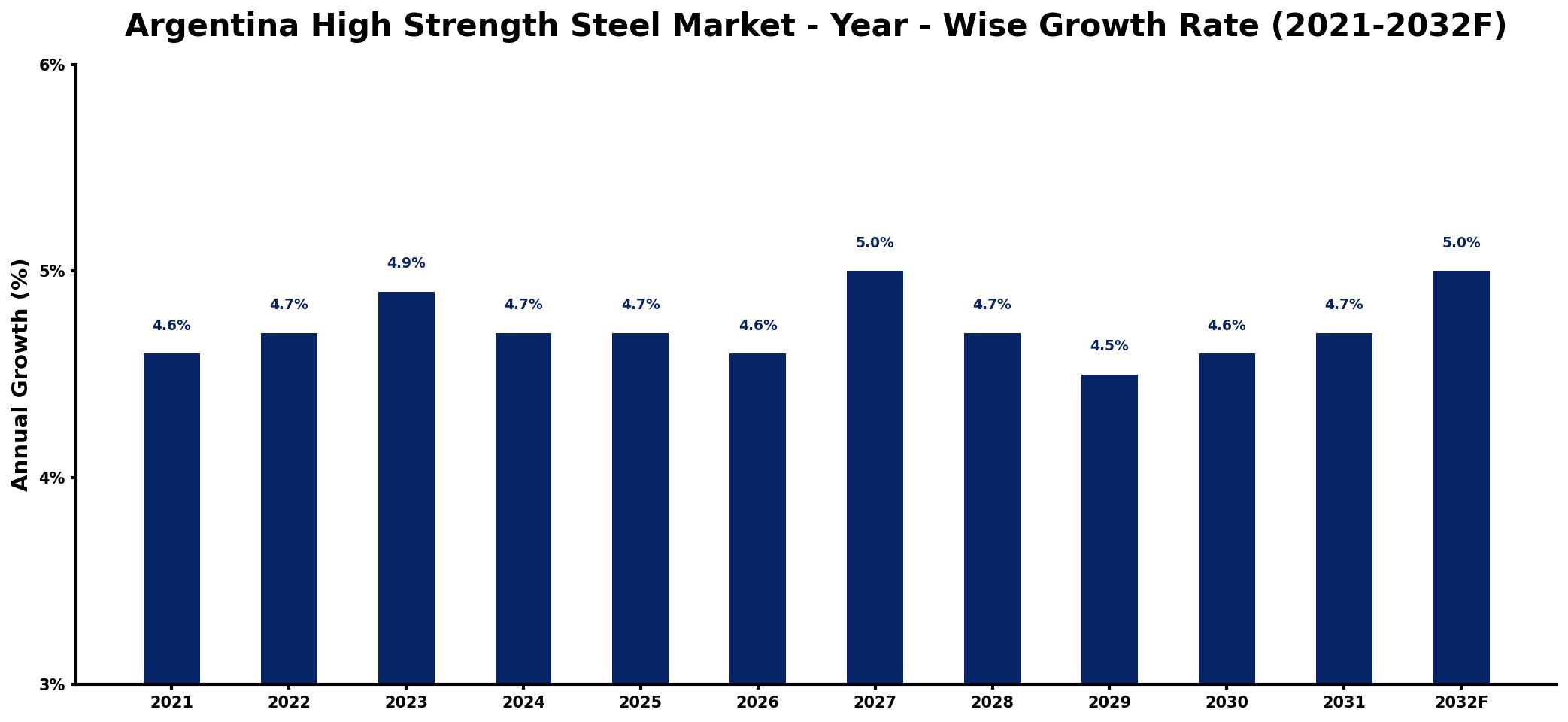
The table below presents the year‑wise growth rates along with the key drivers influencing the market
| Year | Growth Rate | Major Drivers |
| 2021 | 4.6% | Infrastructure projects driving demand |
| 2022 | 4.7% | Automotive sector expansion continues |
| 2023 | 4.9% | Increased construction activity nationwide |
| 2024 | 4.7% | Renewable energy investments rising rapidly |
| 2025 | 4.7% | Manufacturing sector showing resilience |
| 2026 | 4.6% | Transportation infrastructure upgrades planned |
| 2027 | 5.0% | Urban development projects gaining momentum |
| 2028 | 4.7% | Technological advancements in production |
| 2029 | 4.5% | Export opportunities in regional markets |
| 2030 | 4.6% | Government incentives for industrial growth |
| 2031 | 4.7% | Sustainability initiatives promoting usage |
| 2032 | 5.0% | Collaborations boosting research initiatives |
Note: Market size estimations and growth projections presented in this report are based on 6Wresearch's proprietary forecasting methodology, utilizing the latest available industry data, government publications, and primary research inputs.
Argentina High Strength Steel Market Synopsis
The Argentina High Strength Steel Market has recently gained momentum due to a convergence of factors, including aggressive infrastructure spending and the expansion of the automotive sector. However, as these sectors evolve, the demand for advanced materials will only amplify, positioning high strength steel as a crucial component in Argentinas industrial growth.
Looking forward, the market is transitioning from traditional materials to innovative high strength solutions, driven by both technological advancements and a growing awareness of sustainability. This shift not only enhances the performance of products but also aligns with global trends emphasizing energy efficiency and reduced environmental impact.
Argentina High Strength Steel Market Key Takeaways
- The market is supported by robust growth in the construction and automotive sectors.
- Technological advancements are expanding the applications and properties of high strength steel.
- Investment in infrastructure is a significant driver of demand for high strength steel.
- Ongoing education about material benefits is essential for broader market adoption.
- Government policies are increasingly favorable towards the development and use of high strength steel.
Evaluation of Restraints in Argentina High Strength Steel Market
Despite its growth prospects, the Argentina High Strength Steel Market faces several constraints. Fluctuations in raw material prices can significantly impact profitability and pricing strategies. Moreover, the high bar for technological advancements in steel manufacturing often requires substantial investment and research. The need for extensive testing and certification to guarantee product performance and safety further complicates market penetration. To overcome these hurdles, educating end-users about the advantages of high strength steel over conventional materials remains paramount for the market's sustained growth.
Argentina High Strength Steel Market Trends
The current landscape of the Argentina High Strength Steel Market is shaped by key trends that enhance its growth potential. A notable trend is the increased adoption of lightweight materials in automotive design, driving demand for high strength steel. Additionally, the integration of advanced manufacturing techniques, including automation and data analytics, is enhancing production efficiency and reducing costs. The growing emphasis on sustainability is also prompting industries to seek materials that offer both strength and lower environmental impact, further bolstering the relevance of high strength steel.
Argentina High Strength Steel Market Opportunities
Opportunities within the Argentina High Strength Steel Market are abundant, particularly in sectors that prioritize innovation and efficiency. The ongoing infrastructure projects present a prime opportunity for suppliers to engage with construction firms seeking durable materials. Additionally, the automotive industry's shift towards electric vehicles opens new avenues for high strength steel usage, as manufacturers aim to reduce vehicle weight while maintaining safety. Investing in research for advanced steel grades that cater to niche applications can also yield significant competitive advantages.
Government Initiatives in the Argentina High Strength Steel Market
The Argentine government is actively fostering the growth of the high strength steel sector through various initiatives. Policies have been designed to incentivize the production and utilization of high strength steel, including research grants and technical assistance programs aimed at both producers and end-users. Furthermore, regulatory frameworks are established to maintain high safety and performance standards, ensuring that the industry remains competitive and capable of meeting the challenges of modern applications.
Future Insights of the Argentina High Strength Steel Market
As we look ahead to the years 2026-2032, the Argentina High Strength Steel Market is set for transformative growth driven by technological innovation and shifting industry needs. The projected CAGR of 4.0% reflects increasing integration of high strength steel across diverse sectors, particularly as sustainability becomes a critical driver for material selection. Anticipated advancements in steel formulation and processing will likely open new markets and applications, further solidifying high strength steels role in Argentina's industrial landscape.
Argentina High Strength Steel Market Latest Developments (2025 - 2026)
In recent months, the Argentine high strength steel industry has seen a flurry of activity centered around technological advancements and product innovation. Efforts are underway to enhance the mechanical properties of high strength steel through new alloy formulations and manufacturing techniques. Concurrently, various stakeholders are participating in forums and workshops aimed at boosting awareness regarding the advantages of high strength steel, indicating a concerted push to educate end-users and facilitate wider adoption across key sectors.
Argentina High Strength Steel Market - Key Attractiveness of the Report
- 10 Years of Market Numbers
- Historical Data Starting from 2022 to 2025
- Base Year: 2025
- Forecast Data until 2032
- Key Performance Indicators Impacting the Market
- Major Upcoming Developments and Projects
Key Highlights of the Report:
- Argentina High Strength Steel Market Outlook
- Market Size of Argentina High Strength Steel Market, 2025
- Forecast of Argentina High Strength Steel Market, 2032
- Historical Data and Forecast of Argentina High Strength Steel Revenues & Volume for the Period 2022-2032F
- Argentina High Strength Steel Market Trend Evolution
- Argentina High Strength Steel Market Drivers and Challenges
- Argentina High Strength Steel Price Trends
- Argentina High Strength Steel Porter's Five Forces
- Argentina High Strength Steel Industry Life Cycle
- Historical Data and Forecast of Argentina High Strength Steel Market Revenues & Volume By Product Type for the Period 2022-2032F
- Historical Data and Forecast of Argentina High Strength Steel Market Revenues & Volume By Dual Phase Steel for the Period 2022-2032F
- Historical Data and Forecast of Argentina High Strength Steel Market Revenues & Volume By Bake Hardenable Steel for the Period 2022-2032F
- Historical Data and Forecast of Argentina High Strength Steel Market Revenues & Volume By Carbon Manganese Steel for the Period 2022-2032F
- Historical Data and Forecast of Argentina High Strength Steel Market Revenues & Volume By Other Product Types for the Period 2022-2032F
- Historical Data and Forecast of Argentina High Strength Steel Market Revenues & Volume By Application for the Period 2022-2032F
- Historical Data and Forecast of Argentina High Strength Steel Market Revenues & Volume By Automotive for the Period 2022-2032F
- Historical Data and Forecast of Argentina High Strength Steel Market Revenues & Volume By Construction for the Period 2022-2032F
- Historical Data and Forecast of Argentina High Strength Steel Market Revenues & Volume By Yellow Goods and Mining Equipment for the Period 2022-2032F
- Historical Data and Forecast of Argentina High Strength Steel Market Revenues & Volume By Aviation and Marine for the Period 2022-2032F
- Historical Data and Forecast of Argentina High Strength Steel Market Revenues & Volume By Other Applications for the Period 2022-2032F
- Argentina High Strength Steel Import Export Trade Statistics
- Market Opportunity Assessment By Product Type
- Market Opportunity Assessment By Application
- Argentina High Strength Steel Top Companies Market Share
- Argentina High Strength Steel Competitive Benchmarking By Technical and Operational Parameters
- Argentina High Strength Steel Company Profiles
- Argentina High Strength Steel Key Strategic Recommendations






































