Argentina Infrared Imaging Market Size, Share & Growth Rate
The Argentina Infrared Imaging Market was estimated at USD 279 Million in 2025 and is projected to reach USD 381 Million by 2032, growing at a CAGR of 4.6% from 2026 to 2032. This growth is propelled by increasing adoption of thermal imaging across sectors such as security, healthcare, and industrial applications, where predictive maintenance and real-time monitoring are becoming indispensable. The rise in awareness regarding safety and operational efficiency continues to solidify the market's trajectory.
Argentina Infrared Imaging Market Year-wise Growth Rate and Key Drivers
This graph highlights how the Argentina Infrared Imaging Market has steadily grown over the years, supported by major growth factors.
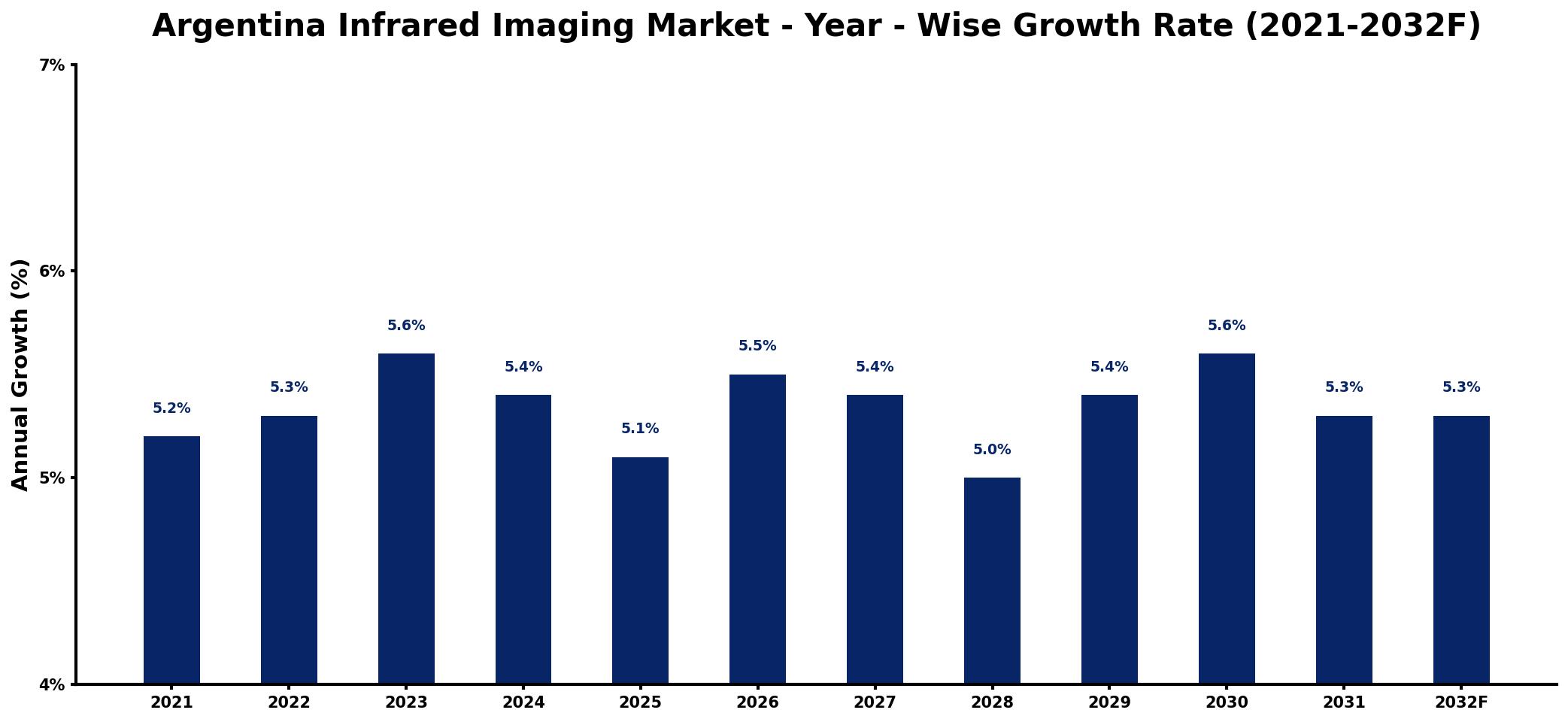
The table below presents the year‑wise growth rates along with the key drivers influencing the market
| Year | Growth Rate | Major Drivers |
| 2021 | 5.2% | Rising demand from healthcare sector |
| 2022 | 5.3% | Increased investments in technology |
| 2023 | 5.6% | Growing applications in manufacturing |
| 2024 | 5.4% | Expansion in research and development |
| 2025 | 5.1% | Surge in construction industry needs |
| 2026 | 5.5% | Emerging trends in security applications |
| 2027 | 5.4% | Growing interest in environmental monitoring |
| 2028 | 5.0% | Increased focus on energy efficiency |
| 2029 | 5.4% | Boost in automotive safety standards |
| 2030 | 5.6% | expanding industrial usage applications |
| 2031 | 5.3% | Growing adoption in agricultural practices |
| 2032 | 5.3% | Expansion of smart building technologies |
Note: Market size estimations and growth projections presented in this report are based on 6Wresearch's proprietary forecasting methodology, utilizing the latest available industry data, government publications, and primary research inputs.
Argentina Infrared Imaging Market Synopsis
The most significant force shaping the Argentina Infrared Imaging Market is the growing emphasis on safety and efficiency across various sectors. With industries increasingly recognizing the benefits of thermal imaging technology, the demand for sophisticated imaging systems is surging, particularly in security and healthcare applications.
Additionally, industrial inspection is witnessing a noteworthy transformation, with infrared imaging providing non-destructive testing solutions that can detect anomalies and potential risks in equipment performance. This innovation not only boosts operational efficiency but also enhances quality control measures within organizations.
Argentina Infrared Imaging Market Key Takeaways
- The market is driven by rising demand for predictive maintenance and real-time monitoring across various industries.
- Government initiatives are promoting the adoption of infrared imaging in critical sectors like healthcare and agriculture.
- Limited awareness and understanding of infrared technology among end-users pose a significant challenge.
- Ongoing innovations in thermal imaging technology are expanding application possibilities and enhancing performance.
- The overall economic environment plays a critical role in influencing investment in advanced imaging solutions.
Evaluation of Restraints in Argentina Infrared Imaging Market
Despite the promising growth potential, the Argentina Infrared Imaging Market faces several restraints. A primary concern is the insufficient awareness and understanding of infrared technology among potential end-users, leading to a hesitant market adoption. Many organizations fail to see the concrete benefits of infrared imaging systems, resulting in underinvestment in these crucial technologies. Compounding this issue is the lack of standardized regulations governing infrared imaging applications, which introduces uncertainty and discourages investment. Additionally, economic instability has created budget constraints that limit companies' abilities to embrace advanced imaging solutions, further stunting market expansion.
Argentina Infrared Imaging Market Trends
The market is currently witnessing several key trends that are shaping demand and technology. Firstly, there is a growing integration of infrared imaging with IoT devices, enhancing real-time data collection and analysis capabilities. Secondly, industries are increasingly adopting automated systems that incorporate thermal imaging for predictive maintenance, leading to reduced downtime and improved safety. Furthermore, advancements in camera technology are producing high-resolution images, expanding application areas and increasing the reliability of infrared diagnostics.
Argentina Infrared Imaging Market Opportunities
There are significant growth and investment opportunities within the Argentina Infrared Imaging Market. As sectors like healthcare, security, and manufacturing seek greater efficiency and safety measures, the demand for advanced thermal imaging solutions will continue to rise. Opportunities lie in developing tailored infrared imaging solutions that meet local industry needs and addressing educational gaps to enhance technology adoption. Additionally, government support for research and development initiatives presents a conducive environment for innovation and market expansion.
Government Initiatives in the Argentina Infrared Imaging Market
The Argentine government has implemented several initiatives to stimulate the growth of infrared imaging technology across various sectors. These include financial incentives such as subsidies for equipment purchases, especially in healthcare and agriculture, which highlight the strategic importance of infrared imaging. Collaborative programs with industry stakeholders are also being promoted to develop innovative, specialized solutions that cater to the unique needs of local industries, further supporting the market's advancement.
Future Insights of the Argentina Infrared Imaging Market
Looking ahead to 2026-2032, the Argentina Infrared Imaging Market is poised for dynamic growth driven by technological advancements and increased adoption across multiple sectors. As organizations recognize the importance of safety and operational efficiency, the demand for infrared imaging solutions will intensify. The introduction of smart systems and enhanced imaging technologies will facilitate better decision-making processes, thereby attracting investment and fostering innovation. Overcoming current awareness gaps will be essential for maximizing the potential of infrared imaging in Argentina.
Argentina Infrared Imaging Market Latest Developments (2025 - 2026)
In recent months, the Argentina Infrared Imaging Market has seen substantial advancements. Companies are increasingly focusing on integrating artificial intelligence with thermal imaging solutions, allowing for more accurate anomaly detection and predictive maintenance applications. Concurrently, partnerships between governmental bodies and technology providers have been established to enhance research and development efforts aimed at creating region-specific solutions. These collaborations are expected to further drive market growth and adoption rates.
Argentina Infrared Imaging Market - Key Attractiveness of the Report
- 10 Years of Market Numbers
- Historical Data Starting from 2022 to 2025
- Base Year: 2025
- Forecast Data until 2032
- Key Performance Indicators Impacting the Market
- Major Upcoming Developments and Projects
Key Highlights of the Report:
- Argentina Infrared Imaging Market Outlook
- Market Size of Argentina Infrared Imaging Market, 2025
- Forecast of Argentina Infrared Imaging Market, 2032
- Historical Data and Forecast of Argentina Infrared Imaging Revenues & Volume for the Period 2022-2032F
- Argentina Infrared Imaging Market Trend Evolution
- Argentina Infrared Imaging Market Drivers and Challenges
- Argentina Infrared Imaging Price Trends
- Argentina Infrared Imaging Porter's Five Forces
- Argentina Infrared Imaging Industry Life Cycle
- Historical Data and Forecast of Argentina Infrared Imaging Market Revenues & Volume By Technology for the Period 2022-2032F
- Historical Data and Forecast of Argentina Infrared Imaging Market Revenues & Volume By Cooled Infrared Imaging for the Period 2022-2032F
- Historical Data and Forecast of Argentina Infrared Imaging Market Revenues & Volume By Uncooled Infrared Imaging for the Period 2022-2032F
- Historical Data and Forecast of Argentina Infrared Imaging Market Revenues & Volume By Wavelength for the Period 2022-2032F
- Historical Data and Forecast of Argentina Infrared Imaging Market Revenues & Volume By Near Infrared for the Period 2022-2032F
- Historical Data and Forecast of Argentina Infrared Imaging Market Revenues & Volume By Shortwave Infrared for the Period 2022-2032F
- Historical Data and Forecast of Argentina Infrared Imaging Market Revenues & Volume By Mid-wave Infrared for the Period 2022-2032F
- Historical Data and Forecast of Argentina Infrared Imaging Market Revenues & Volume By Long-wave Infrared for the Period 2022-2032F
- Historical Data and Forecast of Argentina Infrared Imaging Market Revenues & Volume By Application for the Period 2022-2032F
- Historical Data and Forecast of Argentina Infrared Imaging Market Revenues & Volume By Security & Surveillance for the Period 2022-2032F
- Historical Data and Forecast of Argentina Infrared Imaging Market Revenues & Volume By Monitoring & Inspection for the Period 2022-2032F
- Historical Data and Forecast of Argentina Infrared Imaging Market Revenues & Volume By Detection for the Period 2022-2032F
- Historical Data and Forecast of Argentina Infrared Imaging Market Revenues & Volume By Vertical for the Period 2022-2032F
- Historical Data and Forecast of Argentina Infrared Imaging Market Revenues & Volume By Industrial for the Period 2022-2032F
- Historical Data and Forecast of Argentina Infrared Imaging Market Revenues & Volume By Nonindustrial for the Period 2022-2032F
- Argentina Infrared Imaging Import Export Trade Statistics
- Market Opportunity Assessment By Technology
- Market Opportunity Assessment By Wavelength
- Market Opportunity Assessment By Application
- Market Opportunity Assessment By Vertical
- Argentina Infrared Imaging Top Companies Market Share
- Argentina Infrared Imaging Competitive Benchmarking By Technical and Operational Parameters
- Argentina Infrared Imaging Company Profiles
- Argentina Infrared Imaging Key Strategic Recommendations






































