Argentina Laboratory Equipment Market: Import Trend Analysis
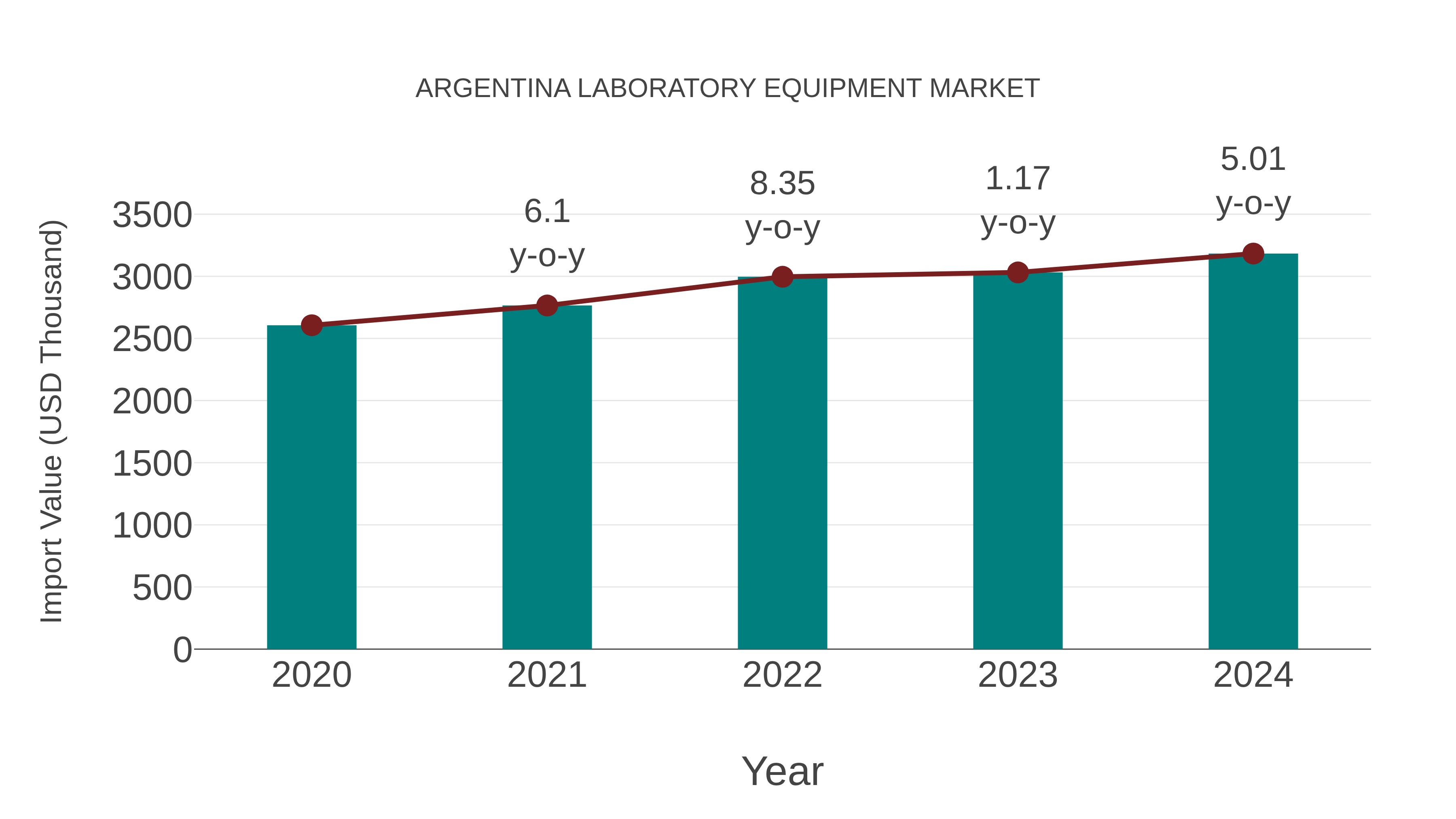
The Argentina laboratory equipment market experienced a steady increase in imports during 2020-2024, with a Compound Annual Growth Rate (CAGR) of 5.13%. Notably, the year-on-year growth rate for 2023-2024 was 5.01%, indicating a consistent upward trend in imported laboratory equipment during this period.
Argentina Laboratory Equipment Market Highlights
| Report Name | Argentina Laboratory Equipment Market |
| Forecast period | 2025-2031 |
| CAGR | 7.7% |
| Growing Sector | Pharmaceutical |
Topics Covered in the Argentina Laboratory Equipment Market Report
Argentina Laboratory Equipment Market Report thoroughly covers the market By Product type, By Application and by End-Users. The market report provides an unbiased and detailed analysis of the ongoing market trends, opportunities/high growth areas, and market drivers which would help the stakeholders to devise and align their market strategies according to the current and future market dynamics.
Argentina Laboratory Equipment Market Synopsis
Argentina laboratory equipment market is positioned for significant growth, driven by increasing demand across key sectors such as healthcare, pharmaceuticals, and scientific research. This market encompasses a diverse range of essential equipment used for conducting accurate experiments and analyses. As Argentina prioritizes the enhancement of its scientific capabilities, the demand for advanced, reliable laboratory instruments is on the rise.
According to 6Wresearch, the Argentina Laboratory Equipment Market is estimated to reach a CAGR of 7.7 % during the forecast period 2025-2031. This growth is driven by several key factors, including significant investments in the healthcare and pharmaceutical sectors, which are intensifying their research and development activities. Additionally, the expansion of academic institutions and increased funding for scientific research contribute to the rising demand for advanced laboratory equipment. Argentina’s focus on modernizing its healthcare system and the ongoing development of biotechnology facilities further enhance market opportunities. Moreover, efforts to improve regulatory standards and quality assurance are prompting laboratories to upgrade their equipment.
However, the market faces substantial challenges that could impede growth. Economic instability, characterized by currency fluctuations and inflation, affects purchasing power and limits budget allocations for new equipment. The heavy reliance on imports also presents difficulties, as high tariffs and logistical issues may limit access to the latest international technologies. Furthermore, a skills gap remains a concern, as professionals require specialized training to operate complex devices effectively.
Argentina Laboratory Equipment Market Trends
Current trends in Argentina laboratory equipment market highlight a growing shift towards automation and digitalization, significantly improving the efficiency and precision of analytical processes. Additionally, the adoption of environmentally friendly equipment is on the rise, aligning with global sustainability goals. Another prominent trend is the increasing use of portable and compact equipment, offering enhanced flexibility in research and laboratory settings. As the market progresses, innovative and specialized solutions are expected to emerge, tailored to meet the varied needs of industries such as healthcare, pharmaceuticals, and biotechnology.
Investment Opportunities in the Argentina Laboratory Equipment Market
Investment opportunities within the Argentine laboratory equipment sector are plentiful, especially for forward-thinking enterprises emphasizing innovation. The expansion of healthcare services and the growing pharmaceutical industry create lucrative prospects for investment. Moreover, collaborations with local academic and research institutions provide avenues for growth and development in this increasingly competitive landscape. As Argentina continues to prioritize scientific advancement, the demand for cutting-edge laboratory equipment is expected to remain robust, positioning the market as an appealing destination for investment.
Leading Players in the Argentina Laboratory Equipment Market
The Argentina laboratory equipment market is characterized by the presence of several key players who drive innovation and supply a wide range of products to meet the diverse needs of laboratories across the country. Leading the market are global giants such as Thermo Fisher Scientific and Agilent Technologies, known for their comprehensive portfolios that include analytical instruments, lab consumables, and sophisticated diagnostic equipment. Local manufacturers also play a significant role, with companies like CIBA S.A. offering tailored solutions that cater specifically to regional demands. These players continuously invest in research and development to enhance the precision and efficiency of their offerings, ensuring that the Argentine market remains competitive and well-equipped.
Government Regulations
Government regulations significantly impact the laboratory equipment market in Argentina, emphasizing quality, safety, and compliance. The National Institute of Industrial Technology (INTI) plays a crucial role in setting standards and ensuring that products meet strict regulatory requirements. These regulations mandate that equipment is tested and certified before reaching the market, ensuring reliability and performance. Moreover, import regulations can also affect the availability and cost of foreign-made equipment, encouraging local production and innovation. By enforcing these standards, the government not only protects end-users but also supports the development of a robust and trustworthy laboratory equipment sector within the country.
Future Insights of the Argentina Laboratory Equipment Market
The future of the laboratory equipment market in Argentina appears promising, driven by technological advancements and increased demand for precision and efficiency in research and diagnostics. Emerging technologies such as automation, artificial intelligence, and the Internet of Things (IoT) are expected to revolutionize the way laboratories operate, offering unparalleled accuracy and streamlining processes. As these innovations become more accessible, laboratories will likely adopt them to improve data management and enhance analytical capabilities. Furthermore, the growing focus on biotechnology and pharmaceutical industries is set to bolster demand for specialized laboratory equipment. Government policies supporting scientific research and innovation, along with educational initiatives aimed at fostering a skilled workforce, will further catalyze market growth. As Argentina continues to integrate into the global scientific community, the laboratory equipment market is well-positioned to thrive, contributing significantly to advancements in healthcare, environmental studies, and industrial applications.
Market Segmentation Analysis
The report offers a comprehensive study of the subsequent market segments and their leading categories.
Autoclaves o Dominate the Market-By Product
In the Argentine laboratory equipment market, autoclaves are projected to lead by product type category due to their essential role in sterilization processes across various applications. This growth is driven by the increasing demand for hygiene and safety standards in healthcare and research settings, where reliable sterilization is critical.
Microbiology to Dominate the Market-By Application
In the Argentine laboratory equipment market, the application category expected to lead is microbiology. This is largely due to the growing focus on infectious disease research and diagnostics, which necessitates advanced laboratory instruments and techniques.
Diagnostic Laboratories to Dominate the Market -By End-User
According to Saurabh, Senior Research Analyst, 6Wresearch, In the Argentine laboratory equipment market, the end-user category anticipated to lead is diagnostic laboratories. This growth is driven by the rising demand for accurate and timely diagnostics in healthcare, particularly in response to increasing healthcare needs and advancements in medical technology.
Key Attractiveness of the Report
- 10 Years of Market Numbers.
- Historical Data Starting from 2021 to 2024.
- Base Year: 2024.
- Forecast Data until 2031.
- Key Performance Indicators Impacting the market.
- Major Upcoming Developments and Project
Key Highlights of the Report:
- Argentina Laboratory Equipment Market Outlook
- Market Size of Argentina Laboratory Equipment Market, 2025
- Forecast of Argentina Laboratory Equipment Market, 2032
- Historical Data and Forecast of Argentina Laboratory Equipment Revenues & Volume for the Period 2022 - 2032F
- Argentina Laboratory Equipment Market Trend Evolution
- Argentina Laboratory Equipment Market Drivers and Challenges
- Argentina Laboratory Equipment Price Trends
- Argentina Laboratory Equipment Porter's Five Forces
- Argentina Laboratory Equipment Industry Life Cycle
- Historical Data and Forecast of Argentina Laboratory Equipment Market Revenues & Volume By Product Type for the Period 2022 - 2032F
- Historical Data and Forecast of Argentina Laboratory Equipment Market Revenues & Volume By Autoclaves for the Period 2022 - 2032F
- Historical Data and Forecast of Argentina Laboratory Equipment Market Revenues & Volume By Incubators for the Period 2022 - 2032F
- Historical Data and Forecast of Argentina Laboratory Equipment Market Revenues & Volume By Centrifuges for the Period 2022 - 2032F
- Historical Data and Forecast of Argentina Laboratory Equipment Market Revenues & Volume By Spectrometers for the Period 2022 - 2032F
- Historical Data and Forecast of Argentina Laboratory Equipment Market Revenues & Volume By Sonicators for the Period 2022 - 2032F
- Historical Data and Forecast of Argentina Laboratory Equipment Market Revenues & Volume By Scopes for the Period 2022 - 2032F
- Historical Data and Forecast of Argentina Laboratory Equipment Market Revenues & Volume By Others for the Period 2022 - 2032F
- Historical Data and Forecast of Argentina Laboratory Equipment Market Revenues & Volume By Application for the Period 2022 - 2032F
- Historical Data and Forecast of Argentina Laboratory Equipment Market Revenues & Volume By Genetic Testing for the Period 2022 - 2032F
- Historical Data and Forecast of Argentina Laboratory Equipment Market Revenues & Volume By Endocrinology for the Period 2022 - 2032F
- Historical Data and Forecast of Argentina Laboratory Equipment Market Revenues & Volume By Hematology for the Period 2022 - 2032F
- Historical Data and Forecast of Argentina Laboratory Equipment Market Revenues & Volume By Microbiology for the Period 2022 - 2032F
- Historical Data and Forecast of Argentina Laboratory Equipment Market Revenues & Volume By Biochemistry for the Period 2022 - 2032F
- Historical Data and Forecast of Argentina Laboratory Equipment Market Revenues & Volume By Others for the Period 2022 - 2032F
- Historical Data and Forecast of Argentina Laboratory Equipment Market Revenues & Volume By End-users for the Period 2021 - 2032
- Historical Data and Forecast of Argentina Laboratory Equipment Market Revenues & Volume By Diagnostic Laboratories for the Period 2022 - 2032F
- Historical Data and Forecast of Argentina Laboratory Equipment Market Revenues & Volume By Hospitals and Clinics for the Period 2022 - 2032F
- Historical Data and Forecast of Argentina Laboratory Equipment Market Revenues & Volume By Others for the Period 2022 - 2032F
- Argentina Laboratory Equipment Import Export Trade Statistics
- Market Opportunity Assessment By Product Type
- Market Opportunity Assessment By Application
- Market Opportunity Assessment By End-users
- Argentina Laboratory Equipment Top Companies Market Share
- Argentina Laboratory Equipment Competitive Benchmarking By Technical and Operational Parameters
- Argentina Laboratory Equipment Company Profiles
- Argentina Laboratory Equipment Key Strategic Recommendations
Market Covered
The market report has been segmented and sub-segmented into the following categories:
By Product Type
- Autoclaves
- Incubators
- Centrifuges
- Spectrometers
- Sonicators
- Scopes
- Others
By Application
- Genetic Testing
- Endocrinology
- Haematology
- Microbiology
- Biochemistry
- Others
By End-users
- Diagnostic Laboratories
- Hospitals and Clinics
- Others






































