Argentina Life Science Reagents Market Size, Share & Growth Rate
The Argentina Life Science Reagents Market was estimated at USD 1345 Million in 2025 and is projected to reach USD 1934 Million by 2032, growing at a CAGR of 5.3% from 2026 to 2032. This growth trajectory is driven by the surge in research activities within the biotechnology and pharmaceutical sectors, coupled with an increasing emphasis on personalized medicine and advanced genomics applications.
Argentina Life Science Reagents Market Year-wise Growth Rate and Key Drivers
This graph highlights how the Argentina Life Science Reagents Market has steadily grown over the years, supported by major growth factors.
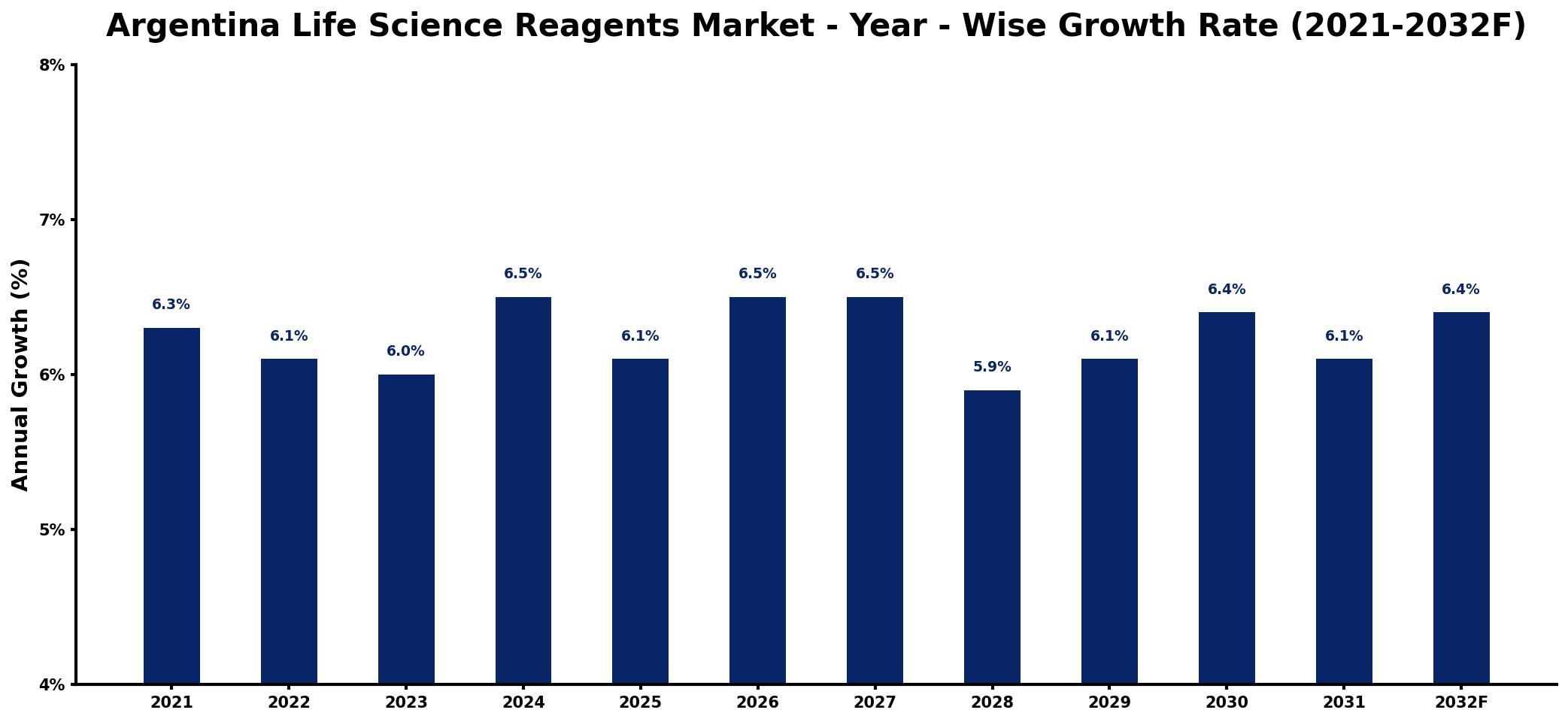
The table below presents the year‑wise growth rates along with the key drivers influencing the market
| Year | Growth Rate | Major Drivers |
| 2021 | 6.3% | Increased research funding allocations |
| 2022 | 6.1% | Expansion of biotechnology sectors |
| 2023 | 6.0% | Rising demand for diagnostics |
| 2024 | 6.5% | Growth in pharmaceutical investments |
| 2025 | 6.1% | Surge in academic collaborations |
| 2026 | 6.5% | Emergence of new technologies |
| 2027 | 6.5% | Increased government health initiatives |
| 2028 | 5.9% | improved processing technologies adoption |
| 2029 | 6.1% | Rising focus on personalized medicine |
| 2030 | 6.4% | rising procurement volume requirements |
| 2031 | 6.1% | Increased public health awareness |
| 2032 | 6.4% | growing emerging market penetration |
Note: Market size estimations and growth projections presented in this report are based on 6Wresearch's proprietary forecasting methodology, utilizing the latest available industry data, government publications, and primary research inputs.
Argentina Life Science Reagents Market Synopsis
A notable demand in Argentinas life science reagents market stems from its robust research community, particularly in biotechnology. As local institutions ramp up their R&D efforts, the requirement for high-quality reagents becomes paramount, especially in specialized fields such as proteomics and molecular biology.
Additionally, Argentina benefits from a skilled workforce and a growing network of research institutions, which are enhancing the market dynamics. Despite the presence of challenges such as economic fluctuations and stringent regulations, the outlook remains optimistic, suggesting a vibrant future for life science reagent providers.
Argentina Life Science Reagents Market Key Takeaways
- The market is poised for growth driven by rising R&D investments in biotechnology and pharmaceutical domains.
- Emerging trends indicate a shift towards sustainable and environmentally friendly reagent solutions.
- Customization and specialization of reagents are becoming essential to meet the unique needs of researchers.
- Regulatory frameworks are evolving, creating both challenges and opportunities for market participants.
- Strategic partnerships with research institutions are vital for competitive advantage in this sector.
Evaluation of Restraints in Argentina Life Science Reagents Market
Despite the promising growth potential, the Argentina Life Science Reagents Market faces several significant restraints. The ongoing economic instability and fluctuating currency values are primary concerns, making it challenging for businesses to maintain consistent pricing for imported reagents. Furthermore, stringent regulatory requirements can complicate market entry and limit operational efficiency for new entrants. These hurdles necessitate a proactive approach to navigating the complex landscape, requiring companies to develop strategic responses to mitigate risks and seize opportunities.
Argentina Life Science Reagents Market Trends
Several key trends are shaping the Argentina Life Science Reagents Market. There is an increasing demand for reagents tailored for advanced research applications, particularly in genomics and proteomics, as researchers look to push the boundaries of scientific discovery. Additionally, the growing adoption of innovative technologies such as CRISPR-Cas9 is driving the need for specialized reagents that cater to these cutting-edge methodologies. The shift towards sustainability is also notable, with more researchers and manufacturers emphasizing eco-friendly reagent options to align with global sustainability initiatives.
Argentina Life Science Reagents Market Opportunities
Investment opportunities abound in the Argentina Life Science Reagents Market, particularly in areas like molecular biology and cell culture reagents. As healthcare expenditures rise and the focus on personalized medicine intensifies, firms that innovate and offer high-quality products are positioned for success. Furthermore, forming strategic alliances with local research institutions can enhance market penetration and foster collaborative research efforts, thus unlocking significant growth potential for stakeholders within the sector.
Government Initiatives in the Argentina Life Science Reagents Market
The Argentine government has implemented various policies to bolster the life science reagents market, focusing on regulatory compliance and quality control standards. Agencies like ANMAT play a crucial role in overseeing the approval process for life science reagents, ensuring that products meet safety and efficacy benchmarks. Moreover, the government encourages sustainable practices in reagent manufacturing and disposal, fostering a competitive environment that prioritizes public health and environmental protection.
Future Insights of the Argentina Life Science Reagents Market
Looking ahead to 2026-2032, the Argentina Life Science Reagents Market is anticipated to continue its upward trajectory, driven by heightened investments in R&D and the growth of the biotechnology and pharmaceutical sectors. With a focus on innovative medical solutions and advancements in personalized medicine, demand for high-quality reagents is expected to rise significantly. While navigating regulatory challenges and economic fluctuations will be critical, companies that are agile and responsive to market needs will likely thrive in this evolving landscape.
Argentina Life Science Reagents Market Latest Developments (2025 - 2026)
Recently, the Argentina Life Science Reagents Market has seen a notable shift towards enhanced collaboration between academia and industry, leading to breakthroughs in reagent development. New initiatives aimed at promoting research partnerships have emerged, enabling better access to cutting-edge technologies and innovative solutions. Furthermore, companies are increasingly investing in sustainability measures, aligning their operations with global environmental standards and consumer preferences for greener products.
Argentina Life Science Reagents Market - Key Attractiveness of the Report
- 10 Years of Market Numbers
- Historical Data Starting from 2022 to 2025
- Base Year: 2025
- Forecast Data until 2032
- Key Performance Indicators Impacting the Market
- Major Upcoming Developments and Projects
Key Highlights of the Report:
- Argentina Life Science Reagents Market Outlook
- Market Size of Argentina Life Science Reagents Market, 2025
- Forecast of Argentina Life Science Reagents Market, 2032
- Historical Data and Forecast of Argentina Life Science Reagents Revenues & Volume for the Period 2022-2032F
- Argentina Life Science Reagents Market Trend Evolution
- Argentina Life Science Reagents Market Drivers and Challenges
- Argentina Life Science Reagents Price Trends
- Argentina Life Science Reagents Porter's Five Forces
- Argentina Life Science Reagents Industry Life Cycle
- Historical Data and Forecast of Argentina Life Science Reagents Market Revenues & Volume By Product for the Period 2022-2032F
- Historical Data and Forecast of Argentina Life Science Reagents Market Revenues & Volume By Chromatography Reagents for the Period 2022-2032F
- Historical Data and Forecast of Argentina Life Science Reagents Market Revenues & Volume By Molecular Diagnostics Reagents for the Period 2022-2032F
- Historical Data and Forecast of Argentina Life Science Reagents Market Revenues & Volume By Immunoassay Reagents for the Period 2022-2032F
- Historical Data and Forecast of Argentina Life Science Reagents Market Revenues & Volume By Clinical Chemistry Reagents for the Period 2022-2032F
- Historical Data and Forecast of Argentina Life Science Reagents Market Revenues & Volume By Flow Cytometry Reagents for the Period 2022-2032F
- Historical Data and Forecast of Argentina Life Science Reagents Market Revenues & Volume By Cell & Tissue Culture Reagents for the Period 2022-2032F
- Historical Data and Forecast of Argentina Life Science Reagents Market Revenues & Volume By Hematology & Hemostasis Reagents for the Period 2022-2032F
- Historical Data and Forecast of Argentina Chromatography Reagents Life Science Reagents Market Revenues & Volume By Microbiology Reagents for the Period 2022-2032F
- Historical Data and Forecast of Argentina Life Science Reagents Market Revenues & Volume By End-user for the Period 2022-2032F
- Historical Data and Forecast of Argentina Life Science Reagents Market Revenues & Volume By Hospitals & Diagnostics Laboratories for the Period 2022-2032F
- Historical Data and Forecast of Argentina Life Science Reagents Market Revenues & Volume By Commercial & Contract Research Manufacturers for the Period 2022-2032F
- Historical Data and Forecast of Argentina Life Science Reagents Market Revenues & Volume By Academic & Research Institutes for the Period 2022-2032F
- Historical Data and Forecast of Argentina Life Science Reagents Market Revenues & Volume By Others for the Period 2022-2032F
- Argentina Life Science Reagents Import Export Trade Statistics
- Market Opportunity Assessment By Product
- Market Opportunity Assessment By End-user
- Argentina Life Science Reagents Top Companies Market Share
- Argentina Life Science Reagents Competitive Benchmarking By Technical and Operational Parameters
- Argentina Life Science Reagents Company Profiles
- Argentina Life Science Reagents Key Strategic Recommendations






































