Argentina Potassium chlorate Market Size, Share & Growth Rate
The Argentina Potassium chlorate Market was estimated at USD 1224 Million in 2025 and is projected to reach USD 1740 Million by 2032, growing at a CAGR of 5.2% from 2026 to 2032. This upward trajectory can be attributed to the expanding agricultural practices that utilize potassium chlorate for effective weed control and crop protection. Moreover, the booming fireworks and explosives industries further stimulate demand, indicating robust growth prospects in the coming years.
Argentina Potassium chlorate Market Growth Rate Analysis (2021-2032)
The Argentinian potassium chlorate market has shown a stable growth pattern, with annual increases hovering around the 6% mark. In 2021, the market grew by 6.1%, followed by 6.2% in 2022, driven largely by heightened consumer demand in the agriculture and chemical sectors. Despite a slight decline to 5.9% in 2023, factors such as infrastructure improvements and increased industrial activities contributed to a resurgence, edging growth back to 6.2% in 2024. As Argentina continues its energy transition and enhances digitalization across sectors, the overall landscape remains robust, with growth expected at 6.1% in 2025 and stabilizing around 6% until 2028, emphasizing resilience in both domestic and export markets.
Argentina Potassium chlorate Market Year-wise Growth Rate and Key Drivers
This graph highlights how the Argentina Potassium chlorate Market has steadily grown over the past five years, supported by major growth factors.
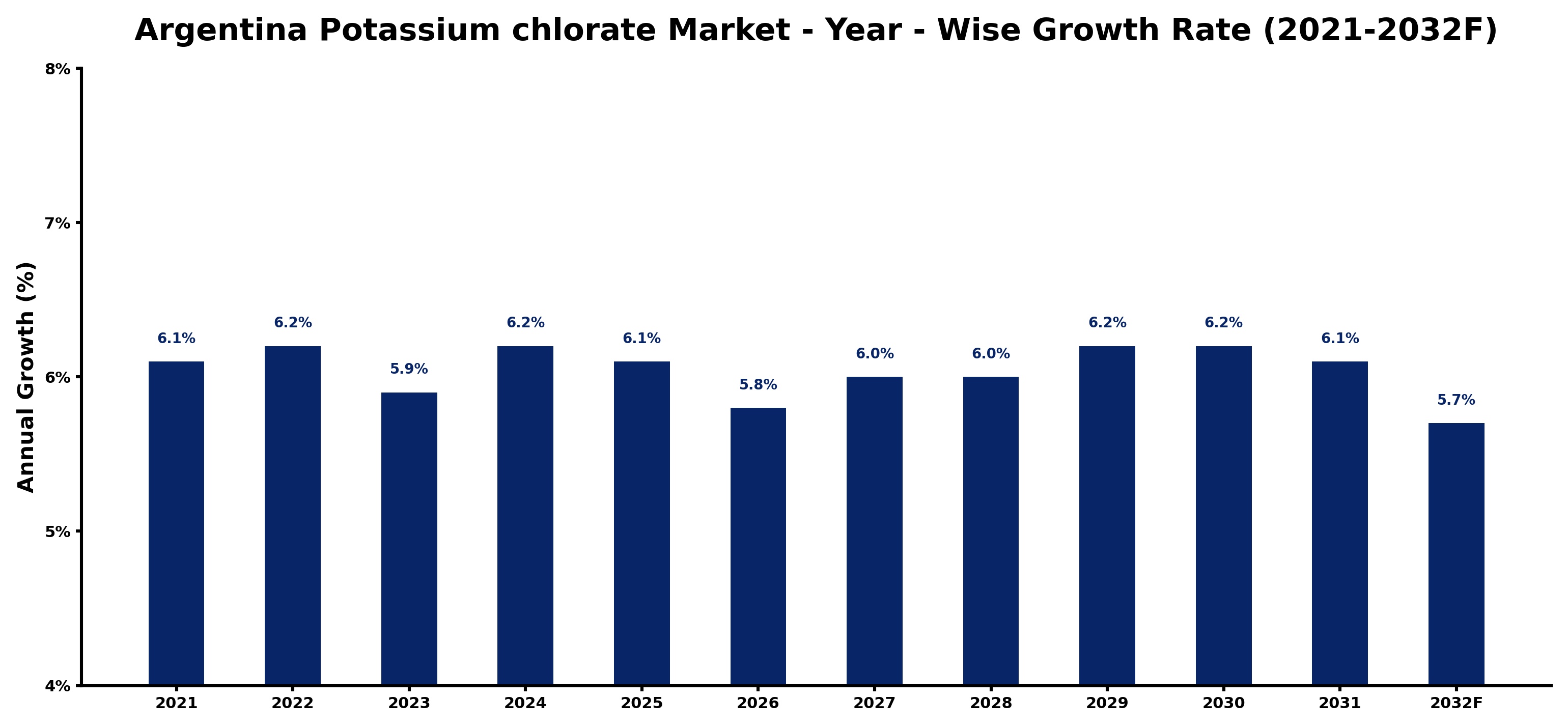
The table below presents the year‑wise growth rates along with the key drivers influencing the market
| Year | Growth Rate | Major Drivers |
| 2021 | 6.1% | Domestic fertilizer production boost drives potassium chlorate manufacturing demand |
| 2022 | 6.2% | Domestic potassium chlorate production investments boosted agricultural chemical supply |
| 2023 | 5.9% | Improved production efficiency drives potassium chlorate manufacturing investments |
| 2024 | 6.2% | Investment in processing upgrades boosted potassium chlorate production efficiency |
| 2025 | 6.1% | Modernized processing facilities enhance potassium chlorate production capabilities |
| 2026 | 5.8% | Revamped agricultural production techniques spurred potassium chlorate consumption growth |
| 2027 | 6.0% | Technology adoption in potassium chlorate production boosts efficiency levels |
| 2028 | 6.0% | Higher potassium chlorate production capacity boosts export market competitiveness |
| 2029 | 6.2% | Export demand resurgence fuels potassium chlorate production investments |
| 2030 | 6.2% | Export driven chemical sector investments boost potassium chlorate production capacity |
| 2031 | 6.1% | New plant openings drive local potassium chlorate production capabilities |
| 2032 | 5.7% | Chemical manufacturing upgrades drive potassium chlorate production efficiency |
Note - Market size estimations and growth projections presented in this report are based on 6Wresearch’s advanced forecasting approach, validated with industry datasets as of June 2026.
Argentina Potassium chlorate Market Synopsis
Recently, the Argentina potassium chlorate market has seen a consistent upswing fueled by its diverse applications. However, as we look towards the future, the demand is set to intensify as agriculture and chemical manufacturing sectors continue to evolve, integrating potassium chlorate in their processes. This momentum is likely to be sustained through strategic investments in research and development, aimed at enhancing product efficiency.
Despite the promising outlook, the market must navigate complex regulatory landscapes that govern chemical usage. These regulations, while ensuring safety, can impact the speed of growth. Thus, industry stakeholders will need to focus on compliance and innovation to maintain their competitive edge in this dynamic environment.
Argentina Potassium chlorate Market Key Takeaways
- The market is driven by strong demand in agriculture, pharmaceuticals, and fireworks production.
- Investment in R&D is vital for improving potassium chlorate applications and product safety.
- Stricter regulations present both challenges and opportunities for market players.
- Innovative practices are increasingly prioritized to meet sustainability goals.
- The expanding agricultural sector is a significant driver for market growth.
Evaluation of Restraints in Argentina Potassium chlorate Market
The Argentina potassium chlorate market faces significant restraints due to stringent regulations that govern the production and use of this chemical. The hazardous nature of potassium chlorate, particularly its flammability and explosive properties, necessitates rigorous compliance measures, which can hamper growth. Furthermore, fluctuations in raw material prices can create instability, impacting production costs. Companies must also contend with the presence of alternative chemicals that may provide competitive options for consumers, thus exerting additional pressure on market pricing and innovation.
Argentina Potassium chlorate Market Trends
Current trends in the Argentina potassium chlorate market indicate a heightened demand for this compound as a critical component in fireworks, matches, and explosives. The cultural inclination towards elaborate fireworks displays during festivals has amplified this demand. Concurrently, the agricultural sector continues to explore potassium chlorate for its efficacy in weed management, contributing to its popularity as a pesticide.
Moreover, there is a notable shift towards sustainability and environmental consciousness. This trend is prompting market players to seek eco-friendly alternatives, pushing innovation in potassium chlorate production and application methods. Such developments not only address consumer preferences but also align with global sustainability goals.
Argentina Potassium chlorate Market Opportunities
The Argentina potassium chlorate market presents several lucrative investment opportunities, particularly in production and distribution. As demand escalates across various sectors, potential investors can benefit significantly from establishing facilities that cater to this need. Additionally, there is a pressing call for advancements in research and development to identify new applications and enhance existing processes, providing a fertile ground for innovation-driven investments. By capitalizing on these opportunities, stakeholders can position themselves strategically in a market poised for growth.
Government Initiatives in the Argentina Potassium chlorate Market
In Argentina, the potassium chlorate market is shaped by regulatory frameworks enforced by institutions such as the National Institute of Industrial Technology (INTI) and the National Administration of Medicines, Food, and Medical Technology (ANMAT). These organizations ensure that safety and quality standards are adhered to, with a keen focus on public health and environmental protection. Government policies are designed to foster industry growth while managing the potential risks associated with chemical usage, thereby creating a balanced regulatory environment that encourages responsible market practices.
Future Insights of the Argentina Potassium chlorate Market
Looking ahead to the period from 2026 to 2032, the Argentina potassium chlorate market is expected to experience moderate yet steady growth. This forecast is largely driven by the agricultural sector's increasing reliance on potassium chlorate for herbicidal applications and the chemical industry's ongoing demand for efficient oxidizing agents. While stringent regulations and competitive pressures from alternative chemicals may pose challenges, ongoing innovation and strategic investments are set to enhance the market's resilience and adaptability. Overall, the outlook remains positive, fueled by continuous advancements in technology and application.
Argentina Potassium chlorate Market Latest Developments (May 2025 - June 2026)
Recent developments in the Argentina potassium chlorate market highlight a growing emphasis on sustainability and regulatory compliance. Companies are actively engaging in research initiatives to develop safer and more efficient manufacturing practices. Concurrently, the market has seen an uptick in collaborative efforts between industry stakeholders to address environmental concerns, leading to a more responsible approach towards chemical production and usage.
Argentina Potassium chlorate Market - Key Attractiveness of the Report
- 10 Years of Market Numbers
- Historical Data Starting from 2022 to 2025
- Base Year: 2025
- Forecast Data until 2032
- Key Performance Indicators Impacting the Market
- Major Upcoming Developments and Projects
Key Highlights of the Report:
- Argentina Potassium chlorate Market Outlook
- Market Size of Argentina Potassium chlorate Market, 2025
- Forecast of Argentina Potassium chlorate Market, 2032
- Historical Data and Forecast of Argentina Potassium chlorate Revenues & Volume for the Period 2022-2032F
- Argentina Potassium chlorate Market Trend Evolution
- Argentina Potassium chlorate Market Drivers and Challenges
- Argentina Potassium chlorate Price Trends
- Argentina Potassium chlorate Porter's Five Forces
- Argentina Potassium chlorate Industry Life Cycle
- Historical Data and Forecast of Argentina Potassium chlorate Market Revenues & Volume By Product type for the Period 2022-2032F
- Historical Data and Forecast of Argentina Potassium chlorate Market Revenues & Volume By Pharmaceutical Grade for the Period 2022-2032F
- Historical Data and Forecast of Argentina Potassium chlorate Market Revenues & Volume By Chemical Grade for the Period 2022-2032F
- Historical Data and Forecast of Argentina Potassium chlorate Market Revenues & Volume By End-use for the Period 2022-2032F
- Historical Data and Forecast of Argentina Potassium chlorate Market Revenues & Volume By Explosives for the Period 2022-2032F
- Historical Data and Forecast of Argentina Potassium chlorate Market Revenues & Volume By Matches for the Period 2022-2032F
- Historical Data and Forecast of Argentina Potassium chlorate Market Revenues & Volume By Disinfectants for the Period 2022-2032F
- Historical Data and Forecast of Argentina Potassium chlorate Market Revenues & Volume By Bleaches for the Period 2022-2032F
- Historical Data and Forecast of Argentina Potassium chlorate Market Revenues & Volume By Medical for the Period 2022-2032F
- Argentina Potassium chlorate Import Export Trade Statistics
- Market Opportunity Assessment By Product type
- Market Opportunity Assessment By End-use
- Argentina Potassium chlorate Top Companies Market Share
- Argentina Potassium chlorate Competitive Benchmarking By Technical and Operational Parameters
- Argentina Potassium chlorate Company Profiles
- Argentina Potassium chlorate Key Strategic Recommendations






































