Argentina Workplace Safety Market Size & Growth Rate (2026-2032)
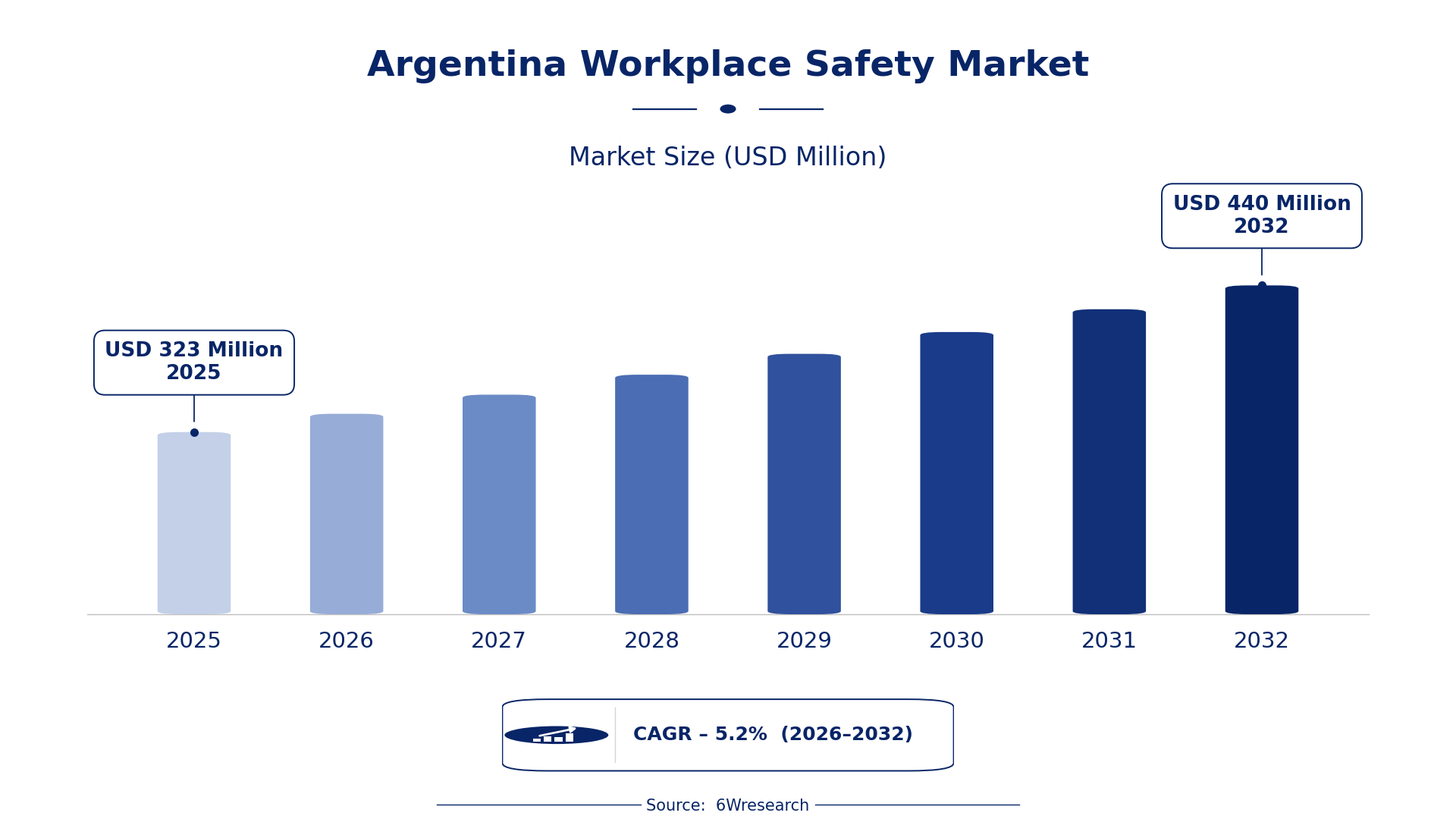
The Argentina Workplace Safety Market was estimated at USD 323 Million in 2025 and is projected to reach USD 440 Million by 2032, growing at a CAGR of 5.2% from 2026 to 2032.
Argentina Workplace Safety Market Synopsis
Occupational safety in Argentina is no longer an afterthought; it’s a growing priority across various sectors. The increasing awareness of safety standards, coupled with stringent regulatory requirements, is propelling organizations to implement effective safety measures. Notably, sectors such as construction, manufacturing, and mining are particularly focused on reducing risks and ensuring worker safety.
In recent years, the landscape of the Argentina Workplace Safety Market has evolved significantly, driven by technological innovations. The adoption of IoT devices, wearables, and data analytics is changing how companies monitor workplace conditions. Furthermore, mental health support and ergonomic solutions are gaining traction as companies acknowledge the need for comprehensive safety strategies that go beyond just physical risks.
Argentina Workplace Safety Market Year-wise Growth Rate and Key Drivers
This graph illustrates the annual growth rates of the Argentina Workplace Safety Market from 2021 to 2032, highlighting a steady upward trajectory and projected expansion over the forecast period.
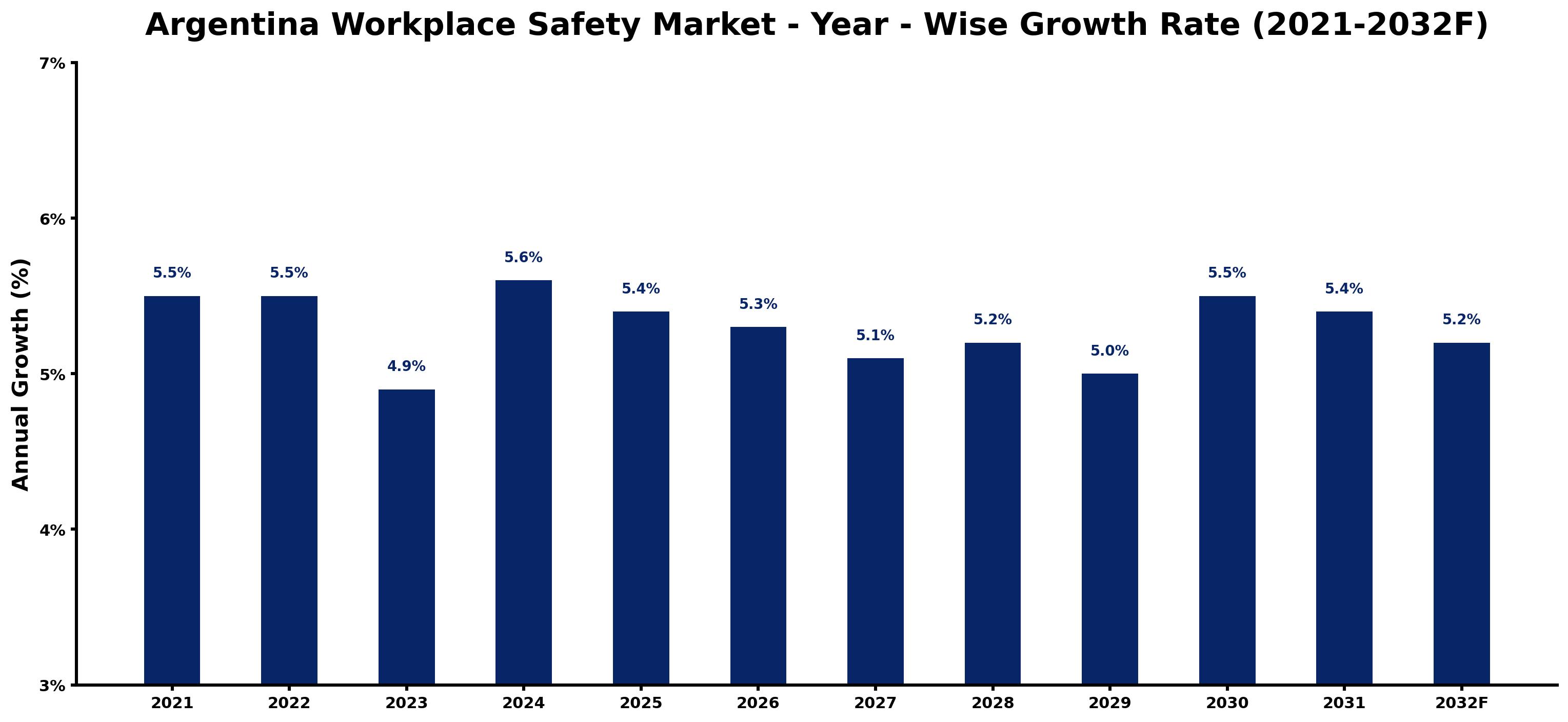
The table below presents the year‑wise growth rates along with the key drivers influencing the market
| Year | Growth Rate | Major Drivers |
| 2021 | 5.5% | Strengthened labor laws promoting workplace safety regulations. |
| 2022 | 5.5% | Increased corporate investments in employee health initiatives. |
| 2023 | 4.9% | Emergence of local startups offering innovative safety solutions. |
| 2024 | 5.6% | Government subsidies for occupational health and safety training. |
| 2025 | 5.4% | Growing awareness on mental health in workplace settings. |
| 2026 | 5.3% | Rise in urban construction boosting safety standards compliance. |
| 2027 | 5.1% | Implementation of stricter enforcement from the Ministry of Labor. |
| 2028 | 5.2% | Demand for ergonomic products from a young workforce. |
| 2029 | 5.0% | Collaborations between industries and government for safety innovations. |
| 2030 | 5.5% | Focus on compliance due to recent workplace accidents. |
| 2031 | 5.4% | Enhanced training programs mandated by Argentina's labor regulations. |
| 2032 | 5.2% | Public campaigns promoting safety awareness and practices. |
Note: Market size estimations and growth projections presented in this report are based on 6Wresearch's proprietary forecasting methodology, utilizing the latest available industry data, government publications, and primary research inputs.
Argentina Workplace Safety Market Key Takeaways
Below are some of the specific key takeaways from the market, including:
- Increased investment in personal protective equipment (PPE) is reshaping safety protocols across industries.
- The integration of technology, such as IoT and AI, is enhancing safety monitoring and compliance measures.
- Government initiatives are intensifying, reflecting the urgency for improved workplace safety standards.
- There's a marked shift towards holistic employee well-being, including mental health programs.
- Economic factors are influencing companies' ability to invest in safety solutions and training.
Evaluation of Restraints in Argentina Workplace Safety Market
The Argentina Workplace Safety Market faces significant challenges. A persistent lack of enforcement in safety regulations has led many companies to neglect necessary compliance, increasing the risk of accidents. Economic instability is another constraint, as businesses often opt for cost-cutting over investing in safety measures. Furthermore, the complexity of obtaining safety certifications can dissuade organizations from prioritizing workplace safety, creating a culture where compliance becomes secondary to operational efficiency. This environment necessitates a unified effort from government bodies, businesses, and stakeholders to reinforce the importance of safety in the workplace.
Argentina Workplace Safety Market Trends
The Argentina Workplace Safety Market is evolving with several key trends. One of the most significant is the move towards integrating technology into safety protocols. IoT devices are being utilized for real-time monitoring of workplace conditions, enhancing awareness and responsiveness to safety hazards. Wearable technology is also becoming commonplace, with devices that can track health metrics and alert employees to potential risks. Simultaneously, the emphasis on mental health and ergonomic solutions signifies a shift towards a more comprehensive approach to employee welfare.
Argentina Workplace Safety Market Opportunities
Opportunities abound for investors in the Argentina Workplace Safety Market, particularly in the development and supply of innovative safety solutions. The demand for personal protective equipment (PPE) is expected to rise significantly, driven by heightened regulatory scrutiny. Companies that offer safety training and consulting services will find a receptive market, as organizations strive to meet compliance requirements. Furthermore, technological solutions for monitoring workplace safety conditions present attractive avenues for investment, particularly as companies seek to leverage data analytics to improve their safety outcomes.
Government Initiatives in the Argentina Workplace Safety Market
Government policies play a crucial role in shaping the Argentina Workplace Safety Market, reflecting a strong commitment to protecting worker well-being. Recent legislation and initiatives have focused on enhancing safety standards across various sectors, ensuring that organizations prioritize compliance and accountability.
- A recently completed initiative established a new regulatory framework for risk assessments in high-risk industries, mandating comprehensive safety audits.
- Current efforts are underway to enhance training programs offered by the National Institute of Occupational Safety and Health (INSST), aimed at improving employee awareness of safety protocols.
- A planned public-private partnership aims to develop a national safety certification program expected to roll out by 2028, streamlining the certification process for companies.
- Ongoing campaigns promoting workplace safety awareness are being conducted nationwide, targeting both employees and employers to foster a safety-first culture.
- Regulatory updates to the Occupational Health and Safety Act are expected in 2026, which will introduce stricter penalties for non-compliance.
Future Insights of the Argentina Workplace Safety Market
Looking forward to 2026-2032, the Argentina Workplace Safety Market is set to experience steady expansion. As companies increasingly recognize the importance of employee safety in relation to productivity, the demand for innovative safety solutions will grow. Additionally, government initiatives aimed at bolstering safety standards will likely accelerate investments in training and advanced safety technologies. As the market continues to shift towards a proactive safety approach, organizations that embrace these changes will position themselves advantageously for future growth.
Argentina Workplace Safety Market Latest Developments
The past year has seen notable developments in the Argentina Workplace Safety Market, reflecting a growing commitment to improving occupational health and safety standards. Companies are increasingly adopting new technologies and practices to enhance safety measures, while regulatory bodies are stepping up enforcement efforts.
- A major technology vendor launched a new suite of safety management tools in early 2025, aimed at helping organizations comply with updated safety regulations.
- Currently ongoing is a nationwide campaign to promote mental health resources in workplaces, initiated by the Ministry of Labor, which is receiving positive feedback.
- Plans for a comprehensive safety training program have been announced, set to begin in mid-2026, with the goal of reaching thousands of employees in key sectors.
- An initiative that started in late 2024 focuses on the integration of AI technologies in safety audits to streamline compliance processes.
- Upcoming legislation is expected to tighten regulations around workplace ergonomics, with a rollout expected by 2027.
Argentina Workplace Safety Market - Key Attractiveness of the Report
- 10 Years of Market Numbers
- Historical Data Starting from 2022 to 2025
- Base Year: 2025
- Forecast Data until 2032
- Key Performance Indicators Impacting the Market
- Major Upcoming Developments and Projects
Key Highlights of the Report:
- Argentina Workplace Safety Market Outlook
- Market Size of Argentina Workplace Safety Market, 2025
- Forecast of Argentina Workplace Safety Market, 2032
- Historical Data and Forecast of Argentina Workplace Safety Revenues & Volume for the Period 2022-2032F
- Argentina Workplace Safety Market Trend Evolution
- Argentina Workplace Safety Market Drivers and Challenges
- Argentina Workplace Safety Price Trends
- Argentina Workplace Safety Porter's Five Forces
- Argentina Workplace Safety Industry Life Cycle
- Historical Data and Forecast of Argentina Workplace Safety Market Revenues & Volume By Component for the Period 2022-2032F
- Historical Data and Forecast of Argentina Workplace Safety Market Revenues & Volume By Hardware for the Period 2022-2032F
- Historical Data and Forecast of Argentina Workplace Safety Market Revenues & Volume By Software for the Period 2022-2032F
- Historical Data and Forecast of Argentina Workplace Safety Market Revenues & Volume By Services for the Period 2022-2032F
- Historical Data and Forecast of Argentina Workplace Safety Market Revenues & Volume By Application for the Period 2022-2032F
- Historical Data and Forecast of Argentina Workplace Safety Market Revenues & Volume By Incident for the Period 2022-2032F
- Historical Data and Forecast of Argentina Workplace Safety Market Revenues & Volume By Emergency Management for the Period 2022-2032F
- Historical Data and Forecast of Argentina Workplace Safety Market Revenues & Volume By Asset Tracking for the Period 2022-2032F
- Historical Data and Forecast of Argentina Workplace Safety Market Revenues & Volume By PPE Detection for the Period 2022-2032F
- Historical Data and Forecast of Argentina Workplace Safety Market Revenues & Volume By System for the Period 2022-2032F
- Historical Data and Forecast of Argentina Workplace Safety Market Revenues & Volume By Environmental Health and Safety for the Period 2022-2032F
- Historical Data and Forecast of Argentina Workplace Safety Market Revenues & Volume By Access Control and Surveillance System for the Period 2022-2032F
- Historical Data and Forecast of Argentina Workplace Safety Market Revenues & Volume By Real Time Location Monitoring for the Period 2022-2032F
- Historical Data and Forecast of Argentina Workplace Safety Market Revenues & Volume By Others for the Period 2022-2032F
- Historical Data and Forecast of Argentina Workplace Safety Market Revenues & Volume By Deployment Mode for the Period 2022-2032F
- Historical Data and Forecast of Argentina Workplace Safety Market Revenues & Volume By On-premise for the Period 2022-2032F
- Historical Data and Forecast of Argentina Workplace Safety Market Revenues & Volume By Cloud for the Period 2022-2032F
- Historical Data and Forecast of Argentina Workplace Safety Market Revenues & Volume By End User for the Period 2022-2032F
- Historical Data and Forecast of Argentina Workplace Safety Market Revenues & Volume By Energy and Utilities for the Period 2022-2032F
- Historical Data and Forecast of Argentina Workplace Safety Market Revenues & Volume By Construction and Engineering for the Period 2022-2032F
- Historical Data and Forecast of Argentina Workplace Safety Market Revenues & Volume By Chemical and Materials for the Period 2022-2032F
- Historical Data and Forecast of Argentina Workplace Safety Market Revenues & Volume By Government and Defense for the Period 2022-2032F
- Historical Data and Forecast of Argentina Workplace Safety Market Revenues & Volume By Healthcare for the Period 2022-2032F
- Historical Data and Forecast of Argentina Workplace Safety Market Revenues & Volume By Food and Beverages for the Period 2022-2032F
- Historical Data and Forecast of Argentina Workplace Safety Market Revenues & Volume By Others for the Period 2022-2032F
- Argentina Workplace Safety Import Export Trade Statistics
- Market Opportunity Assessment By Component
- Market Opportunity Assessment By Application
- Market Opportunity Assessment By System
- Market Opportunity Assessment By Deployment Mode
- Market Opportunity Assessment By End User
- Argentina Workplace Safety Top Companies Market Share
- Argentina Workplace Safety Competitive Benchmarking By Technical and Operational Parameters
- Argentina Workplace Safety Company Profiles
- Argentina Workplace Safety Key Strategic Recommendations






































