China Workplace Safety Market Size & Growth Rate (2026-2032)
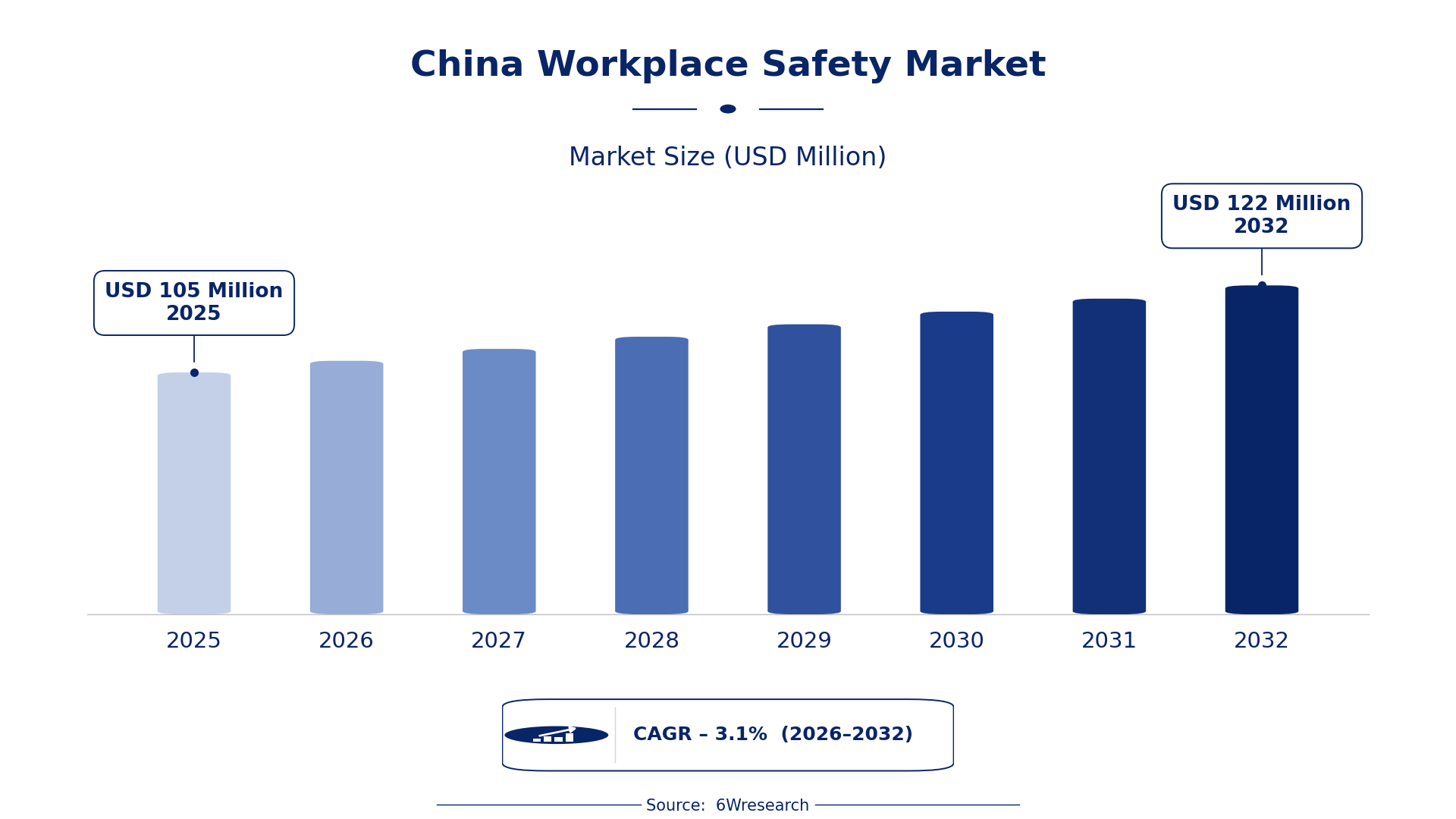
The China Workplace Safety Market was estimated at USD 105 Million in 2025 and is projected to reach USD 122 Million by 2032, growing at a CAGR of 3.1% from 2026 to 2032.
China Workplace Safety Market Synopsis
The China Workplace Safety Market is witnessing notable growth driven by heightened awareness around occupational health regulations. A significant focus on minimizing workplace accidents has spurred demand for safety equipment, training programs, and compliance services. This growth is not just a trend but a necessary shift as companies recognize the importance of employee well-being.
Advanced technologies, such as IoT and AI, are transforming how organizations approach safety management. These tools enable more effective monitoring and compliance checks across various industries. As companies adapt to these innovations, a shift towards a proactive safety culture becomes increasingly evident.
China Workplace Safety Market Year-wise Growth Rate and Key Drivers
This graph illustrates the annual growth rates of the China Workplace Safety Market from 2021 to 2032, highlighting a steady upward trajectory and projected expansion over the forecast period.
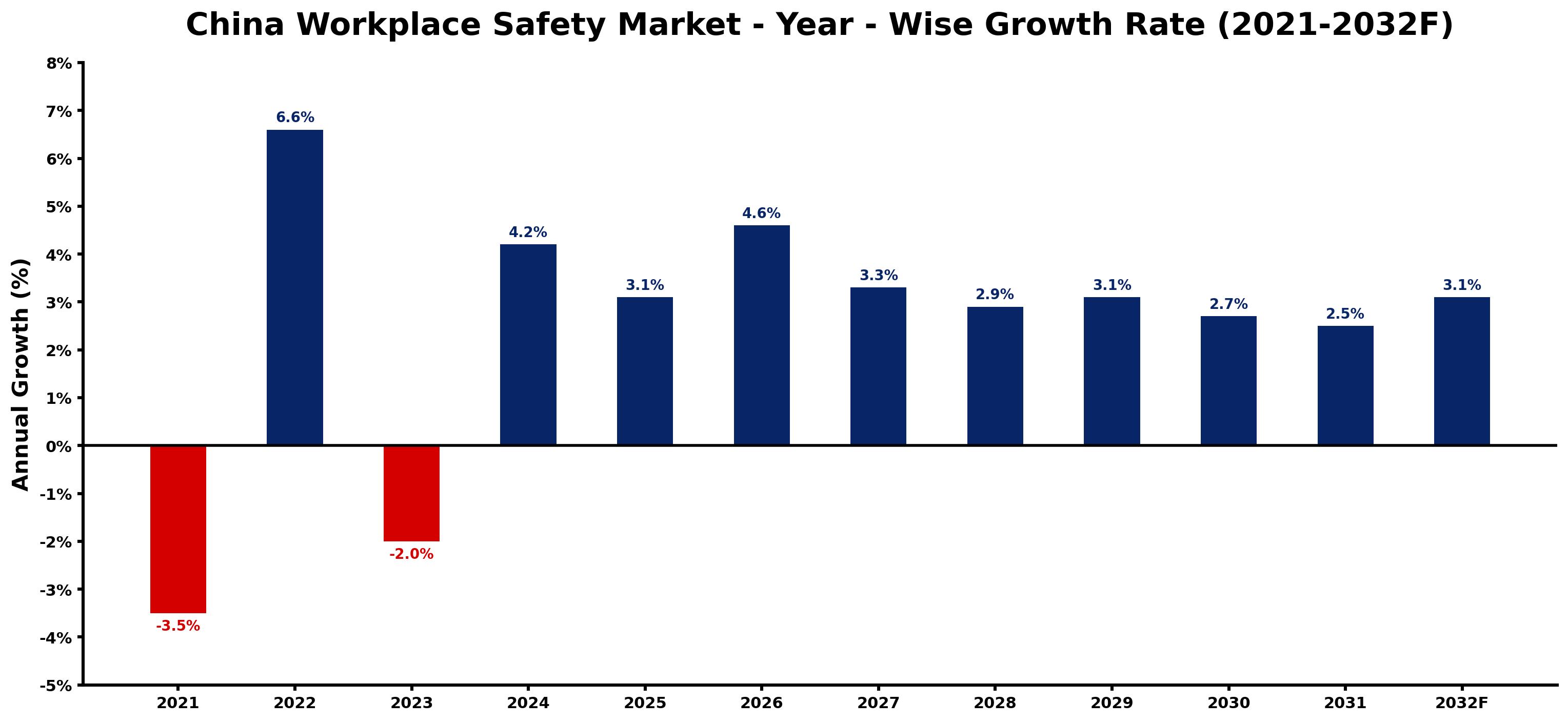
The table below presents the year‑wise growth rates along with the key drivers influencing the market
| Year | Growth Rate | Major Drivers |
| 2021 | -3.5% | COVID-19 lockdowns limited workplace safety investments. |
| 2022 | 6.6% | Strengthened regulations from National Safety Production Administration |
| 2023 | -2.0% | New regulations from Ministry of Emergency Management delayed projects. |
| 2024 | 4.2% | Increased enforcement of occupational health standards nationwide |
| 2025 | 3.1% | Growing focus on construction site safety protocols |
| 2026 | 4.6% | Rising public awareness of workplace injury consequences |
| 2027 | 3.3% | Launch of new employee safety training initiatives |
| 2028 | 2.9% | Government incentives for small business safety upgrades |
| 2029 | 3.1% | Investment in workplace safety technology advancements |
| 2030 | 2.7% | Enhanced safety inspection processes by local authorities |
| 2031 | 2.5% | Prioritization of employee mental health in safety measures |
| 2032 | 3.1% | Collaboration between industries for safety best practices |
Note: Market size estimations and growth projections presented in this report are based on 6Wresearch's proprietary forecasting methodology, utilizing the latest available industry data, government publications, and primary research inputs.
China Workplace Safety Market Key Takeaways
Below are some of the specific key takeaways from the market, including:
- Rising adoption of technology-driven safety solutions like wearables and IoT sensors.
- Emphasis on mental health programs as an integral part of workplace safety initiatives.
- Compliance with stringent safety regulations is becoming a critical operational focus.
- Government initiatives are bolstering standards and promoting safety practices across industries.
- Investment opportunities are emerging in high-quality safety equipment and innovative technology solutions.
Evaluation of Restraints in China Workplace Safety Market
Despite the market's growth, several factors hinder its full potential. The enforcement of safety regulations often lacks rigor, with inadequate training among workers and employers contributing to persistent safety gaps. Compounding these issues are cultural attitudes that discourage the reporting of safety incidents. The pressing need for production efficiency can also lead to compromising safety standards, creating a challenging environment for stakeholders committed to upholding workplace safety.
China Workplace Safety Market Trends
Technology is undeniably a major trend reshaping the China Workplace Safety Market. Wearable devices and AI-powered management systems are becoming commonplace for monitoring safety compliance and response. Additionally, a growing commitment to mental health and wellness is pushing organizations to implement supportive programs for their employees. The COVID-19 pandemic has also sparked an urgent focus on hygiene measures, prompting workplaces to enhance sanitation practices to protect against infectious diseases.
China Workplace Safety Market Opportunities
The future of the China Workplace Safety Market is ripe with opportunities. Demand for personal protective equipment (PPE) and innovative safety technologies is surging, particularly in industries like construction and healthcare. Investors are encouraged to explore avenues in safety training services and consulting, which will be pivotal as companies strive to comply with evolving regulations. The introduction of advanced monitoring solutions offers long-term potential to foster safer workplace environments.
Government Initiatives in the China Workplace Safety Market
Government policy is crucial in shaping the China Workplace Safety Market, as stringent regulations are continuously being reinforced. The State Administration of Work Safety (SAWS) is leading efforts to elevate workplace safety standards through robust policy enforcement and public initiatives. This proactive stance is essential for creating a safer work environment across all sectors.
- A recent initiative launched in 2025 focused on enhancing safety training protocols for high-risk industries.
- Currently ongoing programs include inspections and compliance checks by regional safety authorities to ensure adherence to safety standards.
- A planned public awareness campaign for 2026 aims to educate businesses about the importance of mental health in workplace safety.
- The Safe Production Law, which mandates strict employer responsibilities for maintaining safe work conditions, was recently revised to strengthen penalties for non-compliance.
- Upcoming infrastructure upgrades are set to improve safety equipment supply chains by 2027, promoting better access to safety solutions.
Future Insights of the China Workplace Safety Market
Looking ahead to 2026-2032, the China Workplace Safety Market is likely to experience steady growth, fueled by both increased regulatory pressures and a cultural shift towards valuing employee safety. As industries become more aware of safety implications and invest in technology, the market is expected to expand significantly. This ongoing evolution will not only address current challenges but also set new benchmarks for workplace safety.
China Workplace Safety Market Latest Developments
In the past year, the China Workplace Safety Market has seen a surge in activity, with businesses increasingly adopting advanced safety protocols and technologies. Companies are recognizing the vital role safety plays in their operational success, leading to innovative approaches to workplace management.
- A major technology vendor announced a partnership in early 2025 to implement AI-driven safety management systems across multiple sectors.
- An ongoing initiative started in mid-2025 focuses on enhancing personal protective equipment standards in manufacturing industries.
- A rollout of new safety training programs is expected to begin in the second half of 2026, aimed at reducing workplace incidents.
- Recent upgrades to safety compliance software have begun to enhance reporting capabilities for organizations, allowing for better tracking of safety metrics.
- In late 2025, a collaborative effort was launched to standardize safety equipment across healthcare facilities, improving safety conditions for both workers and patients.
China Workplace Safety Market - Key Attractiveness of the Report
- 10 Years of Market Numbers
- Historical Data Starting from 2022 to 2025
- Base Year: 2025
- Forecast Data until 2032
- Key Performance Indicators Impacting the Market
- Major Upcoming Developments and Projects
Key Highlights of the Report:
- China Workplace Safety Market Outlook
- Market Size of China Workplace Safety Market, 2025
- Forecast of China Workplace Safety Market, 2032
- Historical Data and Forecast of China Workplace Safety Revenues & Volume for the Period 2022-2032F
- China Workplace Safety Market Trend Evolution
- China Workplace Safety Market Drivers and Challenges
- China Workplace Safety Price Trends
- China Workplace Safety Porter's Five Forces
- China Workplace Safety Industry Life Cycle
- Historical Data and Forecast of China Workplace Safety Market Revenues & Volume By Component for the Period 2022-2032F
- Historical Data and Forecast of China Workplace Safety Market Revenues & Volume By Hardware for the Period 2022-2032F
- Historical Data and Forecast of China Workplace Safety Market Revenues & Volume By Software for the Period 2022-2032F
- Historical Data and Forecast of China Workplace Safety Market Revenues & Volume By Services for the Period 2022-2032F
- Historical Data and Forecast of China Workplace Safety Market Revenues & Volume By Application for the Period 2022-2032F
- Historical Data and Forecast of China Workplace Safety Market Revenues & Volume By Incident for the Period 2022-2032F
- Historical Data and Forecast of China Workplace Safety Market Revenues & Volume By Emergency Management for the Period 2022-2032F
- Historical Data and Forecast of China Workplace Safety Market Revenues & Volume By Asset Tracking for the Period 2022-2032F
- Historical Data and Forecast of China Workplace Safety Market Revenues & Volume By PPE Detection for the Period 2022-2032F
- Historical Data and Forecast of China Workplace Safety Market Revenues & Volume By System for the Period 2022-2032F
- Historical Data and Forecast of China Workplace Safety Market Revenues & Volume By Environmental Health and Safety for the Period 2022-2032F
- Historical Data and Forecast of China Workplace Safety Market Revenues & Volume By Access Control and Surveillance System for the Period 2022-2032F
- Historical Data and Forecast of China Workplace Safety Market Revenues & Volume By Real Time Location Monitoring for the Period 2022-2032F
- Historical Data and Forecast of China Workplace Safety Market Revenues & Volume By Others for the Period 2022-2032F
- Historical Data and Forecast of China Workplace Safety Market Revenues & Volume By Deployment Mode for the Period 2022-2032F
- Historical Data and Forecast of China Workplace Safety Market Revenues & Volume By On-premise for the Period 2022-2032F
- Historical Data and Forecast of China Workplace Safety Market Revenues & Volume By Cloud for the Period 2022-2032F
- Historical Data and Forecast of China Workplace Safety Market Revenues & Volume By End User for the Period 2022-2032F
- Historical Data and Forecast of China Workplace Safety Market Revenues & Volume By Energy and Utilities for the Period 2022-2032F
- Historical Data and Forecast of China Workplace Safety Market Revenues & Volume By Construction and Engineering for the Period 2022-2032F
- Historical Data and Forecast of China Workplace Safety Market Revenues & Volume By Chemical and Materials for the Period 2022-2032F
- Historical Data and Forecast of China Workplace Safety Market Revenues & Volume By Government and Defense for the Period 2022-2032F
- Historical Data and Forecast of China Workplace Safety Market Revenues & Volume By Healthcare for the Period 2022-2032F
- Historical Data and Forecast of China Workplace Safety Market Revenues & Volume By Food and Beverages for the Period 2022-2032F
- Historical Data and Forecast of China Workplace Safety Market Revenues & Volume By Others for the Period 2022-2032F
- China Workplace Safety Import Export Trade Statistics
- Market Opportunity Assessment By Component
- Market Opportunity Assessment By Application
- Market Opportunity Assessment By System
- Market Opportunity Assessment By Deployment Mode
- Market Opportunity Assessment By End User
- China Workplace Safety Top Companies Market Share
- China Workplace Safety Competitive Benchmarking By Technical and Operational Parameters
- China Workplace Safety Company Profiles
- China Workplace Safety Key Strategic Recommendations






































