Asia Pacific (APAC) Construction Equipment Market Size & Growth Rate
According to 6Wresearch internal database and industry insights, the Asia Pacific (APAC) Construction Equipment Market was valued at USD 110 billion in 2025 and is projected to reach USD 201.08 billion by 2032, growing at a CAGR of approximately 9% during 2026–2032.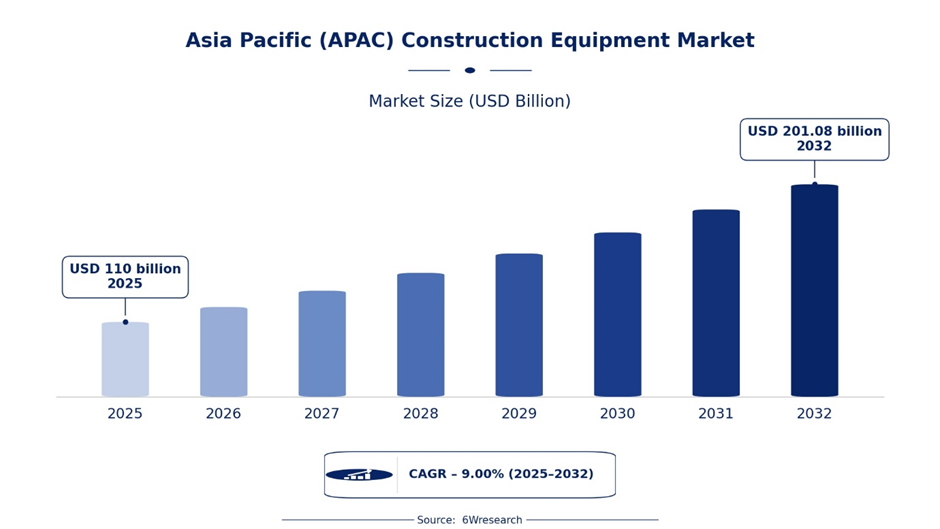
Asia Pacific (APAC) Construction Equipment Market Highlights
|
Report Metric |
Details |
|
Report Name |
Asia Pacific (APAC) Construction Equipment Market (2026-2032) |
|
Market Size 2025 |
USD 110 billion |
|
Market Size 2032 |
USD 201.08 billion |
|
Absolute Growth 2025–2032 |
USD 91.08 billion |
|
CAGR 2026–2032 |
9% |
|
Peak Annual Growth |
10.3% (2029) |
|
Forecast Period |
2026–2032 |
|
Historical Data |
2022–2025 |
|
Base Year |
2025 |
|
Leading Types, 2025 |
Earthmoving Equipment (38% share) |
|
Leading Applications, 2025 |
Construction (72% share) |
|
Leading Countries, 2025 |
China (42% share) |
|
Fastest-Growing Types |
Aerial Work Equipment (12.4% CAGR) |
|
Fastest-Growing Applications |
Mining (10.5% CAGR) |
|
Fastest-Growing Countries |
India (12.8% CAGR) |
|
Growing Sector |
Data centre, renewable energy and logistics infrastructure construction |
|
Key End Users or Key Procuring Entities |
Infrastructure developers and EPC contractors, mining operators, oil and gas operators, equipment rental companies, real estate developers and public works agencies |
Asia Pacific (APAC) Construction Equipment Market Year-wise Growth Rate and Key Drivers (2022–2032)
This graph illustrates the annual growth rates of the market from 2022 to 2032, highlighting a steady upward trajectory and projected market expansion over the forecast period.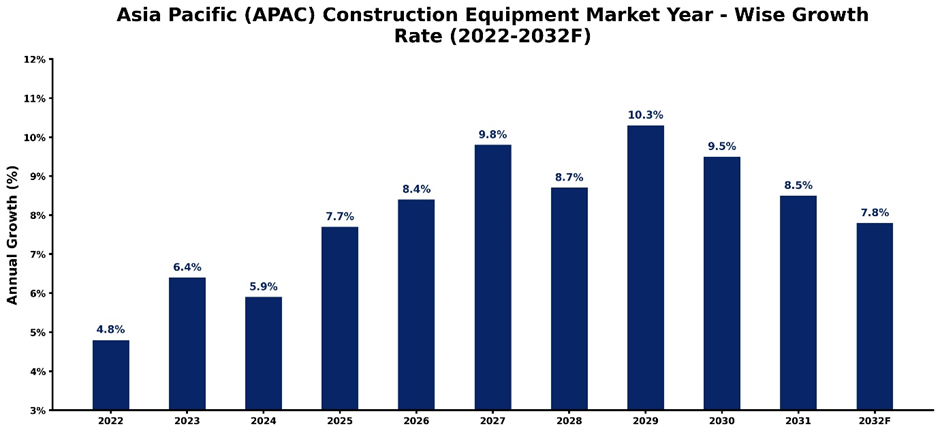
The following table presents the estimated annual growth rate for each year together with the principal factor influencing market performance. The values are intended to highlight year-specific drivers rather than to provide a direct comparison between individual years.
|
Year |
Estimated Annual Growth (%) |
Market Rationale |
|
2022 |
4.8% |
Shanghai lockdowns and a weakening Chinese property sector curbed excavator sale, although continued highway awards in India supported regional demand. |
|
2023 |
6.4% |
Post-pandemic project restarts in Southeast Asia and mining investment in Australia and Indonesia lifted equipment orders despite weakness in China. |
|
2024 |
5.9% |
India’s general election slowed public tendering in early 2024 and high interest rates delayed equipment purchases across Southeast Asia, moderating growth. |
|
2025 |
7.7% |
China’s equipment trade-in programme and a rebound in domestic excavator sales, alongside rising machinery exports, accelerated regional growth. |
|
2026 |
8.4% |
Large road and metro awards in India and wider replacement of ageing fleets in China are expected to lift orders. |
|
2027 |
9.8% |
Phase two works at Indonesia’s Nusantara capital and Vietnam’s expressway expansion are expected to raise orders for earthmoving machines. |
|
2028 |
8.7% |
Completion of several large rail and highway packages is expected to moderate orders before newer project cycles begin. |
|
2029 |
10.3% |
Peak Brisbane 2032 Olympic works and large airport and port expansions in India are expected to drive the strongest growth. |
|
2030 |
9.5% |
The tapering of Olympic works is expected to ease growth, although electric and autonomous machine adoption will sustain demand. |
|
2031 |
8.5% |
Maturing urbanisation in China and Japan and a tapering of earlier infrastructure pipelines are expected to restrain growth. |
|
2032 |
7.8% |
Normalisation after project peaks and a larger base are expected to slow growth, with rental and aftermarket revenues gaining weight. |
Note: Market size estimations and growth projections presented in this report are based on 6Wresearch’s proprietary forecasting methodology, utilizing the latest available industry data, government publications, and primary research inputs.
Asia Pacific (APAC) Construction Equipment Market Synopsis
The Asia Pacific (APAC) Construction Equipment Market is expected to grow at a rapid pace through 2032. The industry covers machinery used to build, excavate, lift, haul and surface infrastructure, comprising of cranes, earthmoving equipment, aerial work platforms, material handling machines, road construction equipment, dump trucks, tractors and bulldozers, supplied to buyers across China, India, Japan, Australia and Southeast Asia. Industry expansion is shaped by India’s highway and metro expansion, China’s equipment renewal and urban upgrading, Indonesia’s capital city development and Australia’s resource and transport projects. Competition is led by Chinese and Japanese manufacturers, with rising localisation and rental adoption steadily reshaping how fleets are procured.
Market Dynamics Impact Analysis (2026–2032)
|
Factor |
Type |
Impact |
Primary Segment Affected |
|
Mine fleet expansion and replacement |
Driver |
High |
Dump Trucks |
|
Large-scale rail, metro and airport build-out |
Driver |
High |
Tower Cranes |
|
Equipment rental and fleet-leasing models |
Opportunity |
High |
Scissor Lifts |
|
Electrification of warehouse and compact machines |
Opportunity |
Medium |
Forklifts |
|
Property sector slowdown in China |
Restraint |
High |
Excavators |
|
High interest rates and costly equipment finance |
Restraint |
Medium |
Loaders |
|
Shortage of skilled operators and technicians |
Challenge |
High |
Mobile Cranes |
|
Fragmented emission and safety standards |
Challenge |
Medium |
Motor Grader |
Evaluation of Drivers in the Asia Pacific (APAC) Construction Equipment Market (2026–2032)
Below mentioned are some major drivers and their influence on the market dynamics:
|
Drivers |
Primary Segment Affected |
Why It Matters (Evidence) |
|
Mine fleet expansion and replacement |
Dump Trucks |
Open-cut iron ore, coal and nickel operations need high-payload haulage to cut cost per tonne, so output growth translates directly into truck orders. Australia is the world’s largest iron ore exporter, and Pilbara operators run some of the largest haul truck fleets globally. |
|
Data centre and industrial park build-out |
Telescopic Handlers |
Large-footprint steel-frame facilities need machines that lift and place materials at height across wide sites, which raises telescopic handler utilisation. Johor in Malaysia has emerged as one of Southeast Asia’s largest data centre clusters since 2023. |
|
Wind energy installation |
Crawler Cranes |
Turbine tower and nacelle erection needs heavy lift capacity with high load charts at remote sites, so each new wind farm creates specialised crane demand. China added close to 80 GW of wind capacity in 2024. |
|
Viaduct-based rail and metro construction |
Tower Cranes |
Elevated corridors need tower cranes for precast segment and girder placement over long stretches, so every kilometre of viaduct adds crane hours. The Mumbai–Ahmedabad high-speed rail corridor includes more than 460 km of viaduct. |
|
Ageing infrastructure inspection and maintenance |
Telescopic Boom Lifts |
Bridges, tunnels and elevated roads need access equipment for inspection and repair at height, which creates recurring demand that is independent of new project cycles. Japan has more than 700,000 road bridges, and a growing share is over 50 years old. |
Demand is underpinned by rapid urbanisation, with more than half of the region’s population living in cities, which sustains continuous additions to housing, utilities and commercial space. A growing middle class widens the base of property buyers and developers. Foreign direct investment into ASEAN has exceeded USD 200 billion annually in recent years, and supply-chain diversification towards India and Southeast Asia adds factory and logistics floor space. Expanding equipment finance networks allow smaller buyers to acquire modern machines without heavy upfront outlay, which widens the addressable buyer base. Rising private investment in commercial real estate further expands the number of project owners and sustains regular equipment procurement.
Evaluation of Restraints in the Asia Pacific (APAC) Construction Equipment Market
Below mentioned are some major restraints and their influence on the market dynamics:
|
Market Restraint |
Primary Segment Affected |
Why It Matters (Evidence) |
|
Slowdown in China’s property sector |
Excavators |
Residential construction drives excavator sales, so weak housing activity reduces the region’s largest buyer pool. Chinese excavator sales fell by roughly 40 percent between 2021 and 2023. |
|
High interest rates and costly equipment finance |
Loaders |
Most small buyers purchase through loans or leases, so higher borrowing costs delay replacement and reduce fleet additions. Bank Indonesia raised its policy rate to 6.25 percent in April 2024. |
|
Commodity price volatility and capital discipline |
Oil & Gas |
Operators defer field development when prices soften, which postpones orders for lifting and earthmoving machines. Brent crude averaged about USD 80 per barrel in 2024, down from above USD 100 in 2022. |
|
Stricter emission norms raising machine prices |
Construction Tractor and Bulldozer |
Cleaner engines and after-treatment systems raise unit cost, and price-sensitive buyers may delay purchases or keep older machines in service. India’s Stage V norms for construction equipment applied from April 2024. |
|
Seasonal weather disruption of site work |
Road Rollers |
Heavy rain halts earthworks and paving, which compresses the working season and defers fleet purchases. The southwest monsoon runs from June to September across most of India. |
Asia Pacific (APAC) Construction Equipment Market Challenges
The Asia Pacific (APAC) Construction Equipment Industry is facing structural restrictions. Skilled labour is scarce in ageing economies, and Japan’s construction workforce has shrunk by roughly 30 percent from its peak, which limits operator availability and slows project mobilisation. Logistics add cost in archipelagic markets, where Indonesia’s more than 17,000 islands make parts delivery and field servicing slow and expensive for dealers. Emission rules are uneven across the region, and China’s National IV non-road standard, applied from December 2022, forces manufacturers to maintain several engine variants. Price-sensitive buyers in Southeast Asia and South Asia also favour used or low-cost machines, which compresses margins for premium suppliers.
Trends in the Asia Pacific (APAC) Construction Equipment Market
Major industry trends in the Asia Pacific (APAC) Construction Equipment Market Growth are summarized below:
- Transition from Ownership to Rental and Fleet Sharing: Equipment rental is gaining ground as buyers seek to avoid capital lock-up and maintenance risk. Established rental firms such as Kanamoto in Japan and Coates Hire in Australia are being joined by digital rental platforms in India and Southeast Asia. This favours suppliers that offer standardised fleets, buy-back support and telematics for utilisation tracking.
- Shift from Manual Operation to Telematics-Enabled and Autonomous Machines: Australia’s iron ore producers in the Pilbara run autonomous haul trucks supplied by Komatsu and Caterpillar, and Chinese manufacturers. these manufactures are introducing unmanned rollers and remote-operated excavators on highway projects. Connected machines generate utilisation and fuel data that suppliers can convert into service contracts, positioning software and aftermarket revenue.
- Local Assembly Prioritised over Imports: Manufacturers are building regional production bases to cut delivery times and import duties, with JCB and Caterpillar operating plants in India and Sany maintaining assembly near Pune. Localised sourcing of structures, cabins and hydraulics lowers cost, and suppliers that qualify as domestic component partners gain stable volumes.
Investment Opportunities in the Asia Pacific (APAC) Construction Equipment Market
Potential investment opportunities in the Asia Pacific (APAC) Construction Equipment Market include the following:
- Aftermarket Parts and Remanufacturing Hubs: Ageing fleets in Indonesia, Australia and India require continuous spares and rebuilds, as owners favour rebuilding over replacement when budgets tighten. Investors can establish regional parts depots and remanufacturing centres for engines, hydraulic pumps and undercarriages. The most practical entry is through authorised dealer partnerships or OEM-backed service networks near mining belts and port clusters.
- Operator Training and Simulator Centres: Skilled operators and technicians are in short supply in India and Southeast Asia as fleets become more connected. Investors can build simulator-based training academies for excavators, cranes and aerial platforms, with certification and placement services for contractors and rental firms. Partnerships with OEMs, vocational institutes and large rental companies provide curriculum, equipment access and a ready client base.
- Warehouse and Logistics Material Handling Fleets: Industrial and logistics parks in India, Malaysia and Thailand are adding storage space that needs forklifts and telescopic handlers on lease. Investors can supply forklift and telehandler fleets bundled with maintenance and telematics. Entry is best through leasing arrangements with park developers and third-party logistics operators, supported by a local service workshop.
Leading Players in Asia Pacific (APAC) Construction Equipment Market
A comprehensive list of major companies operating in the Asia Pacific (APAC) Construction Equipment Market is provided below:
1. Komatsu Ltd.
|
Company Name |
Komatsu Ltd. |
|---|---|
|
Established Year |
1921 |
|
Headquarters |
Tokyo, Japan |
|
Official Website |
Komatsu Ltd. manufactures a broad range of excavators, loaders, dump trucks and mining machinery. It maintains an established dealer and service presence across Japan, Southeast Asia, India and Australia.
2. Caterpillar Inc.
|
Company Name |
Caterpillar Inc. |
|---|---|
|
Established Year |
1925 |
|
Headquarters |
Irving, Texas, United States |
|
Official Website |
Caterpillar Inc. supplies earthmoving, mining and material handling equipment along with engines and aftermarket services. It serves infrastructure and resource customers across the region through a wide dealer network and local manufacturing.
3. Sany Heavy Industry Co., Ltd.
|
Company Name |
Sany Heavy Industry Co., Ltd. |
|---|---|
|
Established Year |
1989 |
|
Headquarters |
Changsha, China |
|
Official Website |
Sany Heavy Industry Co., Ltd. produces excavators, cranes, concrete machinery and road equipment. It is a leading Chinese manufacturer with growing export and local assembly activity across Asia Pacific.
4. JCB
|
Company Name |
JCB |
|---|---|
|
Established Year |
1945 |
|
Headquarters |
Rocester, England, United Kingdom |
|
Official Website |
JCB designs and manufactures backhoe loaders, telescopic handlers, excavators and compact equipment.
Government Initiatives in the Asia Pacific (APAC) Construction Equipment Market
India’s PM Gati Shakti National Master Plan, launched in 2021 with an outlay of about INR 100 lakh crore, coordinates multimodal infrastructure, and the Union Budget 2025–26 allocated INR 11.21 lakh crore to capital expenditure. China’s 2024 Action Plan for Large-Scale Equipment Renewal and Trade-Ins supports the switch of older machinery, while Japan’s five-year acceleration plan for national resilience committed roughly JPY 15 trillion to disaster-prevention works through fiscal 2025.
Implementation is led by agencies such as India’s National Highways Authority of India, which is increasing a national highway network of about 146,000 km, and Indonesia’s Nusantara Capital Authority, established under Law No. 3 of 2022 to build the new capital. Australia’s Infrastructure Investment Program commits A$120 billion over ten years from 2024–25, while Malaysia’s 665 km East Coast Rail Link is advancing towards completion by the end of 2026.
Future Insights of the Asia Pacific (APAC) Construction Equipment Market
The Asia Pacific (APAC) Construction Equipment Market is expected to grow at a rapid pace through 2032. Future demand will be shaped by deeper regional trade integration, which supports cross-border manufacturing, shorter equipment supply chains and wider dealer networks. In addition, wider use of building information modelling, machine control and digital twins will raise site productivity and supports upgrades to connected fleets and reduce idle time. Expanding urban transit and utility networks, supported by rising participation of private infrastructure funds, will sustain a continuous project pipeline in fast-growing cities. Furthermore, net-zero commitments, with India targeting 2070 and China 2060, will steer procurement towards low-emission machines and charging infrastructure.
Market Segmentation Analysis
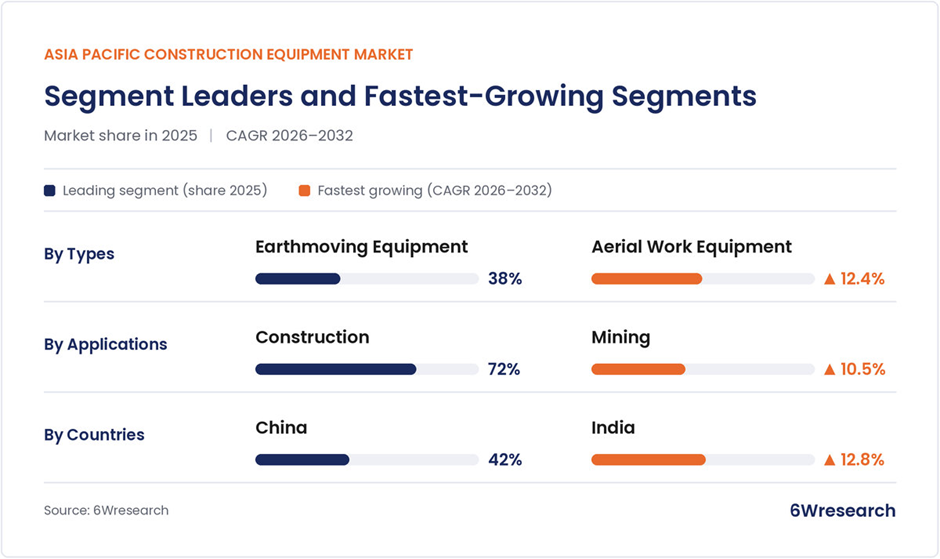
The report offers a comprehensive study of the market across its key segments. The chart below highlights the leading segment by market share in 2025 and the fastest-growing segment by CAGR over 2026–2032, followed by a detailed analysis of each segment.
By Types – Earthmoving Equipment Leads, Aerial Work Equipment Expected to Grow Fastest
According to Ravi Bhandari, Research Head at 6Wresearch, Earthmoving Equipment led the types segment with a 38% Asia Pacific (APAC) Construction Equipment Market Share in 2025, supported by highway embankments, urban development and open-cut mine stripping across China, India and Indonesia where excavation, grading and loading anchor fleet purchases. Meanwhile, Aerial Work Equipment is expected to grow fastest at a CAGR of 12.4% during 2026–2032, as data centre and industrial plant projects in India, Malaysia and Japan require safe elevated access and rental firms widen fleets.
By Applications – Construction Leads, Mining Expected to Grow Fastest
With a 72% market share in 2025, Construction was the largest application, as urban housing, highway, metro and airport programmes in China and India keep fleets in continuous use. At the same time, Mining is projected to expand fastest at a CAGR of 10.5% over 2026–2032, led by iron ore, coal and critical mineral output in Australia and Indonesia that requires larger haulage and loading fleets.
By Countries – China Leads, India Expected to Grow Fastest
China was the largest country in 2025 with a 42% industry share, owing to its large installed fleet, the manufacturing clusters of Changsha and Xuzhou and sustained urban renewal and utility works. In parallel, India is projected to record the fastest growth, at a CAGR of 12.8% during 2026–2032, as highway, metro, port and housing projects expand and domestic assembly deepens.
Key Attractiveness of the Report
- 10 Years of Market Numbers
- Historical Data Starting from 2022 to 2025
- Base Year 2025
- Forecast Data until 2032
- Key Performance Indicators Impacting the Market
- Major Upcoming Developments and Projects
Key Highlights of the Report:
- Asia Pacific Construction Equipment Market Outlook
- Market Size of Asia Pacific Construction Equipment Market, 2025
- Forecast of Asia Pacific Construction Equipment Market, 2032
- Historical Data and Forecast of Asia Pacific Construction Equipment Market Revenues & Volume for the Period 2022-2032
- Asia Pacific Construction Equipment Market Trend Evolution
- Asia Pacific Construction Equipment Market Drivers and Challenges
- Asia Pacific Construction Equipment Price Trends
- Asia Pacific Construction Equipment Porter's Five Forces
- Asia Pacific Construction Equipment Industry Life Cycle
- Historical Data and Forecast of Asia Pacific Construction Equipment Market Revenues and volume by Type for the Period 2022-2032
- Historical Data and Forecast of Asia Pacific Construction Equipment Market Revenues and Volume by Cranes for the Period 2022-2032
- Historical Data and Forecast of Asia Pacific Construction Equipment Market Revenues and volume by Construction Tractor and Bulldozer for the Period 2022-2032
- Historical Data and Forecast of Asia Pacific Construction Equipment Market Revenues and volume by Earthmoving Equipment for the Period 2022-2032
- Historical Data and Forecast of Asia Pacific Construction Equipment Market Revenues and volume by Aerial Work Equipment for the Period 2022-2032
- Historical Data and Forecast of Asia Pacific Construction Equipment Market Revenues and volume by Material Handling Equipment for the Period 2022-2032
- Historical Data and Forecast of Asia Pacific Construction Equipment Market Revenues and volume by Dump Trucks for the Period 2022-2032
- Historical Data and Forecast of Asia Pacific Construction Equipment Market Revenues and volume by Road Construction Equipment for the Period 2022-2032
- Historical Data and Forecast of Asia Pacific Construction Equipment Market Revenues and volume by Application for the Period 2022-2032
- Historical Data and Forecast of Asia Pacific Construction Equipment Market Revenues and volume by Construction for the Period 2022-2032
- Historical Data and Forecast of Asia Pacific Construction Equipment Market Revenues and volume by Oil and Gas for the Period 2022-2032
- Historical Data and Forecast of Asia Pacific Construction Equipment Market Revenues and volume by Mining for the Period 2022-2032
- Historical Data and Forecast of Asia Pacific Construction Equipment Market Revenues and volume by key countries for the Period 2022-2032
- Historical Data and Forecast of Asia Pacific Construction Equipment Market Revenues and volume by India for the Period 2022-2032
- Historical Data and Forecast of Asia Pacific Construction Equipment Market Revenues and volume by China for the Period 2022-2032
- Historical Data and Forecast of Asia Pacific Construction Equipment Market Revenues and volume by Thailand for the Period 2022 – 2032
- Historical Data and Forecast of Asia Pacific Construction Equipment Market Revenues and volume by Malaysia for the Period 2022-2032
- Historical Data and Forecast of Asia Pacific Construction Equipment Market Revenues and volume by Japan for the Period 2022-2032
- Historical Data and Forecast of Asia Pacific Construction Equipment Market Revenues and volume by Australia for the Period 2022-2032
- Historical Data and Forecast of Asia Pacific Construction Equipment Market Revenues and volume by Indonesia for the Period 2022-2032
- Historical Data and Forecast of Asia Pacific Construction Equipment Market Revenues and volume by Rest of the Asia Pacific for the Period 2022-2032
- Asia Pacific Construction Equipment Import Export Trade Statistics
- Market Opportunity Assessment By Type
- Market Opportunity Assessment By Application
- Market Opportunity Assessment By Countries
- Asia Pacific Construction Equipment Top Companies Market Share
- Asia Pacific Construction Equipment Competitive Benchmarking By Technical and Operational Parameters
- Asia Pacific Construction Equipment Company Profiles
- Asia Pacific Construction Equipment Key Strategic Recommendation
Market Scope and Segmentation
The report provides a detailed analysis of the following market segments:
By Types:
- Cranes (Mobile Cranes, Crawler Cranes, Tower Cranes)
- Earthmoving Equipment (Loaders, Excavators, Motor Grader)
- Aerial Work Equipment (Articulated Boom Lifts, Telescopic Boom Lifts, Scissor Lifts)
- Material Handling Equipment (Telescopic Handlers, Forklifts)
- Road Construction Equipment (Pavers, Road Rollers)
- Dump Trucks
- Construction Tractor and Bulldozer
By Applications:
- Construction
- Oil & Gas
- Mining
By Countries:
- India
- China
- Thailand
- Malaysia
- Japan
- Australia
- Indonesia
- Rest of the Asia Pacific































