Asia Pacific Frozen Food Market report thoroughly covers the market by product types, end-users, distribution channels, freezing techniques, and key countries including China, Japan, Australia, Indonesia, and the Rest of Asia Pacific. The Asia Pacific Frozen Food market outlook report provides an unbiased and detailed analysis of the on-going Asia Pacific Frozen Food market trends, market share, opportunities/high growth areas, and market drivers which would help the stakeholders to devise and align their market strategies according to the current and future market dynamics.
Asia Pacific Frozen Food Market Synopsis
Asia Pacific Frozen Food Market is expected to register significant growth in the forecast period (2020-2026). Increasing employment and a rising number of women entering the workforce in the region is also expected to augment the demand for frozen food products in the region in the years to come. Further, the consumer apprehensions regarding the coronavirus outbreak in 2020 may lead people to increase their demand for frozen food to reserve to endure the health crisis by avoiding public interactions. However, the economic slowdown and dampening of production capacity resulting from the health emergency is expected to obstruct market growth in the first half of 2020 and would recover once the crisis is effectively dealt with. However, due to the spread of pandemic COVID-19, the market is estimated to witness a decline in revenues in the year 2020, as a result of the halt in the on-going projects and no new projects being announced in the first half of the year.
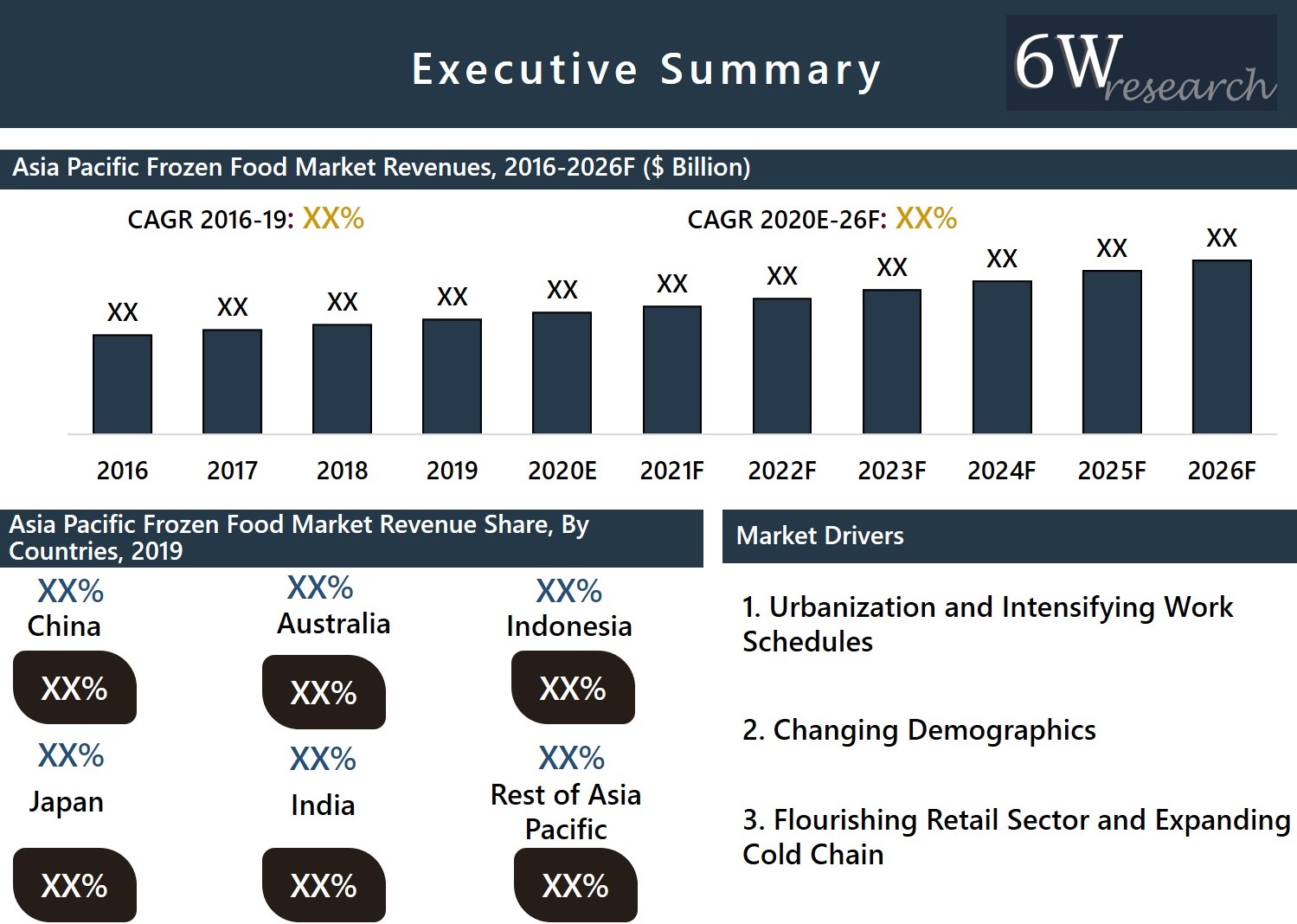
According to 6Wresearch, Asia Pacific Frozen Food Market size is projected to grow at CAGR of 6.2% during 2020-2026. With healthy options being made available in the frozen food market, consumer sentiment regarding frozen food is expected to improve further during the forecast period. The demand for frozen food in a single person and nuclear households is driven by the consumer preference for convenient, reasonable, and small portions of meals, and the increase in the proportion of such households is likely to propel the market for frozen food in the region over the coming years. Unforeseen events such as the coronavirus outbreak are expected to boost the demand for frozen food in the short run as people are expected to stockpile necessities including food to endure the crisis. However, disruptions in the supply chain in countries in the Asia Pacific region are expected to dampen the production of frozen food products in the first half of 2020.
Market Analysis by Types
Based on product types, the ready meals segment has recorded significant growth in the overall market revenues in 2019 and in demand too due to the changing consumers’ lifestyle and an increasing number of working women in the region and is anticipated to grow further during the forecast period. Based on end-users, the retail customers are the leading contributors to the frozen food market and are expected to sustain their position over the next few years.
Market Analysis by Countries
Japan and China currently hold the largest market size in the region in revenue in 2019 terms on account of their well-established and expanding cold chains. On the other hand, the Indian frozen food market is projected to grow at the highest rate during the forecast period in the Asia Pacific region owing to its increasing working-age population and the booming FMCG sector in the region. Additionally, government initiatives of developing countries to bridge the gap between food demand and supply, such as subsidies offered on particular products would boost the market for frozen food in the region over the coming years.
Key Attractiveness of the Report
- COVID-19 Impact on the Market.
- 10 Years Market Numbers.
- Historical Data Starting from 2016 to 2020.
- Base Year: 2019
- Forecast Data until 2026.
- Key Performance Indicators Impacting the Market.
- Major Upcoming Developments and Projects.
Key Highlights of the Report:
- Asia Pacific Frozen Food Market Overview
- Asia Pacific Frozen Food Market Outlook
- Asia Pacific Frozen Food Market Forecast
- Asia Pacific Frozen Food Market Size
- Historical Data of Asia Pacific Frozen Food Market Revenues for the Period 2016-2019
- Market Size & Forecast of Asia Pacific Frozen Food Market Revenues until 2026F
- Historical Data of Asia Pacific Frozen Food Market Revenues by Product Types for the Period 2016-2019
- Market Size & Forecast of Asia Pacific Frozen Food Market Revenues by Product Types until 2026F
- Historical Data of Asia Pacific Frozen Food Market Revenues by End Users for the Period 2016-2019
- Market Size & Forecast of Asia Pacific Frozen Food Market Revenues by End Users until 2026F
- Historical Data of Asia Pacific Frozen Food Market Revenues by Distribution Channels for the Period 2016-2019
- Market Size & Forecast of Asia Pacific Frozen Food Market Revenues by Distribution Channels until 2026F
- Historical Data of Asia Pacific Frozen Food Market Revenues by Freezing Techniques for the Period 2016-2019
- Market Size & Forecast of Asia Pacific Frozen Food Market Revenues by Freezing Techniques until 2026F
- Historical Data of China Frozen Food Market Revenues for the Period 2016-2019
- Market Size & Forecast of China Frozen Food Market Revenues until 2026F
- Historical Data of Japan Frozen Food Market Revenues for the Period 2016-2019
- Market Size & Forecast of Japan Frozen Food Market Revenues until 2026F
- Historical Data of Australia Frozen Food Market Revenues for the Period 2016-2019
- Market Size & Forecast of Australia Frozen Food Market Revenues until 2026F
- Historical Data of India Frozen Food Market Revenues for the Period 2016-2019
- Market Size & Forecast of India Frozen Food Market Revenues until 2026F
- Historical Data of Indonesia Frozen Food Market Revenues for the Period 2016-2019
- Market Size & Forecast of Indonesia Frozen Food Market Revenues until 2026F
- Market Drivers and Restraints
- Market Trends and Developments
- Player Market Share and Competitive Landscape
- Company Profiles
- Key Strategic Recommendations
Market Scope and Segmentation
The report provides a detailed analysis of the following market segments:
- By Product Types
- Frozen Ready Meals (including noodles, curries, rice items, and pizzas)
- Frozen Meat and Poultry
- Frozen Fish and Seafood
- Frozen Fruits and Vegetables
- Frozen Snack Products (including nuggets, kebabs, cutlets, and croquettes)
- Frozen Confectionery and Bakery Items (including frozen pies, bread, and pastries)
- Others (including frozen soups, condiments, juices, and sauces)
- By End Users
- Retail Customers
- Food Service Industry
- By Distribution Channels
- Online
- Offline
- By Freezing Technique
- Individual Quick Freezing
- Blast Freezing
- Deep Freezing
- Others (including cryogenic freezing and belt freezing)
- By Countries
- China
- Japan
- Australia
- India
- Indonesia
- Rest of Asia Pacific
Other Key Reports Available:
- Middle East Frozen Food Market (2020-2026F)






































