Australia Air Handling Unit Market: Import Trend Analysis
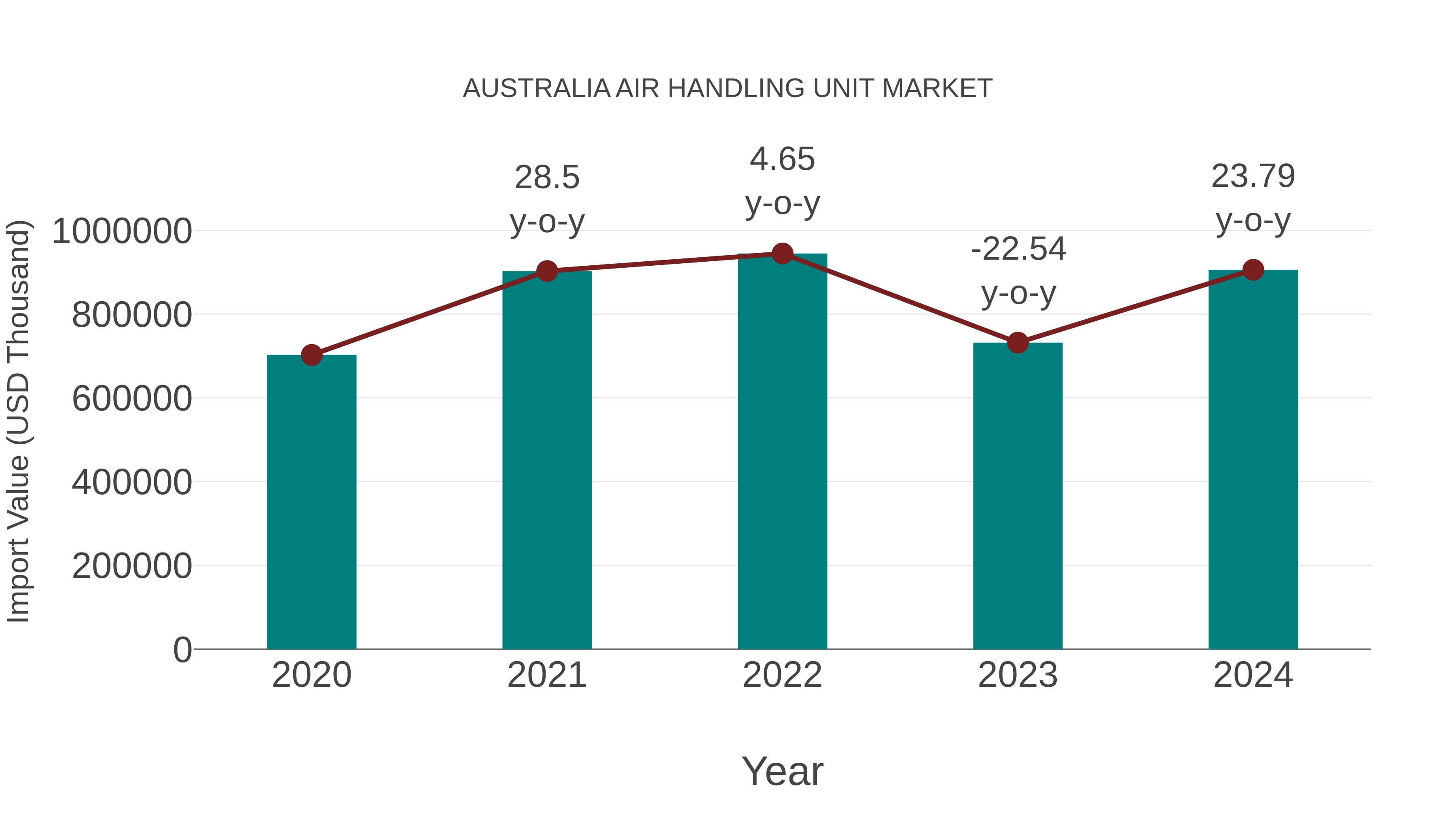
Australia`s import trend for the air handling unit market showed a notable growth rate of 23.79% from 2023 to 2024, with a compound annual growth rate (CAGR) of 6.56% from 2020 to 2024. This surge in imports can be attributed to the increasing demand for energy-efficient HVAC systems and advancements in air quality regulations driving market stability.
Australia Air Handling Unit Market Overview
The air handling unit market in Australia is experiencing steady growth driven by factors such as increasing construction activities, stringent regulations for energy efficiency in buildings, and the growing awareness of indoor air quality. The market is characterized by the demand for energy-efficient and sustainable HVAC solutions to reduce operational costs and environmental impact. Key players in the Australian air handling unit market offer a range of products including packaged AHUs, custom AHUs, and modular AHUs to cater to various end-user industries such as commercial, industrial, and residential sectors. Technological advancements such as the integration of smart controls, air purification systems, and heat recovery units are also influencing market growth. Overall, the Australia air handling unit market is poised for further expansion as the need for efficient HVAC systems continues to rise in the country.
Australia Air Handling Unit Market Trends
In the Australia air handling unit market, a key trend is the growing demand for energy-efficient and sustainable HVAC solutions. With increasing environmental concerns and regulations, there is a significant focus on reducing energy consumption and carbon emissions in buildings. This has led to a rise in the adoption of air handling units with advanced technologies such as energy recovery systems, variable speed drives, and smart controls. Additionally, there is a growing emphasis on improving indoor air quality, which has driven the integration of filtration systems and air purification technologies in air handling units. The market is also witnessing a trend towards modular and customizable units to cater to diverse building requirements and facilitate easier installation and maintenance processes. Overall, the Australia air handling unit market is evolving towards more efficient, sustainable, and user-friendly solutions to meet the changing needs of the industry.
Australia Air Handling Unit Market Challenges
In the Australia air handling unit market, one of the key challenges faced is the increasing demand for energy-efficient and sustainable solutions. As regulations become stricter and environmental concerns grow, there is a heightened pressure on manufacturers to develop AHUs that are not only efficient in operation but also eco-friendly. This requires investment in research and development to incorporate innovative technologies such as heat recovery systems and advanced filtration methods. Additionally, the competitive landscape in the market poses a challenge for companies to differentiate their products and services to stand out among the numerous options available to consumers. Adapting to changing customer preferences and market trends while maintaining high quality standards further adds to the complexities faced by players in the Australia AHU market.
Australia Air Handling Unit Market Investment Opportunities
The Australia air handling unit market presents attractive investment opportunities driven by factors such as increasing construction activities, growing awareness of energy-efficient HVAC systems, and stringent government regulations promoting sustainable building practices. Investors could focus on providing innovative and energy-efficient air handling units to cater to the rising demand for green buildings and sustainable solutions. Additionally, there is potential for investments in research and development to create advanced air handling technologies that offer higher efficiency and better indoor air quality. Collaborating with key market players or expanding product offerings to include smart and IoT-enabled air handling units could also be profitable strategies in this evolving market landscape. Overall, the Australia air handling unit market offers promising prospects for investors looking to capitalize on the growing demand for modern, sustainable HVAC solutions.
Australia Air Handling Unit Market Government Policy
In the Australia air handling unit market, government policies focus on energy efficiency and environmental sustainability. The government has implemented regulations and incentives to encourage the use of energy-efficient air handling units to reduce carbon emissions and energy consumption. Building codes and standards require new constructions to adhere to specific energy efficiency requirements, including the use of high-performance air handling units. Additionally, government initiatives such as rebates and grants are available to incentivize businesses and individuals to upgrade to more sustainable air handling units. Compliance with these policies is necessary for businesses operating in the Australian market to meet environmental standards and reduce their carbon footprint.
Australia Air Handling Unit Market Future Outlook
The Australia air handling unit market is expected to witness steady growth in the coming years due to increasing demand for energy-efficient HVAC systems in commercial and residential buildings. Factors such as rising awareness about indoor air quality, stringent government regulations to promote sustainable practices, and growing emphasis on green building standards are driving the market expansion. Additionally, the adoption of smart technologies and IoT integration in air handling units is poised to further propel market growth. With a focus on enhancing energy efficiency and reducing operational costs, manufacturers are increasingly offering innovative products with advanced features. Overall, the Australia air handling unit market is projected to experience sustained growth as the construction industry continues to expand and modernize its infrastructure.
Key Highlights of the Report:
- Australia Air Handling Unit Market Outlook
- Market Size of Australia Air Handling Unit Market, 2025
- Forecast of Australia Air Handling Unit Market, 2032
- Historical Data and Forecast of Australia Air Handling Unit Revenues & Volume for the Period 2022-2032F
- Australia Air Handling Unit Market Trend Evolution
- Australia Air Handling Unit Market Drivers and Challenges
- Australia Air Handling Unit Price Trends
- Australia Air Handling Unit Porter's Five Forces
- Australia Air Handling Unit Industry Life Cycle
- Historical Data and Forecast of Australia Air Handling Unit Market Revenues & Volume By Type for the Period 2022-2032F
- Historical Data and Forecast of Australia Air Handling Unit Market Revenues & Volume By Modular for the Period 2022-2032F
- Historical Data and Forecast of Australia Air Handling Unit Market Revenues & Volume By Custom for the Period 2022-2032F
- Historical Data and Forecast of Australia Air Handling Unit Market Revenues & Volume By Application for the Period 2022-2032F
- Historical Data and Forecast of Australia Air Handling Unit Market Revenues & Volume By Residential for the Period 2022-2032F
- Historical Data and Forecast of Australia Air Handling Unit Market Revenues & Volume By Commercial for the Period 2022-2032F
- Historical Data and Forecast of Australia Air Handling Unit Market Revenues & Volume By Industrial for the Period 2022-2032F
- Australia Air Handling Unit Import Export Trade Statistics
- Market Opportunity Assessment By Type
- Market Opportunity Assessment By Application
- Australia Air Handling Unit Top Companies Market Share
- Australia Air Handling Unit Competitive Benchmarking By Technical and Operational Parameters
- Australia Air Handling Unit Company Profiles
- Australia Air Handling Unit Key Strategic Recommendations






































